
5 Powerful Guided Play Ideas for Happy Homeschool Days
Turn a pretend shop, delivery route, or cardboard bridge into a purposeful learning invitation. Five adaptable adventures connect everyday play with a small printable task.
Ages 4–6 · Home learning · Everyday materials
Before breakfast dishes disappear, a four-year-old lines up three cups and announces a café. You could turn the moment into a counting test, or join the story. Guided play offers a third possibility: keep the child's idea alive while gently opening a learning opportunity. This guide pairs five everyday adventures with small printable tasks for children around four to six. Parents get manageable starting points, teachers get adaptable group invitations, and young learners get meaningful choices. A worksheet becomes a menu, map, or record of an experiment, with room for surprises.
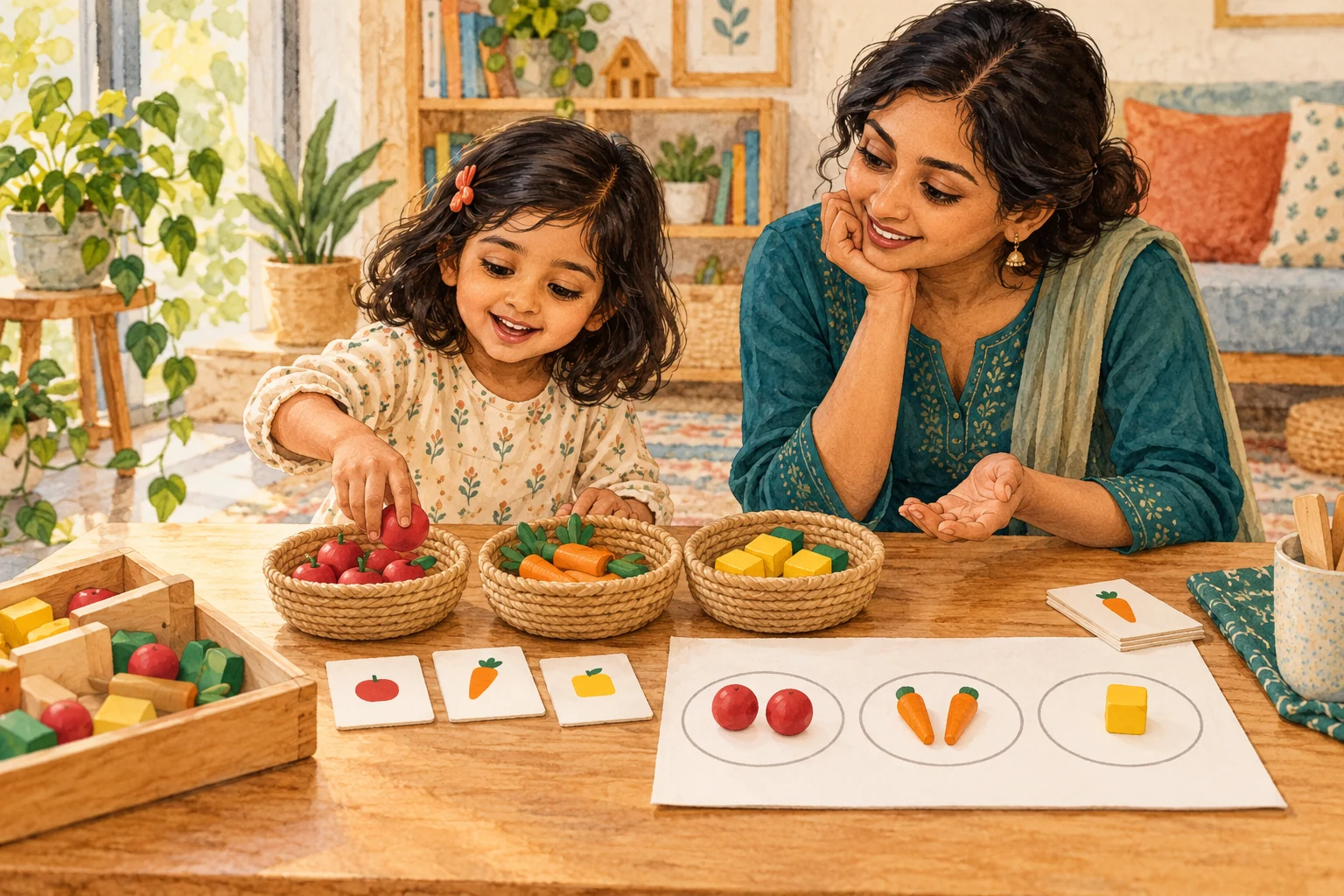
Original illustration: a parent follows her child's sorting decisions while baskets, picture cards, and a simple paper record support the game. The pictured materials are activity suggestions.
What guided play looks like between the toys and the page
Think of guided play as a shared arrangement: an adult has a learning intention, and the child has genuine influence over the activity. You might notice quantities, introduce positional words, or invite a comparison. In guided play, the learner still decides which shop to open, where a delivery travels, or how a bridge should change.
During guided play, an invitation such as “How could everyone get a cup?” leaves room for several answers. Giving detailed instructions for every move changes the experience. Equally, a pile of toys without adult involvement may be enjoyable free play; this particular approach adds thoughtful support.
That balance is receiving fresh attention. NAEYC's Fall 2026 collection on guided play and hands-on learning explores how intentional teaching and children's choices can work together. The practical question for a homeschool morning is simple: What might I notice, and what can my child decide?
Pack one tray, choose one intention
A useful guided play setup can fit on a kitchen tray: chunky blocks, a toy vehicle, scrap paper, crayons, and one selected printable. Keep other materials nearby rather than displaying everything at once. Too many choices can make guided play harder to begin.
For guided play with younger preschoolers, start with sorting two kinds of objects or counting a small collection. Kindergarten learners might compare two routes or explain a pattern. Age labels are starting points; watch the particular child's language, movement, interests, and familiarity with the task.
Preview a worksheet before printing. Look for a clear match with the intended skill, readable pictures, and enough space for the response. Check the access label and file instructions on its page. The illustrations in this article show possible setups; they are separate from any downloadable worksheet.
Today's intention: Write one sentence for yourself, such as “Notice whether Sam matches one object to each spoken number.” Guided play becomes easier to observe when the intention stays small.
A repeatable rhythm without a rigid lesson
Try this guided play sequence when you have a little shared time. Ten or fifteen minutes may be convenient, but there is no required duration. Continue while the learner remains involved, and pause when the activity stops making sense.
- Offer a situation. Put out a basket and say, “Our shop needs a way to organise these.” For this guided play story, let the child suggest what the shop sells.
- Watch the first attempts. Notice the rule they invent. They may sort by colour when you expected size; ask about their choice before changing anything.
- Add one helpful question. “How could we check?” often invites more thinking than several rapid questions. Leave quiet time for an answer.
- Bring in paper with a purpose. Offer a tally, a route, or a matching box when the game needs it. Guided play does not require finishing every printed item.
- Revisit one discovery. Invite the learner to show a favourite decision. Record their explanation, then let the materials return to ordinary play.
Keep guided play responsive. If a new problem interests the child more than your first plan, consider whether it offers another useful learning opportunity.
Five invitations to try across your week
Choose one guided play idea below, then change the characters, objects, or setting to suit the learner. Each invitation includes a possible paper connection; none depends on a particular purchased kit.
1. Open a tiny market
Gather chunky pretend food or blocks and two bowls. Let the shopkeeper decide what belongs together. Become a customer who needs three items, then ask how the order could be checked.
In this guided play invitation, a child can touch each item while counting, rearrange the collection, and count again. Offer a scrap-paper order card with dots. If numeral practice fits, browse number worksheets for the chosen quantity and select a short task that matches the child's readiness.
Change the challenge: Compare two baskets using more, fewer, or the same. Keep guided play open by allowing the shopkeeper to design the checking method.
2. Deliver a parcel along a path
Draw a wide road on paper or choose a suitable route from the prewriting and tracing collection. The guided play story begins when a toy vehicle needs to deliver a block to a paper house. The child chooses the destination and describes the journey.
Use guided play to explore around, between, and beside. Moving the vehicle can come before drawing a line; pointing or describing is also a valid response. Avoid turning every bend into a correction.
Try a twist: Place a pretend puddle on the road. Ask what could change. Guided play now includes planning a detour, with the learner deciding whether to redraw, move, or rebuild.
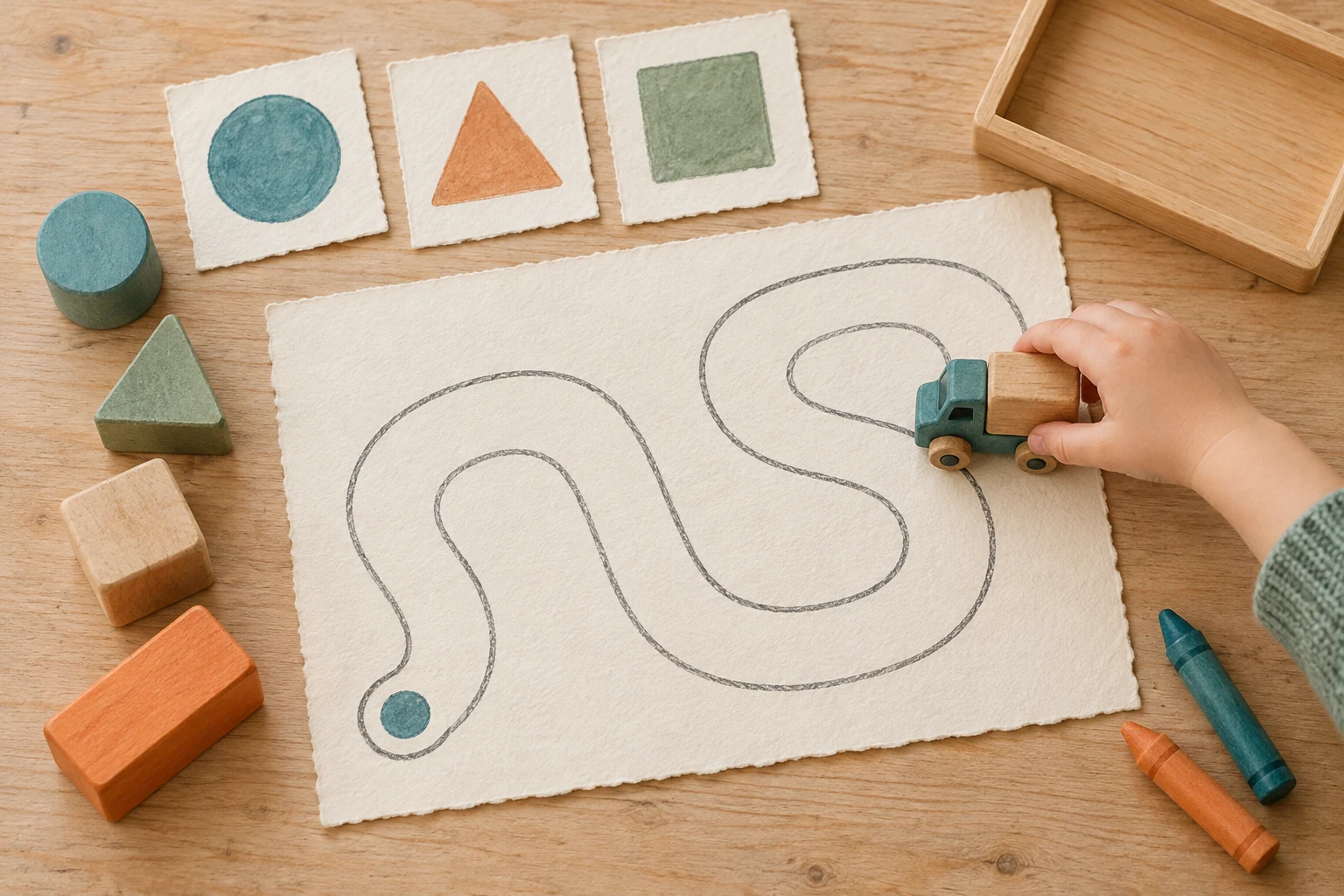
Original overhead illustration of a homemade road, toy truck, large blocks, and shape cards. The scene demonstrates an optional activity rather than the contents of a download.
Give the story a sound, a structure, or a mystery
3. Run a sound detective desk
Choose three familiar objects with easily named beginnings, such as a cup, sock, and ball. A puppet has mixed up its delivery labels. Name the objects together before asking which one begins with a sound you model clearly.
This guided play situation makes listening useful to the story. For guided play, choose examples that work in the language being practised, and accept the child's familiar name for an object. For a later paper turn, inspect beginning-sound activities in the phonics collection before selecting a matching task.
Let the learner lead: Invite them to invent the puppet's next mistake. Guided play can continue orally when drawing or writing would interrupt the conversation.
4. Build a bridge for a visitor
Place a toy animal beside a paper river. Offer blocks and a strip of firm cardboard. Ask how the visitor might cross without touching the water, then watch the first design.
During guided play, words such as wider, support, and balance arise from something visible. Let the guided play partners test the bridge with a lightweight toy. If it tips, describe the movement and invite another idea instead of immediately fixing the structure yourself.
Paper connection: Fold scrap paper into “first try” and “next try” spaces. The child draws or dictates what changed. Guided play leaves a record of reasoning even when the drawing is wonderfully rough.
5. Repair a pattern museum
Arrange a repeating trail of two kinds of large shapes. Tell the museum keeper that one display has a missing piece. During guided play, let the child inspect, explain, and repair it, then create a different exhibit for you.
Keep guided play focused on the repeating unit rather than guessing the next colour. Say the sequence aloud and ask where it starts again. Use the puzzle collection to look for an appropriate matching or pattern challenge when another representation would be useful.
Make it personal: Replace shapes with claps and taps. Guided play can move off the table while the underlying rule stays available to explore.
Six small gains worth noticing
The value of guided play often appears in an ordinary action, not a polished finished page. Look for these possibilities across several visits; they are observations to explore, not promises about a child's progress.
- Number meaning: A shopkeeper connects a spoken count with actual items instead of reciting a sequence without checking the collection.
- Useful vocabulary: A delivery driver has a reason to say “between the houses” and show what that phrase means.
- Planning: A bridge builder chooses a support before placing the cardboard, then compares the result with the original intention.
- Flexible thinking: A museum keeper finds another material that follows the same pattern. Guided play gives the rule a second setting.
- Communication: Partners explain an idea, listen to an alternative, or ask for a particular piece rather than relying on an adult to interpret everything.
- Purposeful marks: Dots, lines, sketches, and early letters communicate something needed in the game, making paper part of the experience.
For additional age-based games, Harvard's Brain-Building Through Play handouts offer ideas for practising attention, remembering information, and managing responses. Use them alongside guided play according to the learner's interests.
Two ordinary mornings, two different kinds of support
At home: the café order changes
Imagine Noor, five, opening a café for two toy bears. Her father asks how many cups they need. She places one beside each bear. Then another bear arrives. Instead of announcing the answer, he asks what has changed. Noor fetches a cup and adds a dot to her paper order.
The guided play goal was matching quantities. Her father notes the action and follows her next idea: making a sign. If she asks him to write the words, that assistance keeps the story moving without turning the session into a spelling assessment.
In a classroom or co-op: the bridge has three designers
Three learners want the same cardboard strip. Their teacher names the problem and asks how everyone could try a design. They agree on a shared build, with one child choosing supports and another testing the crossing. The third sketches their decision.
Here, guided play includes negotiation as well as spatial language. Roles can rotate, and a child may contribute through pointing or demonstrating. The teacher observes whose ideas receive attention and makes room for quieter participation. Guided play should offer agency to every learner at the table.
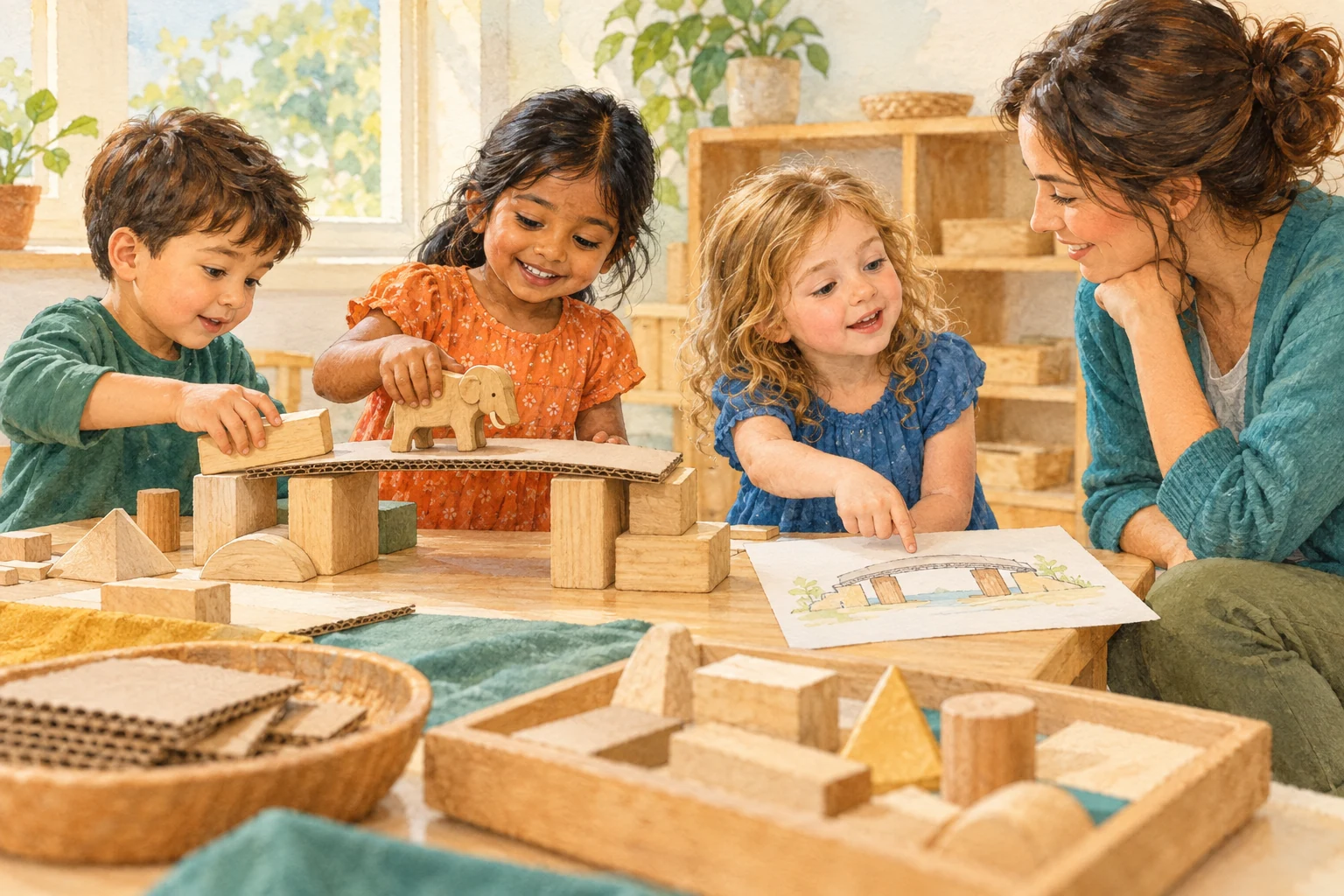
Original illustration of a small learning group comparing a cardboard bridge with a drawing. An adult listens while children choose, test, and describe their construction.
Adjust the invitation when the first plan stalls
Responsive guided play changes with the child's signals. Try one adjustment, then watch again. A smaller task, a different response method, or a quieter workspace may make participation more comfortable.
| What you notice | A change to try | What remains available |
|---|---|---|
| The learner cannot choose where to begin. | Offer two materials and one visible problem. | A manageable decision. |
| Pencil work interrupts an engaging explanation. | Write their words or invite pointing. | The same thinking goal. |
| The challenge feels immediately easy. | Ask for another solution or a changed rule. | Room for investigation. |
| Noise or crowded materials distract. | Clear space and offer a quieter turn. | A comfortable way to join. |
In multilingual guided play, welcome explanations in a familiar language and model a useful new word alongside a gesture. For movement differences, stabilise the paper, enlarge pieces, or let a partner move objects as directed. Guided play does not depend on everyone producing an identical response.
Leave the child wanting another turn
A collapsed bridge can feel disappointing. Pause before offering a solution: “You worked on that, and it fell.” Then ask whether the learner wants company, a new material, or a break. Guided play can include frustration without making frustration the price of finishing.
Describe a specific decision: “You moved the supports closer together.” That tells the child what you noticed. Avoid ranking siblings' designs or using completed pages as evidence that someone is the better learner. During guided play, different routes can reveal equally interesting thinking.
After guided play, keep a small note with the date, the child's words, and a possible next invitation. “Counted three cups by touching each; next time offer a fourth guest” is more useful than “did well.” Over several sessions, guided play notes can help parents and teachers discuss what support seems helpful.
Tomorrow's invitation: Put out one familiar material and ask what it could become. Guided play begins with attention to the learner in front of you. A lively question, a little space, and a purposeful piece of paper are enough to start.