
6 Brilliant Find the Sum Worksheet Ideas for Kids

A Find the Sum Worksheet turns early addition into something children can see, touch with their eyes, count aloud, and solve with confidence. This printable uses bright fruit groups - apples, watermelons, mangoes, oranges, and kiwi slices - with plus signs and blank answer boxes. Instead of starting with bare numbers, the page lets preschool and kindergarten learners count real-looking objects first. That makes addition feel less like a rule and more like a small discovery: one group joins another group, and together they make a new total.
A Fruit Counter’s First Addition Adventure
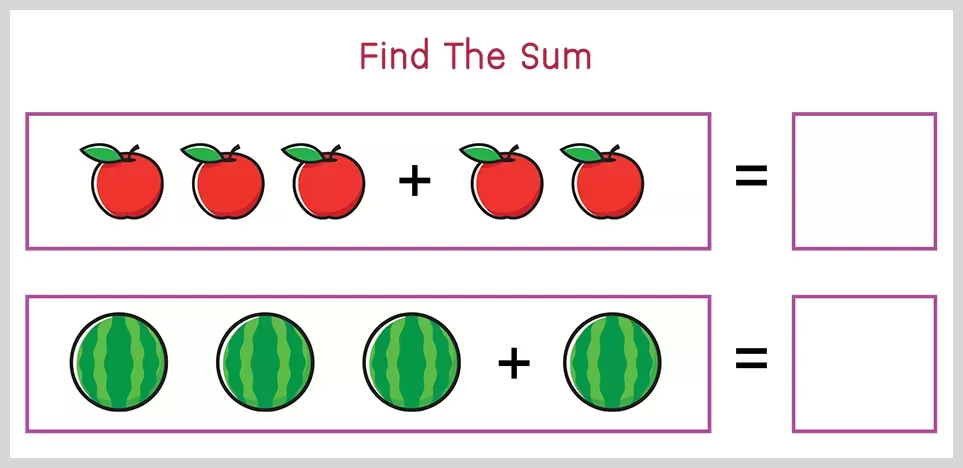
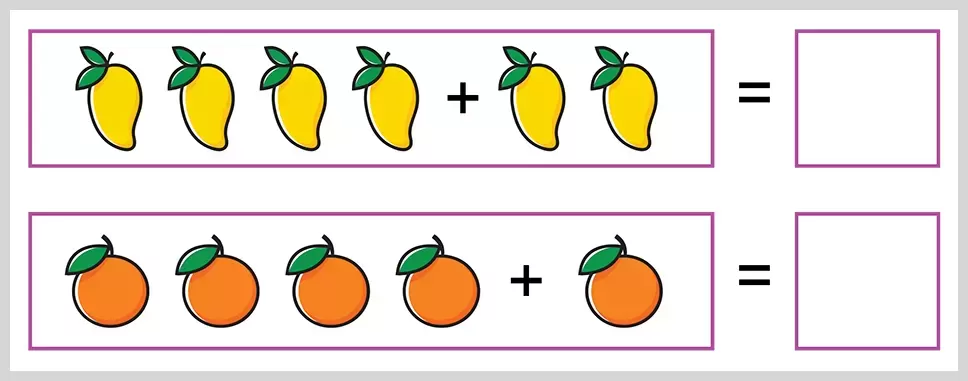
This Find the Sum Worksheet is built around five visual addition problems. Children count the fruit on the left side, count the fruit on the right side, then write the total in the answer box. The first row shows apples, the second row shows watermelons, the third row shows mangoes, the fourth row shows oranges, and the last row shows kiwi slices.
That fruit theme gives the page a warm, everyday feeling. A child may have seen apples in a lunchbox, mangoes at home, oranges in a fruit bowl, or watermelon at a picnic. When math uses familiar objects, children are more willing to try. A Find the Sum Worksheet like this gently says, “You already know how to count. Now let’s count two groups together.”
What “Find the Sum” Means for Young Learners
The word sum can sound grown-up, but the idea is simple: the sum is the total after two groups are put together. If there are three apples and two more apples, the sum is five apples. If there are two kiwi slices and one more kiwi slice, the sum is three kiwi slices. This Find the Sum Worksheet helps children see that addition is not magic. It is careful counting.
Children can point, tap, whisper numbers, or circle each fruit lightly with a pencil. Some will count the first group and then keep counting from there. Others will count every fruit from the beginning. Both methods are acceptable for early math. The page gives them space to practice without pressure.
Learning Value Hidden Inside This Find the Sum Worksheet
Addition Meaning
Children learn that the plus sign means two groups are joining to make one total.
Visual Counting
Fruit pictures allow children to count objects instead of guessing from symbols alone.
Answer Writing
Blank boxes encourage children to record totals after solving each addition problem.
Math Talk
Adults can ask, “How many altogether?” and help children use addition language naturally.
Working Memory
Learners hold the first count in mind while adding the second group.
Self-Checking
Children can recount the fruits to see whether the written answer matches the picture.
Gentle Step-by-Step Teaching Plan
| Moment | Teacher or Parent Action | Child Action |
|---|---|---|
| Warm-up | Point to the fruit and name each kind slowly. | Say apple, watermelon, mango, orange, and kiwi. |
| Count left | Ask, “How many are before the plus sign?” | Touch-count the first fruit group. |
| Count right | Ask, “How many more are after the plus sign?” | Count the second fruit group. |
| Find total | Use the phrase “altogether” again and again. | Count both groups and say the sum. |
| Write answer | Guide number formation only if needed. | Write the total in the blank answer box. |
Home Scenario: Snack-Time Addition
A parent can place three apple slices on one napkin and two apple slices on another. Then the child solves the first row of the Find the Sum Worksheet with real food nearby. The adult might say, “Three apples plus two apples makes how many apples altogether?” After the child answers, the worksheet problem feels connected to a real plate.
This is especially helpful for children who learn by doing. The printable introduces the math, and the snack makes the idea memorable.

Classroom Scenario: Fruit Market Station
In class, the Find the Sum Worksheet can become part of a pretend fruit market. Place toy fruit, picture cards, or counters at a table. Children “buy” two groups, count them, and then solve one row on the page. A child might choose four mango cards and two more mango cards, then write the total.
This playful setup supports math vocabulary, turn-taking, oral counting, and early addition without making the lesson feel heavy.
Why Children Enjoy Picture Addition
Children often enjoy a Find the Sum Worksheet because the pictures give them something friendly to focus on. Fruit feels bright, familiar, and easy to count. The answer boxes feel like little finish lines. Each row gives a small success, and five rows feel manageable rather than tiring.
There is also a quiet emotional win here. A child who is unsure about numbers may still feel comfortable counting pictures. When the answer appears from their own careful counting, confidence begins to grow. That feeling matters. Early math should not feel like a wall; it should feel like a door opening.
Extend the Find the Sum Worksheet With Fresh Activities
- Fruit counter cups: Put small counters in two cups, pour them together, and count the new total.
- Draw the second group: Cover the right-side fruit group and ask children to draw how many more should be added.
- Clap and add: Clap three times, pause, clap two more times, then ask for the total number of claps.
- Market roleplay: One child is the fruit seller, one child is the buyer, and both count the sum together.
- Number card match: After solving each row, children match the answer to a number card on the table.
- Quick revisit: Pair this page with the Maths worksheets category for another short math practice day.
Common Mistakes to Watch For
Some children count only the first group and forget the fruit after the plus sign. Others count too quickly and skip an object. A few may write the first number they counted instead of the total. With a Find the Sum Worksheet, the best fix is usually not a long explanation. Try a calm prompt: “Let’s count both groups together.”
Another common mistake is covering the answer box with the hand while writing, which can make the child lose track of the row. Encourage them to point first, count second, say the sum third, and write last. This tiny routine can make the Find the Sum Worksheet much easier.
Suitable Age Group
This Find the Sum Worksheet is suitable for ages 4 to 6, especially preschool, pre-k, kindergarten, and beginning Grade 1 learners who need concrete addition practice. Younger children may complete it orally with adult help. Older children can solve it independently and then explain their thinking.
Practice Without Pressure
To encourage regular practice, keep the session short and predictable. Use one Find the Sum Worksheet during a morning table routine, after lunch, or before story time. Let children use a favorite pencil. Celebrate counting effort, not only correct answers. You can say, “I like how you touched every mango,” or “You remembered to count both sides.”
For variety, connect this printable with Numbers worksheets, the Number 1 to 6 Dice Game, and the Learning the Number 5 Worksheet. A rotating folder keeps math fresh.
Download the Find the Sum Worksheet
This Find the Sum Worksheet is made for simple printing and quick use. Download the printable file, print it on regular paper, and invite your child or class to count each fruit group carefully. The page has no watermark, no distracting ads inside the activity area, and a clear printable format that works for home practice, classroom centers, homeschool folders, and early math review.
Get the worksheet PDF.
Use standard paper size.
Touch each fruit picture.
Write the sum in the box.