
Number 1 to 6 Dice Game: Fun & Challenging Math Practice!

Introducing the Number 1 to 6 Dice Game: A Playful Path to Math Skills
Getting children excited about numbers can sometimes feel like a puzzle, but it doesn't have to be! This printable worksheet offers a delightful solution by transforming simple dice rolls into a vibrant learning experience. The core of this activity is the Number 1 to 6 dice game, where children roll a cube and then interact with a corresponding number on the page. It’s a hands-on approach that naturally builds essential early math concepts. Imagine the joy on a child's face as they roll the dice, eagerly anticipating which number they'll get to find and color. This isn't just about coloring; it's about connecting a physical action (rolling the dice) with a numerical representation and then a visual outcome (coloring a circle). This connection is fundamental for developing a solid understanding of numbers and quantities. The worksheet cleverly integrates two key components: a collection of numbered circles and a net for constructing a cube. This duality ensures that children not only practice number recognition but also engage with spatial reasoning and fine motor skills as they prepare to build their own dice. It's a multi-faceted approach designed to keep young minds engaged and learning. Whether used in a classroom setting or as a fun home activity, this resource provides a solid foundation for future mathematical exploration. We aim to make learning feel like play, and this Number 1 to 6 dice game is a prime example of that philosophy in action. Explore how this simple yet effective tool can make a significant difference in a child's early math journey.
Download this engaging worksheet today!
Get a free, printable, no-ad, no-watermark version of the 'Color circle of number by rolling dice' activity. It's ready for immediate use in your home or classroom.
Why This Number 1 to 6 Dice Game Stands Out
In a world filled with digital distractions, the tactile and visual engagement offered by a well-designed printable worksheet is invaluable. This particular resource stands out due to its direct connection between a physical tool (the dice) and the abstract concept of numbers. It's not just about rote memorization; it's about understanding that a rolled '3' means three units, and that this '3' corresponds to a specific visual representation on the page. The dual nature of the worksheet – the coloring activity and the cube construction – provides a comprehensive learning experience. Children get to practice their fine motor skills by coloring, their number recognition by identifying the rolled number, and their spatial reasoning and construction skills by building the dice. This multi-sensory approach caters to different learning styles and reinforces concepts more effectively. Furthermore, the simplicity of the core mechanic makes it accessible for a wide range of young learners, while the potential for extension activities ensures it remains engaging as children develop. It’s a truly versatile tool for early mathematical development.
Understanding the Core Mechanics of the Worksheet
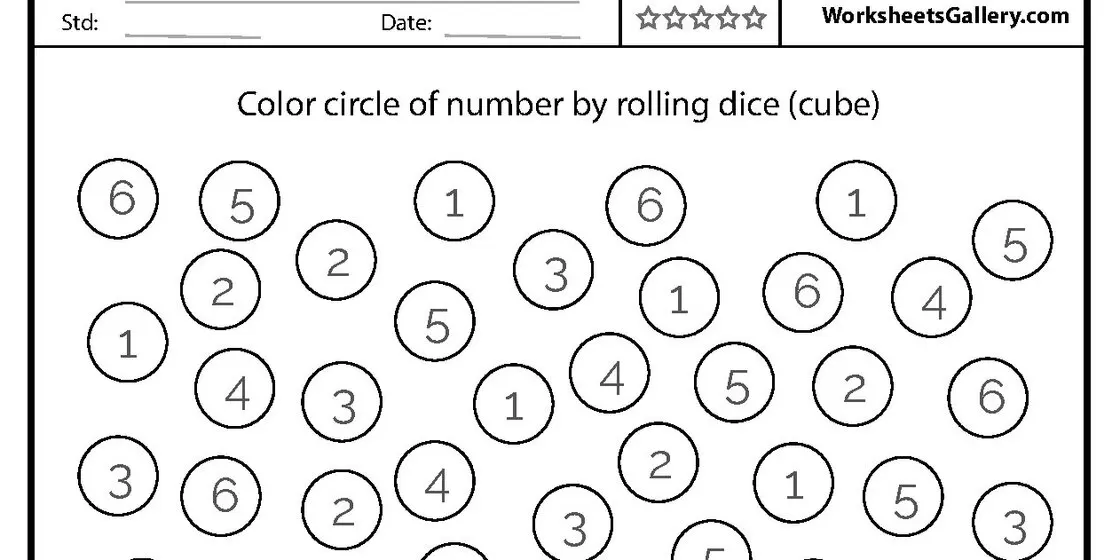
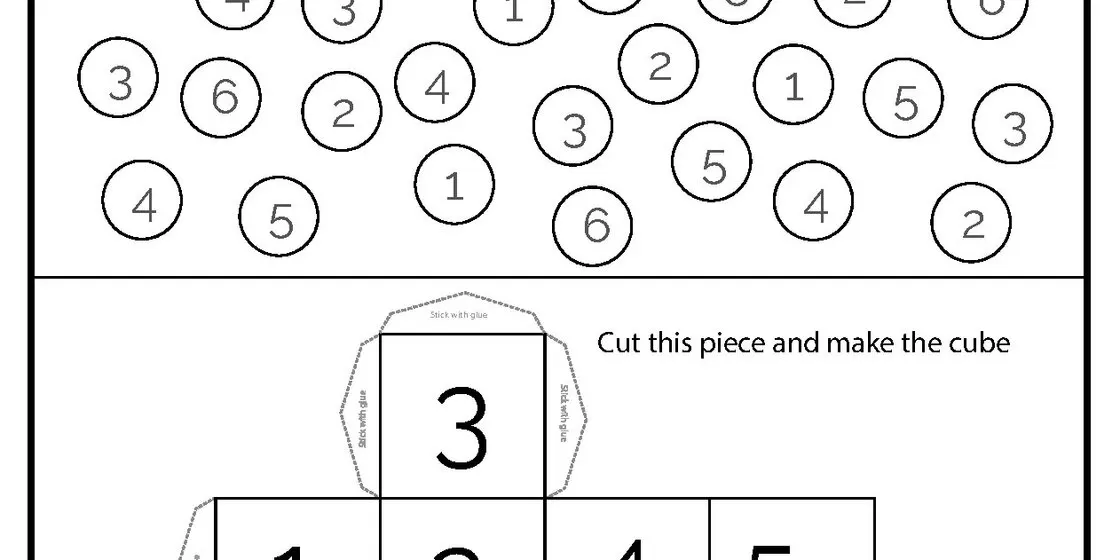
At its heart, this worksheet is designed around a simple yet powerful concept: linking the outcome of a dice roll to a visual task. The worksheet presents two main sections. The top portion features a large circle filled with smaller circles, each containing a number from 1 to 6. The instruction is clear: 'Color circle of number by rolling dice (cube)'. This means that after rolling the dice, the child identifies the number shown and then finds and colors a corresponding circle on the page. This repetitive action of rolling, identifying, and coloring is what builds number recognition and counting fluency. The second section of the worksheet provides a net for a cube. Children are instructed to 'Cut this piece and make the cube'. This net includes tabs marked 'Stick with glue' for easy assembly. Once constructed, this cube becomes the central tool for the game, providing the random numbers needed for the coloring activity. The numbers on the cube's faces will typically range from 1 to 6, aligning perfectly with the numbers presented in the circle activity. This integration ensures a cohesive and functional learning tool.
The Educational Benefits: More Than Just Coloring
Engaging with this Number 1 to 6 dice game offers a rich tapestry of developmental benefits for young children. It's a holistic activity that touches upon several crucial areas of early learning:
- Number Recognition: Children directly associate the dots or numeral on the dice with the numerals in the circles, reinforcing their ability to identify numbers 1 through 6.
- Counting Skills: As children roll the dice and then locate the corresponding number of circles to color, they are implicitly practicing counting. They might count the dots on the dice, and then count the circles they color.
- One-to-One Correspondence: This activity helps children understand that each number represents a specific quantity. Rolling a '4' means they need to find and color one circle, then another, and so on, up to four.
- Fine Motor Skill Development: Holding a pencil or crayon to color within the circles, and later cutting and folding to build the cube, significantly enhances dexterity, hand-eye coordination, and the small muscle control needed for handwriting.
- Hand-Eye Coordination: The act of rolling the dice, identifying the number, and then accurately coloring within the designated circles requires precise coordination between what the eyes see and what the hands do.
- Spatial Reasoning: Constructing the cube from its net involves understanding how 2D shapes fold into 3D forms, a key aspect of spatial awareness.
- Following Instructions: The worksheet provides clear instructions, encouraging children to listen, read, and follow multi-step directions, a vital skill for academic success.
- Problem-Solving: Figuring out how to fold the net into a cube, or deciding which circle to color first, involves simple problem-solving processes.
- Patience and Focus: Completing the activity, especially the cube construction, requires sustained attention and patience, helping to build concentration skills.
Practical Scenarios: Home and Classroom Integration
This versatile Number 1 to 6 dice game can be seamlessly integrated into various learning environments, offering adaptable ways to engage children.
At Home: A Fun Afternoon Activity
Imagine a rainy afternoon. You pull out this worksheet, along with some crayons and scissors. Your child's eyes light up. First, you work together to cut out the cube net. This might involve a little help with the scissors, but the child eagerly folds along the lines, applying glue to the tabs. As the cube takes shape, you talk about the numbers on its faces. Once the dice is ready, the real fun begins! Your child rolls the dice, perhaps landing on a '5'. They excitedly scan the numbered circles, find a '5', and begin coloring it in. You can join in, rolling your own dice (or using a pre-made one if you have it) and coloring alongside them. This shared activity not only reinforces the math concepts but also strengthens your bond. You can ask questions like, "How many more circles do we need to color to reach ten?" or "Can you find a number that is bigger than the one you rolled?" This transforms a simple worksheet into a meaningful interaction, building both academic skills and positive memories.
In the Classroom: Small Group Learning Stations
For teachers, this worksheet is an excellent addition to a math learning station. You can prepare several copies of the cube net in advance, or have children assemble them as part of a craft activity. The numbered circles can be printed multiple times, or children can use a single sheet and aim to color a certain number of circles for each roll. To differentiate, you could provide dice with more or fewer sides, or use dice with different color patterns. For instance, one station might focus solely on the Number 1 to 6 dice game, while another could involve rolling two dice and adding the numbers together. You could also have children draw their own circles and write numbers in them after rolling the dice. This activity is perfect for small group work, allowing children to learn from each other, share their strategies, and practice turn-taking. It’s a low-prep, high-impact activity that supports curriculum goals for number sense and fine motor development. It also provides a wonderful opportunity for observation, allowing teachers to gauge individual student understanding of numbers and their ability to follow instructions.
Developing Essential Skills Through Play

The Number 1 to 6 dice game is more than just a coloring sheet; it's a carefully crafted tool for developing a range of cognitive, motor, and language skills vital for a child's growth. The interplay between the physical act of rolling dice and the visual task of coloring numbers fosters a deep understanding of numerical concepts.
Cognitive Skill Enhancement
The cognitive benefits are substantial. Children learn to recognize numerals, understand their value, and practice counting. The process of matching the dice outcome to the correct circle reinforces logical thinking and pattern recognition. Building the cube itself introduces basic geometric concepts and problem-solving as they figure out how the net folds. This worksheet also encourages strategic thinking, such as deciding which circles to color first or how to best use their coloring tool.
Motor Skill Refinement
The physical demands of the worksheet are equally important. Cutting out the cube net requires precise scissor control, developing fine motor skills and hand-eye coordination. Folding and gluing the net further refines these abilities. Coloring within the lines of the circles demands controlled pencil or crayon grip, strengthening the muscles used for handwriting. This tactile engagement is crucial for developing the dexterity needed for writing letters and numbers independently.
Language and Communication Growth
While seemingly focused on numbers, the activity also stimulates language development. Children learn and use number words, discuss their rolls, and describe their coloring choices. Parents or teachers can prompt conversations by asking questions about the numbers, colors, and the process of building the cube. This encourages vocabulary expansion and the ability to articulate thoughts and processes. For example, a child might say, "I rolled a six! Now I need to find the circle with the number six." or "This part of the net sticks here." These verbalizations are key to consolidating learning and developing communication skills.
Extending the Fun: More Games and Activities
The basic Number 1 to 6 dice game is just the beginning. Here are several ways to expand upon this activity, keeping children engaged and continuously challenged:
- Addition Adventures: Once children are comfortable rolling one die, introduce a second die. Have them roll both and add the numbers together, coloring a circle that matches the sum. This is a fantastic way to introduce early addition concepts.
- Color Sorting: Assign a different color to each number (e.g., 1=red, 2=blue, 3=green, etc.). As children roll the dice, they color the corresponding circle with the assigned color. This adds a color recognition and matching element.
- Number Hunt: Instead of coloring circles, have children find and circle all instances of the number they rolled within a larger grid of numbers. This enhances number identification skills across a broader context.
- Cube Construction Challenge: After building one cube, challenge children to build another, perhaps decorating it or trying to make a different colored cube. Discuss the properties of a cube – how many faces, edges, and corners it has.
- Storytelling with Dice: Use the rolled number as a prompt for a story. If a child rolls a 4, they could start a story with "Once upon a time, there were four little bears..." This encourages creative thinking and narrative skills.
- Memory Match: Create pairs of cards with numbers 1-6. Have children roll the dice, then try to find the matching number card. This adds a memory game component.
Why Children Adore This Activity
Children are naturally drawn to activities that involve elements of chance and physical manipulation. The Number 1 to 6 dice game taps into these natural inclinations. The thrill of the unknown – what number will the dice show? – creates excitement and anticipation. Rolling a physical object and seeing the result is far more engaging for many young children than simply being told a number. The tactile experience of building the cube, cutting, folding, and gluing, provides a satisfying sense of accomplishment. Furthermore, the coloring aspect appeals to their creative side, allowing for personal expression. When learning feels like a game, children are more motivated, focused, and eager to participate. This worksheet strikes a perfect balance between structured learning and free, playful exploration, making it a highly enjoyable experience for kids.
Age Appropriateness and Skill Level
This worksheet is ideally suited for children aged 4-6. At this stage, most children are developing their number recognition skills, beginning to grasp counting concepts, and refining their fine motor abilities. The numbers 1 through 6 are foundational, making them perfect for this age group. Younger children within this range (4-5) might require more assistance with cutting and folding the cube, while older children (5-6) can often complete these tasks more independently and might be ready for the extension activities involving addition.
Navigating Common Challenges
While this activity is generally straightforward, some common challenges might arise:
- Cutting and Folding Difficulties: Younger children may struggle with precise cutting and folding. Offer assistance, use safety scissors, or pre-cut the nets for them.
- Number Confusion: Some children might confuse similar-looking numbers (e.g., 1 and 7, or 6 and 9, though 9 isn't on this specific die). Focus on clear numeral formation and repetition.
- Staying Within the Lines: Coloring accurately can be challenging. Break down the task into smaller sections and praise effort rather than perfection.
- Maintaining Focus: The cube construction can be tedious for some. Break it into steps, or have children work in pairs.
Encouraging Consistent Practice
Consistency is key to mastering early math skills. Here’s how to encourage regular engagement with this Number 1 to 6 dice game:
- Make it a Routine: Dedicate a short, regular time slot for this activity, perhaps during a designated "learning time" or as a fun reward.
- Celebrate Small Wins: Acknowledge and praise every step of progress, whether it's correctly identifying a number, completing a fold, or coloring a circle neatly.
- Keep it Positive: Frame the activity as play and exploration, not a test. If a child is frustrated, take a break and return to it later.
- Offer Choices: Let children choose their coloring tools or decide which extension activity they want to try next.
- Connect to Real Life: Point out numbers 1-6 in everyday situations – on clocks, house numbers, or game boards – to show the relevance of their learning.
Download Instructions for Your Free Printable
Getting your hands on this valuable learning tool is simple. The worksheet is provided in a convenient printable PDF format, ensuring you can use it immediately. Importantly, this resource is completely free of watermarks and advertisements, offering a clean and distraction-free experience for both you and the child. To download:
- Navigate to the download link provided on our website.
- Click the download button.
- The PDF file will automatically save to your device.
- Open the file using any standard PDF reader and print it on your home or office printer.
You can also explore our free worksheet library for more engaging educational resources.
Helpful worksheet links
Popular Worksheets
Printable resources families and teachers are downloading now.
 Free
Free
 Free
Free