Joyful Subitizing: 5 Essential Games to Try at Home
Spot a small quantity, explain the arrangement, and keep counting available. Five family games connect dot cards and everyday materials with purposeful printable practice.
Three cushions sit on the sofa. A child glances over and says “three” before anyone starts counting. That little moment has a mathematical name: subitizing. It means recognising how many are in a small group without counting each item. For families with children around three to six, these subitizing moments can become relaxed games with cards, large counters, and a simple printable record. The five ideas here give parents something manageable to try, teachers a way to share the learning, and children room to explain what they noticed.
“I saw two together, and one beside them.”
A description can reveal more than a fast answer.
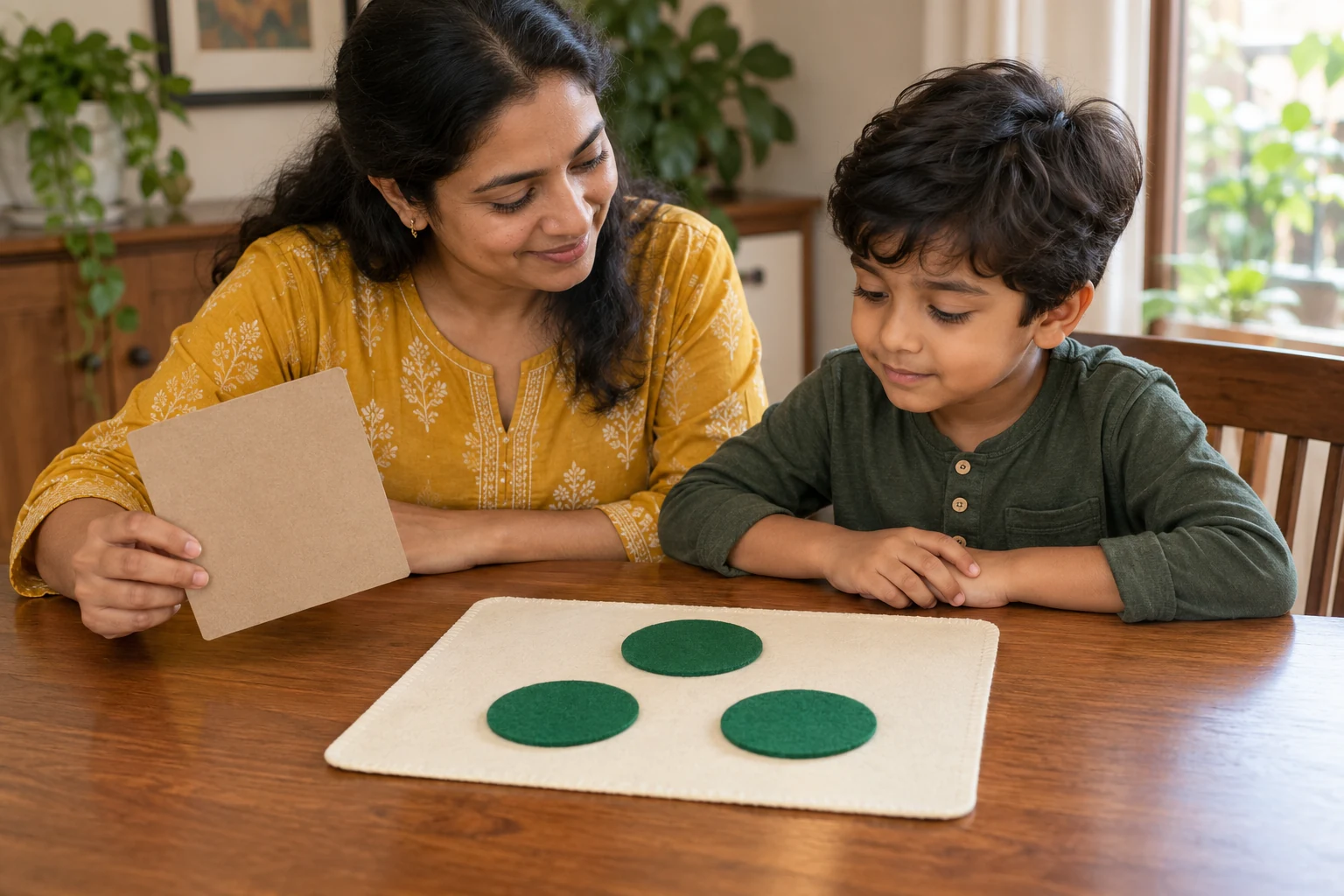
AI-created illustrative photograph of a fictional parent and child examining exactly three felt circles. The scene models an optional home activity; it is separate from any worksheet download.
Five reasons to look at the group before the numeral
Subitizing invites a learner to attend to a collection rather than immediately search for a written symbol. The paper can come afterward. Watch for these useful opportunities during subitizing:
- A quantity gets a name. “Three” connects with the group the child actually sees, giving a spoken number a concrete meaning.
- Arrangement becomes discussable. A row and a triangle can hold the same quantity. Children can compare their appearances and check the objects.
- Small parts become noticeable. A learner may describe four as two beside two, opening a conversation about how a whole group is organised.
- Strategies become visible. Listening for counting, whole-group recognition, or smaller groups gives an adult a clearer next step than recording an answer alone.
- Paper gains a purpose. Drawing a remembered arrangement or selecting a matching card records an idea that came from handling or seeing a collection.
These are reasons to explore subitizing, not predictions about how quickly a child should progress. A useful response may be a careful comparison or an honest request to look again.
Subitizing names two related ways of seeing number
With perceptual subitizing, a very small collection is recognised as a whole. For example, a child may see two spoons and know there are two without touching each one. Begin with quantities the individual learner can comfortably recognise, often within one to three.
Conceptual subitizing uses smaller recognised groups to make sense of a larger total. A ready learner might see two pairs and describe four as “two and two.” This is a different demand from recognising a tiny collection immediately.
Stanford DREME's explanation of subitizing gives adults a useful overview of that distinction. Neither approach makes counting unnecessary. Counting remains a valuable way to work out or verify a quantity.
Treat subitizing, counting, and numeral recognition as related skills with different jobs. Finding a printed 3 does not by itself show how the child recognised three objects.
Plan a first visit in seven small moves
Choose a moment when both of you have a little attention to spare. Subitizing does not require a daily race, a countdown, or an app. A few calm turns can give you enough information to plan another invitation.
- Clear a small space. Use a plain mat and a few large, identical objects that suit the learner.
- Choose a comfortable quantity. Start with one or two if three still needs counting.
- Show the collection. Let the child look. When familiar, a brief look can invite whole-group recognition; do not race the cover.
- Invite an answer. Accept a number word, a gesture, or choosing a matching collection.
- Ask about the noticing. “What helped you know?” can start a conversation without demanding a long explanation.
- Check together. Uncover the objects, touch-count if useful, or compare with a second arrangement.
- Leave a small subitizing record. Draw the group or dictate a sentence about the strategy, then decide whether another turn is welcome.
For subitizing, plain dots are often easier to discuss than busy scenes. Inspect the early maths printable collection for an appropriately simple page, checking its preview and access requirements before downloading.
At home, the second look can be the useful one
Imagine Leena, four, looking at three large felt circles while her grandfather prepares to cover them. She says “two.” He leaves the mat visible and asks whether she wants another look. She points to a pair, notices the third circle, and counts all three.
That turn was not independent subitizing of three. It still gives her grandfather something specific to work with. He returns to two circles for the next turn and leaves three available for counting. The adult changes the subitizing challenge without turning the first answer into a public mistake.
Later, Leena draws two marks on a scrap-paper ticket and finds a matching pair of circles. Her grandfather notes that she recognised two without a visible count on that occasion. One observation can guide tomorrow's subitizing invitation without becoming a label for the child.
Five games for a family table, floor, or learning corner
Pick the subitizing game that fits your materials. Use large pieces suitable for the child and supervise the activity. Keep the quantities small, the turn-taking friendly, and the checking method available.
1. Send a quantity ticket
Draw one, two, or three dots on separate tickets. A toy recipient needs a collection matching its ticket. Show a ticket, let the child describe the quantity, and invite a delivery of the same number of large blocks.
In this subitizing game, the ticket is an invitation to recognise the group. Building the delivery may involve counting, which is a separate useful action. Check the ticket and blocks side by side before the recipient says thank you.
Another turn: Swap roles so the child makes the ticket. Ask how they arranged the dots; subitizing can become part of the explanation as well as the answer.
2. Find a partner with the same amount
Lay out a card with two dots and another with three. For this subitizing match, offer a second three-dot card in a different arrangement. Invite the learner to find its quantity partner and explain what stayed the same.
Subitizing may help with these tiny collections. If the child counts instead, record that strategy accurately and keep the activity enjoyable. A matching page from the picture puzzle collection can provide later practice if its actual task fits this comparison.
Keep one thing steady: Use equally sized dots at first. Subitizing practice can become harder to interpret when quantity, size, colour, and layout all change together.

AI-created educational still life containing exactly three dots on each of two cards. The cards illustrate a comparison to make at home; this image is not a downloadable activity sheet.
Keep the number idea; change what the child does
3. Rebuild a tiny constellation
Set up this subitizing invitation with a simple three-dot arrangement, then let the child place large paper circles on an empty mat. They may copy while looking or choose to try after the card is covered. Ask about both the amount and the arrangement.
Subitizing is only one part of this activity: copying a layout also involves spatial thinking, and covering it adds a memory demand. Keep the model visible if that extra challenge gets in the way of the number conversation.
Useful question: “Is your group the same amount, even if the circles moved?” Subitizing and counting can offer different ways to investigate the answer.
4. Open a little parking area
Put a dot ticket beside each of two paper parking areas. A small fleet of toy vehicles needs somewhere to park. The subitizing turn starts when the child chooses an area, looks at its ticket, and brings the matching number of vehicles.
Leave room between the vehicles so the collection remains clear. During subitizing, the dot ticket can invite a whole-group response; moving vehicles one at a time may then support counting. Describe which action you observed rather than calling the entire turn one skill.
Paper connection: When recognising the quantity is comfortable, offer a suitable numeral from the number recognition and tracing pages. A numeral labels the collection; it does not replace the subitizing experience.
5. Look through two number windows
For a learner ready for this subitizing extension and comfortable with pairs, draw two large windows on paper and place two circles in each. Ask what small groups they notice before discussing the total. Keep everything visible while the child thinks.
This can introduce conceptual subitizing: two recognised pairs combine to make four. If the learner needs to count every circle, welcome that and return to a single pair later. Naming a total after counting is not evidence of conceptual subitizing by itself.
Let the learner design: Offer the same four circles on an open mat. A different layout may suggest a new subitizing conversation, but there is no requirement to produce every possible arrangement.
Read the response before adding another challenge
Subitizing does not become clearer just because the cards disappear faster. Use what the child actually does to choose the next invitation. This small reference can support a home conversation or a teacher's observation note.
| Observed response | Possible interpretation | A useful adjustment |
|---|---|---|
| Touches every dot before answering. | Counting is the visible strategy. | Keep counting available; offer a smaller group next. |
| Names a familiar small group without an apparent count. | The turn may show subitizing. | Revisit the quantity in another clear layout. |
| Says “two and two” and explains four. | Smaller groups are informing the total. | Discuss the parts without immediately increasing the number. |
| Asks to uncover the card again. | More viewing time or less memory demand may help. | Show it again and keep the next turn open. |
One quick answer can be a guess. Several relaxed observations, including a different arrangement, give a better picture of the learner's subitizing. Keep notes descriptive instead of treating a home game as a formal assessment.
A teacher can make several strategies feel welcome
In an imagined kindergarten subitizing session, a teacher displays four circles as two pairs. Arun says “four”; Bea describes “two here and two there”; another learner counts each circle with a pointer. The teacher asks for a demonstration and records the different approaches.
The subitizing opportunity is shared, but the responses are not identical. The teacher offers a smaller card to the child who wants it and invites Bea to draw her two pairs. Nobody receives a prize for speaking first.
A family note can carry that same precision: “Try a small collection, leave time to look, and tell us what your child noticed.” Adults can share a subitizing observation through a few words or a drawing. There is no need for a video, a score sheet, or identical materials in every home.
Protect the pleasure of finding something out
“You noticed a pair before you looked at the other circle” tells a child what caught your attention. “You are the fastest” shifts attention toward a comparison with other people. Keep subitizing connected with finding a useful number idea.
That emphasis fits a current conversation in early maths education. DREME's August 2026 reflection on children's enjoyment of everyday maths considers how adults can support voluntary mathematical exploration. Subitizing can sit alongside a child's pleasure in counting, building, and arranging.
Offer larger cards, a less crowded surface, familiar number words, or a spoken description when those supports are useful. If the visual task itself is inaccessible, choose an accessible counting or grouping activity rather than treating it as the same visual subitizing task.
For more ways to follow a learner's chosen story, explore these child-led homeschool invitations. The adult can hold a small mathematical intention while the child decides who needs a ticket or where the vehicles travel.
A gentle stopping point: Save one arrangement the child wants to revisit. Subitizing practice can end with “Let's look again tomorrow,” leaving an unfinished page and a good question ready for another day.