Picture Talk: 6 Smart Questions for Confident Kids
Give young learners six useful questions for looking at pictures, explaining an idea, and deciding what to check. Printed images and familiar objects keep the conversation practical.
Suppose a child points to a picture of a fish carrying an umbrella and asks, “Could that happen?” There is a whole conversation inside that question. Picture talk gives children around four to six a friendly way to describe details, share possibilities, and recognise when they need more information. A simple printable can hold their observations without demanding independent reading. For parents, teachers, and early learners, picture talk encourages thoughtful curiosity: noticing what a picture shows, separating that from a guess, and enjoying make-believe while naming it clearly.
Picture talk starts with a detail, not a verdict
A conversation about an image can begin with a colour, a shape, or something unexpectedly missing. During picture talk, adults listen for the child's reasoning before supplying an explanation. “The cup has a handle” describes something visible. “Someone wants tea” adds an idea that might be reasonable but needs more information.
That distinction matters when children encounter drawings, photographs, advertisements, and computer-made illustrations. A realistic appearance does not establish that an event happened. A photograph can also leave out important context. Picture talk provides an ordinary place to practise asking, without expecting a preschooler to authenticate digital media.
Keep imaginative answers welcome. A flying fish can belong in a wonderful invented story. The useful move in picture talk is to say when you are describing the image, when you are imagining, and when you are unsure.
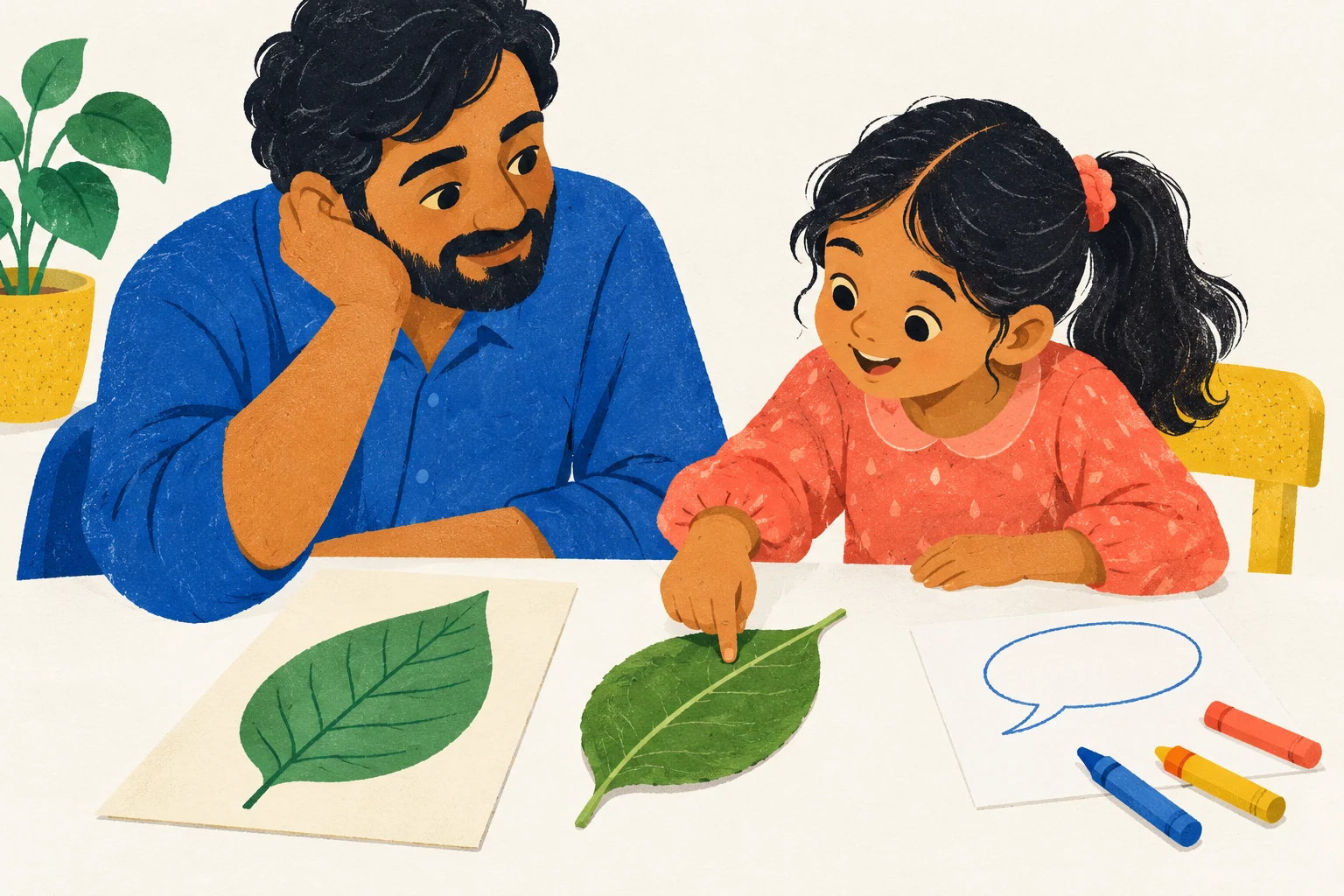
AI-created editorial illustration of a parent and child comparing a leaf with a picture card. This image demonstrates a conversation; it does not document a real family or supply a printable worksheet.
A few words can change the kind of answer
Before extending picture talk, model a short sentence that matches what you are doing. Children can point, gesture, speak in a familiar language, or dictate a response. There is no need to read these phrases independently.
| Say this | What it signals | A small example |
|---|---|---|
| I can see… | A visible observation. | A red kite is beside a branch. |
| I think… | An interpretation to discuss. | Perhaps the wind moved it. |
| I would check… | A question needing another source. | Who made this picture? |
| I imagine… | A deliberately invented possibility. | The kite is a dragon's letter. |
These phrases are supports, not categories to police. In picture talk, a child may move between observation and storytelling several times. Gently name the shift: “Now we are inventing what might happen next.”
Six questions to keep beside your picture
Use one or two prompts per picture talk session. Asking all six in rapid succession can make an interesting image feel like an oral test. Follow whichever detail has caught the learner's attention.
01 · Look
What can you actually see?
Invite a precise detail before a whole story: a bent stem, two wheels, or a yellow patch. During picture talk, you might ask the child to show where that detail appears. Accept a point as readily as a sentence.
If counting arises naturally, compare visible objects with a suitable task from the number activities collection. Count only what the image lets you see; something hidden behind a box remains uncertain.
02 · Explain
What gives you that idea?
A child says the character feels sad. Ask which part of the drawing suggested that possibility. Picture talk can connect an interpretation with a visible clue while leaving room for another explanation.
A downturned mouth might suggest sadness, but one expression cannot reveal everything someone feels. Try “That is one possibility” before inviting another thought. Avoid treating an adult's preferred story as the single correct picture talk answer.
03 · Ask
How was this picture made?
Explain what you know: “I took this photograph of our cup,” or “An illustrator drew this.” If software generated an image, name that plainly. Picture talk works better when adults share the source than when they hide it for a guessing contest.
When the source is unknown, say so. Odd-looking details can invite questions, but picture talk should never teach that one strange hand or unusual shadow proves how an image was created.
04 · Wonder
What can this image not tell us?
A picture of a bowl may show its colour, but not whether the soup is hot. During picture talk, explore something a flat image cannot settle. You might need the object, the maker's explanation, or information about what happened outside the frame.
Choose ordinary examples rather than frightening surprises. “We cannot hear that bell from a still picture” is enough. The purpose of picture talk is a useful question, not suspicion about everything the child enjoys.
05 · Investigate
Where could we find out more?
Connect a question with a manageable action. Compare a leaf picture with a leaf, consult a familiar nonfiction book about birds, or ask the person who took a photograph. Picture talk becomes more concrete when checking means doing something understandable.
Choose the next step together. An adult can handle any online searching separately and bring back an appropriate resource. Picture talk can remain entirely on paper, without a child's device or account.
06 · Create
What would you change for a pretend version?
Now deliberately invent something: give the umbrella fish a cloud-shaped house or put the kite in a moon garden. Mark the new drawing as a story. Picture talk can celebrate creativity while keeping the invented part clear.
Select an inviting outline from the colouring pictures collection if the child wants a starting shape. A picture talk caption dictated to an adult can explain what the learner chose to change.
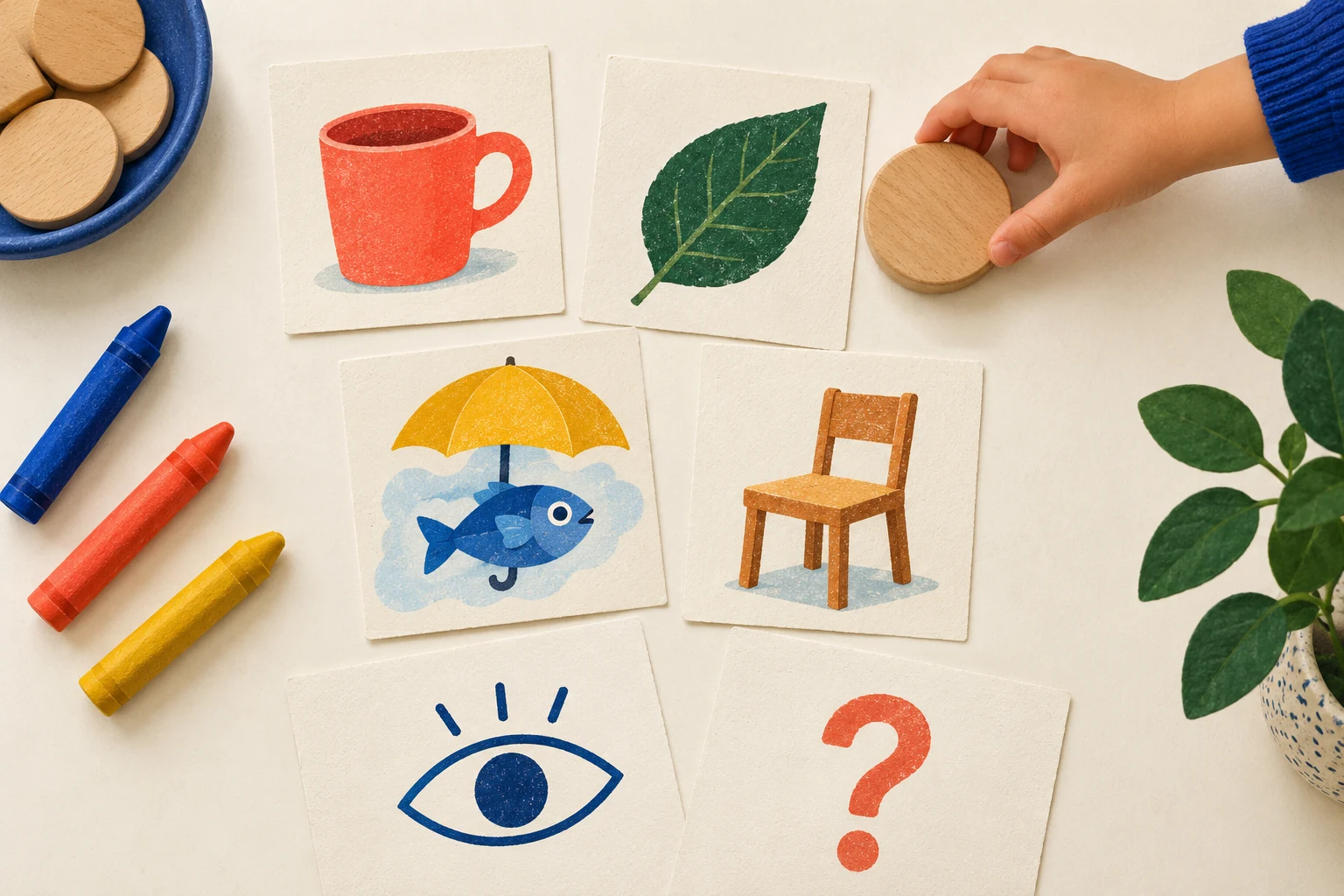
AI-created tabletop artwork showing example picture cards, crayons, and wooden markers. Every card here is illustrated; the imaginary fish is a story invitation, not an image-authentication test or downloadable card set.
Prepare a page that leaves space for an answer
For picture talk, select a clear image with a few discussable details. Avoid a crowded page if the learner is already working hard to name objects. A useful picture talk pair combines a photograph you took of an ordinary object with a clearly labelled drawing.
- Inspect the image yourself. Know its source when possible and check that its subject suits this learner.
- Choose one purpose. Noticing details, explaining an idea, and identifying a source are different tasks.
- Make two recording spaces. Draw an eye in one box and a question mark in another, explaining both symbols.
- Offer a first turn. Let the child choose a detail before you model a picture talk response.
- Record their contribution. Scribe a sentence, accept a sketch, or let a marker indicate the chosen picture.
- Return to one question. Decide whether to check it now, save it, or continue the story.
Browse visual matching puzzles when a simple comparison suits the task. Preview the actual file and its access label before downloading. For a drawn response, the prewriting pages offer another possible starting point; picture talk never depends on tracing an entire sheet.
Listen to the difference between these two moments
At the kitchen table: a cup has a hidden side
Imagine Dev, four, looking at a photograph of the family's blue cup. He says it has no handle. His grandmother brings over the cup and slowly turns it. Their picture talk changes when the handle appears. She asks what the camera could see from its original position.
The picture talk discovery concerns viewpoint. Dev draws a curved handle beside the printed cup and dictates, “It was around the other side.” Nobody needs to call his first answer foolish. He used more information to revise an idea.
In kindergarten: a kite has more than one possible history
A teacher shows a drawing of a kite in a tree. One learner suggests wind; another imagines someone placing it there. The class points to the string and branches, then names what the picture leaves unknown.
During this picture talk, the teacher records both suggestions as ideas. Children invent separate endings and label them as stories. A learner who prefers not to speak selects the branch with a pointer, contributing a detail that everyone can use.
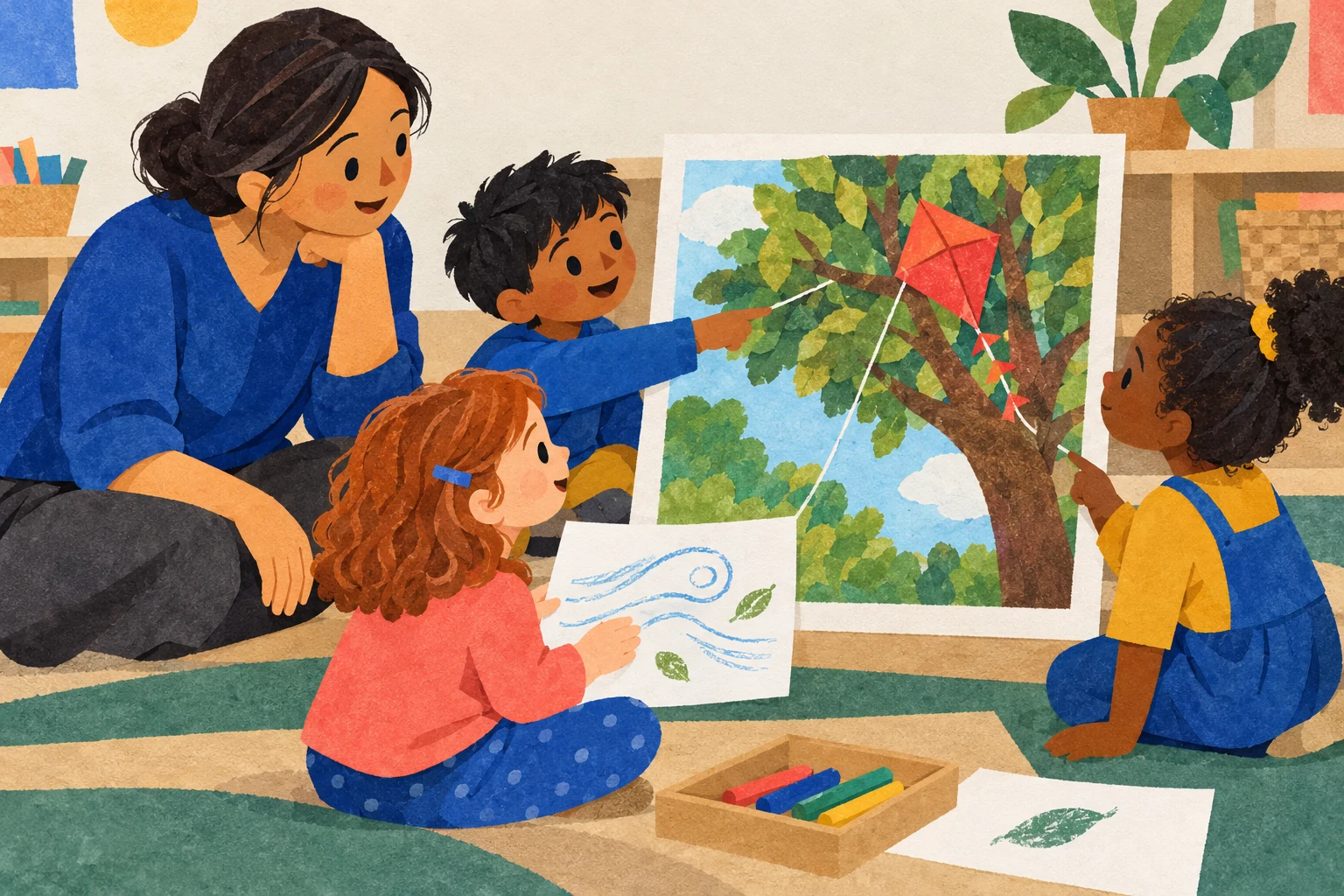
AI-created classroom illustration showing children pointing, drawing, and discussing a kite picture. It represents an invented teaching scenario and does not report a real classroom event.
Seven things an adult can notice besides a right answer
Look for a developing habit during picture talk, then describe the specific action. These are opportunities for practice, not a checklist every child must complete at a particular age.
- Detail vocabulary: A learner moves from “that bit” to words such as edge, stripe, handle, or branch.
- Evidence language: They point to something visible when explaining an interpretation.
- Listening: A partner's observation adds a detail they had overlooked.
- Flexible thinking: An earlier explanation changes after examining the object.
- Source awareness: Picture talk introduces the question of who made an image and how.
- Expressive choices: A gesture, drawing, spoken phrase, or dictated caption communicates an idea.
- Comfort with uncertainty: “We do not know yet” becomes an acceptable place to pause.
For a kindergarten extension, Common Sense Education's Fact or Fiction? lesson addresses early distinctions between factual and invented information. Read the resource before adapting it, then choose familiar examples that connect picture talk with the children's existing questions.
Keep the investigation playful
Give picture talk another form when the learner wants more. Pick one extension rather than adding a second full lesson.
The object museum
Place two familiar objects beside their pictures. Children choose one comparison to show a visitor. During picture talk, a museum guide can explain a match or point out a difference without sorting everything into “real” and “fake.”
A missing-information parcel
Cover one part of a drawing with paper. Invite a question about the hidden area before revealing it. Picture talk can explore how a frame changes available information without assuming the uncovered detail will prove everyone's guess.
Two endings, clearly invented
Fold paper into two panels and draw different endings for the same picture. In picture talk, name both as invented possibilities. Neither needs to become the official ending.
The helpful question puppet
A puppet asks what it should check before believing a surprising picture. Let the child suggest a source or an adult to ask. Picture talk gives the puppet permission to remain unsure.
Why make room for this conversation now?
AI-generated media adds another reason to discuss how pictures are made. In its February 2026 guidance on parenting in the AI age, UNICEF describes following a young child's curiosity as an opening for an age-appropriate conversation. Picture talk offers one practical, screen-free starting point.
For these ages, begin with familiar materials and short explanations. “A computer program made this illustration” can be enough. All three supporting images in this article are AI-created illustrations, labelled in their descriptions. Picture talk can include attractive generated artwork while keeping its origin clear.
There is no need to stage a difficult deception exercise. The educational goal is to practise noticing, asking, and seeking support. Picture talk is not a promise that a child, or an adult, can reliably identify every altered or generated image.
Let “I changed my mind” sound like progress
A child may feel embarrassed when a new detail changes their answer. Respond to the process: “You looked at another side and noticed something new.” In picture talk, revising an idea deserves the same warmth as offering a confident first observation.
Make the exchange accessible. Use a larger print, reduce visual clutter, describe important details aloud, or welcome a familiar language. Allow time between turns. Picture talk should not measure confidence by how quickly or loudly someone speaks.
End with the child's question, drawing, or chosen detail on the page. A useful note might read, “Wondered where the cup handle went; checked by turning the object.” This small picture talk note records an investigation in the child's own terms.
Keep this invitation: “What would you like to look at again?” Picture talk can finish with an unanswered question and still leave everyone with something worthwhile to explore.