Feedback: 6 Smart Prompts for Confident Young Learners
One useful observation, one manageable next step, and time to try: six practical prompts turn worksheet comments into conversations that guide the learner's next action.
A tick tells a child that an answer passed a check. What helps them decide what to do next? Feedback can turn a worksheet pause into a useful exchange: noticing a successful action, understanding a difficulty, and trying one manageable change. For teachers and parents supporting children around four to seven, the wording matters less than whether the learner can use it. These six prompts connect feedback with tracing, matching, counting, and picture tasks, while leaving room for demonstrations, home languages, thoughtful silence, and children who need a smaller first step.
Feedback gives an action somewhere to go
Useful feedback connects something the learner did with a clear learning intention. If today's purpose is finding the beginning sound, a comment about beautifully coloured borders will not explain the sound choice. Decide what you are looking for before commenting.
A small intention might be “touch each picture once as you count” or “begin at the marked dot.” Share it in ordinary words, demonstrate if needed, and then watch what the child actually does. Feedback becomes more accurate when it responds to that evidence.
The Education Endowment Foundation's feedback evidence summary emphasises specific information about the task and opportunities to act on it. For younger learners, keep the message concrete and check that it makes sense to them. Warm encouragement can accompany the conversation; the actionable part explains what to continue or try.
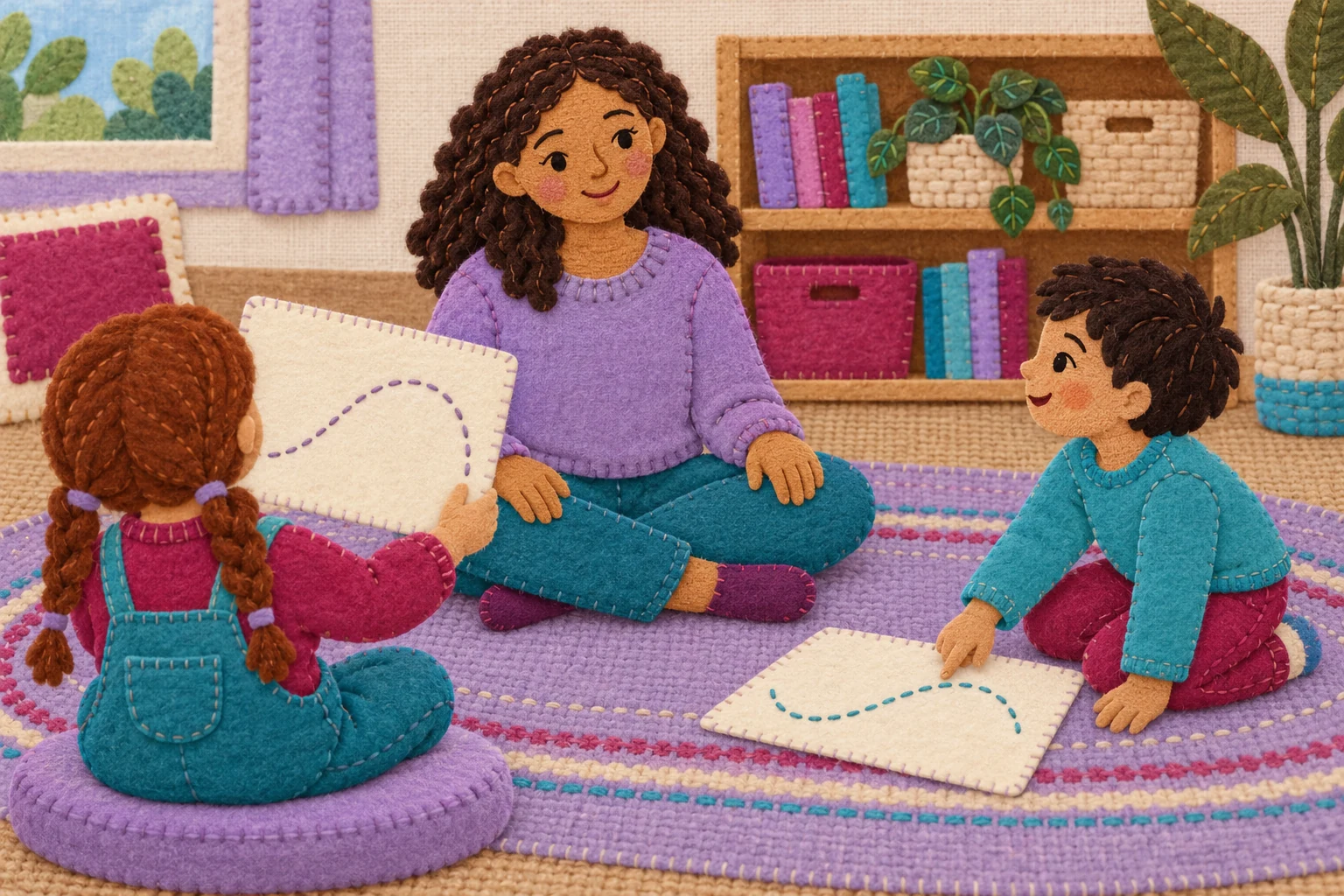
One child holds a card while another points to a path. A centrally seated teacher listens, making space for feedback based on the learners' explanations and actions.
Six feedback prompts to keep beside the next worksheet
Pick the feedback prompt that fits the moment. You do not need to use all six in one sitting. Each suggested line is a starting point; adapt its vocabulary to the child and the actual task.
1. Make feedback precise about one useful action
“You touched each picture once. That helped you keep track.”
Suppose a learner counts a row of five objects accurately. Descriptive feedback can identify the action worth carrying into the next row. Point to what you observed, connecting it with the agreed intention.
Keep the description truthful. If the child counted after your demonstration, include that support rather than claiming independent success. You might say, “After we tried one together, you pointed to each picture in this row.”
Offer feedback when work is successful as well as when it needs changing. Then invite another example. The learner gets a chance to find out whether the same action helps again, without being asked to perform for a personal label such as “the clever one.”
2. Ask for the thinking behind a choice
“Show me what helped you choose that one.”
A circled answer can hide several routes to the same result. On a matching task, a child might notice shape, copy a neighbour, or choose the closest picture. Feedback informed by their explanation can address the route they actually used.
Accept pointing, moving a card, or using familiar home-language words. Give the question time to land. If the learner seems unsure what you are asking, model how you would explain one different example.
This feedback invitation is especially useful when an answer surprises you. Hear the reasoning before supplying a correction. A reasonable interpretation of an unclear instruction may call for clearer teaching or a better page, rather than another attempt at the same instruction.
3. Direct attention to a helpful comparison
“Look at where these two paths begin. What do you notice?”
Place the learner's attempt beside a visible example. Keep the comparison about one relevant feature: a starting position, the number of objects, or the sound at the beginning of a word. Feedback can focus attention without listing every difference on the page.
For tracing, avoid treating exact visual copying as the only worthwhile outcome. If the chosen intention is starting at the marked dot, discuss that beginning. Shape, pressure, speed, and neatness need not all become targets at once.
A short line-and-curve page from the writing practice collection can supply a clear example when its preview suits the learner. Leave the model visible while giving feedback; remembering a hidden model adds another demand.
4. Give feedback a single next step
“On the next line, shall we try beginning at this dot?”
Actionable feedback points toward a small opportunity. Choose a change related to the learning intention, and ask the child to show what they think it means before starting another whole row.
Sometimes a limited choice helps: practise the beginning with a finger, or try one large pencil mark. Both choices should serve the same intention. An open request to “make it better” may leave a young learner guessing what better means.
After feedback, leave enough time and materials for a response. If the page is already crowded, use scrap paper or a larger example. The important follow-up is the child's attempt at the agreed change, not how many additional boxes are filled.
5. Model one part, then hand the task back
“Watch where I begin this short section. Now you can try yours.”
A child may understand the feedback message and still need to see an action. Demonstrate one manageable part on a separate example, describing the decision you want them to notice. Then make room for their turn.
For a picture-counting task, show how touching one object at a time keeps your place. For a path, model the beginning rather than completing the child's entire sheet. Ask what they noticed in your demonstration.
If the next attempt still needs support, adjust the task or demonstrate again in a different way. Feedback is part of teaching. It does not require a child to discover an unfamiliar method from a hint that has not yet made sense.
6. Return to what happened after the attempt
“What happened when you tried that? Show me the part you checked.”
Feedback becomes a conversation when the adult returns to the learner's response. Compare the new attempt with the original intention, and describe what changed or what still needs explaining.
A ready child might point out their own useful action. Another may need you to name it: “Your finger stayed on each picture until you said its number.” Keep the explanation connected to evidence, including any help that remained necessary.
Finish the feedback loop with a sensible decision. Continue with another example, revisit the teaching, simplify the task, or pause. Repeating the same correction more loudly does not provide a clearer route to the next step.

The coloured line follows the beginning of the dotted guide, with the remaining path still visible. Use the example to discuss where feedback directs attention before another attempt.
Use a four-move feedback routine during practice
Keep feedback short enough for the learner to hold in mind. A useful routine can fit around one example, without stopping the whole activity for a long explanation.
- Observe. Watch an attempt and ask for its meaning if the strategy is unclear.
- Connect. Name one relevant action or difficulty in relation to the shared intention.
- Offer. Give a specific next step, comparison, or demonstration the learner can use.
- Recheck. Let the child act, then decide together what the response shows.
Current classroom discussions emphasise responding to what pupils show. EEF's April 2026 article on small teaching adjustments describes refining responses such as modelling or adding a prompt. Use that principle with feedback by selecting one purposeful adjustment and checking its effect in the next attempt.
Two feedback pauses, two different responses
A family table: the instruction needs clearing up
In this imagined home example, Rohan colours every picture on a beginning-sound page. His aunt had expected him to choose the pictures starting with the target sound. When she asks him to explain, he says the pictures “all needed colour.”
The feedback conversation reveals an instruction problem. She says the words aloud, demonstrates the sound choice on one separate example, and invites him to point to a match. His coloured page stays available; there is no need to erase the whole effort.
For the next feedback exchange, she checks the spoken response before adding pencil work. A task from the phonics collection is useful only when its actual sound focus and instructions fit what she intends to teach.
A classroom group: the count needs a visible strategy
Consider a kindergarten learner who says a different number each time they look at the same pictures. The teacher watches first and notices that one picture receives two count words. The next feedback message concerns touching and counting once, with a brief model on another row.
The learner tries again while the teacher listens. A note such as “counted each picture once after a model” records the response accurately. It gives the next adult more information than a tick beside the total alone.
Keep feedback tied to the chosen skill. A short page from the number practice resources can provide another attempt without adding several new kinds of challenge.
Five things useful feedback makes possible
Look for these opportunities during feedback, rather than expecting a particular result after one conversation:
- A clear focus: The learner knows which feature of the task deserves attention now.
- A visible strategy: A successful action can be named and tried on another example.
- A manageable revision: One specific change gives the child somewhere practical to begin.
- A shared interpretation: Pointing, demonstrating, or explaining reveals how each partner understands the task.
- A better teaching decision: The child's response helps an adult choose whether to continue, model, adapt, or pause.
Choose the next feedback response from what you see
Feedback can change when the evidence changes. This guide keeps the next move small and related to the difficulty.
| You notice | Try | Look for afterward |
|---|---|---|
| The instruction has a different meaning to the child. | Show one example and restate the purpose. | A response that shows what the child thinks the task asks. |
| A method is unfamiliar. | Demonstrate one small part. | An attempt at that action, with support if needed. |
| The child can explain a useful strategy. | Invite a second suitable example. | Whether the strategy is available in the new task. |
When the learner is tired or upset, feedback may need to wait. Offer a pause and return when there is room to listen and respond.
Four ways to revisit feedback without repeating the whole page
- Teach a toy. Let the child demonstrate the agreed action while an adult voices a curious toy's question.
- Choose an example. Put two attempts together and invite the learner to point out one relevant feature.
- Make a reminder. Draw a simple cue for the strategy, such as a pointing finger beside countable objects.
- Carry it into play. Use the same action while counting play materials or following a large path outdoors.
Use feedback to connect the new activity with the idea already discussed. The purpose is another chance to use a strategy, with room to enjoy the play itself.
Let feedback make room for asking for help
A confident response can be, “Please show me that part again.” Make that request useful. Repeat a demonstration, enlarge the task, or reduce the amount of information instead of asking the child to conceal uncertainty.
Leave the learner with one step they understand. Receiving feedback does not require finishing every item on a sheet. A short exchange followed by a willing attempt can tell you enough to plan the next invitation.
Keep the child's contribution visible in any note you share with another adult: the task, the prompt, the response, and the support that helped. Feedback becomes part of an ongoing relationship in which questions are welcome and useful actions can be tried again.