Repeating Patterns: 5 Powerful Games for Happy Kids
Build a border, repair a puppet's row, and turn shapes into actions. Five practical games help children explain the repeating unit and connect their ideas with printable practice.
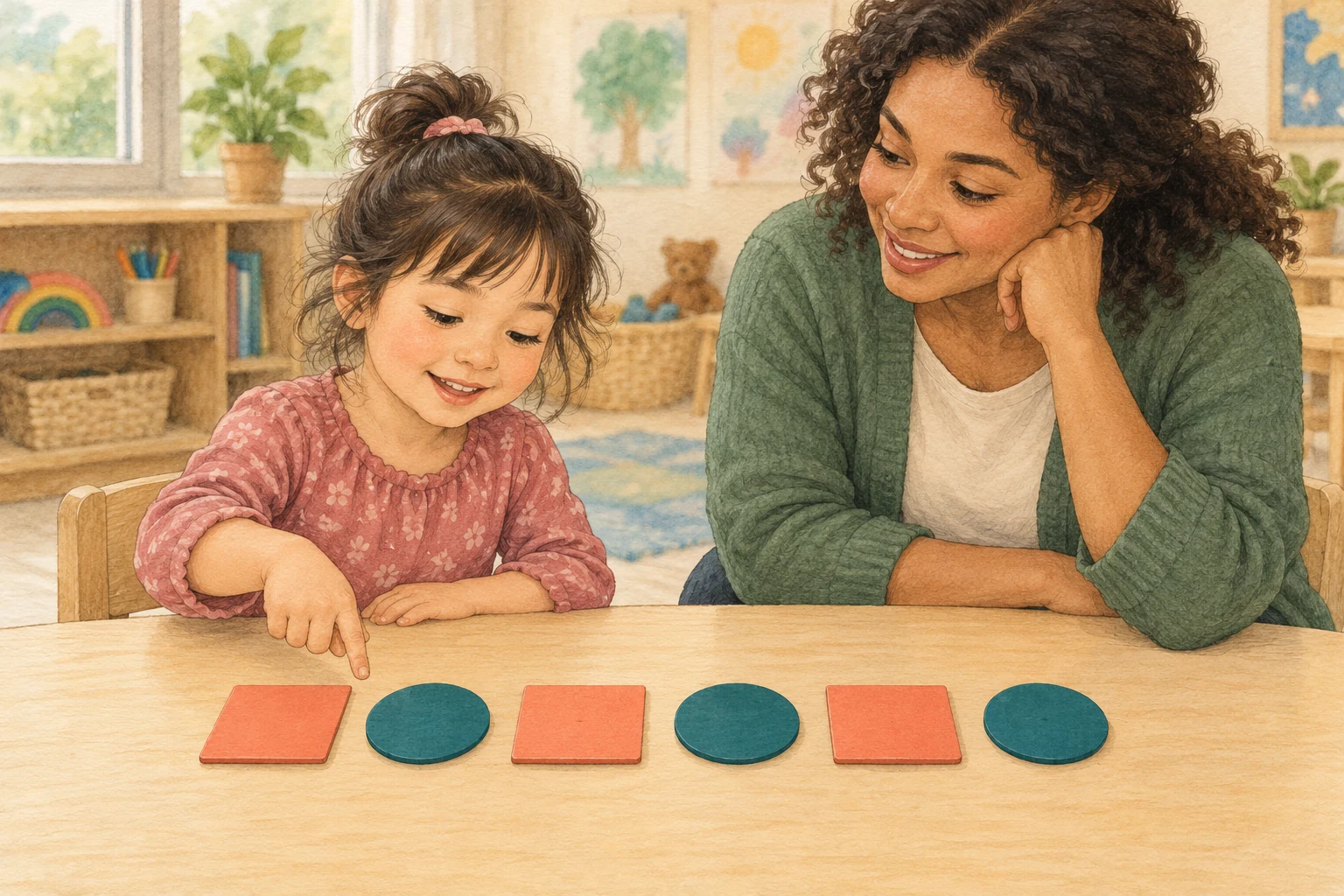
Across the kitchen table, a child arranges a square, a circle, another square, another circle. Then comes a delighted announcement: “It starts again!” That discovery sits at the heart of repeating patterns. For children around three to six, a few large shapes, familiar gestures, and a carefully chosen printable can make the idea tangible. This guide turns repeating patterns into five playful investigations for home or school. Parents get useful conversation starters, teachers get things to notice, and young learners get permission to build, change, and explain their own arrangements.
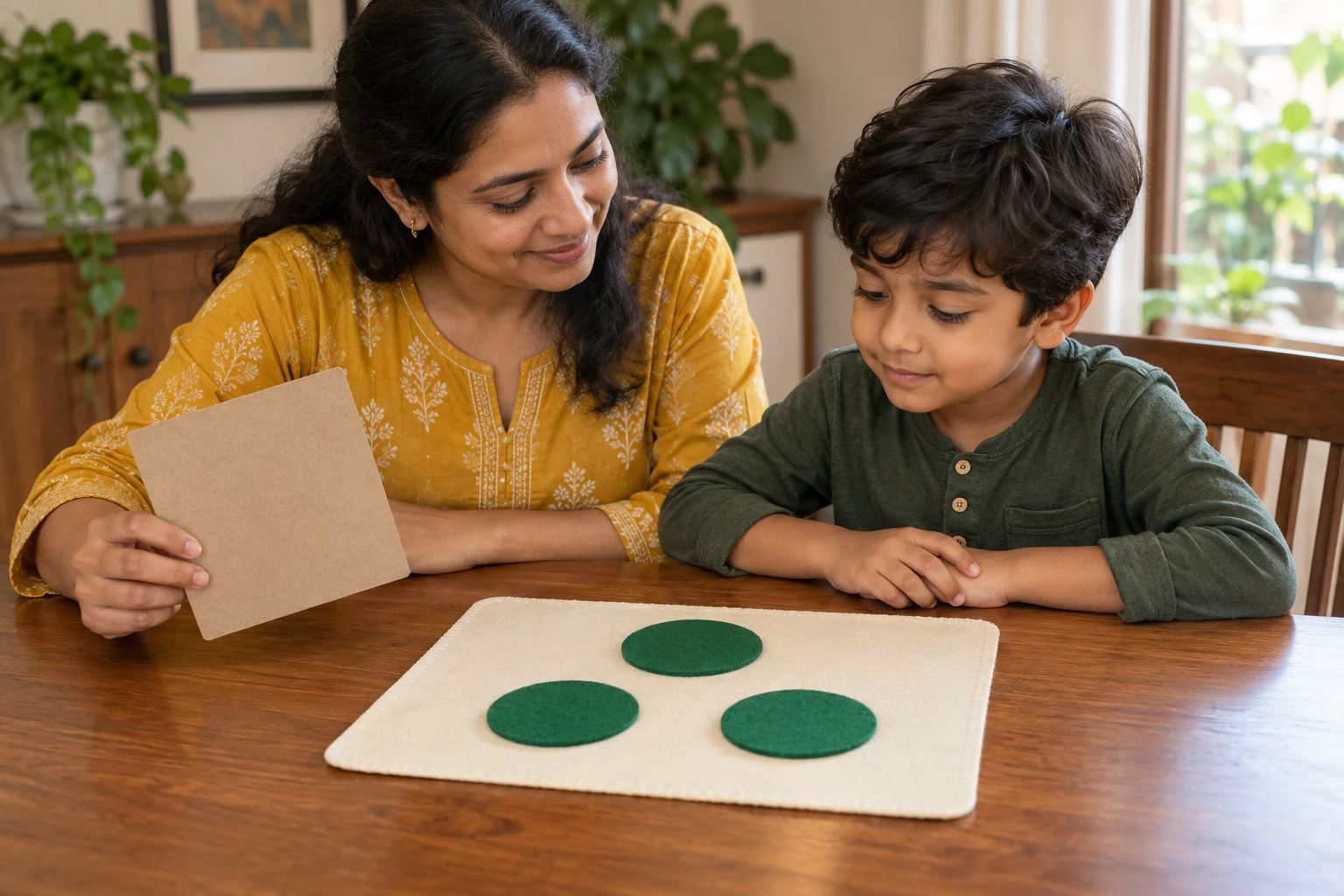
A child and adult examine three square-circle pairs. The clear row gives them a shared example of repeating patterns to describe before adding another tile.
Repeating patterns have a smallest repeating part
In square, circle, square, circle, square, circle, the smallest repeating part is square, circle. That part is called the pattern unit. Sweep a finger under one pair, then the next. The sequence is organised by repeating the whole unit in the same order.
For repeating patterns, show at least two complete units before asking a child to predict an extension. A lone square followed by a circle could begin several different arrangements. Stanford DREME's plain-language pattern overview explains this starting point and the different ways children can work with a sequence.
Copying a row and explaining its unit are different accomplishments. Repeating patterns become more interesting when an adult asks, “Which little group could you repeat to make all of this?” Leave the model visible while the learner investigates. The task is about noticing structure, not remembering a hidden display.
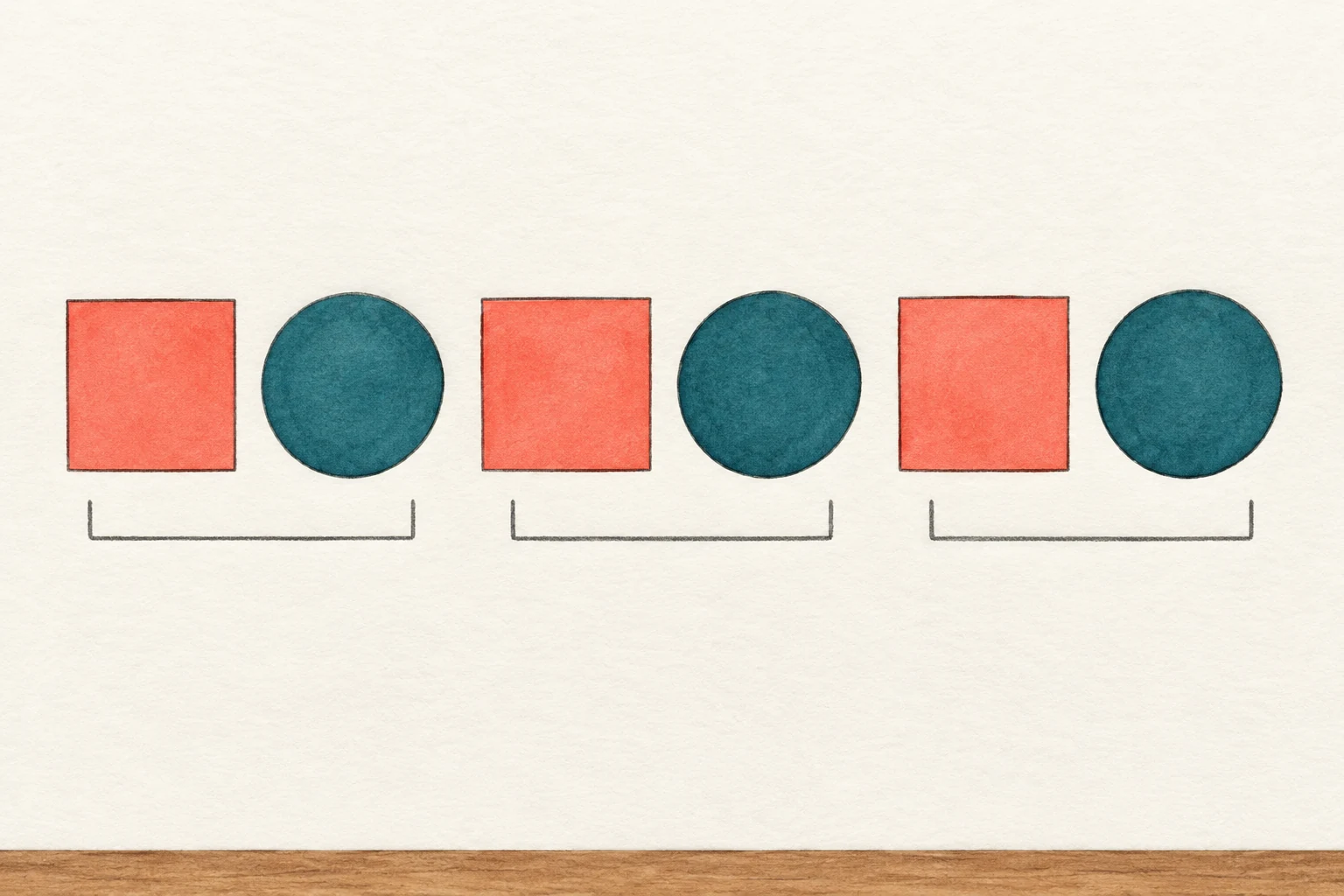
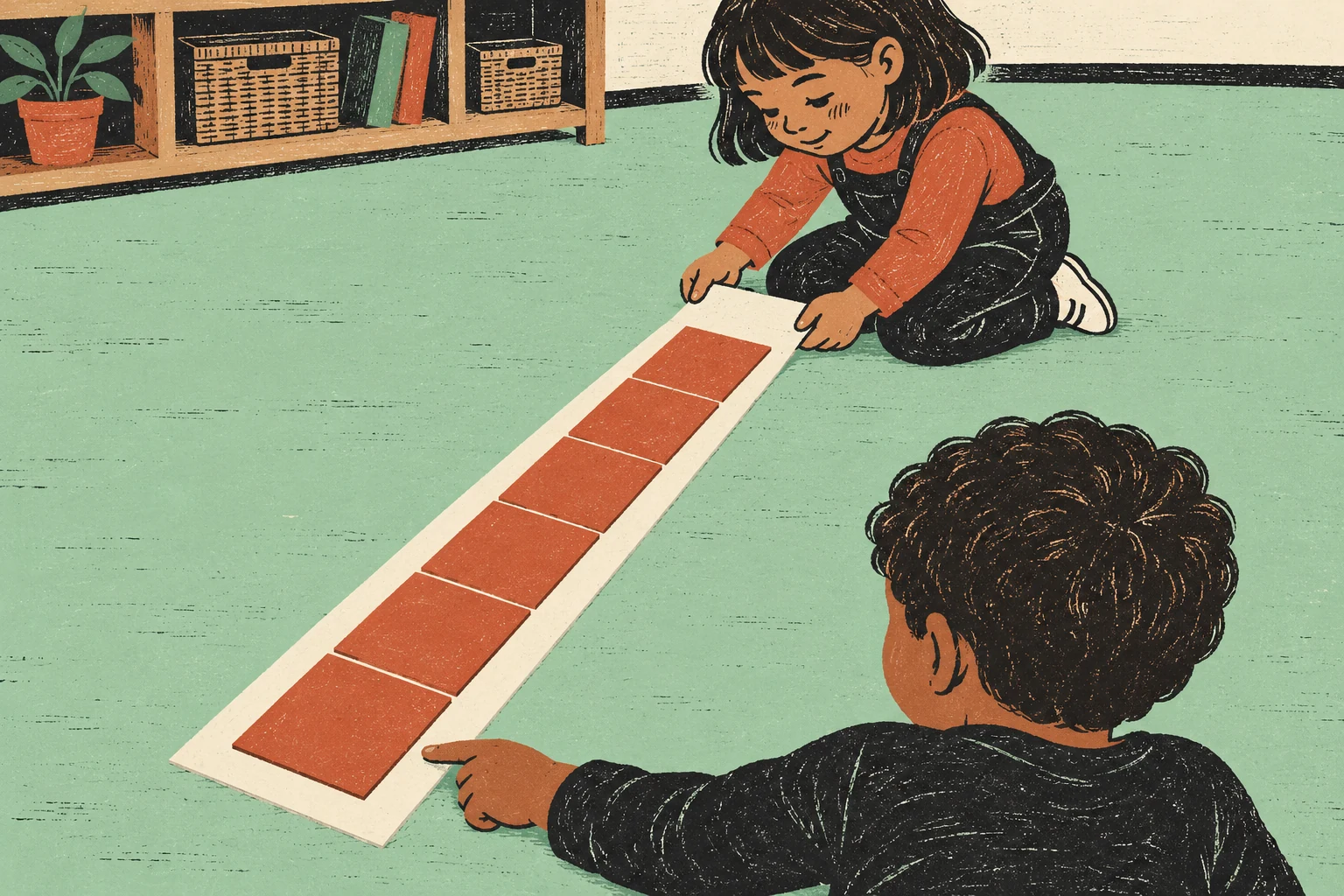
Three brackets separate the six tiles into matching pairs. Use this view to discuss where each unit begins and ends when exploring repeating patterns.
Sorting, growing, and repeating ask different questions
A pile of circles beside a pile of squares shows sorting by shape. It does not yet show repeating patterns, because there is no ordered unit returning along a sequence. First sort if that makes the materials easier to handle; next arrange them into a row with a rule.
Growing rows follow a different idea. One block, then two blocks, then three blocks changes the amount each time. Repeating patterns keep the chosen unit intact. Both arrangements are worth discussing, but naming the difference helps an adult offer a clear task instead of calling every organised collection the same thing.
Set up one small investigation
Before choosing a game, prepare repeating patterns that the learner can actually inspect. Two clearly different shapes are enough. Large paper pieces or chunky tiles keep the first attempt manageable; supervise the activity and choose materials suitable for the child.
- Choose one contrast. Begin with shape or texture, avoiding several changing features at once.
- Build a readable model. Arrange three complete units with even spacing on a plain surface.
- Read it together. Point along the row, using the child's familiar words or gestures.
- Mark the unit. Place a paper strip beneath the smallest group that keeps recurring.
- Offer one job. Copy, extend, repair, or translate; choose a single challenge for this turn.
- Keep a trace. Draw the arrangement or write down the child's explanation, then finish while interest remains.
A short encounter with repeating patterns can end with an unfinished row. Save it for another visit rather than adding more instructions to a tired moment.
Five games that give the rule a different job
These repeating patterns games are invitations, not a timetable. Pick one, watch the response, and change the materials before increasing the complexity. The maker should always get a chance to explain the rule.
1. Build a tiny exhibition border
Give a toy animal a paper picture frame. Lay square, circle, square, circle, square, circle along its bottom edge. Ask the child to continue the border with two more pieces, then show the unit that guided the choice.
Repeating patterns now have a practical job: keeping a display organised. Leave spare squares and circles within reach. If the learner adds two squares, read the entire row together before deciding whether to change anything.
Let the child choose a new unit for a second border, then compare the two repeating patterns.
Keep the thinking: Sketch the border on scrap paper. Repeating patterns do not need perfect drawing; a recognisable mark for each shape preserves the rule.
2. Deliver the missing parcel
Make two matching rows of circle, circle, square, circle, circle, square. Keep one complete. In the second, cover the first square with a small paper envelope. Invite the child to select a shape for the covered place.
With repeating patterns, the evidence comes from the whole unit, not only the neighbour beside the gap. Compare both rows, slide a strip beneath each circle-circle-square group, and let the learner uncover the original square.
For repeating patterns with a covered place, let the learner place their chosen tile above the envelope before checking.
Change the challenge: Move the envelope to a different position. Repeating patterns can stay familiar while the location of the missing piece changes.
3. Help a muddled puppet
A puppet proudly presents triangle, square, triangle, square, square, square. Explain that it intended to make triangle-square units. Ask where its plan stopped working and which piece it might replace.
Repairing repeating patterns lets children disagree with an object rather than feel examined themselves. Give the puppet a curious voice: “Can you show me how you checked?” Accept moving pieces as an explanation.
Ask the puppet to point to every repaired unit, checking the repeating patterns from beginning to end.
Switch ownership: The child makes the puppet's next puzzle. Ask for the intended unit first; repeating patterns need an agreed rule before a different choice can count as an error.
4. Turn tiles into gentle actions
Place square-circle pairs where both partners can see them. Agree that square means clap and circle means tap knees. Read each tile while performing its action, maintaining the same steady pace.
Translating repeating patterns asks whether a rule survives a change of materials. The coral colour disappears, but the alternation remains. Invite a partner to point along the tiles while the other performs, then exchange roles.
Meanwhile, keep the repeating patterns model nearby so nobody has to remember the row unaided.
Make it accessible: Choose any comfortable pair of distinguishable gestures or sounds. Repeating patterns can use finger movements, spoken syllables, or selected picture cards without requiring standing or jumping.
5. Open a make-your-own pattern studio
Offer two or three kinds of large paper shapes and an empty strip. The child chooses a unit, builds it, and repeats it twice more. A visiting adult tries to recreate the design on a second strip without taking the original apart.
Inventing repeating patterns changes the child from answerer to designer. Ask the maker to approve the copy by pointing to corresponding units. If the row changes halfway through, invite them to describe whether they want one consistent rule or two separate designs.
For longer repeating patterns, have the maker show a complete new unit before preparing the visitor's copy.
Paper connection: Browse the colouring collection for a suitable outline to decorate. Repeating patterns can form a border around a chosen picture; inspect the actual preview and access label before downloading.

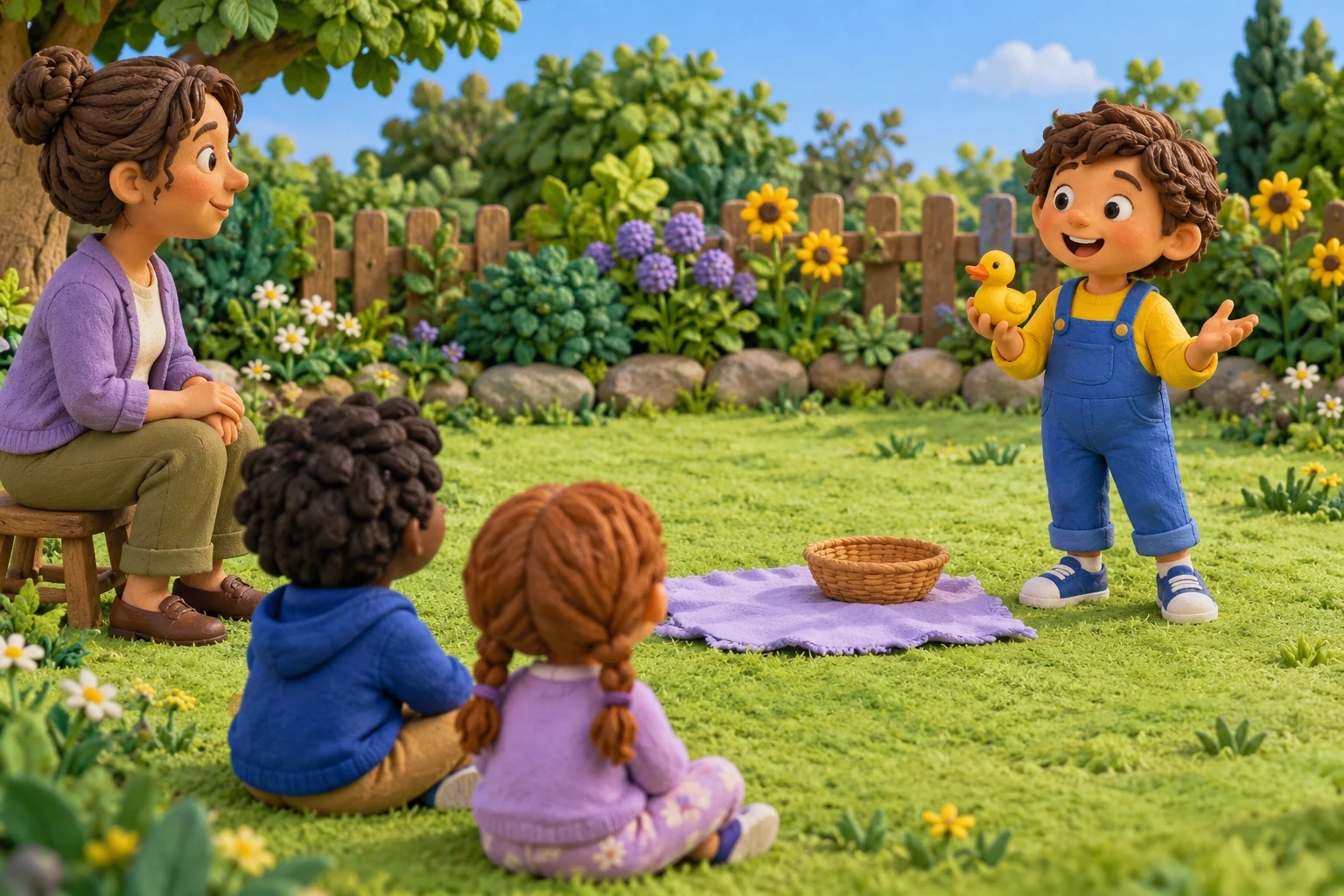
Clapping and knee tapping offer two distinct actions for a shared sequence. A teacher watches the children's choices during an exploration of repeating patterns.
A home moment: the decoration becomes explainable
Imagine Ishan arranging paper shapes while his aunt makes a greeting card. He copies her square-circle border accurately, then points to the entire row when she asks what repeats. She places a short strip beneath the first pair and asks him to find another group just like it.
He slides the strip along. The next two groups match. His aunt records, “Matched the repeating pair with a strip.” That description is more useful than deciding he has mastered repeating patterns after one successful copy.
On another afternoon, she offers triangle-circle pairs. Ishan explains the new row using shape names in the language he speaks most comfortably. Repeating patterns stay central while the adult changes the surface details. A small drawing beside the greeting card becomes a record of what he meant.
A classroom moment: give both partners a thinking turn
Picture a kindergarten pair working with repeating patterns at a table. One child places tiles rapidly; the other watches without touching anything. The teacher offers separate jobs: the maker builds a unit, and the checker uses a strip to locate each repeat. Then they swap.
One learner says “same, same, different” while pointing to circle-circle-square. The teacher connects those words to the actual shapes before introducing an AAB label. Letters can describe the structure later; alphabet knowledge need not become the obstacle today.
NAEYC's Spring 2026 guidance for multilingual learners encourages maths within everyday activity and children's home languages, including movement sequences. For repeating patterns, accept a demonstration before asking for an English explanation. Record whose idea you observed, because a partner's finished row cannot show each child's thinking.
Choose a printable by the thinking it asks for
A page for repeating patterns should make its rule readable. Start in the maths worksheet collection, checking the preview rather than assuming every page contains pattern work. This guide describes activities you can make yourself; it does not include a separate downloadable pack.
| Purpose | Look for | Ask afterward |
|---|---|---|
| Extend | Two or more complete units before the empty space. | Which whole group will start again? |
| Repair | A clear intended rule and one change to discuss. | Where does the model stop matching? |
| Translate | Space to rebuild a rule using new symbols. | What stayed the same between your rows? |
Print one test copy. Repeating patterns that depend only on colour may become unclear in grayscale. Shape or texture differences give the learner another reliable clue.
Six worthwhile things to listen for
Look beyond a correctly coloured box. During repeating patterns, these observations can help adults choose a sensible next invitation:
- Order: The learner names or indicates items in sequence without skipping a position.
- Grouping: A finger, strip, or gesture identifies the small unit inside the longer row.
- Prediction: The child chooses an extension and connects it to the visible model.
- Checking: A surprising choice leads to comparing units instead of guessing again immediately.
- Transfer: The same arrangement appears in a new set of shapes, sounds, or gestures.
- Explanation: Words, pointing, drawing, or a demonstration make the child's idea available to somebody else.
These are opportunities within repeating patterns, not a scorecard or an age-based deadline. Keep an example of the response, including any support you gave.
Keep a note that helps with the next invitation
For example, a useful note about repeating patterns might read: “Copied three square-circle pairs with the model beside the mat; found the unit after I placed a strip under one pair.” The materials, response, and adult support are all visible in that sentence.
On the next visit, offer repeating patterns with the same structure and different shapes. Watch whether the learner uses the strip independently. If they need help again, keep it available. Recording repeating patterns this way helps a family and teacher discuss a concrete example without comparing children or turning an enjoyable game into a test.
When the answer surprises you, return to the model
Repeating patterns can be harder to explain than to copy. Offer a smaller row, increase the size of the shapes, or let the child move a strip beneath each unit. Avoid adding faster turns as a reward for understanding.
A learner who draws slowly can place tiles while an adult records the idea. The writing and tracing resources can support separate pencil practice when that is useful; handwriting skill should not decide who gets to explore repeating patterns.
Try saying, “Show me the little group you used.” Then wait. A quiet adjustment, a careful point, or a request to build together can reveal something worth following. Repeating patterns belong to the child who is still experimenting as much as to the child who already has a confident explanation.