Maze Play: 5 Creative Challenges for Happy Explorers
Pause at a junction, direct a toy, or build a route worth testing. Five playful challenges connect printed puzzles with spatial language and decisions children can explain.
Before the pencil touches paper, a whole journey can happen in a child's head. Which opening continues? Where does that branch stop? Maze play gives these questions a visible home, with routes to inspect and decisions to revisit. For children around four to seven, the interesting part need not be a perfectly drawn finish. A finger, a toy vehicle, or a spoken direction can reveal the plan. These five challenges turn a printed page into a conversation about space, with practical ways for families and teachers to adjust the invitation.
Choose the maze invitation before choosing a pencil
Start with what the learner wants to investigate. A crowded maze can demand visual searching, unfamiliar directions, and careful pencil movement together. Change one demand before deciding the puzzle is too difficult.
| The child enjoys | Offer | Keep out of the way |
|---|---|---|
| Looking and pointing | A broad route explored with a finger. | Tiny corridors and a demand for neat lines. |
| Moving and building | A simple block junction and a large toy vehicle. | Several rules or destinations at once. |
| Explaining a plan | A partner who follows one direction at a time. | A race against another child's finishing time. |
Browse the puzzle collection by its actual previews. The collection includes different task types; choose a suitable route page if available, or draw the simple maze described below.
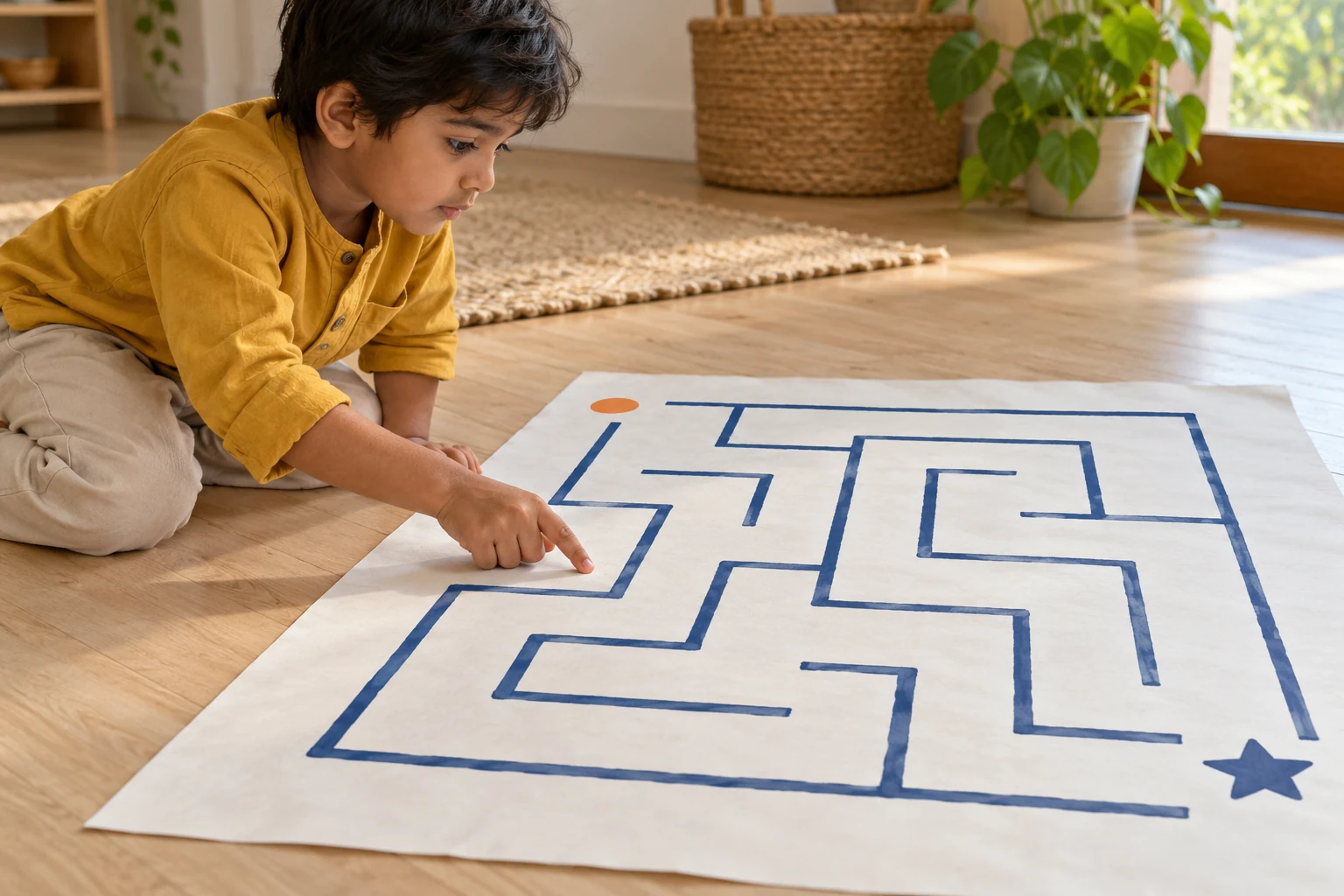
An unsolved paper maze occupies the space beside the learner. The orange starting circle and blue goal star give the inspection a purpose without adding a coloured solution.
What makes a maze different from a tracing path?
A tracing path usually supplies a line to follow. A maze introduces choices: a corridor continues, a junction offers alternatives, and a dead end requires returning. Explain whether the dark marks are walls or the route itself; different puzzle designs use different conventions.
For the challenges here, the blank corridor is the travelling space and the lines are walls. The learner moves from an agreed start toward a destination without crossing those walls. A dead end is simply a branch with no onward opening.
Keep the maze page facing one way while introducing position words. Pointing to “the window side” may communicate more than demanding an immediate left-right answer. NAEYC's January 2026 guidance on spatial thinking connects location language, representations, and movement. Here, that connection becomes a practical invitation to say, show, and test a route.
Set up one short maze session
- Inspect the maze page yourself. Check that an opening really connects the start and goal. A faulty print or unclear wall should not become the child's problem.
- Agree on the travelling space. Demonstrate one small section on a different example, distinguishing corridor from wall.
- Choose a way to respond. Offer pointing, a finger journey, a chunky pencil, or moving a large paper marker.
- Try a single challenge. Leave the remaining ideas for another day if the first one supplies plenty to discuss.
- Save one discovery. Ask for a useful turn, word, or changed decision before putting the maze away.
When pencil control is the main obstacle, choose a wider route. A separate page from the line and curve practice resources can provide an optional drawing warm-up, without making handwriting a condition of joining the puzzle.
Five ways to make the maze worth exploring
Each challenge changes the job, rather than merely adding more twists. Use a route the child can see clearly, and introduce only the rule needed for that version.
01 / Look ahead
Send a finger scout to the next junction
Invite the learner to travel through the maze with a finger and pause where the corridor splits. Ask, “Where could each opening take us?” The child can inspect one branch before committing to a pencil line.
Do not insist on solving the entire maze route silently first. Looking one turn ahead may be enough. If a finger covers the junction, lift it briefly and point beside the page while discussing the alternatives.
In this version, success means noticing a choice and investigating it. A child who explores a dead end has discovered information about the maze. Invite them to show where the last choice occurred, then let the journey continue.
02 / Give a maze traveller one useful direction
Put a large paper vehicle at the maze entrance. One player navigates; the other moves it. Begin with a short instruction such as “follow the corridor to the corner,” then stop so the navigator can inspect the next part.
Share the same viewing position. Otherwise, one person's right may be another person's left. Gestures, familiar home-language words, and a named landmark can all make a direction usable. There is no need to turn the game into a vocabulary test.
Swap roles after a manageable section. The new navigator may discover that “go there” leaves the mover guessing. Ask which feature of the maze would make that instruction clearer, without supplying a long route for the child to memorise.
03 / Keep track of the return point
A dead end can make a learner feel that every earlier decision must be discarded. Place a large movable paper arrow beside the most recent maze junction. When a branch closes, trace back to that choice together.
Ask what the blocked branch has revealed. The child might say, “That opening stops,” or point to its end. Move the arrow only after another junction becomes the current decision point.
Keep the marker outside the maze corridor so it does not conceal the puzzle. This maze variation makes returning visible. It is an alternative to rubbing out every exploratory line or beginning again at the entrance after each detour.
04 / Build and test
Make a maze that a toy can actually use
Build a short corridor from large blocks, adding one junction, a closed branch, and an open exit. Choose a toy that fits. The builder's job includes checking the turning space, not just arranging attractive walls.
Let the child test a route and move a wall if necessary. A toy that catches on a corner raises a concrete question: does the corridor need widening? The maze can change in response to that discovery.
Sketch the arrangement afterward with simple wall lines. Comparing the model and drawing introduces a shift from objects to a representation. Keep that comparison brief; the learner does not need an accurate scaled plan.
05 / Exchange a route with a new explorer
Offer a blank sheet for a child-made maze. Draw two widely spaced boundary lines around a short winding corridor, leaving entrance and exit openings. Add a single branch that ends against a wall. Test the route before adding pictures.
The maker then offers it to a partner. Watch where the maze explorer hesitates. Is that an interesting decision, or is the wall unclear? The maker can revise the drawing after hearing what the other person sees.
Keep decoration outside the travelling space. A large creature from the colouring picture collection can inspire a destination drawn on a separate card. The maze remains readable while the child supplies a reason for the journey.
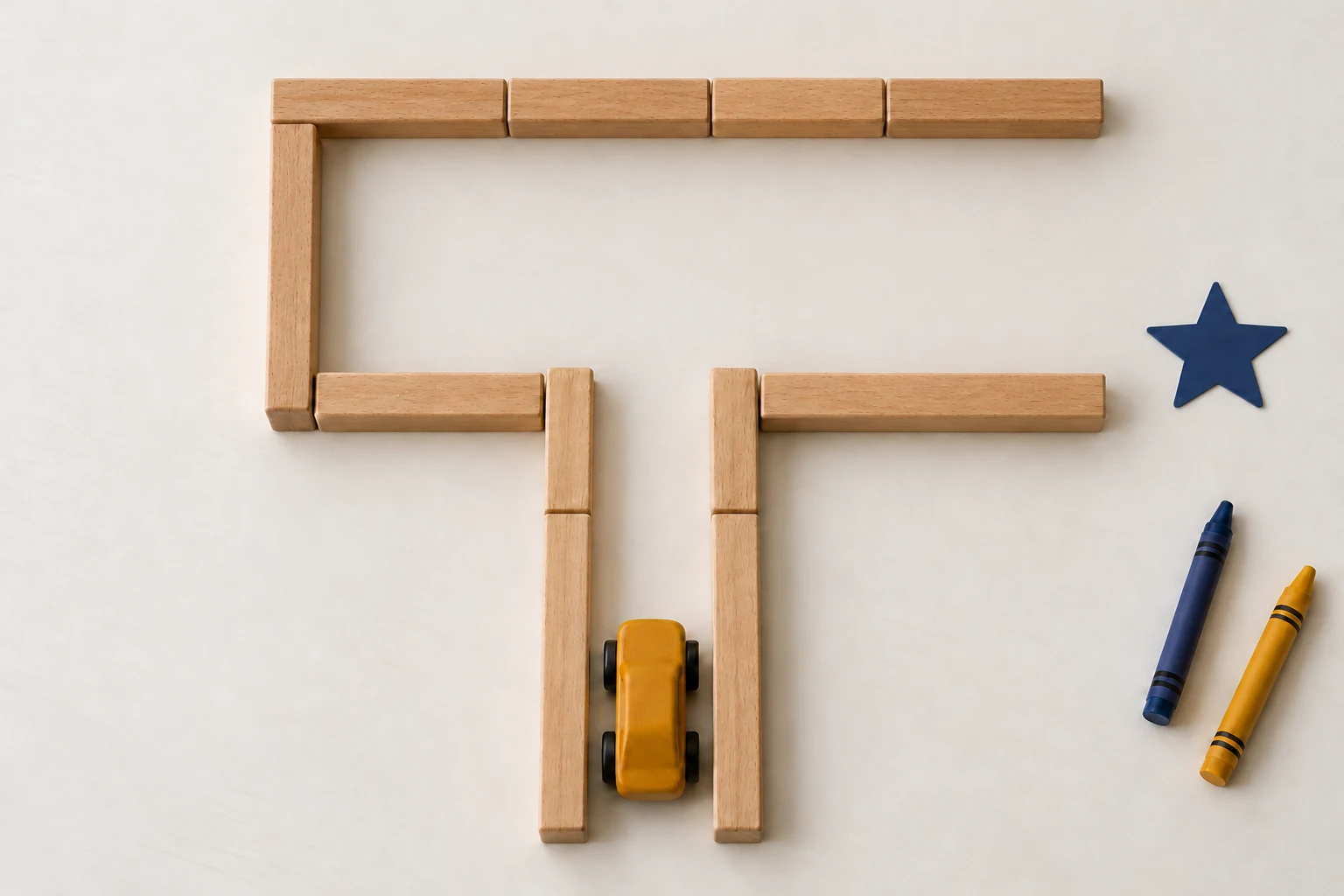
The overhead maze model leaves broad space above the car for turning. Its left end closes against a wooden wall, while the right opening leads toward the star.
The same maze can have two very different afternoons
At home: a parcel takes the longer way
Imagine Eshan delivering a paper parcel through a maze to a star-shaped post office. He selects a branch because it points toward the star, then discovers the closed end. His grandfather leaves the parcel in place and asks where the last opening was.
Eshan returns to the junction and chooses a corridor that initially leads away from the goal. The useful discovery is about connections: a promising direction is not always a continuous route. Nobody needs to call the first choice careless.
In class: the maker hears a different reading
Consider a pair sharing a newly drawn maze. Mira thinks a narrow gap is an opening; Kabir intended it to be a wall. Their teacher invites the maker to explain the boundary and the explorer to describe what they saw.
Together they close the accidental gap, then test the intended entrance. This is a design conversation, not a speed contest. It also gives the teacher a reason to distinguish an unclear drawing from an unsuccessful route decision.
Six things to notice beyond the finishing star
- Looking ahead: The learner inspects an opening before moving, making part of their plan visible.
- Location language: Words such as beside, around, between, and toward connect to something another player can locate.
- Useful revision: A closed branch supplies a reason to return and change a decision.
- Representing space: Comparing a block model with its drawing links a real arrangement and marks on paper.
- Controlled movement: When drawing is appropriate, a broad maze corridor provides a purpose for turns and changes of direction.
- Shared interpretation: Partners find out whether a boundary or instruction communicates what its maker intended.
These are opportunities during maze play, rather than promises about later attainment. Stanford DREME's explanation of spatial relations offers background on position, movement, and the language adults use while children explore space.
Change the demand that is getting in the way
If the learner repeatedly loses the corridor, enlarge the maze or draw a shorter version with wider spaces. Cover unrelated pictures around its border with plain paper. Keep the next junction visible, so the cover does not hide the information needed for a choice.
For a child who understands the route but tires of holding a pencil, separate planning from recording. They can point out the maze journey while a partner draws it, checking each turn with them. Offer the pencil again only if they want that role.
At the other end, a familiar maze may no longer offer an interesting decision. Invite the learner to explain why a tempting branch cannot reach the goal, or design another junction for a partner. Add that single challenge before increasing the page's visual complexity.
A maze session can end after one useful comparison. Finishing every branch is not required to find something worth noticing.
Four small invitations after the maze is put away
- Corner postcards. Draw just one bend from the maze route on a card. Invite a partner to arrange two long blocks to show that turn.
- A landmark voice. Let the destination speak: “You can see me, but which opening reaches me?” The child answers with a gesture or a short explanation.
- A route in the air. Trace one remembered section with an arm while a partner describes its changes. Compare the movement with the paper afterward.
- A builder's swap. Change one wall in a familiar block maze and test what that change does. Keep the original destination so the comparison stays focused.
Return to the printed maze only if the learner wants another look. Extending an idea can be a brief conversation; it does not require another completed sheet.
Leave an opening for another try
A child can understand the maze and still dislike making a permanent line. Offer an unmarked copy, a finger journey, or a pause. Likewise, a quiet learner may show a thoughtful plan without explaining it in a complete sentence.
Ask which part they would keep for another explorer. Perhaps it is a wide corner, a surprising dead end, or a direction that finally made sense to a partner. A changed decision can be part of a successful journey.
Put the maze away with its discoveries intact. The next invitation might be simpler, bigger, or child-made. What matters is leaving the learner with room to investigate, revise, and decide that a puzzle is worth another visit.