
Master 7 Essential CVC -at Words for Reading Triumph!

Building Foundational Reading Skills with CVC -at Words
Welcome to a fantastic resource designed to build your child's early literacy skills! This worksheet focuses on a crucial set of building blocks for reading: CVC -at words. These three-letter words, following the consonant-vowel-consonant pattern, are often among the first that young learners master. By understanding and practicing words like 'hat,' 'cat,' and 'bat,' children develop essential phonemic awareness and decoding abilities. This printable is thoughtfully crafted to make learning fun and effective, offering a variety of exercises that reinforce rhyming, word identification, and sentence completion.
This particular worksheet dives into the '-at' word family. It's a common and accessible starting point for introducing CVC words. The activities are designed to be interactive and engaging, moving from simple repetition to more complex application. Parents and educators will find this a valuable tool for supporting young readers as they embark on their literacy journey. Let's explore how this worksheet can support your child's learning and development.
Why Focus on CVC -at Words?
- Phonics Foundation: Mastering CVC words like those ending in '-at' is fundamental to phonics instruction. It teaches children how to blend sounds together to form words.
- Rhyming Recognition: The '-at' family provides excellent opportunities to practice rhyming, a skill closely linked to phonological awareness and reading comprehension.
- Decoding Skills: Children learn to break down words into their individual sounds (phonemes) and then blend them back together (decode), a critical step in becoming independent readers.
- Vocabulary Expansion: Introducing common CVC words expands a child's early vocabulary, giving them more words they can recognize and use.
- Confidence Building: Successfully reading and identifying words provides a significant confidence boost for young learners, encouraging them to engage more with reading.
- Preparation for More Complex Words: A solid understanding of CVC patterns prepares children for more complex word structures and longer words later on.
- Cognitive Development: Activities like matching rhyming words and completing sentences stimulate cognitive processes such as memory, pattern recognition, and logical thinking.
Worksheet Breakdown: A Skill-Building Journey
This worksheet is structured to guide children through various aspects of word recognition and phonics. Each section builds upon the last, offering a comprehensive learning experience.
Section 1: Say It 3 Times
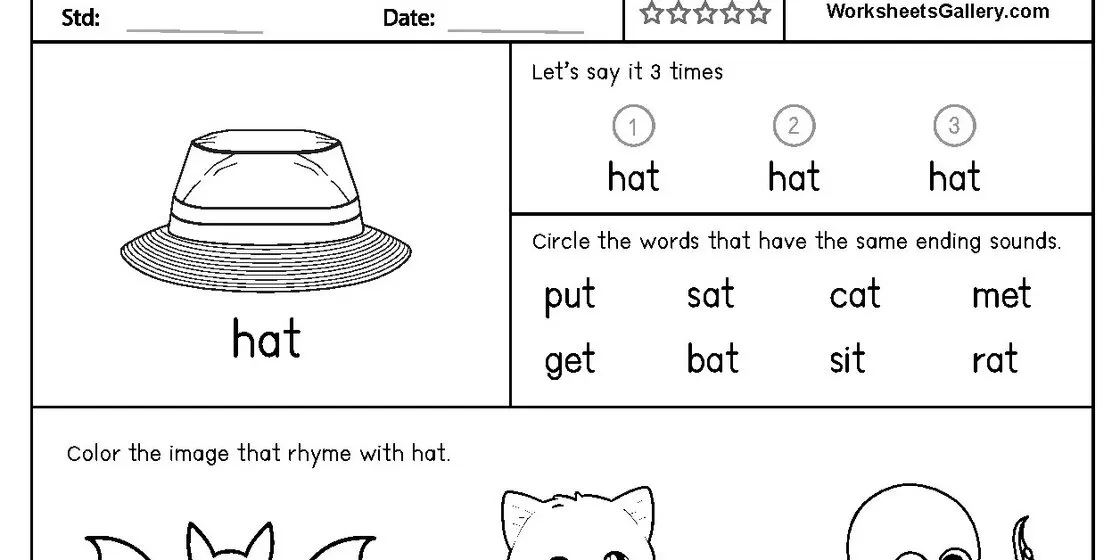
The worksheet begins with a simple yet effective repetition exercise. Children are prompted to say the word 'hat' three times. This activity helps with auditory recognition and reinforces the pronunciation of the target word.
Section 2: Rhyming Word Identification
Following the initial repetition, children are asked to circle words that have the same ending sounds as 'hat.' This section includes words like 'put,' 'get,' 'sat,' 'cat,' 'met,' 'bat,' 'sit,' and 'rat.' This exercise directly targets phonemic awareness, specifically the ability to identify rhyming patterns within words.
Section 3: Visual Rhyme Matching
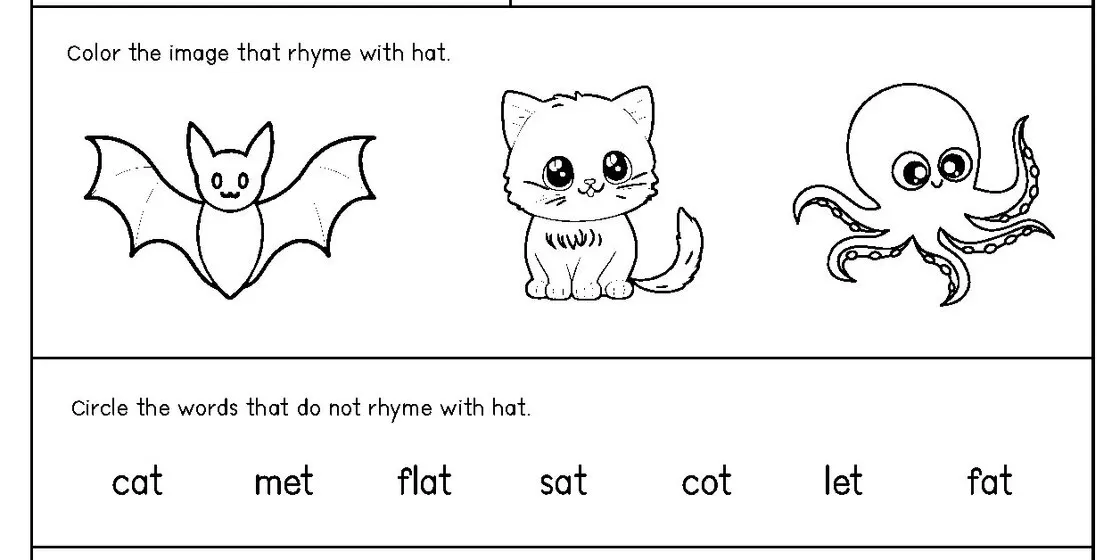
This section introduces a visual element. Children must color the image that rhymes with 'hat.' The options provided are a bat, a kitten, and an octopus. This connects the auditory skill of rhyming with visual recognition, making the concept more concrete.
Section 4: Identifying Non-Rhyming Words
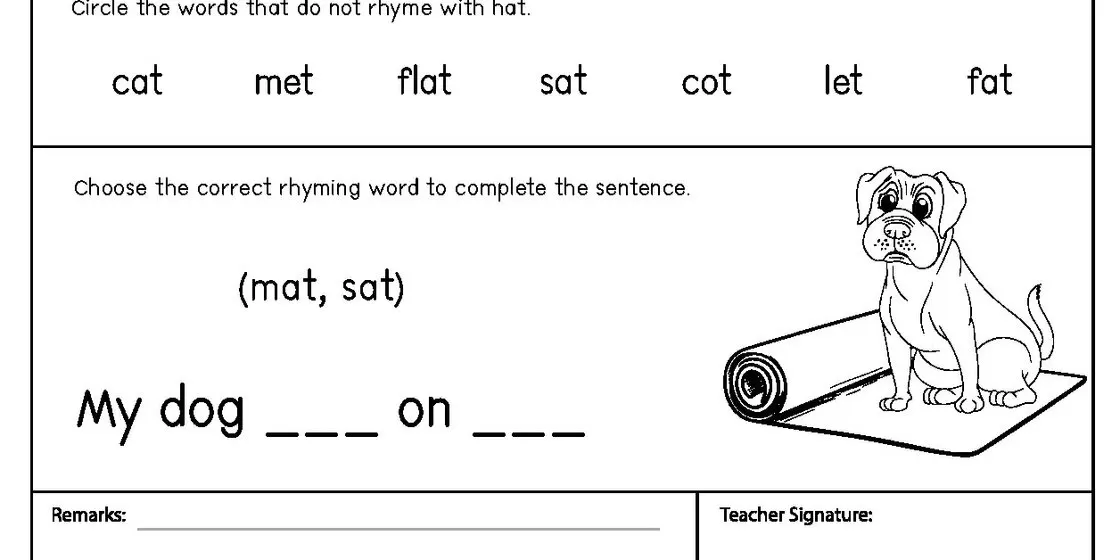
To further solidify their understanding, children are then asked to circle words that *do not* rhyme with 'hat.' This includes words like 'cat,' 'met,' 'flat,' 'sat,' 'cot,' 'let,' and 'fat.' This task requires children to differentiate between rhyming and non-rhyming patterns, a higher-level skill.
Section 5: Sentence Completion
The final activity involves choosing the correct rhyming word to complete a sentence: "My dog __ on __." The choices provided are '(mat, sat).' This applies the learned rhyming and word recognition skills in a meaningful context, demonstrating how these words function in language.
Developmental Benefits for Young Learners
Engaging with this worksheet offers a wide array of developmental benefits for young children:
Language and Literacy Skills
Directly enhances phonemic awareness, phonics, vocabulary, and early reading comprehension through rhyming and word identification.
Cognitive Skills
Develops critical thinking, pattern recognition, memory, and problem-solving abilities as children distinguish between rhyming and non-rhyming words and complete sentences.
Fine Motor Skills
Activities like circling words and coloring the bat image help refine the small muscle movements in the hands and fingers, crucial for handwriting development.
Visual Discrimination
Children learn to differentiate between similar-looking words and images, improving their ability to focus on details.
Auditory Processing
The emphasis on saying words aloud and identifying rhyming sounds strengthens auditory processing skills, helping children distinguish subtle sound differences.
Handwriting Readiness
The act of circling and the implied tracing of letters within words prepares children for formal handwriting instruction.
Practical Application: Home and Classroom Scenarios
This worksheet is versatile and can be used effectively in various settings.
At Home: A Cozy Reading Corner
Imagine a rainy afternoon. You and your child are snuggled on the couch. You pull out this worksheet. Start by reading 'hat' together, emphasizing the sounds. Then, point to the rhyming words and have your child say them aloud. For the coloring section, encourage them to make the bat a vibrant color. When they complete the sentence, celebrate their success! This creates a positive association with learning and strengthens your bond.
Scenario: Sarah, a 5-year-old, is struggling to distinguish between rhyming and non-rhyming words. Her parent uses this worksheet during their evening routine. They read each word aloud, clapping for rhyming pairs and shaking their heads for non-rhyming ones. Sarah particularly enjoys coloring the bat, making it a fun reward for correctly identifying rhyming words.
In the Classroom: Small Group Activity
A teacher can use this worksheet as part of a small group literacy center. After introducing CVC -at words, students can work through the sections independently or with peer support. The teacher can circulate, offering guidance, especially on the rhyming identification and sentence completion tasks. The visual coloring activity provides a calming break and reinforces the target sound. This worksheet is a great way to differentiate instruction, providing targeted practice for students needing extra support with phonics.
Scenario: Mr. Harrison uses this worksheet with a small group of first graders who need extra practice with phonics. He first reviews the concept of rhyming using the worksheet's examples. The students then work through the worksheet together, discussing each section. They particularly enjoy the part where they identify words that *don't* rhyme, as it challenges them to think critically. The sentence completion task helps them see how these words are used in context.
Extending the Learning: Fun Activities
Take the learning beyond the worksheet with these engaging activities:
Rhyming Word Hunt
Go on a rhyming word hunt around the house or classroom. Look for objects whose names rhyme with 'hat,' 'cat,' 'bat,' or 'mat.' For example, 'mat' and 'rat' (if you have a toy rat!). This makes learning active and contextual.
Storytelling with -at Words
Create a short story using as many CVC -at words as possible. For example: "The fat cat sat on a mat. A hat blew off the cat. The bat flew past the cat." Encourage your child to contribute words or ideas.
Rhyming Pairs Game
Write CVC -at words on separate cards (hat, cat, bat, mat, sat, fat, rat). Have your child match the rhyming pairs. You can make it a memory game by flipping the cards face down.
Sound Blending Practice
Use magnetic letters or write letters on paper. Practice blending sounds: /h/ /a/ /t/ -> 'hat'. Start with the '-at' chunk and then add different beginning consonants (b-at, c-at, r-at, s-at).
Common Mistakes and Encouragement
It's natural for young learners to make mistakes. Here are a few common ones and how to address them:
Confusing Similar Sounds
Children might confuse words that sound similar but don't rhyme, or vice-versa. Gently reiterate the sounds. For example, 'hat' and 'hot' have different vowel sounds. 'Cat' and 'bat' rhyme, but 'cat' and 'car' do not.
Difficulty with Blending
Some children struggle to blend the initial consonant sound with the '-at' chunk. Break it down further: say the initial sound, then the '-at' sound, and then blend them slowly. Use your fingers to slide from one sound to the next.
Visual Overlap
Words like 'sat' and 'rat' can look similar. Encourage them to look at the first letter carefully. Using different colored markers for the first letter can help differentiate them.
Encouragement Tips:
- Celebrate Small Wins: Acknowledge every correct answer and effort, no matter how small.
- Keep it Playful: Use a cheerful tone and make the activities feel like games rather than chores.
- Short, Frequent Sessions: Shorter practice sessions (10-15 minutes) are often more effective than long, infrequent ones.
- Positive Reinforcement: Offer praise and encouragement consistently. Avoid criticism.
- Connect to Real Life: Point out CVC -at words in books, signs, or everyday conversations.

Download and Print with Ease
Getting this valuable learning resource is simple. Click the download button to get a high-quality, printable PDF of the worksheet. It's designed to be printer-friendly, with no watermarks or distracting advertisements, ensuring a clean and focused learning experience for your child. Simply print and you're ready to start building essential reading skills!
This worksheet is perfect for children aged 4-6, providing a solid foundation in phonics and early reading.
Popular Worksheets
Printable resources families and teachers are downloading now.
 Free
Free
 Free
Free
 Free
Free
 Free
Free