
Master Tricky CVC -ap Words: 7 Stellar Practice Steps!

Understanding CVC -ap Words: A Foundational Phonics Skill
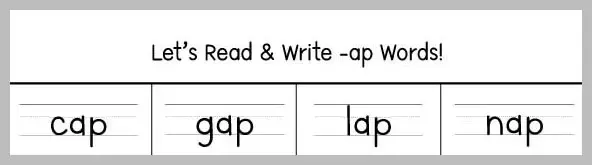
This printable worksheet focuses on a fundamental building block in early reading: CVC -ap words. CVC stands for Consonant-Vowel-Consonant, which describes the simple three-letter structure of these words. Words like "cap," "gap," "lap," "nap," "map," "rap," "sap," and "tap" are perfect examples. They follow a predictable pattern, making them ideal for beginning readers to decode. By mastering these sounds and their corresponding letters, children develop the essential skills needed to tackle more complex words and build a strong foundation for reading fluency. This worksheet provides a structured and fun way to practice these critical early literacy skills.
Why Focus on -ap Words?
- Phonemic Awareness: Helps children hear and isolate the individual sounds within words, particularly the short 'a' sound and the '-ap' ending.
- Decoding Skills: Teaches the crucial skill of sounding out words by blending individual letter sounds together.
- Word Recognition: Builds familiarity with common word patterns, leading to quicker recognition of new words.
- Spelling Foundation: Reinforces the connection between sounds and letters, aiding in early spelling development.
- Confidence Building: Success with simple CVC words provides a significant confidence boost for young learners.
Benefits for Young Learners
Engaging with CVC -ap words offers a wealth of developmental advantages:
- Cognitive Development: Enhances memory, pattern recognition, and logical thinking as children learn word structures.
- Language and Literacy: Expands vocabulary and improves reading comprehension and expressive language skills.
- Fine Motor Skills: The act of writing or tracing letters strengthens the small muscles in the hands and fingers, crucial for handwriting.
- Hand-Eye Coordination: Following dotted lines and forming letters improves the coordination between what the eyes see and what the hands do.
- Auditory Processing: Listening to the sounds in words and associating them with letters sharpens auditory processing abilities.
Using the Worksheet: Home and Classroom Strategies
At Home: Making Learning Fun and Accessible
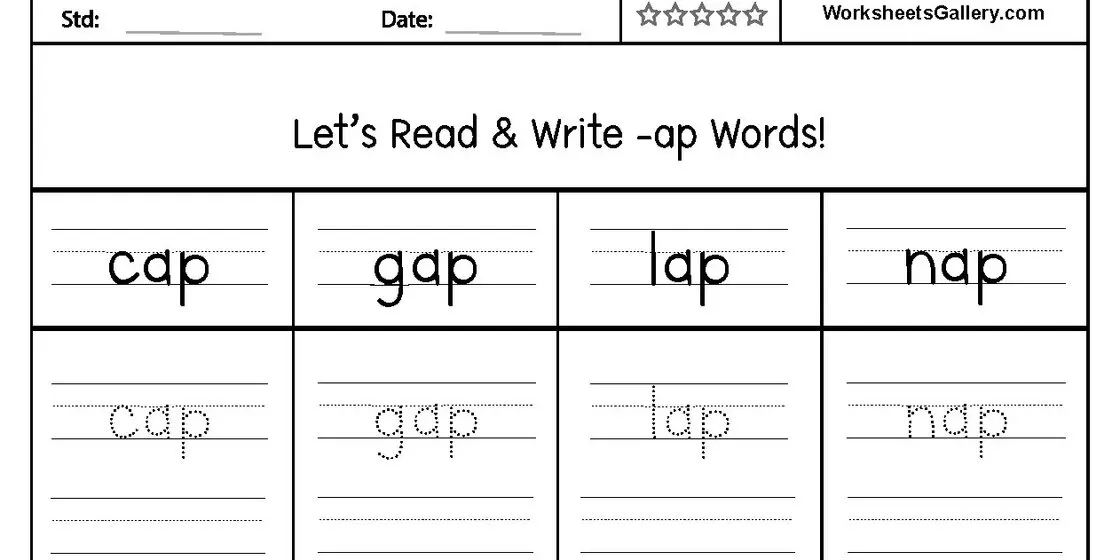
Turn practice time into a positive experience. Start by introducing the worksheet as a fun game. You can read the target words aloud together, emphasizing the sounds. For instance, when looking at 'cap', stretch out the sounds: "c-a-p." Then, encourage your child to trace the letters in the dotted lines. Celebrate each correctly traced word with praise or a small reward. If your child struggles, model the tracing a few times, or have them trace your finger as you guide them. Consider making flashcards with these words to play simple matching games or 'I Spy' with the words around the house.
Scenario: Imagine it's a rainy afternoon. Instead of screen time, you pull out this worksheet. You and your child sit together at the kitchen table. You say, "Let's learn some new words! This one is 'cap'. Can you say 'cap' with me?" You point to the dotted letters and say, "Now, let's trace it together." As they carefully trace, you offer gentle guidance and encouragement. Completing a row earns a high-five. This creates a positive association with learning and builds their confidence with CVC -ap words.
In the Classroom: Integrating into Lesson Plans
This worksheet is a versatile tool for educators. It can be used as a direct instruction activity during small group phonics lessons, focusing on one word family at a time. For instance, dedicate a session to just the '-ap' words. You can also incorporate it into a literacy center. Provide crayons or colored pencils for tracing, adding a visual engagement element. For differentiation, emergent readers can focus on tracing, while more advanced students can be challenged to write the words independently after tracing, or even use them in a sentence. A fun classroom activity could be a 'word hunt' where students find objects in the classroom that rhyme with or start with the sounds practiced.
Scenario: During a literacy center rotation, a small group of first graders uses this worksheet. The teacher has introduced the '-ap' word family earlier that day. The students take turns tracing the words. One student, Sarah, is having trouble with the 'p' in 'tap'. Her teacher, Ms. Evans, kneels beside her and says, "Let's look at the shape of the 'p'. See how it has a circle and a line? Try making that circle first, then the line." Ms. Evans guides Sarah's hand gently, and soon Sarah is forming the 'p' correctly. The group celebrates completing all the words, feeling proud of their accomplishment.
Developing Essential Skills with -ap Words
Fine Motor and Handwriting
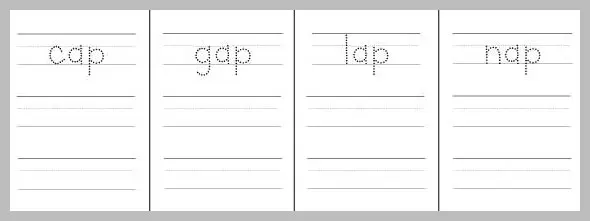
The core activity of tracing dotted lines is a direct exercise for developing fine motor control. Children learn to grip their writing utensil correctly and guide it along specific paths. This practice is foundational for forming letters legibly and eventually writing words and sentences independently. The repetition of forming the same letters within different -ap words helps to solidify muscle memory for these shapes.
Phonics and Decoding
This worksheet directly targets phonics skills. Children learn to associate the grapheme '-ap' with its corresponding phoneme (/ap/). By seeing and tracing words like 'cap' and 'map', they begin to understand how these sounds blend together to form a meaningful word. This systematic approach to phonics is crucial for developing strong decoding abilities, allowing children to sound out unfamiliar words.
Language and Vocabulary Expansion
Each word on the worksheet represents a new vocabulary item. When children correctly identify and write these words, they are expanding their understanding of the English language. Discussing the meaning of each word (e.g., what a 'cap' is, what it means to 'tap' something) further enriches their vocabulary and comprehension. This foundational vocabulary is essential for communication and academic success.
Cognitive Skills: Pattern Recognition
The consistent '-ap' ending across all the words on the worksheet helps children recognize patterns in language. This ability to spot patterns is a key cognitive skill that transfers to many areas of learning, including mathematics and problem-solving. Recognizing that 'cap,' 'gap,' and 'map' share a common structure helps them generalize their learning to other word families.
Common Pitfalls and Encouragement Strategies

Navigating Challenges
- Letter Reversals: Some children may reverse letters like 'p' or 'b'. Gently guide them by showing the correct formation and emphasizing the direction of the strokes. Avoid excessive correction, focusing instead on positive reinforcement for correct attempts.
- Sound Confusion: Occasionally, children might confuse similar sounds. For example, confusing the short 'a' sound with another vowel sound. Use clear enunciation and have them repeat the sounds.
- Motor Control Issues: Difficulty staying within the lines or forming letters can be due to underdeveloped fine motor skills. Offer larger writing spaces or alternative tracing methods, like using a finger in sand or shaving cream.
- Frustration: If a child becomes frustrated, it's a sign to take a break. Revisit the activity later or switch to a more playful, less demanding exercise.
Fostering Consistent Practice
- Short, Frequent Sessions: Aim for brief, focused practice sessions (5-10 minutes) rather than long, overwhelming ones.
- Positive Reinforcement: Offer specific praise for effort and progress, such as, "I love how carefully you traced the 'm' in 'map'!"
- Make it a Game: Turn practice into a game. Who can trace the word fastest (while still being accurate)? Can you find all the words that end with '-ap'?
- Connect to Reading: Point out these words when you encounter them in books. "Look, there's the word 'tap' in our story!"
- Variety is Key: Supplement tracing with other activities like magnetic letters, word building with blocks, or simple rhyming games. Explore our free worksheet library for more engaging resources.
Extending the Learning: Fun Activities Beyond Tracing
Creative Word Play
- Storytelling: Create a short story incorporating all the -ap words. For example: "The little dog wore a cap. He heard a loud tap, tap, tap on the door. He ran to map the sound, but it was just the mailman. He saw a gap in the fence and a napping cat. He decided to rap on the door again, hoping for a treat."
- Rhyming Fun: Brainstorm other words that rhyme with '-ap' (e.g., clap, strap, flap). Use magnetic letters or blocks to build these words.
- Sentence Building: Once tracing is mastered, challenge children to write simple sentences using the words. "I wear a cap." "Tap the drum."
Interactive Games
- Word Sort: Write the -ap words and other CVC words on separate cards. Have the child sort them into piles based on the ending sound.
- Matching Game: Create pairs of cards with the same -ap word. Lay them face down and have the child play a memory matching game.
- Act It Out: Assign an action to each word (e.g., pretend to put on a cap, tap your foot, nap). Call out a word and have the child perform the action.
Why Children Adore Practicing CVC -ap Words
Children often find working with CVC -ap words surprisingly enjoyable for several reasons. Firstly, the predictable pattern provides a sense of mastery and accomplishment. They can easily see the connection between the letters and the sound, which is very rewarding. Secondly, the words themselves are often concrete and relatable – caps, maps, tapping – making them easier to visualize and understand. The act of tracing, especially with colorful pencils or markers, can be a calming and satisfying sensory experience. When presented in a playful context, like a game or a story, these simple words become engaging tools for exploration and learning, rather than just rote memorization.
Download and Print Your Worksheet
Get Your Free Printable Today!
Ready to help your child build essential reading skills? Downloading this CVC -ap words preschool worksheet is simple and completely free. Our printables are designed to be high-quality, with no distracting ads or watermarks, ensuring a clean and focused learning experience for your child. Simply click the download button below to get your printable PDF. You can then print it at home or at your local print shop. Start your child's journey to reading success today!
This resource is designed for educational purposes, supporting early literacy development.
Popular Worksheets
Printable resources families and teachers are downloading now.
 Free
Free
 Free
Free
 Free
Free
 Free
Free