
Master the Dolch Noun Sight Word Leg: 7 Winning Steps for Early Readers

Conquer the Dolch Noun Sight Word 'Leg' with Engaging Practice
Dolch Noun Sight Word Leg gives learners focused practice. Building a strong foundation in early literacy is crucial for a child's academic journey. Among the essential building blocks are sight words, those frequently encountered words that children learn to recognize instantly. The Dolch sight word list is a widely recognized resource for this purpose, and mastering individual words can bring a significant sense of accomplishment. This printable worksheet specifically targets the Dolch Noun Sight Word 'leg', offering a comprehensive and enjoyable approach to learning. Through a variety of interactive exercises, young learners will not only recognize the word 'leg' but also begin to spell it, read it in context, and even use it in their own sentences. This multi-faceted approach ensures a deeper understanding and lasting retention of this important word.
Why Focus on 'Leg'?
- Foundational Literacy: 'Leg' is a common noun and a high-frequency word, making it a vital part of a child's early vocabulary.
- Body Awareness: Learning 'leg' connects language with physical understanding, reinforcing concepts about the human body.
- Reading Fluency: Instant recognition of words like 'leg' significantly improves reading speed and comprehension.
- Writing Skills: Practicing spelling and sentence formation with 'leg' develops essential writing abilities.
- Contextual Understanding: Seeing 'leg' in sentences helps children grasp its meaning in various situations.
Skills Developed Through This Worksheet
- Word Recognition: Identifying the word 'leg' visually.
- Phonics and Decoding: Understanding the letter-sound relationships within the word.
- Spelling: Practicing the correct sequence of letters for 'leg'.
- Fine Motor Skills: Tracing, writing, and coloring activities refine hand-eye coordination.
- Reading Comprehension: Understanding sentences that contain the word 'leg'.
- Language Development: Using the word 'leg' in spoken and written sentences.
Exploring the Worksheet: A Step-by-Step Guide
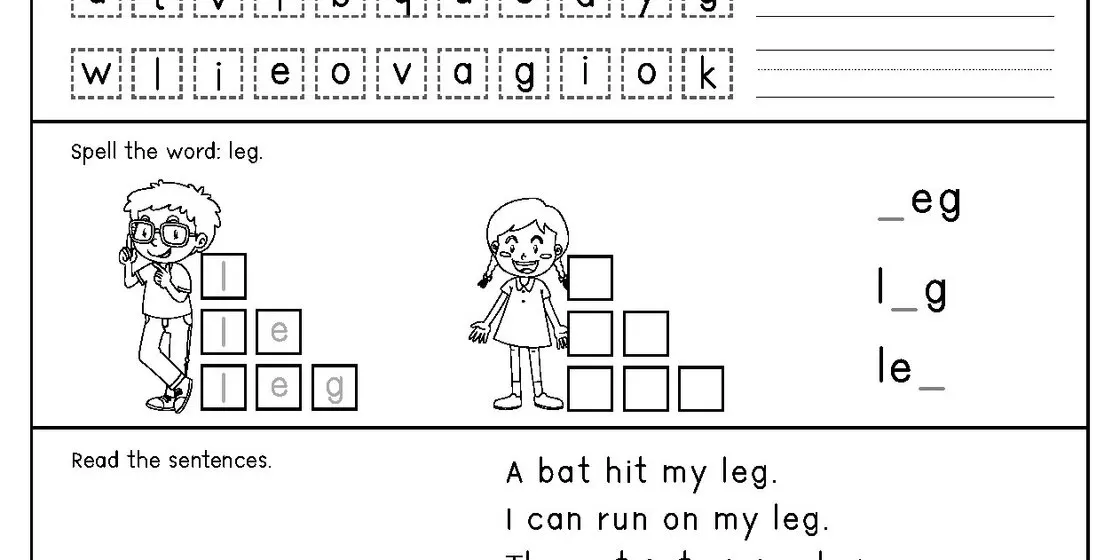
Dolch Noun Sight Word Leg gives learners focused practice. This worksheet is thoughtfully designed to engage young learners through a series of progressive activities. Each section builds upon the last, reinforcing the learning of the Dolch Noun Sight Word 'leg' in a fun and accessible way.
1. Revealing the Word
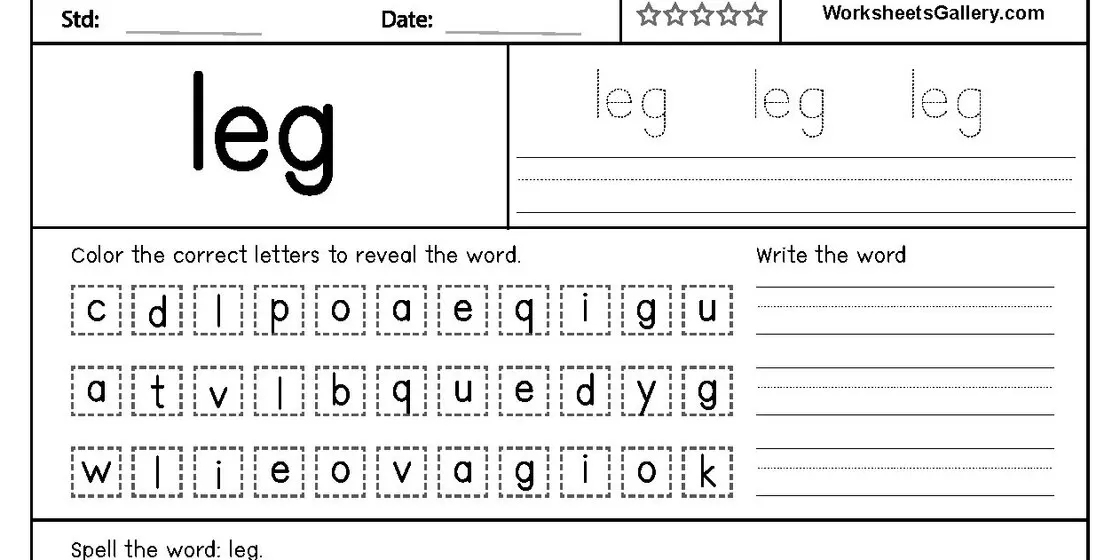
Dolch Noun Sight Word Leg gives learners focused practice. The first exercise challenges children to 'Color the correct letters to reveal the word.' This section presents a grid filled with letters, and the child must select only those that form the word 'leg'. This activity not only reinforces letter recognition but also introduces the concept of word construction in a puzzle-like format. It requires careful observation and the ability to identify specific letters within a jumble, making it an excellent warm-up for the brain.
2. Writing Practice
Dolch Noun Sight Word Leg gives learners focused practice. Following the letter discovery, the worksheet provides ample space for 'Write the word'. This section is crucial for developing muscle memory and reinforcing the correct letter formation of 'leg'. The lines are typically spaced appropriately for young writers, encouraging neat and legible handwriting. Consistent practice here solidifies the visual memory of the word.
3. Spelling Reinforcement
Dolch Noun Sight Word Leg gives learners focused practice. The 'Spell the word: leg' section offers a more interactive approach to spelling. It often presents the word in a fill-in-the-blank format, perhaps with visual cues or letter boxes. This encourages children to actively recall and place the letters in the correct order, moving beyond simple tracing to actual recall and application of spelling knowledge.
4. Reading in Context
'Read the sentences' is a vital step that moves from word identification to comprehension. Children are presented with simple sentences that include the word 'leg'. This helps them see how the word functions in a sentence, understand its meaning through context, and practice their reading fluency. The sentences are typically short and use familiar vocabulary, making them accessible.
5. Sentence Creation
The 'Write a sentence with the word' activity is where children apply their learning creatively. This encourages them to think about the meaning of 'leg' and construct their own meaningful sentences. It’s a powerful way to foster language development and demonstrate understanding beyond simple recognition.
6. Review and Reflection
The 'Review' section with stars allows for self-assessment or teacher feedback, providing a quick way to gauge mastery and celebrate effort. This positive reinforcement is key to encouraging continued learning.
Practical Application: Home and Classroom Scenarios
Integrating this worksheet into a child's learning routine can be done in numerous engaging ways, whether at home or in a classroom setting.
Home Learning Fun
Imagine a rainy afternoon. Instead of screen time, you pull out this worksheet. You and your child sit together at the kitchen table. You start with the letter-finding puzzle, cheering as they correctly identify 'l', 'e', and 'g'. Then, you guide them through tracing 'leg' a few times, praising their neat handwriting. Reading the simple sentences together, like 'A bat hit my leg,' becomes a mini-story time. Finally, you prompt them: 'Can you think of a sentence about your leg?' They might proudly say, 'My leg helps me run fast!' This shared activity not only teaches the word 'leg' but also strengthens your bond.
Tip: Use the word 'leg' throughout the day. 'Can you hop on one leg?' or 'Your leg is strong!'
Classroom Engagement
In a bustling classroom, this worksheet can be a valuable tool for small group instruction or independent work. A teacher might introduce the word 'leg' using a visual aid, then have students complete the letter-finding activity. During writing time, students can practice forming the letters. The teacher can circulate, offering support and positive feedback. For reading centers, the sentence section provides practice in a controlled, supportive environment. The 'write a sentence' part can be adapted for a word wall activity, where students contribute their sentences about 'leg' for the whole class to read.
Tip: Create a 'Word of the Week' display, featuring 'leg' prominently with student-created sentences.
Developing Essential Skills

This worksheet is more than just practicing a single word; it's a catalyst for developing a range of crucial skills:
Cognitive Development
Activities like letter identification, word decoding, and sentence comprehension stimulate critical thinking and problem-solving abilities. Children learn to analyze information, make connections, and apply rules (like letter order).
Fine Motor Skills
The act of tracing letters, writing the word 'leg', and potentially coloring within the lines (if applicable in other sections) directly enhances fine motor control. This is essential for developing legible handwriting and dexterity needed for many tasks.
Language and Literacy
From recognizing letters and sounds to spelling, reading sentences, and constructing original sentences, this worksheet covers multiple facets of language acquisition and literacy development. It builds vocabulary and strengthens communication skills.
Extending the Learning: Fun Activities
Keep the momentum going with these creative extensions:
Movement and Rhyme
Play a game of 'Simon Says' using body parts, including 'leg'. For example, 'Simon says touch your leg.' You can also incorporate rhyming words. While 'leg' doesn't have many common single-syllable rhymes, you can explore near rhymes or words that share vowel sounds. Discuss how words sound different even if they have similar letters.
Storytelling Creation
Encourage your child to create a short story that prominently features the word 'leg'. It could be about a character who uses their legs to run a race, jump over obstacles, or even a funny story about a wobbly leg. This taps into their imagination and reinforces sentence construction.
Body Part Puzzles
Draw or print simple outlines of body parts, including a leg. Have your child label them. You can also create simple puzzles by cutting out the word 'leg' and having them reassemble it or match it to the corresponding body part.
Word Hunt
Go on a 'word hunt' around the house or classroom. Look for the word 'leg' in books, on signs (if applicable), or even written by the child themselves. This reinforces that words are all around us.

Why Children Enjoy This Activity
Children often gravitate towards activities that feel like games rather than chores. The puzzle-like nature of the letter-finding exercise, the satisfaction of correctly writing a word, and the creativity involved in sentence building all contribute to a positive learning experience. The visual aspect of the worksheet, combined with the tactile experience of writing and coloring, caters to different learning styles. Successfully completing each step provides a sense of accomplishment, motivating them to continue learning.
Navigating Common Challenges
While this worksheet is designed for ease of use, some common hurdles might arise:
Letter Reversal
Some young children may reverse letters like 'l' or 'g'. Gently guide them by using directional cues (e.g., 'start at the top for l') and positive reinforcement for correct formation. Consistent practice with tracing can help correct this.
Spelling Difficulties
If spelling 'leg' is challenging, break it down. Focus on one letter at a time. Use magnetic letters or blocks to spell 'leg' physically before writing it. Repeated exposure and multi-sensory approaches are key.
Sentence Construction
For children struggling to write their own sentences, provide sentence starters like 'I use my leg to...' or 'My leg is...'. You can also co-create sentences, taking turns adding words.
Lack of Engagement
If a child seems disengaged, make it more playful. Use silly voices, turn it into a race against a timer (a relaxed one!), or relate the word 'leg' to a favorite activity like dancing or playing sports.
Encouraging Consistent Practice
Consistency is more effective than intensity. Encourage regular, short practice sessions rather than long, infrequent ones. Celebrate small victories, like correctly identifying a letter or writing the word neatly once. Positive reinforcement, such as praise, stickers, or a special activity after completing a section, can foster a positive attitude towards learning. Remember that every child learns at their own pace, and patience is paramount.
Age Appropriateness and Recommendations
This worksheet is ideally suited for children aged 4-6 years old. At this stage, children are typically developing their pre-reading and early writing skills. They are capable of recognizing letters, beginning to sound out words, and forming basic sentences. Younger children (3-4) might benefit from adult assistance, focusing primarily on the letter identification and tracing aspects. Older children (5-6) can be encouraged to complete all sections independently and may even be ready for more complex sentence construction.
Download Instructions
Getting this valuable learning resource is straightforward. Simply click the download button provided on the page. This worksheet is offered in a printable PDF format, ensuring you can easily print it at home or at school. You'll be pleased to know that it comes with no watermarks and no advertisements, allowing for a clean and focused learning experience for your child. It's ready to be used immediately to help your child master the Dolch Noun Sight Word 'leg'.
Explore more foundational literacy resources in our Free worksheet library.
Helpful worksheet links
Popular Worksheets
Printable resources families and teachers are downloading now.
 Free
Free
 Free
Free
 Free
Free
 Free
Free