Colour Choices: 5 Brilliant Ways to Teach Rules and Art
A castle key, a missing quilt corner and a puppy portrait each ask children to use colour differently.
A child paints a puppy's collar red, then colours a castle square red because the printed key says so. The two marks look alike, but the child made a different kind of decision each time. Naming that difference can make colour choices easier to teach and more enjoyable to discuss. This guide uses three existing printables: a numbered castle, a quilt corner puzzle and a puppy picture. Try them across separate short sessions. Each one gives colour a particular job, from carrying a rule to carrying a child's own idea.
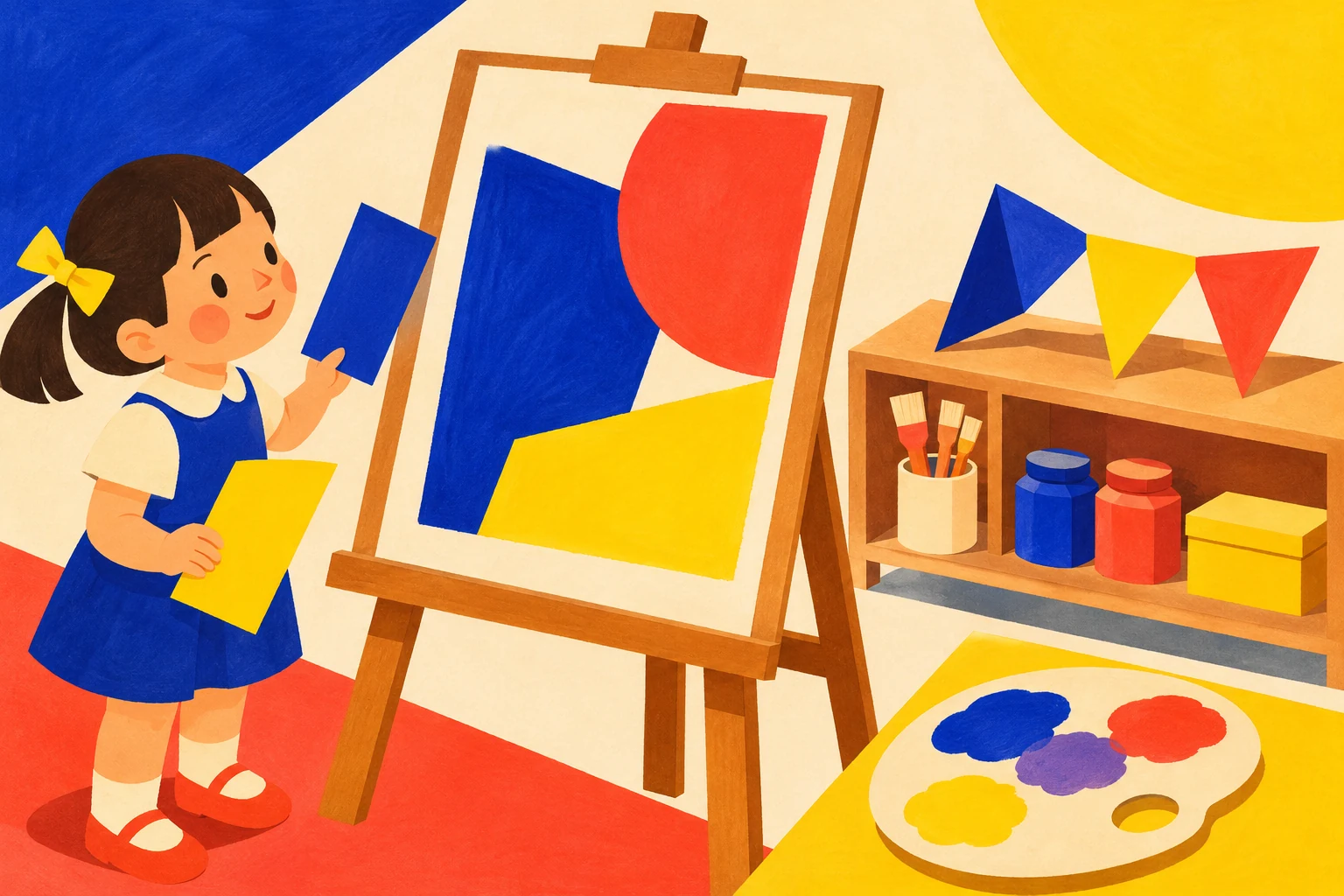
The swatches and easel offer a vocabulary prompt for talking about the difference between matching and choosing.
First decide what counts as an answer
Before you offer crayons, read the instruction and identify what has to stay fixed. A castle code assigns a colour to a number. A quilt repair looks for a continuation of colour at an edge. A puppy portrait can give the artist broad choice. All three are worth doing at different times. Problems arise when an adult changes the terms halfway through. “Choose what you like” and “That colour belongs in a different box” are hard to reconcile when no new purpose has been explained.
Choose a phrase for each kind of activity. With a code, try “The key tells us what to use.” With a seam, ask where two parts meet. With a freely designed picture, invite the artist to pick a palette or decline a suggestion. Point to the evidence when the first two purposes matter. Listen when the answer is a personal choice. An adult who models these differences gives children language for asking what a page really expects.
A studio table for three kinds of colour choices
| Kind of decision | Useful question | What to look for |
|---|---|---|
| Code | Which entry goes with this printed mark? | The learner finds and uses the stated correspondence. |
| Match | Do these two edges continue together? | The learner compares the relevant places on both sides of the gap. |
| Art choice | Where would you like that colour? | The learner makes a decision or asks for material support. |
| A planned contrast | Can a viewer distinguish these adjacent areas? | The child checks two samples before picking one. |
Give a child enough time to notice whether a colour is serving one job or two. A contrasting ball panel could be an artistic choice that also makes a seam easier to see. An adult can describe the effect without trying to make a universal rule about colours that “should” go together.
Five ways to teach the difference
1. Let the key settle a small question
Open Castle Color Codes: 4 Amazing Number-Color Rules and find the four-entry key. The worksheet maps 1 to blue, 2 to yellow, 3 to red and 4 to green. Before reaching for a whole tray of crayons, pick one digit in the castle grid. Show how to find its key entry and then return to the same square. Try that movement in slow motion once, with a finger keeping the position. The child can colour that square, direct an adult or place a matching scrap of paper beside it.
A grid of sixty-four squares can be more work than a child needs. Start with a small region and let the rest wait. If you want to find out whether the child knows the correspondence, ask which key entry applies and record their answer separately from how accurately they fill the space. Fine motor demands can mask a clear understanding of how the key works.
2. Inspect the place where a pattern breaks
With Quilt Corner Clues: 5 Brilliant Colour-Seam Decisions, choose one corner puzzle and look at the missing area. Two boundaries matter. A piece can look convincing along one edge and disagree along the other. Keep the printed options upright as requested and compare a short run of each seam. An adult can mark the two inspection spots with fingertips instead of immediately announcing a letter.
Show the difference with two large squares of homemade coloured paper. A child can slide one alongside another, inspect the joint and swap it for a better match. Use broad, clearly distinguishable colour areas. If a child struggles to distinguish the printed colours, describe them and offer high-contrast practice with stripes or dots first. That substitute rehearses the idea of continuity without treating colour perception as an effort problem.
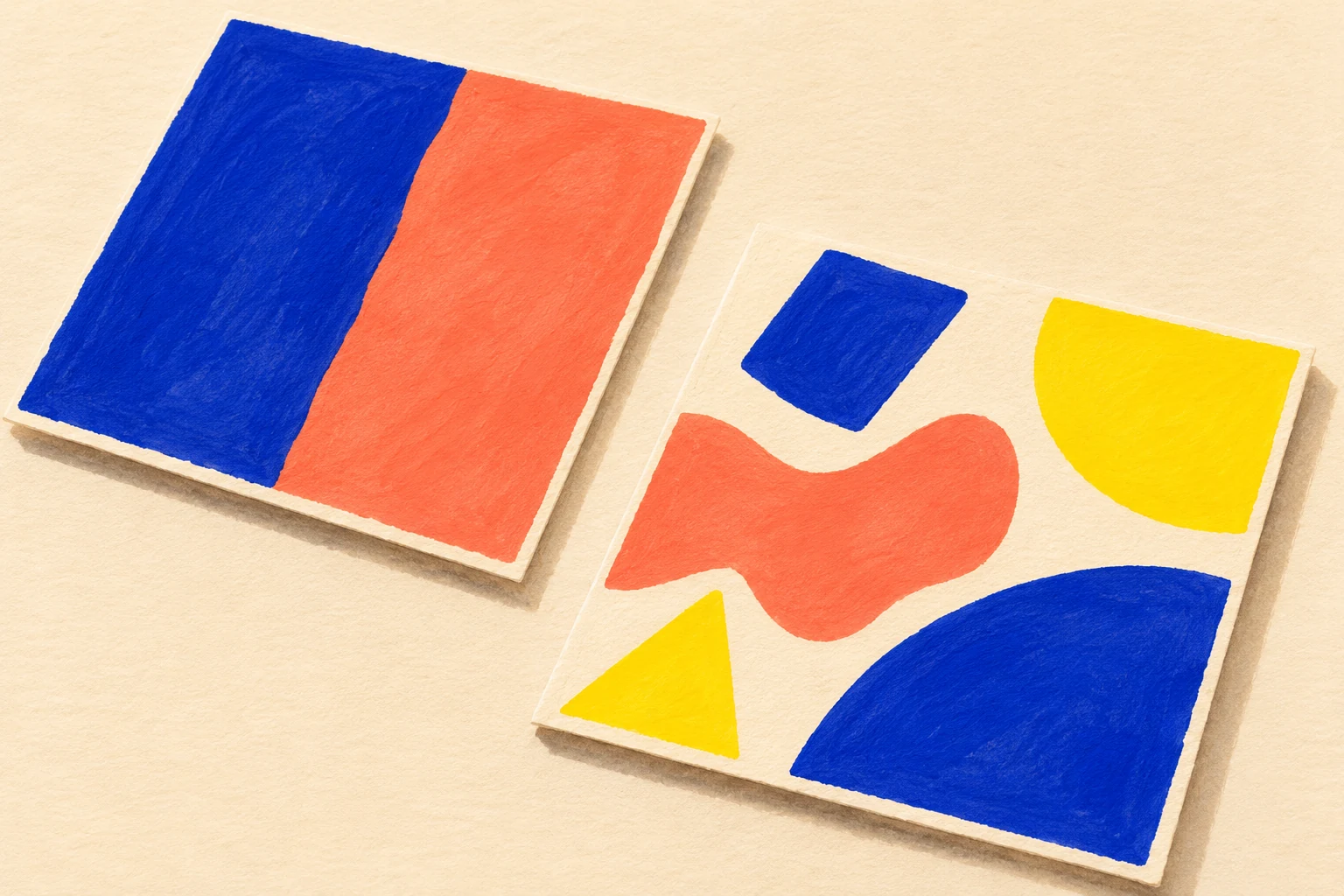
A two-colour seam offers a visible relationship. The separate composition leaves placement open to the artist.
3. Hand the palette over to the artist
The puppy, collar and divided ball on Puppy Palette Play: 6 Wonderful Ball-and-Collar Ideas give children three visible areas where a colour can tell part of a story. Say “You are choosing the colours” before taking out the tools. Someone may want blue fur because the puppy lives in an imaginary ice cave. Another may choose one crayon for the whole picture. Give them the option to keep the reason to themselves.
NAEYC's account of bringing process art into preschool describes giving children time, materials and space to investigate what they can make. A printed outline still sets boundaries in advance. Leave plain paper nearby for a related experiment if the artist wants to invent a different animal, ball or setting. Open-ended art can begin without a picture to fill.
4. Try colour on a scrap before committing
Offer a swatch strip when the question is about visibility. If a dark blue collar disappears against dark blue fur, placing two samples together gives the artist information. Compare one light sample and one dark sample and ask what they notice. Some children may prefer a subtle change. Others want the collar to stand out. Both can decide after looking.
Use the same materials on the test strip that will go on the final page. A marker on glossy package card may look different from a pencil on printer paper. Shape, spacing and line weight can also create a difference the eye can detect. A thicker border around a ball panel is one option when a colour contrast alone is hard to distinguish. If printing in greyscale, choose the open art or lettered numeral task and offer the colour key separately when needed. Keep a colour-dependent seam puzzle for a version the learner can inspect comfortably.

These standalone swatches help compare lightness on a sample area before trying a design change.
5. Invite the learner to make a new rule
On a blank square, let the child give two homemade symbols colour meanings. One symbol could be a broad dot, the other a short bar. Model placing the tiny key beside the picture before asking another person to use it. The child can show where the two symbols occur and help the visitor find their meanings. Colour names, photographed swatches or simple patterns can support access.
Changing a key during the game is allowed when everyone is told and the new version is visible. That step illustrates why a code needs a shared agreement. A visitor applying the earlier version may produce a different picture even though they read carefully. Ask whose information was available at the moment of the decision.
What these small activities make visible
- Reference finding. Children practise returning to a key at the moment it is needed.
- Attention to a joint. Watching colour continue across a seam makes the place of comparison concrete.
- Useful art vocabulary. Words such as edge, light, dark and beside can describe visible features.
- Deliberate trials. A scrap lets the artist test a tool, shade or contrast before choosing.
- Ownership. An open palette gives a child room to communicate a preference through a practical decision.
Two ways a lesson might unfold
At home, the collar blends into the fur
Imagine a child painting a big brown dog and adding a brown collar. Their parent notices the child searching for the collar line. Together they try two brown test strokes next to each other. The child wants to keep both browns, so they add a broad cream border and draw a tag beside it. Their preferred colours survive and the collar is easier to locate. In this hypothetical scene, the adult teaches a tool for solving the problem rather than choosing the collar for them.
A child could also decide the colour is exactly right and move on. A question about contrast is useful when the artist wants someone to notice a particular part. It does not have to interrupt a child happily working out the story of a picture.
In class, two children consult the same key
In a hypothetical kindergarten group, Maya looks at a red castle patch on a neighbour's sheet and reaches for red. Her own selected square contains a 2. The teacher points to her square and asks where she can check. Maya follows the row of the key with a finger and chooses yellow. The teacher briefly describes the checking action. Later the group changes to blank shape paper. The teacher names the new agreement before putting out any crayons: “Here you decide.”
The line between activities matters more than the number of finished squares. Children can experience reliable answers and creative decisions on the same afternoon when the adult makes the purpose clear.
A short preparation sequence for grown-ups
- Preview the selected section. Check whether it asks for a visible match, a fixed key or a personal choice. Pick one region a child can see comfortably.
- Lay out only the relevant tools. For a code, place its colours where the learner can find them. For open art, offer a few accessible choices and a spare sheet.
- Name the job before beginning. Model one decision of that kind and leave time for a turn.
- Decide what to notice. A route through a key and a story about a chosen colour provide different information. Save a short observation if it will guide the next session.
Current panels for the three linked resources show one-page watermarked PDF samples and clean membership copies. The puppy page lists ages three to six. The two rule-based pages list ages four to six. Allow interest and access to guide how much of any page to offer.
Take these ideas beyond a printed outline
The window that needs to stand out
Place a small paper rectangle inside a broad coloured frame. Try three backgrounds from scrap. Ask which makes the window easiest to spot from across the room and why. Ask the artist if they want that much contrast in their design.
Borrow one colour, change the shape
A child picks one colour they notice on a familiar fabric or book cover and invents a new shape for it on plain paper. Encourage conversation about what was borrowed and what was invented. A familiar object can be a starting point without becoming an assignment to copy it.
Invite someone to mend the seam
Lay two generous strips side by side, remove a wide square at one end, then offer two replacements. A painter can point to the place where one strip's colour continues. Draw a stripe variant for children who prefer to match a pattern they can distinguish more easily.
A palette for a place you remember
Ask a child to choose one or two marks for a remembered playground, kitchen or bus stop. The colours can describe a feeling or a feature they saw. An adult can write down the child's words if invited. Avoid assuming a colour has a fixed emotional meaning.
Leave room for revision and enjoyment
A child may return to the same purple all week because they like how it looks. You can bring a new comparison without requiring a new favourite. “Would you like to set these two samples next to each other?” is a manageable offer. Put the materials where the child can examine them and let them choose whether to continue.
Say what belongs to the rule and what belongs to the artist. A key helps someone reproduce a result, a seam makes a relationship visible and an open palette lets a child add something of their own. Give each activity its own ending and a moment to look back at the choice that mattered.