
Quilt Corner Clues: 5 Brilliant Colour-Seam Decisions
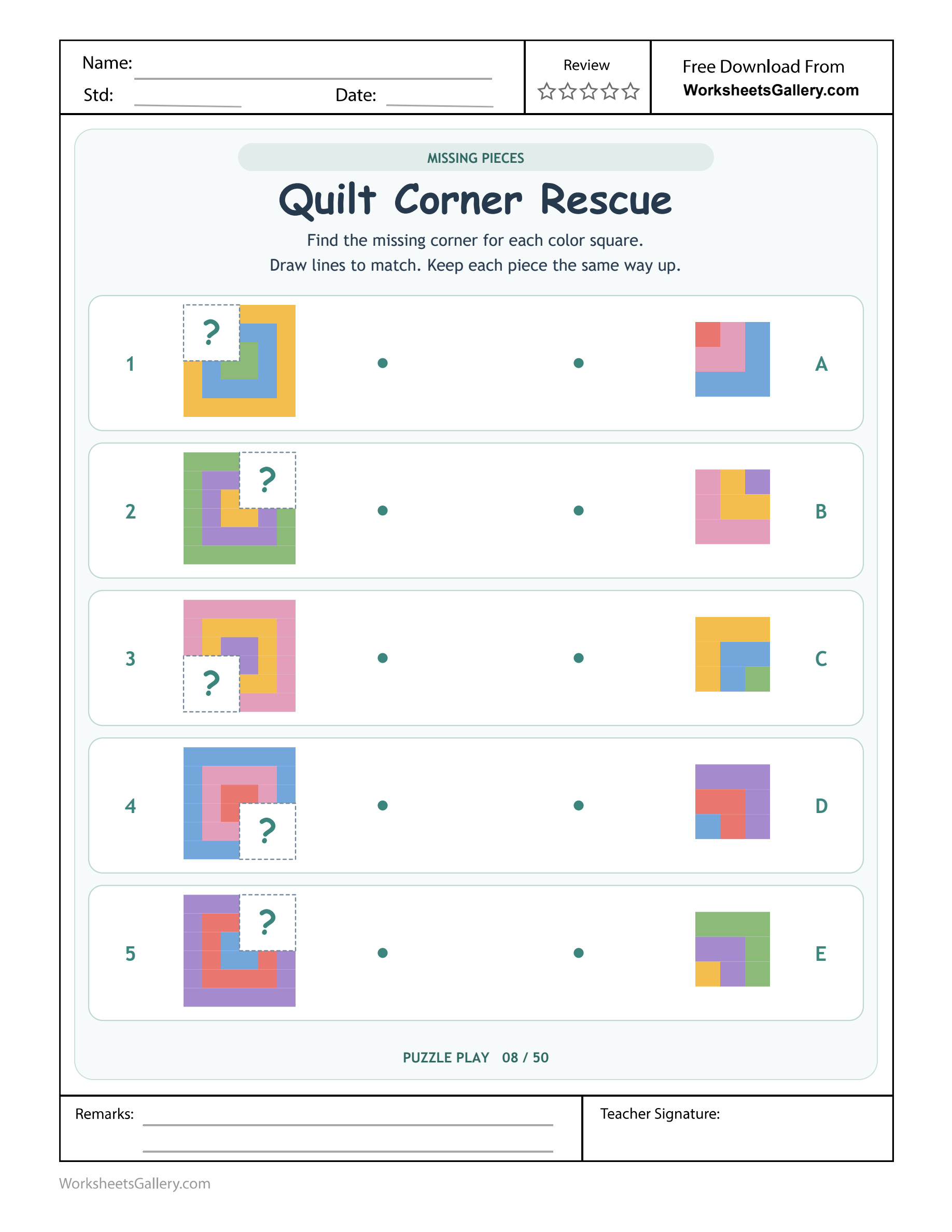
Build a colourful puzzle session around the quilt sheet. For a single $5 purchase, the 25 provided worksheets come together without promotional branding. The combined printable keeps these seam clues close to other matching and reasoning pages.
A quilt corner must continue the colours meeting at its seams. Quilt Corner Clues gives children five incomplete squares and five upright candidate pieces, making that boundary comparison a compact visual puzzle. Follow one exposed edge, describe its colour and then inspect the other join before accepting a replacement. The quilt setting offers useful language for discussing continuity without requiring sewing or cutting. Partners can report different seams, combine their observations and explain why a nearly convincing piece still fails one boundary.
Quilt Corner Clues: the rule on this particular sheet
The quilt-like squares contain small missing corners and five possible pieces. The puzzle asks which candidate continues the colour patches at both joins while remaining the same way up.
A quilt theme invites seam language: beside, above, continues and meets. Those words describe visible colour relationships without requiring actual sewing, cutting fabric or completing a repeated stitch pattern.

What same-way-up rule reveals
Start at one exposed boundary and follow its colour towards the gap. Inspect the second exposed boundary before comparing lettered pieces. A corner that continues one seam but breaks the other cannot complete the square.
The five numbered squares have their own arrangements. Do not borrow an answer from a previous rainbow version or assume that the first visible candidate goes with the first numbered row.
Follow a patch across the join
Invite the child to follow one colour towards the missing area with a fingertip. Where would that patch continue if the candidate corner were seated without turning? Repeat the inspection along the second seam. This boundary-first approach reduces the need to hold the whole busy square in mind and gives the child two concrete places to compare before accepting a piece.
Imagine Asha at a home puzzle table
Asha and her grandmother examine where two coloured paper strips meet on a completed pretend quilt. They follow each strip over the join with a fingertip, then use that idea to describe a printed corner before selecting a piece. Here, Quilt Corner Clues gives Asha a reason to discuss boundary comparison using the Quilt Corner Rescue clues.
A practical Quilt Corner Clues sequence
Horizontal join with Asha
Begin Quilt Corner Clues: horizontal join. Follow the colour along the exposed horizontal seam. Ask Asha, “Where do the two patches meet?” The grandmother and Asha can inspect horizontal join together.
Vertical join with Asha
Next inspect Quilt Corner Clues: vertical join. Inspect the patch beside the upright edge of the gap. Ask Asha, “Does the other join work as well?” The grandmother and Asha can inspect vertical join together.
Same-way-up rule with Asha
Then confirm Quilt Corner Clues: same-way-up rule. Compare candidate pieces without turning them. Ask Asha, “Which seam are you following?” The grandmother and Asha can inspect same-way-up rule together.
Both joins agree with Asha
Finally record Quilt Corner Clues: both joins agree. Accept a corner only after the two seams continue coherently. Ask Asha, “Is that colour in the right corner?” The grandmother and Asha can inspect both joins agree together.
Quilt Corner Clues adult reference
| Printed clue | Source check |
|---|---|
| Horizontal join | Follow the colour along the exposed horizontal seam. |
| Vertical join | Inspect the patch beside the upright edge of the gap. |
| Same-way-up rule | Compare candidate pieces without turning them. |
| Both joins agree | Accept a corner only after the two seams continue coherently. |

The quilt story does not require sewing
A child can imagine being a quilt checker without handling a needle or cutting the worksheet. The printed response is a connecting line to an upright candidate. Use fabric-like language such as joins and patches to support the explanation, then return to the visible colour evidence. The theme gives the comparison a purpose, while the actual page remains a visual matching puzzle. A child can describe a seam with a fingertip instead of naming every colour. Keep the two neighbouring patches visible and ask where each would meet the replacement corner. This leaves the comparison precise even when the broader quilt design feels visually busy.
5 observations in Quilt Corner Clues
Boundary comparison: Where do the two patches meet
In Quilt Corner Clues, the seam becomes a precise place to inspect. The prompt “Where do the two patches meet?” gives Asha a way to explain boundary comparison to the grandmother.
Combining relationships: Does the other join work as well
In Quilt Corner Clues, two neighbouring colours must agree simultaneously. The prompt “Does the other join work as well?” gives Asha a way to explain combining relationships to the grandmother.
Spatial vocabulary: Which seam are you following
In Quilt Corner Clues, horizontal and vertical can be modelled beside visible edges. The prompt “Which seam are you following?” gives Asha a way to explain spatial vocabulary to the grandmother.
Visual discrimination: Is that colour in the right corner
In Quilt Corner Clues, a similar palette can contain a differently placed patch. The prompt “Is that colour in the right corner?” invites Asha to describe the distinguishing seam for her grandmother.
Explaining evidence: Show me the seam that disagrees.
In Quilt Corner Clues, a child can point to a broken join as a reason. The prompt “Show me the seam that disagrees.” gives Asha a way to explain explaining evidence to the grandmother.
Quilt Corner Clues: same-way-up rule mistakes
A child may focus on the whole candidate palette and ignore where each patch sits. Bring attention to the actual join. Keep all pieces upright; a rotated solution to a different puzzle is not evidence for this worksheet choice. Invite Asha to discuss same-way-up rule with the grandmother.
Describe where a colour sits
A candidate containing purple may still fail if its purple patch occupies the wrong part of the corner. Ask for a position phrase alongside the colour name. The child can point instead of supplying a formal spatial term, and the adult can model the wording. This preserves the distinction between recognising a palette and selecting the arrangement that genuinely completes the two exposed boundaries.
Five play invitations after Quilt Corner Clues
Follow a paper seam
Join broad red and blue paper strips across a completed corner. Trace their continuation with a fingertip and describe what stays consistent at the join. After this Quilt Corner Clues play round, ask the grandmother which clue Asha chose to explain.
Be the quilt quality checker
An adult inserts a wrong paper corner into a separate example. The child inspects both seams and reports the exact boundary that needs repair. Let Asha demonstrate this example before another Quilt Corner Clues visit; ask the grandmother to listen for Asha’s reasoning.

Make a two-clue postcard
Write two finished clues on a card, such as BLUE ABOVE and RED BESIDE. A partner constructs a small corner arrangement that satisfies both labels. On a later Quilt Corner Clues visit, ask Asha what changed; the grandmother can discuss Asha’s evidence.
Hide the candidate palette
Initially show only a candidate edge, then reveal the rest. Discuss why the relevant seam can provide stronger evidence than the overall amount of a colour. Ask Asha how this example relates to Quilt Corner Clues; the grandmother can follow the clue that Asha identifies.
Trade seam descriptions
Two partners describe different missing corners without pointing at answer letters. Each listener chooses a piece and explains how the two boundary descriptions guided the decision. Keep Asha’s own explanation central in this Quilt Corner Clues game. Let the grandmother hear what Asha observed.
Classroom partners inspect vertical join
At a quiet puzzle station, children act as seam reporters. One reports the horizontal boundary and another the vertical boundary. An adult asks how the chosen corner satisfies both reports, making the explanation more precise than saying the colours look nice. For a Quilt Corner Clues partner visit, combining relationships is this quilt corner clues partnership focus.
Return to the seam that was overlooked
If a previous attempt considered only the horizontal join, begin the next visit at the vertical one. Ask what this second boundary adds to the evidence. A familiar numbered square can then support a fresh inspection strategy rather than a rehearsal of its old answer letter. The child has a reason to look again because a different part of the relationship is now being discussed.
Readiness for Quilt Corner Clues at ages 4–6
Use broad contrasting paper strips before asking about smaller printed patches. Keep the conversation about the relevant joins rather than demanding names for every colour in the full square. Suggested range for Quilt Corner Clues: ages 4–6. Begin with boundary comparison and adult support.
For a comfortable Quilt Corner Clues visit, let Asha show horizontal join before the grandmother requests another response. Discuss explaining evidence using the printed Quilt Corner Rescue example.
A fresh Quilt Corner Clues reason to return
On a return visit, start with the boundary the child ignored previously. Changing the inspection order can reveal why a nearly convincing piece still fails at its second seam. Asha can show the grandmother a new both joins agree observation during that short quilt corner clues visit.
Save a printable Quilt Corner Clues copy
For an unbranded Quilt Corner Clues printout, eligible active members can select the premium PDF. It has no website watermark, domain name or embedded ads; every quilt square and upright candidate remains part of the activity. The original sample is retained independently. Review the full five-row layout before printing, allowing room for both ends of each matching line. This quilt puzzle is also one of the twenty-five sheets in the separately priced $5 collection.
Quilt Corner Clues: another printable to explore
Extend the boundary comparison conversation beyond Quilt Corner Clues with Horizontal join before a road-width task; Spatial vocabulary and picture-detail tracing; Visual discrimination beside a car-and-flag maze.
Explore Quilt Corner Clues alongside NAEYC family-writing ideas and Quilt Corner Clues with PBS Parents literacy activities. Keep horizontal join, visual discrimination and deliberate recording connected to the pictured puzzle.
Popular Worksheets
Printable resources families and teachers are downloading now.
 Free
 Free
 Free
 Free