
Animal Letter Sudoku: 4 Clever Codes for Little Logic
Make the animal codes part of a varied logic routine. The $5 combined edition includes all 25 provided pages without promotional marks. Keep this four-code Sudoku with the matching, maze and counting sheets in a single printable PDF.
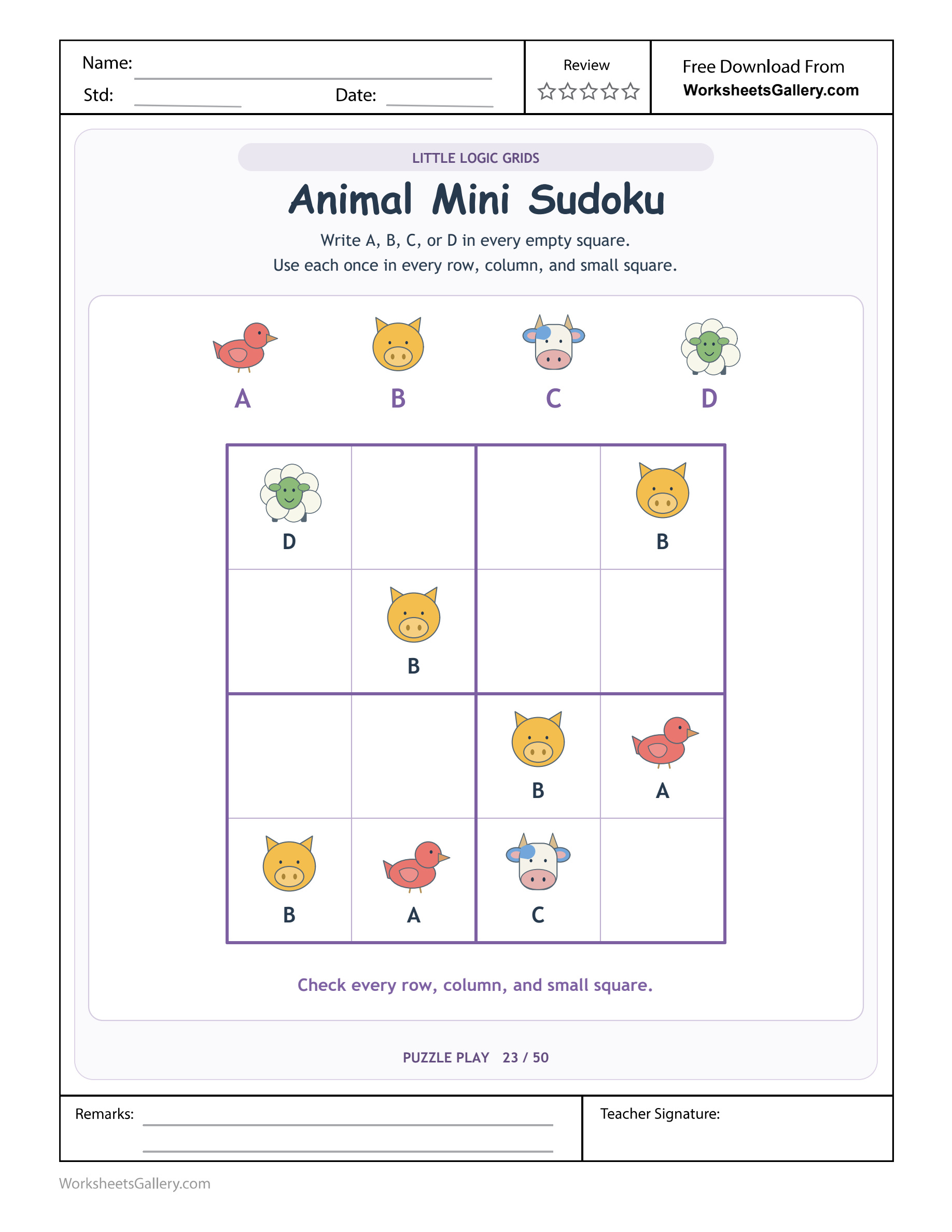
The last row already shows B, A and C, giving a young code detective a useful place to begin. Animal Letter Sudoku uses four letters as animal symbols: bird, pig, cow and sheep. Each code must occur once in every row, column and small two-by-two box. The pictures make the key friendly, while the three crossing constraints give each entry its reason. Start with one nearly complete group, explain which code is missing and check the other groups before writing a capital in an empty cell.
Animal Letter Sudoku: the rule on this particular sheet
A four-by-four Sudoku uses codes A, B, C and D once in every row, column and small two-by-two box. The key pairs A with a bird, B with a pig, C with a cow and D with a sheep.
The supplied grid contains eight givens and eight empty cells. Children write code letters in the empty positions, rather than drawing the animal pictures or treating this as a tracing alphabet page.

What column test reveals
The bottom row begins B, A, C and has one open place. D is its missing code, which can then be checked against the last column and the lower-right small box before it is written.
A candidate that completes a row can still conflict with its column or small box. The rule combines all three constraints; a guess justified only by the animal picture or by one visible row is incomplete.
Animal Letter Sudoku: column test mistakes
Do not repeat a code within a small two-by-two box even when its row looks acceptable. Also distinguish the printed animal key from the playable grid: key pictures name the codes but do not occupy an extra row of the puzzle. Invite Ivo to discuss column test with the teacher.
The key supplies codes rather than extra grid cells
Bird, pig, cow and sheep pictures above the grid identify A, B, C and D. They do not form an additional playable row. Point between a key picture and one given code to establish the relationship before reasoning about empty positions. The required response is a letter, so the child does not need to draw a recognisable animal to show a valid deduction.
A practical Animal Letter Sudoku sequence
Four-code key with Ivo
Begin Animal Letter Sudoku: four-code key. A bird, B pig, C cow and D sheep identify the symbols. Ask Ivo, “Does this letter fit row, column and box?” The teacher and Ivo can inspect four-code key together.
Nearly complete row with Ivo
Next inspect Animal Letter Sudoku: nearly complete row. The bottom B-A-C row needs D in its final position. Ask Ivo, “Which code belongs to the pig?” The teacher and Ivo can inspect nearly complete row together.
Column test with Ivo
Then confirm Animal Letter Sudoku: column test. A proposed letter cannot already occur in its column. Ask Ivo, “Which of A, B, C and D is missing?” The teacher and Ivo can inspect column test together.
Small-box test with Ivo
Finally record Animal Letter Sudoku: small-box test. Check the relevant two-by-two box before writing. Ask Ivo, “What rules out the other letters?” The teacher and Ivo can inspect small-box test together.
Animal Letter Sudoku adult reference
| Printed clue | Source check |
|---|---|
| Four-code key | A bird, B pig, C cow and D sheep identify the symbols. |
| Nearly complete row | The bottom B-A-C row needs D in its final position. |
| Column test | A proposed letter cannot already occur in its column. |
| Small-box test | Check the relevant two-by-two box before writing. |
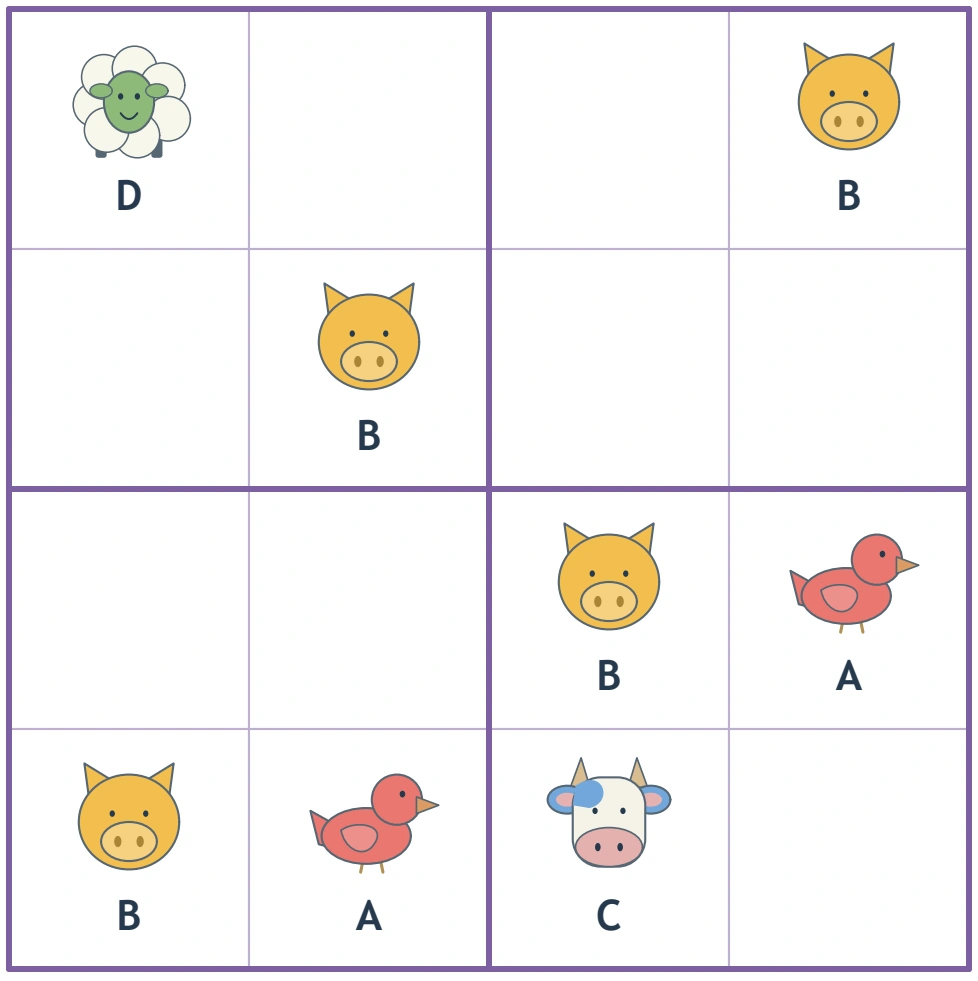
Classroom partners inspect nearly complete row
One partner proposes a code from a nearly complete row, and another checks the column and small box. The partners must agree on all three constraints before recording, so code writing follows a visible reason rather than a race to fill cells. For a Animal Letter Sudoku partner visit, symbol interpretation is this animal letter sudoku partnership focus.
A nearly complete row offers a justified start
The bottom row contains B, A and C, leaving D absent. Check its final cell against the column and small box before entering that code. This is a useful first demonstration because the row evidence is easy to name. Avoid presenting the entry as a guess that happens to work; the missing-code argument gives the child a reason they can explain.
Five play invitations after Animal Letter Sudoku
Meet four animal codes
Display completed cards showing bird A, pig B, cow C and sheep D. Match each picture with its large code letter before attempting any grid reasoning. After this Animal Letter Sudoku play round, ask the teacher which clue Ivo chose to explain.
Finish a three-code row
Lay B, A and C tiles beside a marked final position, then add D. Check that all four codes are present once in this separate physical example. Let Ivo demonstrate this example before another Animal Letter Sudoku visit; ask the teacher to listen for Ivo’s reasoning.
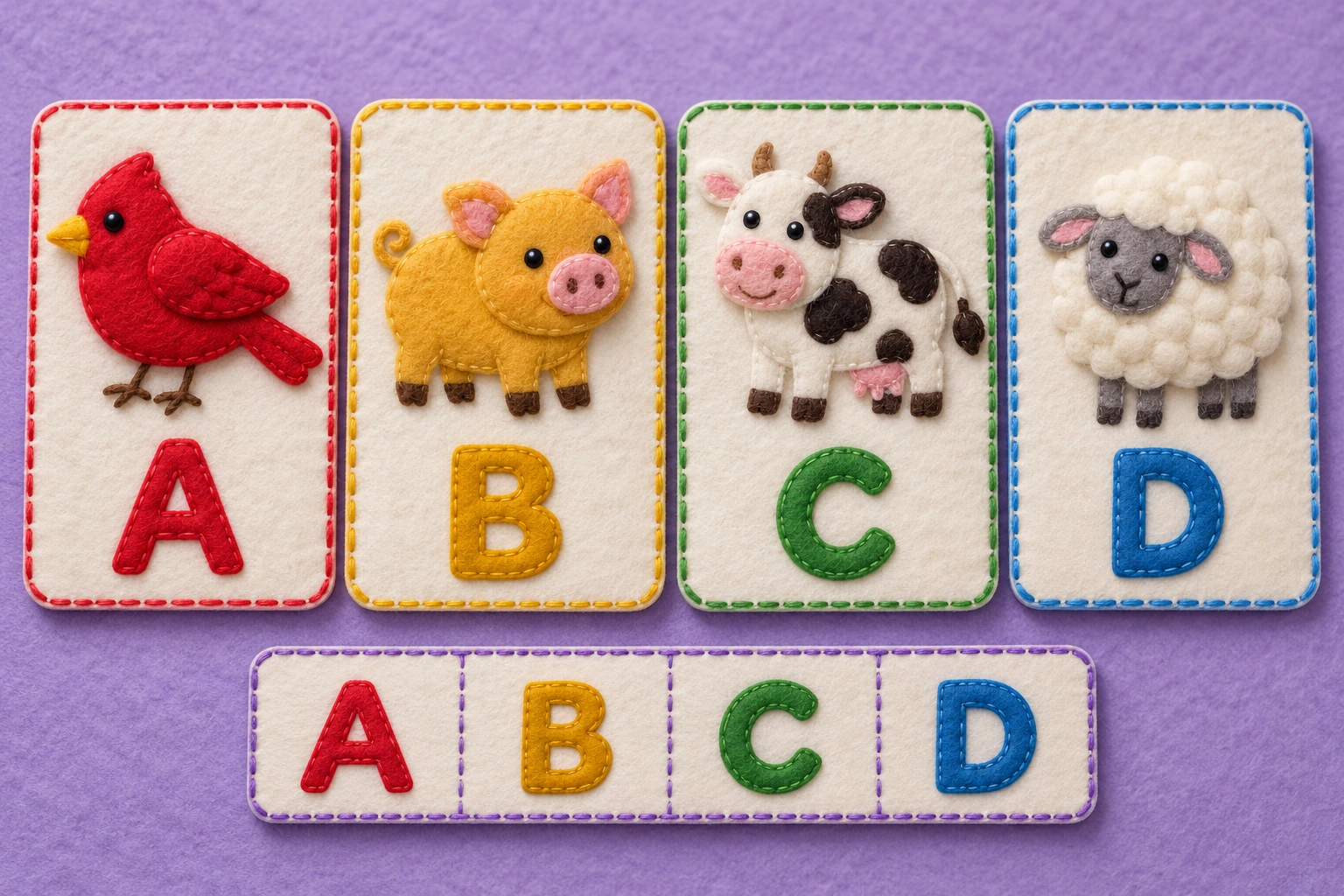
Become a duplicate inspector
Arrange four code tiles with a repeated B and missing C. The child identifies both the repetition and the absent code instead of declaring the whole row wrong. On a later Animal Letter Sudoku visit, ask Ivo what changed; the teacher can discuss Ivo’s evidence.
Ask three grid questions
For one proposed letter, ask about its row, column and small box in turn. Use the visible printed givens as evidence rather than encouraging unsupported trial-and-error writing. Ask Ivo how this example relates to Animal Letter Sudoku; the teacher can follow the clue that Ivo identifies.
Give a reason before a tile
A partner holds the proposed code tile until the child explains the missing-code evidence. Then both inspect crossing groups before the tile is placed on a separate model. Keep Ivo’s own explanation central in this Animal Letter Sudoku game. Let the teacher hear what Ivo observed.
6 observations in Animal Letter Sudoku
Constraint reasoning: Does this letter fit row, column and box
In Animal Letter Sudoku, one code must satisfy three visible groups. The prompt “Does this letter fit row, column and box?” gives Ivo a way to explain constraint reasoning to the teacher.
Symbol interpretation: Which code belongs to the pig
In Animal Letter Sudoku, an animal picture is represented by its letter code. The prompt “Which code belongs to the pig?” gives Ivo a way to explain symbol interpretation to the teacher.
Elimination: Which of A, B, C and D is missing
In Animal Letter Sudoku, already present codes reduce the available candidates. The prompt “Which of A, B, C and D is missing?” gives Ivo a way to explain elimination to the teacher.
Evidence language: What rules out the other letters
In Animal Letter Sudoku, a child can explain why a cell must hold a particular code. The prompt “What rules out the other letters?” gives Ivo a way to explain evidence language to the teacher.
Careful letter placement: Which empty cell are we filling
In Animal Letter Sudoku, one capital records one justified grid decision. The prompt “Which empty cell are we filling?” gives Ivo a way to explain careful letter placement to the teacher.
Checking after entry: Has this entry created a repeat anywhere
In Animal Letter Sudoku, the new code can be reread in each crossing group. The prompt “Has this entry created a repeat anywhere?” gives Ivo a way to explain checking after entry to the teacher.
Three groups constrain one square
A candidate can satisfy its row and still repeat a code in its column or two-by-two box. Name all three groups around the proposed cell and inspect their givens. An adult can help keep those checks organised while the child rules out conflicting codes. A single fully justified placement is a worthwhile reasoning task even if the rest of the grid needs more shared support.
Imagine Ivo at a home puzzle table
Ivo identifies B as the pig code, then looks at the bottom row with his teacher. They name the three visible codes, identify D as missing and check its crossing groups before writing. The explanation is the important part of that first entry. Here, Animal Letter Sudoku gives Ivo a reason to discuss constraint reasoning using the Animal Mini Sudoku clues.
Check the completed group after writing
After a new code is placed, reread its row, column and small box to see whether a repetition has appeared. This habit treats the written letter as a decision worth verifying, not an endpoint beyond discussion. If a conflict occurs, identify the particular group that supplies the contradiction before changing another entry. The visible givens remain the stable evidence throughout the repair.
A fresh Animal Letter Sudoku reason to return
Revisit one justified entry and ask for its row, column and box evidence. A shorter reasoning conversation can be more useful than filling a second whole grid quickly. Ivo can show the teacher a new small-box test observation during that short animal letter sudoku visit.
Readiness for Animal Letter Sudoku at ages 5–7
This page often needs adult support around ages five to seven or beyond, depending on experience with constraints. Begin with the code key and one nearly complete row; independent alphabet recitation is not the goal. Suggested range for Animal Letter Sudoku: ages 5–7. Begin with constraint reasoning and adult support.
For a comfortable Animal Letter Sudoku visit, let Ivo show four-code key before the teacher requests another response. Discuss careful letter placement using the printed Animal Mini Sudoku example.
Save a printable Animal Letter Sudoku copy
Obtain the clean Animal Letter Sudoku PDF through its premium option with eligible active membership access. The unbranded edition removes website watermark and domain text, carries no embedded ads and preserves every given code and empty response cell. An original sample stays separate. Check the animal key and all four small grid boxes in print preview before printing. The $5 twenty-five-page collection includes this exact supplied animal-code puzzle in its clean combined file.
Animal Letter Sudoku: another printable to explore
Extend the constraint reasoning conversation beyond Animal Letter Sudoku with Four-code key before a road-width task; Elimination and picture-detail tracing; Evidence language beside a car-and-flag maze.
Explore Animal Letter Sudoku alongside NAEYC family-writing ideas and Animal Letter Sudoku with PBS Parents literacy activities. Keep four-code key, evidence language and checking after entry connected to the pictured puzzle.
Popular Worksheets
Printable resources families and teachers are downloading now.
 Free
 Free
 Free
 Free