
Fruit Half Matching: 5 Fresh Picture-Pair Discoveries
Find more whole-picture discoveries beyond the fruit halves. The $5 clean PDF contains all 25 submitted sheets in numeric order. Use this fruit-pair page as one choice within a collection that also offers searching, route planning and letter-code logic.
An apple, orange or pear can remain recognisable when only half is visible. Fruit Half Matching asks children to use that partial evidence to find a matching right side among reordered choices. Five fruits supply different outlines and interior details, so a useful explanation can mention more than colour alone. Search beyond the nearest row, compare a distinctive feature and connect the two partners. The complete fruit is already represented across the choices; children are matching supplied pictures rather than drawing or cutting missing halves.
Fruit Half Matching: the rule on this particular sheet
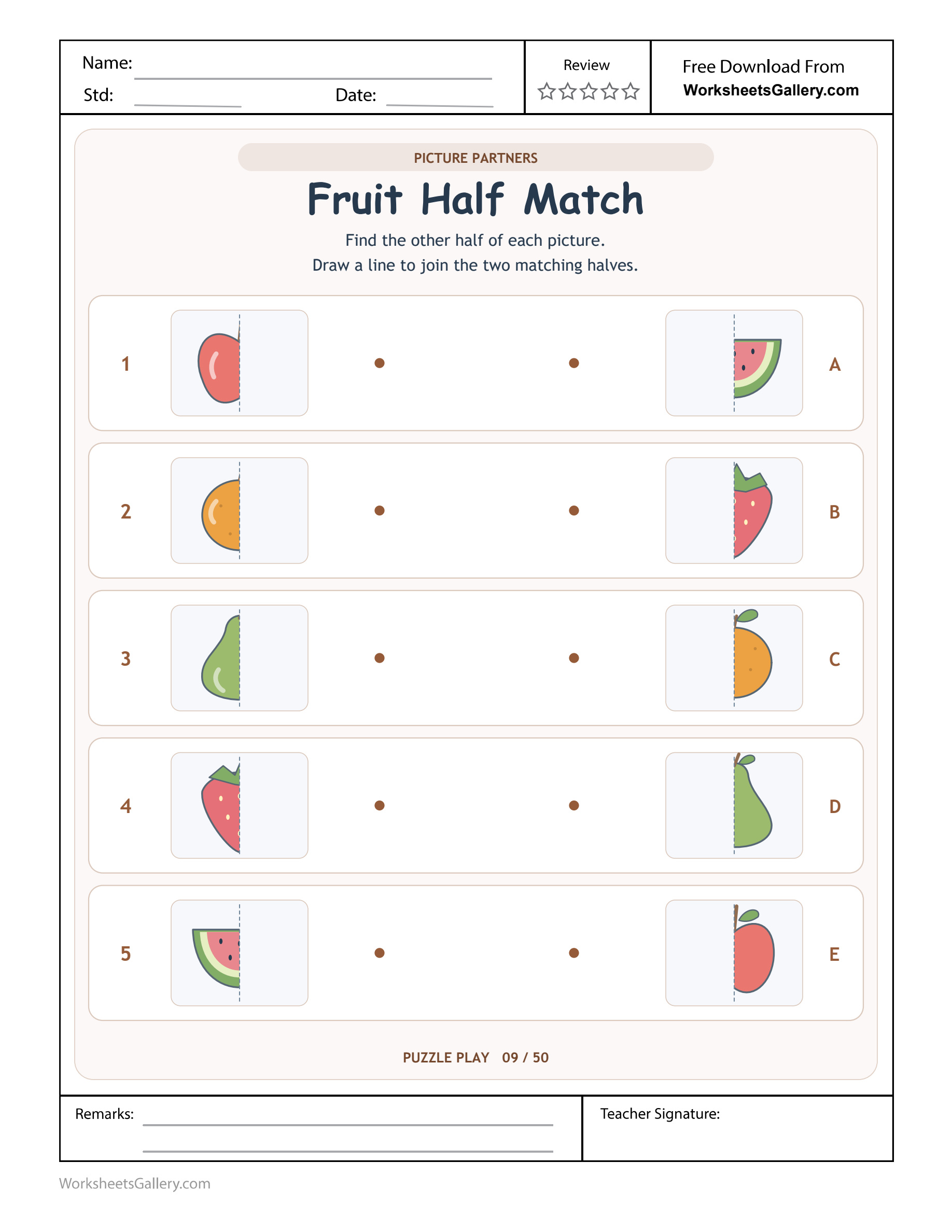
Five left halves show apple, orange, pear, strawberry and watermelon. Their right partners are reordered and labelled A–E, so the correct connection depends on recognising the fruit rather than selecting the nearest row.
The outer silhouette offers one clue: a pear narrows towards its stem, while an orange keeps a rounded edge. Interior details and the visible colour provide additional evidence when two curved halves initially seem alike.
What berry clue reveals
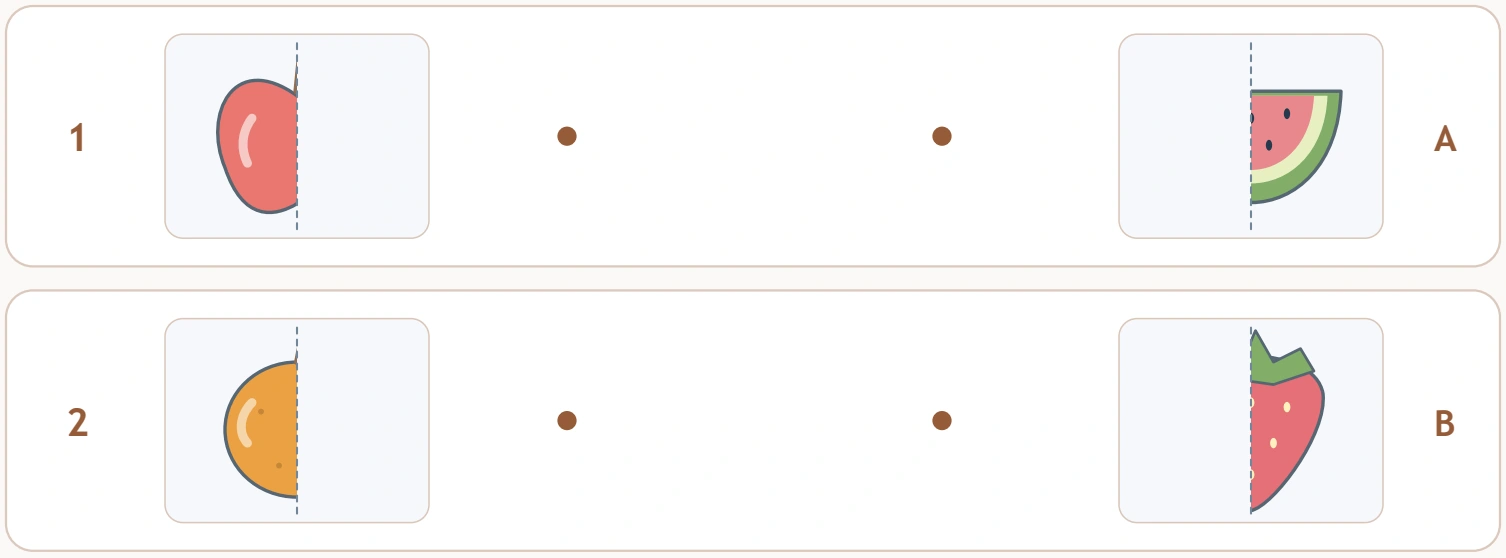
The adult pairings are apple E, orange C, pear D, strawberry B and watermelon A. Check the identity on both ends of a line; crossings can occur naturally when the partner order changes.
This is a picture-half matching task, not an instruction to cut out fruit, divide actual food equally or draw a missing half. The source already supplies the candidate right sides for a visual comparison.
A practical Fruit Half Matching sequence
Apple and orange with Finn
Begin Fruit Half Matching: apple and orange. Apple connects to E and orange to C. Ask Finn, “What whole fruit could this belong to?” The mother and Finn can inspect apple and orange together.
Pear contour with Finn
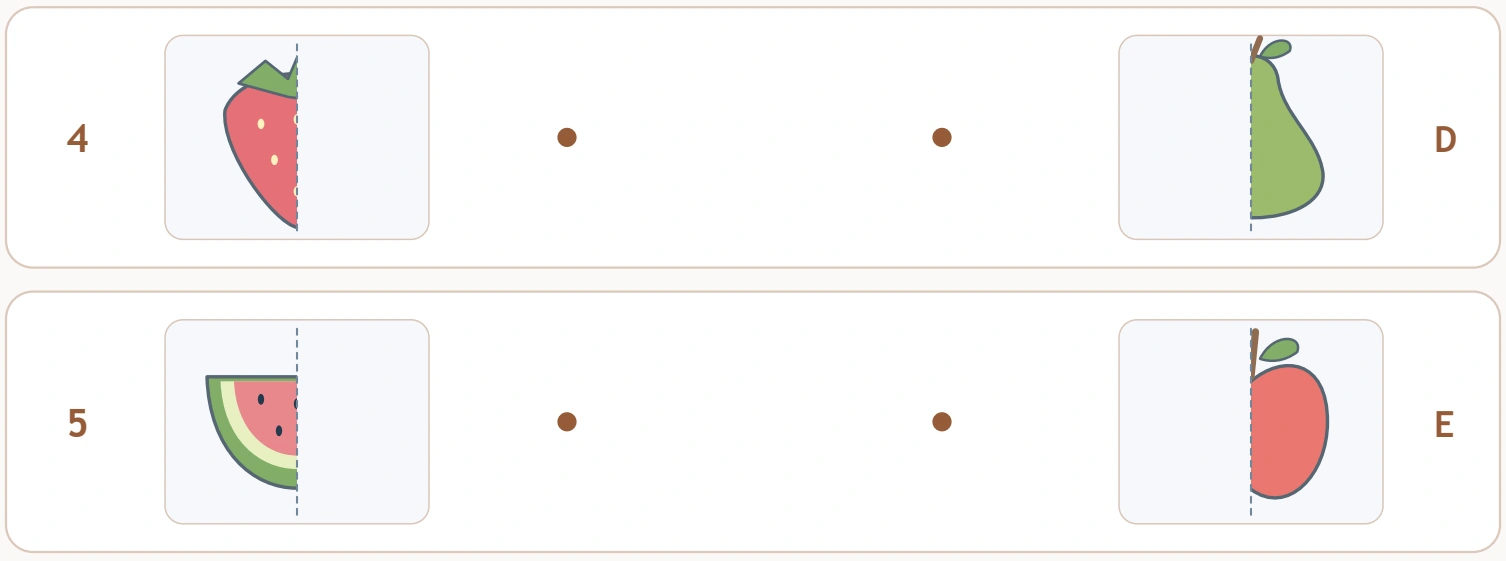
Next inspect Fruit Half Matching: pear contour. The pear partner is D; inspect its narrowing upper outline. Ask Finn, “Where does the shape narrow?” The mother and Finn can inspect pear contour together.
Berry clue with Finn
Then confirm Fruit Half Matching: berry clue. Strawberry B preserves the recognisable berry details. Ask Finn, “What second clue agrees?” The mother and Finn can inspect berry clue together.
Melon finish with Finn
Finally record Fruit Half Matching: melon finish. Watermelon A completes the final left fruit. Ask Finn, “Have you inspected the whole choice column?” The mother and Finn can inspect melon finish together.
Fruit Half Matching adult reference
| Printed clue | Source check |
|---|---|
| Apple and orange | Apple connects to E and orange to C. |
| Pear contour | The pear partner is D; inspect its narrowing upper outline. |
| Berry clue | Strawberry B preserves the recognisable berry details. |
| Melon finish | Watermelon A completes the final left fruit. |

Use a silhouette before a colour label
A pear’s narrowing upper outline provides a different clue from the orange’s rounded edge. Invite the child to follow the contour visually and describe where it changes. Colour can help, but a useful match should also preserve the fruit’s form. This is particularly helpful when a child notices one broad shared colour and is tempted to connect halves belonging to different objects.
Classroom partners inspect pear contour
A teacher lets one partner describe the left fruit without naming it. Another points to a right-side candidate and explains the matching silhouette or interior clue. They reveal the fruit name only after the comparison has a reason. For a Fruit Half Matching partner visit, contour attention is this fruit half matching partnership focus.
The right partner can be far away
The shuffled right column means a child must search above or below the starting row. Ask whether the full choice column has been inspected before accepting the nearest dot. The task does not become harder because a correct line crosses another one; crossings reflect the arrangement of the partners. Check the actual fruit at each endpoint when reviewing the completed connections.
Fruit Half Matching: berry clue mistakes
Joining straight across can connect different fruits because the right side is shuffled. A second slip is relying solely on green or red colour. Compare both the outside edge and a distinctive detail before accepting a partner. Invite Finn to discuss berry clue with the mother.
6 observations in Fruit Half Matching
Whole-object recognition: What whole fruit could this belong to
Here, a partial picture can still identify a familiar fruit. The prompt “What whole fruit could this belong to?” gives Finn a way to explain whole-object recognition to the mother.
Contour attention: Where does the shape narrow
Here, the outside edge distinguishes some similar coloured halves. The prompt “Where does the shape narrow?” gives Finn a way to explain contour attention to the mother.
Detail comparison: What second clue agrees
Here, interior clues can confirm a broad silhouette match. The prompt “What second clue agrees?” gives Finn a way to explain detail comparison to the mother.
Flexible scanning: Have you inspected the whole choice column
In Fruit Half Matching, the partner may be above or below the starting row. The prompt “Have you inspected the whole choice column?” gives Finn a way to explain flexible scanning to the mother.
Descriptive language: How could you describe this half
In Fruit Half Matching, a listener benefits from more than one shape word. The prompt “How could you describe this half?” gives Finn a way to explain descriptive language to the mother.
Line endpoint checking: Which two fruits does your line join
In Fruit Half Matching, a crossing line can be accurate when its partners agree. The prompt “Which two fruits does your line join?” gives Finn a way to explain line endpoint checking to the mother.
Five play invitations after Fruit Half Matching
Describe a pretend fruit parcel
Use large fruit pictures folded along a vertical centre. Show one visible half and ask a listener to describe the likely whole before revealing the rest. After this Fruit Half Matching play round, ask the mother which clue Finn chose to explain.
Find a contour twin
Place two similarly coloured paper fruits together and compare only their outer edges. Identify the narrowing pear and rounder orange without relying on their colour names. Let Finn demonstrate this example before another Fruit Half Matching visit; ask the mother to listen for Finn’s reasoning.
Make an orchard delivery
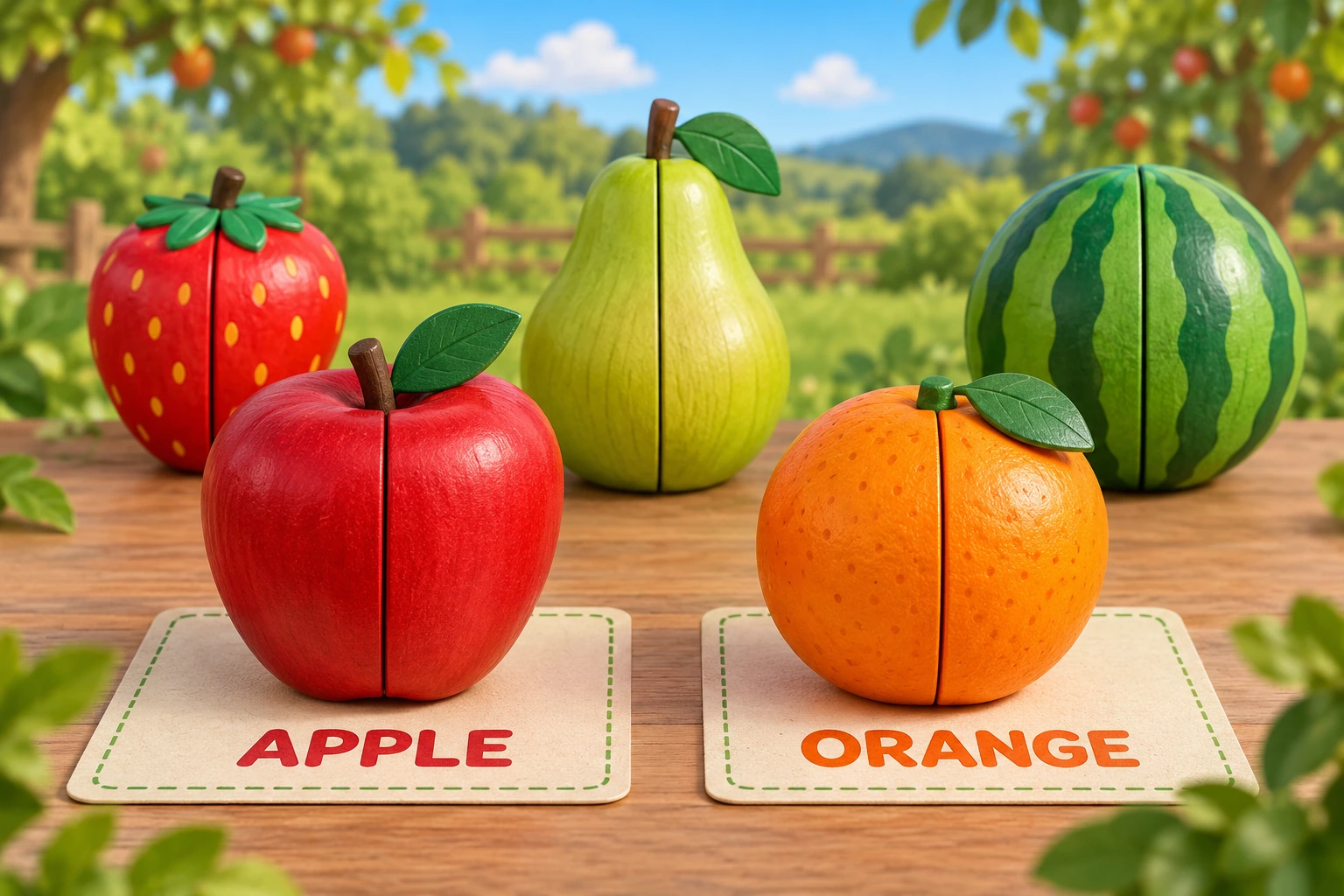
Label finished picture cards APPLE and ORANGE. A child delivers rejoined paper fruit to the appropriate label and explains one detail that supports each identity. On a later Fruit Half Matching visit, ask Finn what changed; the mother can discuss Finn’s evidence.
Shuffle the right-side orchard
Create simple split paper pictures and reorder only the right halves. Match the partners again to experience why row position cannot be the deciding clue. Ask Finn how this example relates to Fruit Half Matching; the mother can follow the clue that Finn identifies.
Give one more fruit clue
One player says round and another asks for additional evidence. Add a stem, segment or seed description until the intended fruit can be identified more confidently. Keep Finn’s own explanation central in this Fruit Half Matching game. Let the mother hear what Finn observed.
Fruit names can be taught alongside matching
A child unfamiliar with watermelon can still compare its visible edge, rind and interior. Name the fruit together and allow those features to support the search. Do not require independent naming as a condition of participating in the visual puzzle. An adult can supply vocabulary while leaving the decision about which supplied right half agrees with the left half to the child.
Imagine Finn at a home puzzle table
Finn describes an orange half as round, then notices that an apple can also look rounded. His mother asks for another clue from the printed picture. The extra detail makes the partner choice more specific than a single broad shape word. Here, Fruit Half Matching gives Finn a reason to discuss whole-object recognition using the Fruit Half Match clues.
A second clue can rescue a vague description
When a child calls a half round, ask what else is visible. For Fruit Half Matching, A stem, segmented interior or berry detail can make the description more informative. Let the child add one clue at a time until the partner is defensible. The goal is a richer account of the same fruit identity, not an exhaustive botanical explanation or a demand to list every small mark in the drawing.
A fresh Fruit Half Matching reason to return
Revisit one previously difficult pair and ask for a different identifying clue. The same correct partner can be supported by a richer explanation without repeating every line. Finn can show the mother a new melon finish observation during that short fruit half matching visit.
Readiness for Fruit Half Matching at ages 4–6
Name the five fruits together before requiring independent matching. If a picture is unfamiliar, discuss it directly; fruit vocabulary and visual pairing can be supported separately. Suggested range for Fruit Half Matching: ages 4–6. Begin with whole-object recognition and adult support.
For a comfortable Fruit Half Matching visit, let Finn show apple and orange before the mother requests another response. Discuss descriptive language using the printed Fruit Half Match example.
Save a printable Fruit Half Matching copy
Select the clean Fruit Half Matching PDF from the premium download after signing in with suitable active member access. Website branding, the domain and watermark have been removed, with no ads added to the file. A separate original sample preserves the upload. Check that print preview includes the apple through watermelon rows and every lettered half. The $5 paid collection contains this fruit-pair activity alongside the other twenty-four supplied puzzle pages.
Fruit Half Matching: another printable to explore
Extend the whole-object recognition conversation beyond Fruit Half Matching with Apple and orange before a road-width task; Detail comparison and picture-detail tracing; Flexible scanning beside a car-and-flag maze.
Explore Fruit Half Matching alongside NAEYC family-writing ideas and Fruit Half Matching with PBS Parents literacy activities. Keep apple and orange, flexible scanning and line endpoint checking connected to the pictured puzzle.
Popular Worksheets
Printable resources families and teachers are downloading now.
 Free
 Free
 Free
 Free