
Robot Mirror Grids: 4 Brilliant Reflection Challenges
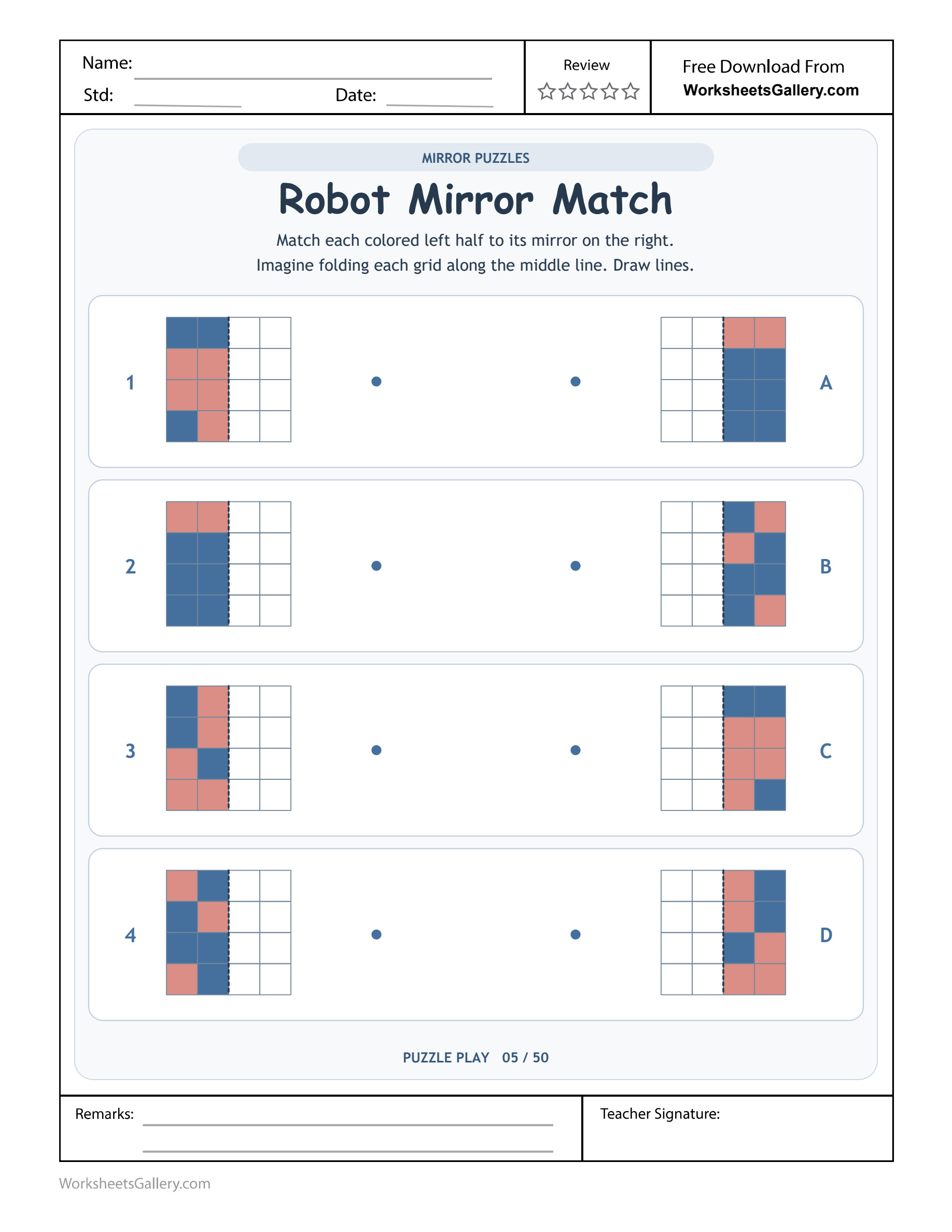
Pair robot reflections with a fresh thinking challenge. All 25 supplied pages are available together for $5 as one clean PDF. Keep this four-grid comparison alongside counting fields and matching activities without assembling separate downloads.
When a coloured square appears in a mirror, it keeps its height while changing sides. Robot Mirror Grids explores that relationship through four numbered half-grids and four lettered partners. Blue and red cells provide the clues; the dotted vertical middle helps children imagine which cell should sit nearest the centre after reflection. Begin with one distinctive row, then test another before connecting the grids. The robot theme names the puzzle, while the actual task is careful spatial comparison rather than completing a robot drawing.
Robot Mirror Grids: the rule on this particular sheet
Four numbered grids show blue and red cells on their left halves. Four lettered choices show coloured right halves. The vertical dotted middle reference asks for a mirror relationship, not a sideways copy of the same two-column order.
Each full grid has four rows and four columns. Reflection across the middle keeps a cell in its original row and changes its horizontal distance to the opposite side. The colour nearest the middle must remain nearest the middle.
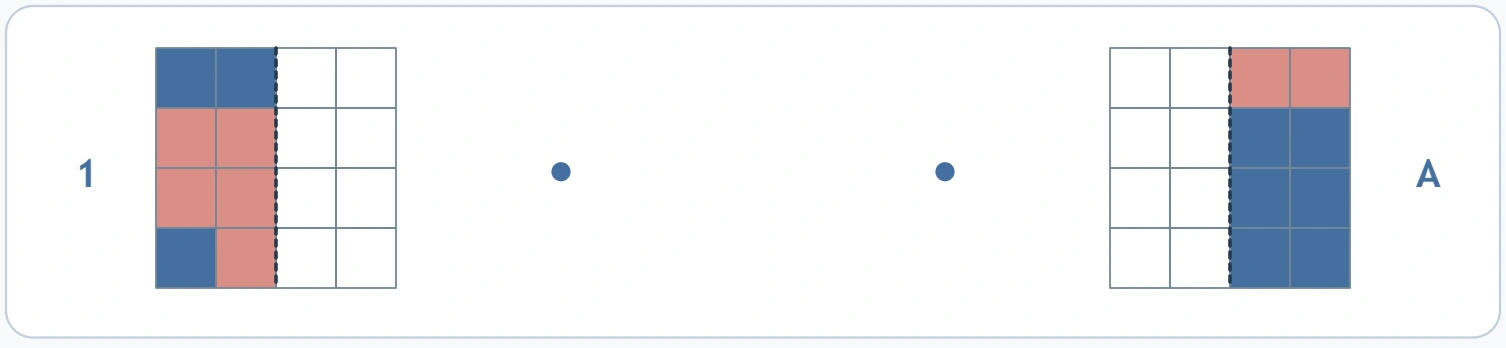
What second-row test reveals
Begin with one distinctive row, such as a mixed blue-red pair. Reverse its left-to-right order when imagining the reflected right half. Then inspect another row; matching one convenient pair is not enough to confirm the whole four-row pattern.
For the supplied robot-themed version, numbered grids 1–4 match C, A, D and B. No robot outline appears for children to complete. They draw connections between half-grid partners after comparing the coloured cell positions.
A practical Robot Mirror Grids sequence
Middle neighbour with Esme
Begin Robot Mirror Grids: middle neighbour. Find the cell beside the dotted axis before the outer one. Ask Esme, “Which colour touches the middle?” The father and Esme can inspect middle neighbour together.
Same row with Esme
Next inspect Robot Mirror Grids: same row. A top-row clue must remain in the top row. Ask Esme, “Are we still in the same row?” The father and Esme can inspect same row together.
Second-row test with Esme
Then confirm Robot Mirror Grids: second-row test. Check another coloured pair before accepting a candidate. Ask Esme, “Which cell becomes the outer one?” The father and Esme can inspect second-row test together.
Partner sequence with Esme
Finally record Robot Mirror Grids: partner sequence. The supplied adult reference is 1-C, 2-A, 3-D, 4-B. Ask Esme, “Can this candidate pass another row?” The father and Esme can inspect partner sequence together.
Robot Mirror Grids adult reference
| Printed clue | Source check |
|---|---|
| Middle neighbour | Find the cell beside the dotted axis before the outer one. |
| Same row | A top-row clue must remain in the top row. |
| Second-row test | Check another coloured pair before accepting a candidate. |
| Partner sequence | The supplied adult reference is 1-C, 2-A, 3-D, 4-B. |
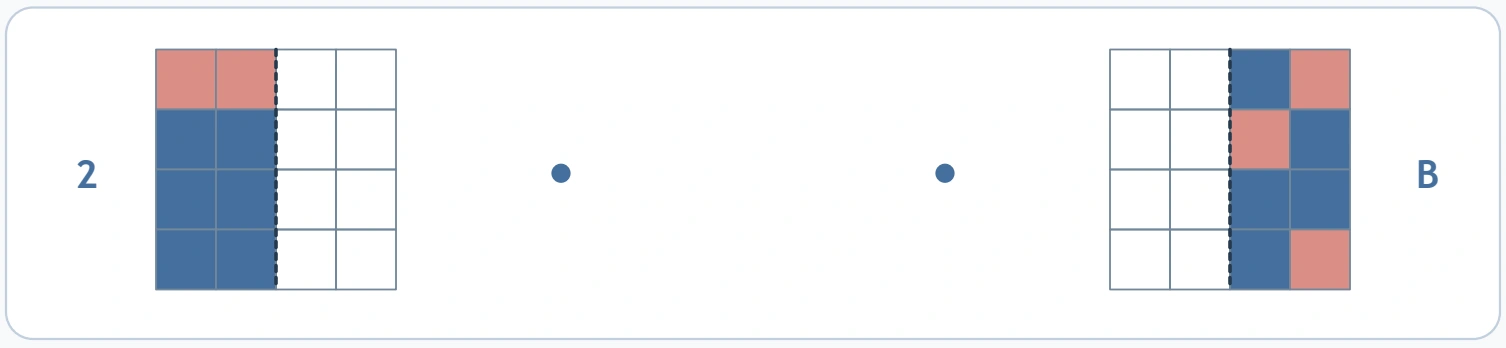
Start nearest the dotted middle
A two-colour row can be described from the axis outward. That description stays meaningful when the opposite half changes left-to-right order: the cell next to the middle still has an opposite neighbour next to the middle. Use a fingertip to identify those neighbouring cells before discussing the outer pair. This gives the reflection a spatial anchor stronger than memorising a colour chant.
Classroom partners inspect same row
A teacher asks one partner to describe the top row and another to check the bottom row of a proposed match. They combine their evidence before drawing. Each partner has a useful inspection job, reducing the chance that one confident colour guess settles the whole grid. For a Robot Mirror Grids partner visit, row tracking is this robot mirror grids partnership focus.
One agreeing row is only a candidate
A proposed partner may match the first row and fail the third. Treat the early agreement as a reason to inspect the candidate further, not permission to stop comparing. Invite a child to choose a second row that could distinguish two similar options. The whole-grid decision becomes a short sequence of evidence checks, with each additional row confirming or rejecting the current hypothesis.
Robot Mirror Grids: second-row test mistakes
The common slip is copying the two coloured columns in the same order instead of reflecting them. Another is turning the page or flipping top and bottom. Keep the source upright and preserve row height while comparing distance from the middle. Invite Esme to discuss second-row test with the father.
6 observations in Robot Mirror Grids
Spatial relationships: Which colour touches the middle
Here, near and far describe a cell relative to the axis. The prompt “Which colour touches the middle?” gives Esme a way to explain spatial relationships to the father.
Row tracking: Are we still in the same row
In Robot Mirror Grids, vertical position remains stable during the reflection. The prompt “Are we still in the same row?” gives Esme a way to explain row tracking to the father.
Comparing sequences: Which cell becomes the outer one
In Robot Mirror Grids, two adjacent colours reverse their horizontal order. The prompt “Which cell becomes the outer one?” gives Esme a way to explain comparing sequences to the father.
Multi-clue checking: Can this candidate pass another row
In Robot Mirror Grids, a second row tests a tentative partner. The prompt “Can this candidate pass another row?” gives Esme a way to explain multi-clue checking to the father.
Precision in talk: Which blue square do you mean
In Robot Mirror Grids, a partner needs both a colour and a position. The prompt “Which blue square do you mean?” gives Esme a way to explain precision in talk to the father.
Controlled connections: Where does this numbered grid belong
In Robot Mirror Grids, selected grid partners are joined intentionally. The prompt “Where does this numbered grid belong?” gives Esme a way to explain controlled connections to the father.
Five play invitations after Robot Mirror Grids
Reflect a two-counter row
Put two differently coloured counters beside a vertical divider. Build the reflected row across it and check which counter is closest to the divider on each side. After this Robot Mirror Grids play round, ask the father which clue Esme chose to explain.
Make a same-height signal
Stack coloured blocks in two short columns beside a safe mirror. Point across at matching heights before discussing the lateral reversal of the whole arrangement. Let Esme demonstrate this example before another Robot Mirror Grids visit; ask the father to listen for Esme’s reasoning.
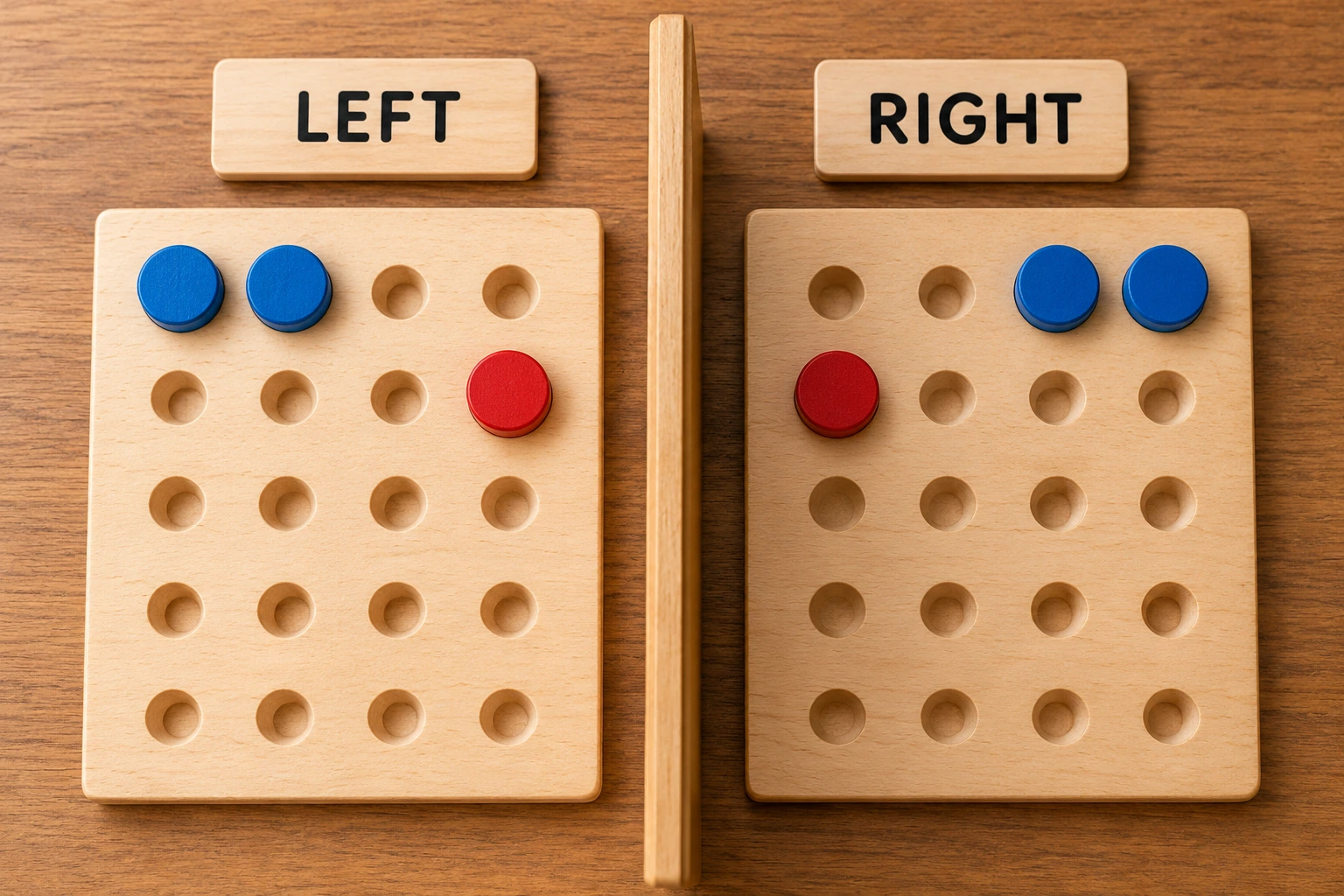
Catch a copied row
An adult repeats a blue-red pair in the same order across a divider. Ask the child whether it is a copy or a reflection and invite one precise repair. On a later Robot Mirror Grids visit, ask Esme what changed; the father can discuss Esme’s evidence.
Describe without pointing
A partner hears near-middle red, outer blue and builds the row from that verbal clue. Reveal the model afterward to compare the positional language with the result. Ask Esme how this example relates to Robot Mirror Grids; the father can follow the clue that Esme identifies.
Inspect a second witness
Offer a candidate that matches the first row but fails another. The child chooses which additional row supplies decisive evidence, explaining why the initial clue was insufficient. Keep Esme’s own explanation central in this Robot Mirror Grids game. Let the father hear what Esme observed.
Reflection is different from moving the paper
Turning the page upside down changes the height relationships and introduces a different transformation. Keep the sheet upright while discussing the dotted vertical reference. If a physical mirror is used in a separate demonstration, show how the reflected cell remains level with its source. The object on the page does not need to rotate for a child to imagine the opposite half.
Imagine Esme at a home puzzle table
Esme places a blue counter beside a red counter near a safe tabletop mirror. Her father asks which counter stays closest to the mirror line in the reflection. The physical comparison gives meaning to the printed grid before they discuss a lettered choice. Here, Robot Mirror Grids gives Esme a reason to discuss spatial relationships using the Robot Mirror Match clues.
Talk about a rejected grid precisely
An adult can ask why one tempting partner fails without demanding the correct answer immediately. For Robot Mirror Grids, A response such as the bottom colours are exchanged identifies a useful mismatch. That explanation can be accepted before the child searches again. It shows awareness of position within a row, which is more informative than merely naming a different letter after an adult signals that the first choice is wrong.
A fresh Robot Mirror Grids reason to return
On a second attempt, inspect a different row first and explain why it is distinctive. The goal is a more deliberate comparison, not memorising C, A, D, B or racing through the lines. Esme can show the father a new partner sequence observation during that short robot mirror grids visit.
Readiness for Robot Mirror Grids at ages 4–6
Start with loose two-colour rows if a four-row grid is too much to hold in view. A safe mirror can support explanation; folding, cutting and completing a robot drawing are not required by this sheet. Suggested range for Robot Mirror Grids: ages 4–6. Begin with spatial relationships and adult support.
For a comfortable Robot Mirror Grids visit, let Esme show middle neighbour before the father requests another response. Discuss precision in talk using the printed Robot Mirror Match example.
Save a printable Robot Mirror Grids copy
Choose the member premium file for a clean Robot Mirror Grids page. Eligible active membership access protects that PDF; the original sample uses a separate download choice. The clean version has no website watermark, no domain text and no ads embedded among its four reflection tasks. Inspect the full grid columns before printing so neither numbered designs nor lettered candidates fall outside the page. This robot-themed sheet also appears in the $5 combined collection.
Robot Mirror Grids: another printable to explore
Extend the spatial relationships conversation beyond Robot Mirror Grids with Middle neighbour before a road-width task; Comparing sequences and picture-detail tracing; Multi-clue checking beside a car-and-flag maze.
Explore Robot Mirror Grids alongside NAEYC family-writing ideas and Robot Mirror Grids with PBS Parents literacy activities. Keep middle neighbour, multi-clue checking and controlled connections connected to the pictured puzzle.
Popular Worksheets
Printable resources families and teachers are downloading now.
 Free
 Free
 Free
 Free