
Cupcake Colour Puzzle: 5 Sweet Ways to Compare Parts
Give the cupcake comparisons some thoughtful companions. The complete selection costs $5 and places all 25 provided puzzles in a single printable download. After matching wrappers and frosting, try a new kind of visual decision.
Imagine ordering a cupcake by naming only its frosting. The pretend baker still needs to know which wrapper belongs underneath. Cupcake Colour Puzzle turns that small communication problem into five colour-part matches. Children compare the lower wrapper and upper swirl with finished candidates, then connect the pair that preserves both clues. An adult can act as the customer while the child explains the order. No baking equipment is needed; the meaningful work is looking at two components and giving each colour its proper place.
Cupcake Colour Puzzle: the rule on this particular sheet
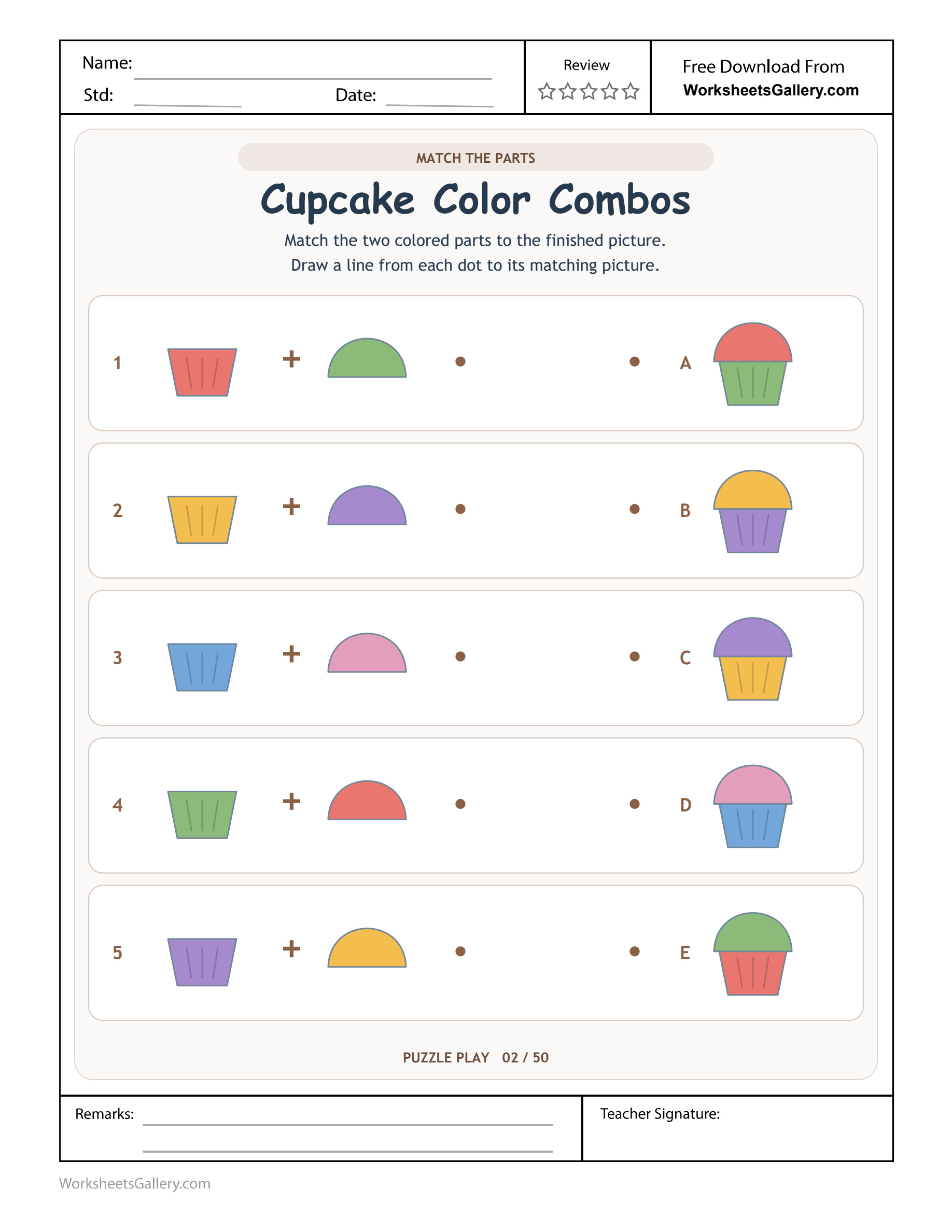
A cupcake is separated into a wrapper and a frosting portion on the numbered side. The finished choices recombine those colours, so a correct partner must satisfy two clues rather than resemble a favourite cake.
The printed plus sign represents assembling pictured components. No ingredients are measured, no sweets need eating and no pigment is blended. Wrapper and frosting remain visibly separate after the parts are joined.

What two-part order reveals
The first red-wrapper and green-frosting combination belongs with E. The second yellow-wrapper and purple-frosting combination matches C. These examples show why stopping at the first familiar colour can produce a misleading choice.
The remaining partners are D for the blue wrapper and pink frosting, A for the green wrapper and red frosting, and B for the purple wrapper and yellow frosting. Reordered letters make direct horizontal guessing unreliable.
Why two-part orders matter
A colour word can identify more than one visible component. Saying green without naming its job leaves open whether green belongs to the wrapper or frosting. Let the pretend customer hear two complete descriptions and decide which one would allow a baker to assemble the intended cupcake. The practical purpose of precise language is a correctly fulfilled order, not a recital of every colour on the page.
6 observations in Cupcake Colour Puzzle
Component language: Which part is purple
Here, naming wrapper and frosting gives each colour a location. The prompt “Which part is purple?” gives Tavi a way to explain component language to the mother.
Two-condition matching: Does the wrapper agree too
Here, a choice must agree with both parts of the order. The prompt “Does the wrapper agree too?” gives Tavi a way to explain two-condition matching to the mother.
Reasoned elimination: What makes this cake unsuitable
Here, one conflicting colour can reject a tempting finished cupcake. The prompt “What makes this cake unsuitable?” gives Tavi a way to explain reasoned elimination to the mother.
Visual memory support: Can you repeat your order
In Cupcake Colour Puzzle, a spoken colour pair can remain available during a search. The prompt “Can you repeat your order?” gives Tavi a way to explain visual memory support to the mother.
Pencil intention: Where should your line finish
In Cupcake Colour Puzzle, connecting selected dots turns a comparison into a deliberate mark. The prompt “Where should your line finish?” gives Tavi a way to explain pencil intention to the mother.
Shared explanations: What else must I know
In Cupcake Colour Puzzle, a pretend customer needs enough information to assemble a cake. The prompt “What else must I know?” gives Tavi a way to explain shared explanations to the mother.
A practical Cupcake Colour Puzzle sequence
Wrapper clue with Tavi
Begin Cupcake Colour Puzzle: wrapper clue. Inspect the lower fluted part before accepting the candidate. Ask Tavi, “Which part is purple?” The mother and Tavi can inspect wrapper clue together.
Frosting clue with Tavi
Next inspect Cupcake Colour Puzzle: frosting clue. Follow the upper swirl and compare its separate colour. Ask Tavi, “Does the wrapper agree too?” The mother and Tavi can inspect frosting clue together.
Two-part order with Tavi
Then confirm Cupcake Colour Puzzle: two-part order. Repeat a base colour and a topping colour together. Ask Tavi, “What makes this cake unsuitable?” The mother and Tavi can inspect two-part order together.
Final connection with Tavi
Finally record Cupcake Colour Puzzle: final connection. Check the numbered dot and lettered endpoint after drawing. Ask Tavi, “Can you repeat your order?” The mother and Tavi can inspect final connection together.
Cupcake Colour Puzzle adult reference
| Printed clue | Source check |
|---|---|
| Wrapper clue | Inspect the lower fluted part before accepting the candidate. |
| Frosting clue | Follow the upper swirl and compare its separate colour. |
| Two-part order | Repeat a base colour and a topping colour together. |
| Final connection | Check the numbered dot and lettered endpoint after drawing. |

Check a component without changing the other
If a candidate has the correct wrapper, keep that successful clue in view while examining its topping. Children sometimes abandon all their evidence after noticing one mismatch. A more useful explanation can preserve what agreed and identify what failed: the wrapper is right, but the frosting is not. That small distinction makes rejecting a near match more informative than starting every search from the beginning.
Imagine Tavi at a home puzzle table
Tavi takes a pretend bakery order from her mother. She repeats only green, then notices that two paper cakes could fit such an incomplete request. Adding red wrapper makes the order precise before she returns to the first printed pair. Here, Cupcake Colour Puzzle gives Tavi a reason to discuss component language using the Cupcake Color Combos clues.
Five play invitations after Cupcake Colour Puzzle
Run a wrapper counter
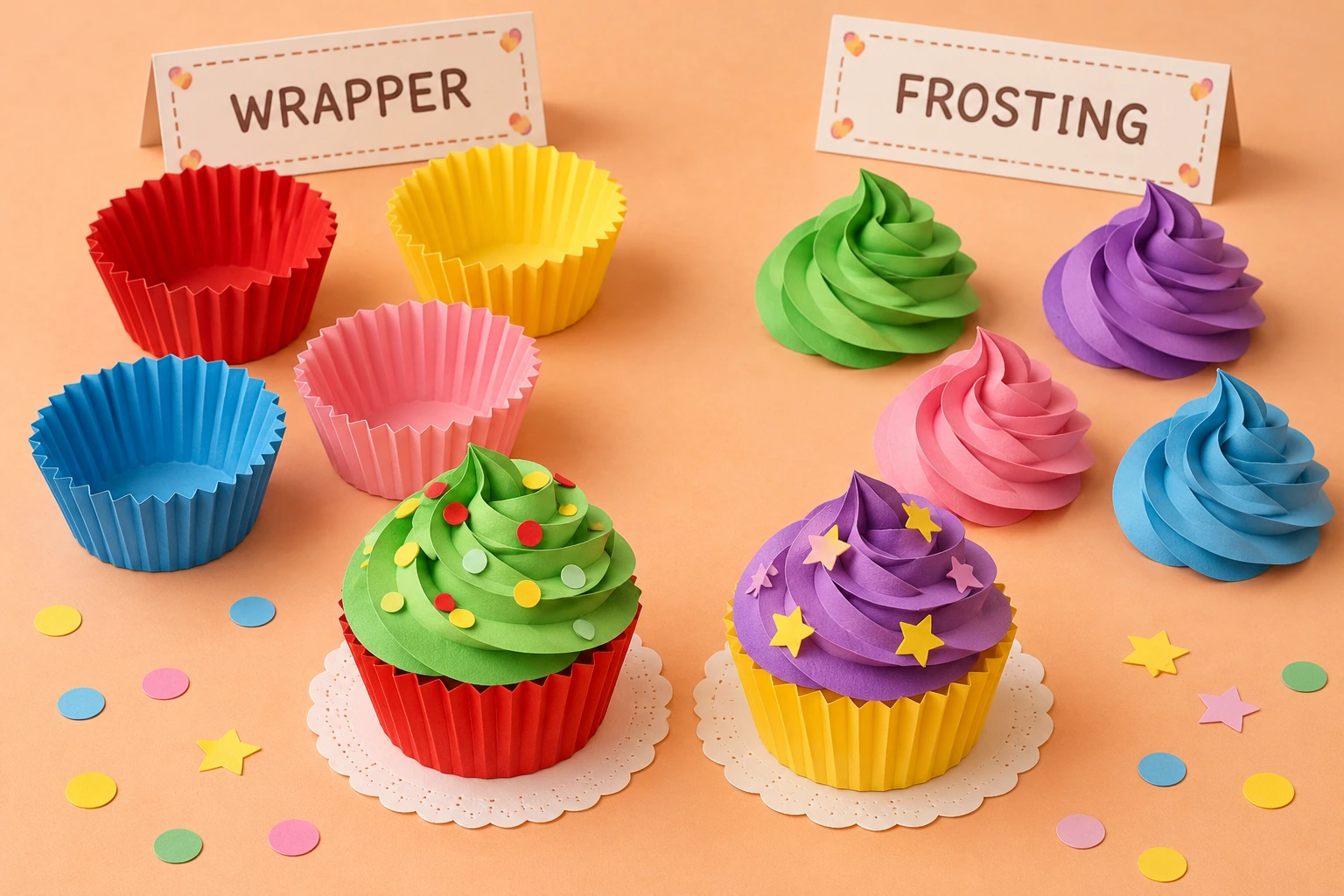
Arrange coloured paper wrappers and let a customer request one with a specific frosting colour. Assemble the order visibly, then check each component against the spoken request. After this Cupcake Colour Puzzle play round, ask the mother which clue Tavi chose to explain.
Spot a swapped topping
Make two complete pretend cupcakes and exchange their frosting pieces. Ask the child to name exactly which component changed rather than call the entire display wrong. Let Tavi demonstrate this example before another Cupcake Colour Puzzle visit; ask the mother to listen for Tavi’s reasoning.
Write a finished order ticket
An adult writes RED WRAPPER and GREEN FROSTING on one completed ticket. The child delivers it to a paper-cake builder who follows the two labels. On a later Cupcake Colour Puzzle visit, ask Tavi what changed; the mother can discuss Tavi’s evidence.
Reject the almost-perfect cake
Offer two constructed cakes with the same yellow wrapper but different toppings. A purple-frosting order gives the child evidence for selecting one and rejecting the other. Ask Tavi how this example relates to Cupcake Colour Puzzle; the mother can follow the clue that Tavi identifies.
Become the bakery inspector
Let an adult assemble a deliberately incorrect order. The child checks the wrapper first, then the frosting, and explains the single repair needed before the pretend delivery. Keep Tavi’s own explanation central in this Cupcake Colour Puzzle game. Let the mother hear what Tavi observed.
Where the connecting line belongs
The numbered pair gives the order and the lettered whole picture supplies the candidate. Ask the child to touch both chosen dots before drawing between them. A curving or crossing line can still carry the intended answer; a perfectly straight line to the adjacent wrong cake cannot. Check the endpoint identities separately from the quality of the pencil movement when discussing the finished sheet.
Cupcake Colour Puzzle: two-part order mistakes
A green wrapper with red frosting reverses the first two colour roles. Ask which colour is touching the table and which sits above it. Also separate matching from colour naming: a child may identify the right pink frosting by pointing even when its name is unfamiliar. Invite Tavi to discuss two-part order with the mother.
Classroom partners inspect frosting clue
At a bakery-themed classroom table, partners trade the roles of customer and colour inspector. The customer describes both components; the inspector points to a finished candidate and repeats the two-part order before either child draws a connection. For a Cupcake Colour Puzzle partner visit, two-condition matching is this cupcake colour puzzle partnership focus.

A pretend bakery can stop after one delivery
Use the first successful order as a natural stopping point if interest fades. For Cupcake Colour Puzzle, A child may enjoy explaining a red wrapper and green topping more than completing all five rows immediately. Leave another order available for a later visit, perhaps with the adult deliberately asking an incomplete question. The child then has a meaningful reason to request the missing component clue.
Readiness for Cupcake Colour Puzzle at ages 4–6
Use large loose paper components before the printed choices if the combined pictures are difficult to separate visually. Keep colour comparisons visible; tasting, baking and detailed drawing are unnecessary for this matching rule. Suggested range for Cupcake Colour Puzzle: ages 4–6. Begin with component language and adult support.
For a comfortable Cupcake Colour Puzzle visit, let Tavi show wrapper clue before the mother requests another response. Discuss pencil intention using the printed Cupcake Color Combos example.
A fresh Cupcake Colour Puzzle reason to return
On a later bakery visit, ask for an explanation beginning with the frosting instead of the wrapper. Reversing the description order refreshes the conversation without changing the worksheet answers. Tavi can show the mother a new final connection observation during that short cupcake colour puzzle visit.
Save a printable Cupcake Colour Puzzle copy
A current qualifying membership unlocks the clean Cupcake Colour Puzzle PDF. Its five cupcake rows retain their colours and directions, with the website watermark and domain removed. The file has no embedded ads. An original sample remains a separate choice for viewing the supplied version. Before printing, inspect the cupcake page boundaries and choose scaling that keeps every row visible. The $5 collection offers this matching sheet within its combined twenty-five-page download.
Cupcake Colour Puzzle: another printable to explore
Extend the component language conversation beyond Cupcake Colour Puzzle with Wrapper clue before a road-width task; Reasoned elimination and picture-detail tracing; Visual memory support beside a car-and-flag maze.
Explore Cupcake Colour Puzzle alongside NAEYC family-writing ideas and Cupcake Colour Puzzle with PBS Parents literacy activities. Keep wrapper clue, visual memory support and shared explanations connected to the pictured puzzle.
Popular Worksheets
Printable resources families and teachers are downloading now.
 Free
 Free
 Free
 Free