
Toy Team Categories: 6 Clever Picture Group Mysteries
Keep the toy-team discussion going with other reasoning tasks. Choose the $5 collection for 25 clean pages covering categories, reflections, routes and more. Its combined PDF makes it easy to select a different challenge after these six group mysteries.
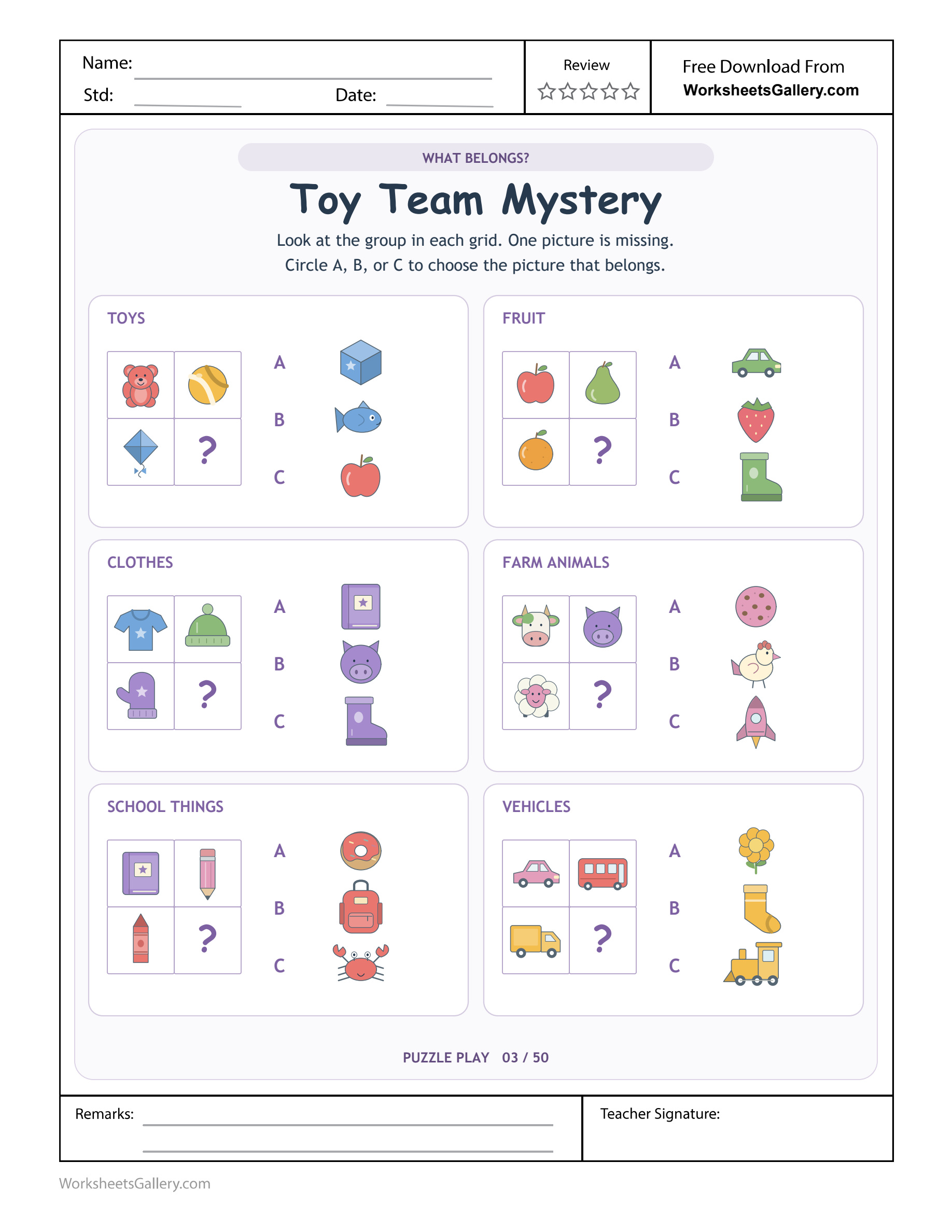
A ball, teddy and kite suggest a toy group, but the next panel needs a different kind of teammate. Toy Team Categories asks children to discover the local rule before choosing a fourth picture. Across six small mysteries, fruit, clothing, farm animals, school things and vehicles join the toy theme. Talk about the three examples already present, then inspect the lettered alternatives. A well-chosen object belongs for a reason the child can explain, even if reading the category heading needs adult help.
Toy Team Categories: the rule on this particular sheet
The six panels are different category problems, even though the title mentions toys. Each panel displays three given pictures and a question-mark position, with A, B and C alternatives beside it. Choose the fourth member by the group rule.
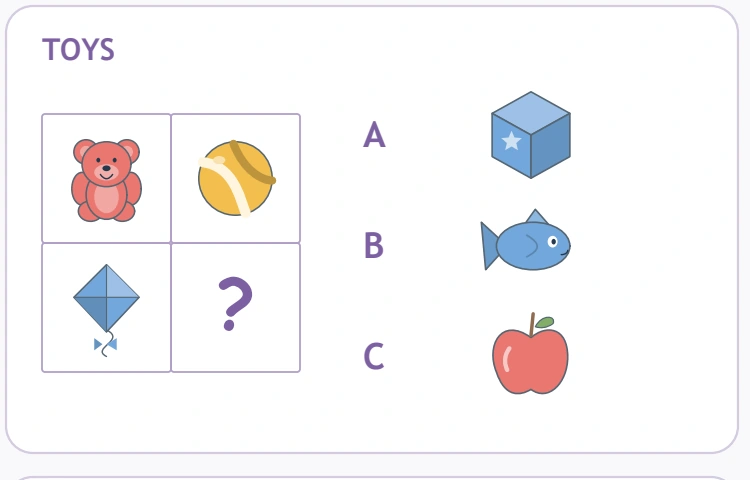
The toy panel accepts the block, while the fruit panel accepts the strawberry. Sharing a colour or appearing on the same row is not enough; the chosen object must belong with all three given examples.
What school equipment reveals
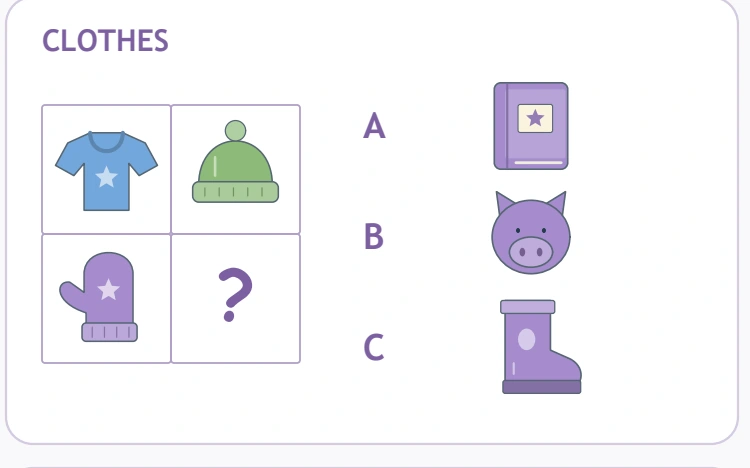
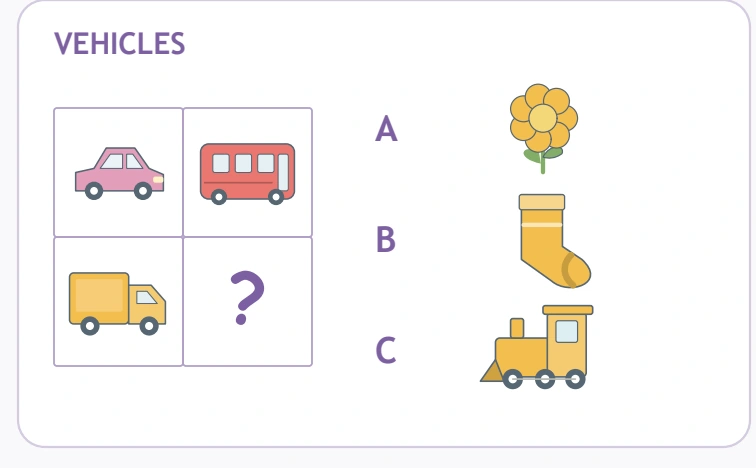
Clothing, farm animals, school things and vehicles provide four further rules. A boot belongs with clothing, a chicken with farm animals, a backpack with school things and a train with vehicles.
In reading order, the adult check is A, B, C, B, B, C. These are category choices, not a numerical sequence or a Sudoku grid. Circle the selected letter after discussing why the pictured candidate belongs.
Toy Team Categories: school equipment mistakes
A child may apply TOYS to every panel because it appears in the page title, or choose a favourite vehicle in the clothing task. Read each local category heading and check the proposed rule against every given picture before circling. Invite Nell to discuss school equipment with the teacher.
A group rule must fit three examples
The question-mark position comes after three category examples. Before offering a candidate, invite the child to describe a relationship that includes all three. A ball is round, but a kite makes round things a poor explanation of the toy panel. That counterexample is useful: it shows how an initially plausible property can be tested against the rest of the printed evidence.
A practical Toy Team Categories sequence
Toys and fruit with Nell
Begin Toy Team Categories: toys and fruit. Block A completes toys; strawberry B completes fruit. Ask Nell, “Which group are we solving now?” The teacher and Nell can inspect toys and fruit together.
Clothing and farm with Nell
Next inspect Toy Team Categories: clothing and farm. Boot C fits clothing; chicken B fits farm animals. Ask Nell, “What do all three share?” The teacher and Nell can inspect clothing and farm together.
School equipment with Nell
Then confirm Toy Team Categories: school equipment. Backpack B shares the school-things rule. Ask Nell, “Does our old rule still fit?” The teacher and Nell can inspect school equipment together.
Vehicle group with Nell
Finally record Toy Team Categories: vehicle group. Train C belongs with the three given vehicles. Ask Nell, “Which choice is a vehicle?” The teacher and Nell can inspect vehicle group together.
Toy Team Categories adult reference
| Printed clue | Source check |
|---|---|
| Toys and fruit | Block A completes toys; strawberry B completes fruit. |
| Clothing and farm | Boot C fits clothing; chicken B fits farm animals. |
| School equipment | Backpack B shares the school-things rule. |
| Vehicle group | Train C belongs with the three given vehicles. |
Classroom partners inspect clothing and farm
A teacher assigns each small group a different panel rather than all six at once. One group explains the farm-animal connection while another describes school equipment. Each explanation must include the three printed examples, not merely the selected option. For a Toy Team Categories partner visit, common properties is this toy team categories partnership focus.
Real objects can have several homes
A toy train can belong among toys and among vehicles in everyday sorting. Acknowledge that flexibility while explaining that each printed panel supplies a particular heading and set of examples. The child is solving the local membership question, not proving that an object can belong to only one category forever. This avoids turning a sensible real-world observation into an unnecessary disagreement.
Five play invitations after Toy Team Categories
Set up a sock-or-toy door
Put a sock and ball beside two labelled baskets, CLOTHES and TOYS. Add a third familiar object and explain its destination using a property rather than its colour. After this Toy Team Categories play round, ask the teacher which clue Nell chose to explain.
Invite a category guest
An adult describes a visitor to the farm group without naming it. The child proposes an animal and checks whether the description fits both the visitor and its future teammates. Let Nell demonstrate this example before another Toy Team Categories visit; ask the teacher to listen for Nell’s reasoning.
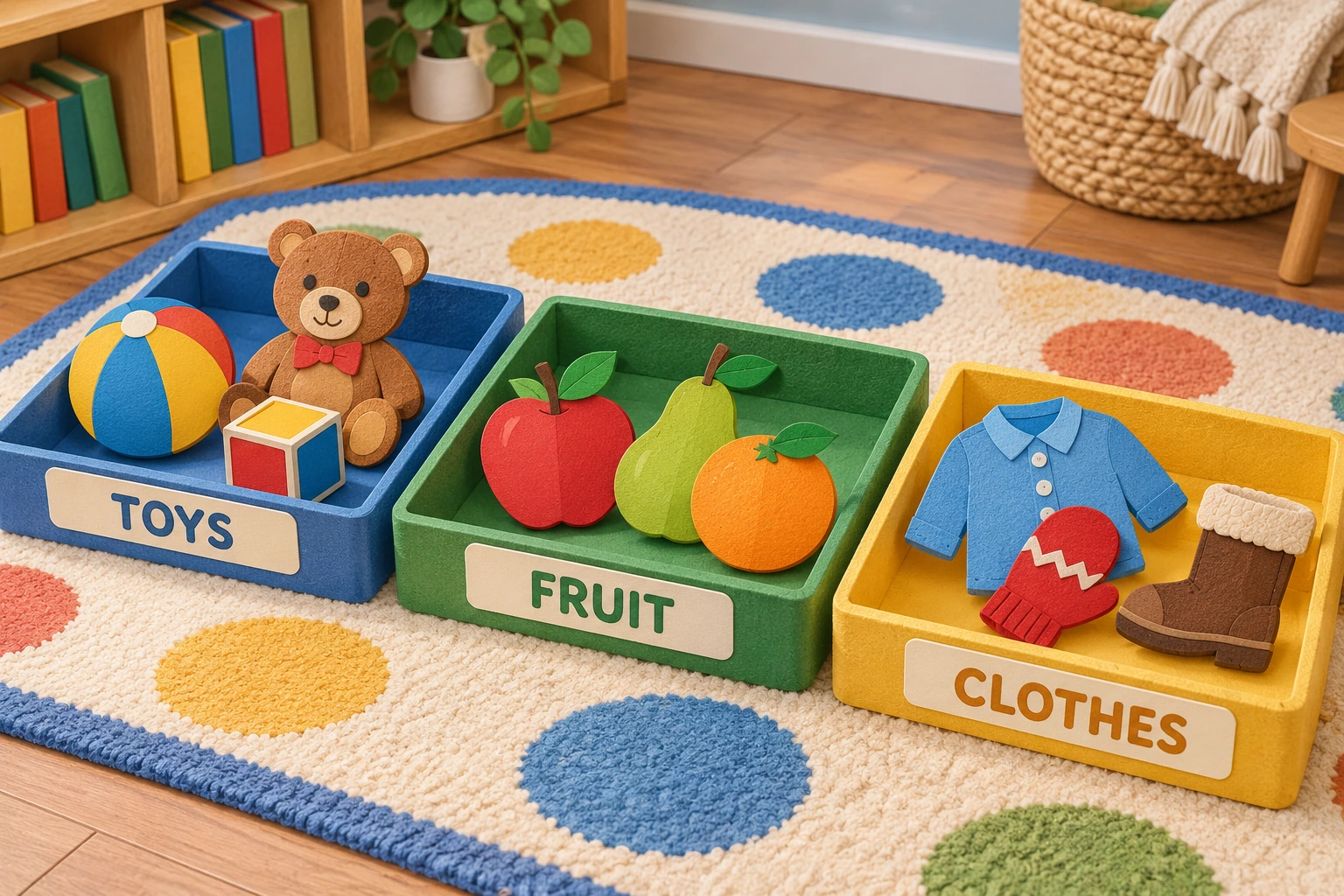
Change the tray heading
Place a toy car under TOYS, then move it under VEHICLES. Discuss how the same object can belong to more than one sensible real-world category while the printed panel still has a particular intended rule. On a later Toy Team Categories visit, ask Nell what changed; the teacher can discuss Nell’s evidence.
Make a school-things delivery
Collect a book, pencil and backpack. Ask a helper to deliver another appropriate school item and describe why a dinner spoon would need a different group heading. Ask Nell how this example relates to Toy Team Categories; the teacher can follow the clue that Nell identifies.
Challenge the fruit picnic
Build a pretend picnic containing three fruit pictures and one boot. Let the child explain the outsider and suggest a replacement that preserves the fruit rule. Keep Nell’s own explanation central in this Toy Team Categories game. Let the teacher hear what Nell observed.
6 observations in Toy Team Categories
Category boundaries: Which group are we solving now
Here, a local heading identifies the rule for one panel. The prompt “Which group are we solving now?” gives Nell a way to explain category boundaries to the teacher.
Common properties: What do all three share
Here, three examples support a rule beyond one favourite item. The prompt “What do all three share?” gives Nell a way to explain common properties to the teacher.
Flexible attention: Does our old rule still fit
In Toy Team Categories, the rule changes between clothing and farm animals. The prompt “Does our old rule still fit?” gives Nell a way to explain flexible attention to the teacher.
Vocabulary in context: What is this school object called
In Toy Team Categories, object names become useful when explaining membership. The prompt “What is this school object called?” gives Nell a way to explain vocabulary in context to the teacher.
Evidence before marking: Why does this choice belong
In Toy Team Categories, a circled letter follows a stated reason. The prompt “Why does this choice belong?” gives Nell a way to explain evidence before marking to the teacher.
Respectful discussion: Can your rule include every picture
In Toy Team Categories, partners can compare competing rules against visible examples. The prompt “Can your rule include every picture?” gives Nell a way to explain respectful discussion to the teacher.
Let a category change become audible
Before moving from fruit to clothing, pause and read the new heading together. Ask the child to say the new rule in their own words. This transition can be more demanding than identifying a single familiar object because the comparison criterion has changed. An adult who hears the old rule carried into the next panel can support that switch directly.
Imagine Nell at a home puzzle table
Nell sorts a mitten away from a ball while her teacher visits the family learning area. They call one set things we wear and another things we play with. Returning to the clothing panel gives those spoken rules a concrete printed test. Here, Toy Team Categories gives Nell a reason to discuss category boundaries using the Toy Team Mystery clues.
A category story needs an outsider
Tell a brief story about a boot arriving at a fruit picnic. Ask what would make it unsuitable as the next fruit guest, then invite a replacement. The point is not to mock an odd answer; it is to make the category property explicit. Return to the actual printed choices afterward so the imaginary story supports the task rather than replacing it.
A fresh Toy Team Categories reason to return
Revisit a panel with a new explanation challenge: name the rule without saying the heading. A child may describe vehicles as things that carry people or goods, then compare that idea with the pictures. Nell can show the teacher a new vehicle group observation during that short toy team categories visit.
Readiness for Toy Team Categories at ages 4–6
Read unfamiliar category headings aloud and name the pictures together. Pointing to the correct candidate can demonstrate grouping even if letter names or pencil circles need adult support. Suggested range for Toy Team Categories: ages 4–6. Explore category boundaries with an adult helper.
For a comfortable Toy Team Categories visit, let Nell show toys and fruit before the teacher requests another response. Discuss evidence before marking using the printed Toy Team Mystery example.
Save a printable Toy Team Categories copy
The clean Toy Team Categories printable is available through the premium download for members whose active plan provides access. It removes website watermark and domain text without changing the six category panels; no ads are embedded in the PDF. You can inspect the original sample separately. In print preview, keep both category columns and all six panels inside the paper margins. The same category sheet is included in the separately purchased $5 collection.
Toy Team Categories: another printable to explore
Extend the category boundaries conversation beyond Toy Team Categories with Toys and fruit before a road-width task; Flexible attention and picture-detail tracing; Vocabulary in context beside a car-and-flag maze.
Explore Toy Team Categories alongside NAEYC family-writing ideas and Toy Team Categories with PBS Parents literacy activities. Keep toys and fruit, vocabulary in context and respectful discussion connected to the pictured puzzle.
Popular Worksheets
Printable resources families and teachers are downloading now.
 Free
 Free
 Free
 Free