
Castle Mirror Puzzle: 4 Clever Same-Height Matches
Add the castle grid to your own puzzle rotation. The 25-page clean collection is priced at $5. It includes this reflection sheet plus the other provided puzzles, so a same-height comparison can lead naturally into a different activity.
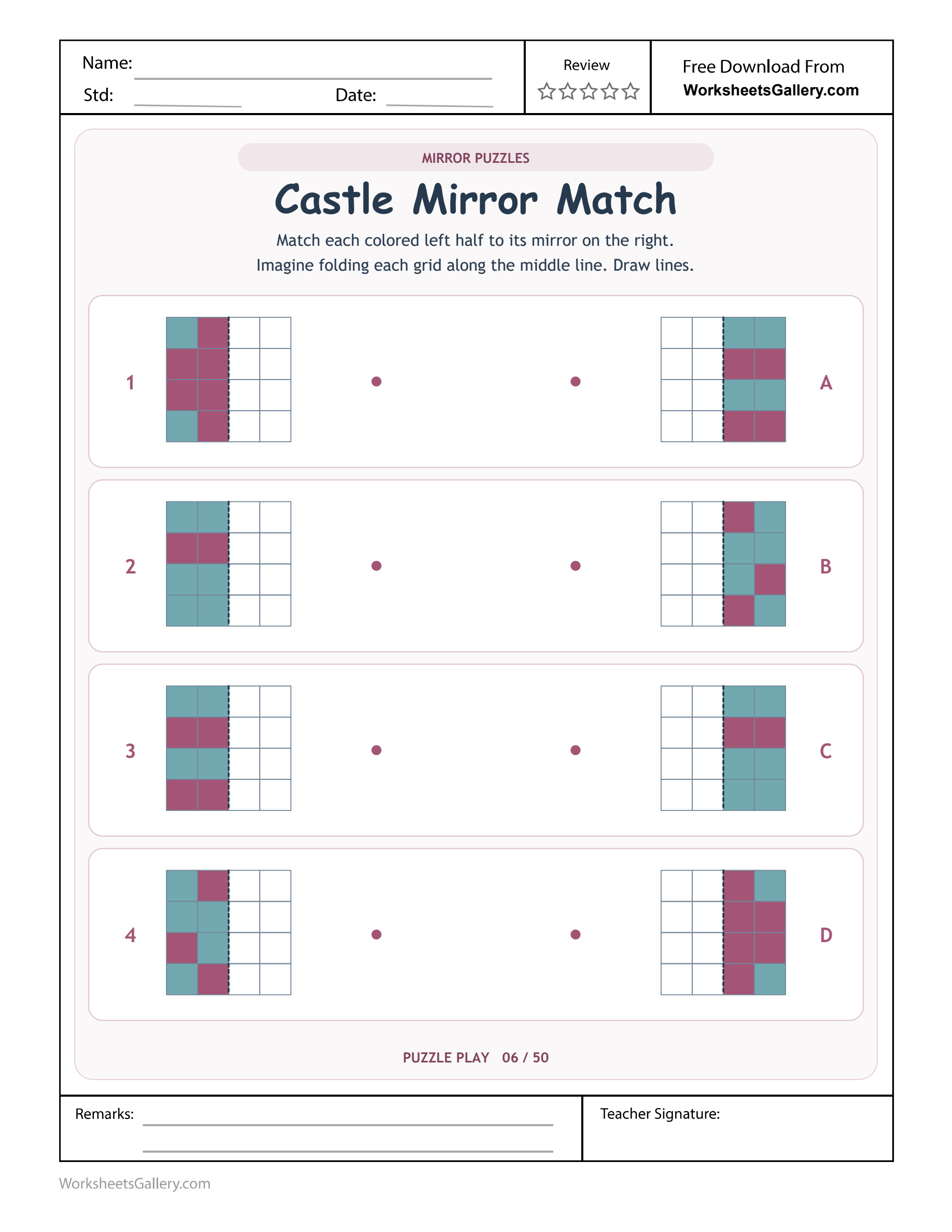
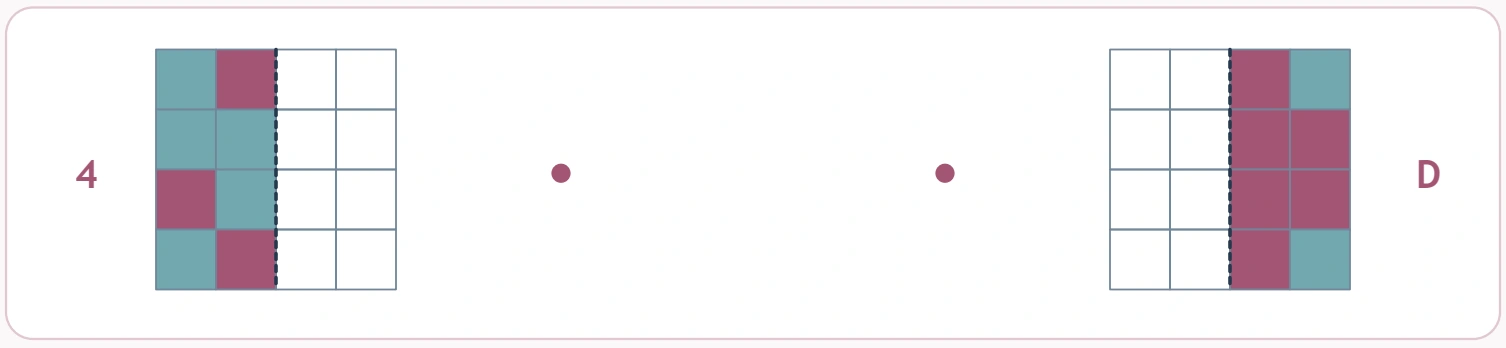
Some mirror matches become clearer when you start halfway down the grid. Castle Mirror Puzzle invites children to choose a distinctive teal-and-burgundy row, locate its reflected arrangement and check the remaining rows. Four numbered designs face four lettered candidates, with a vertical middle reference showing the reflection direction. An adult can help describe near-centre and outer cells while the child supplies the comparison. Equal amounts of colour are not enough; every patch must occupy the corresponding position in the finished match.
Castle Mirror Puzzle: the rule on this particular sheet
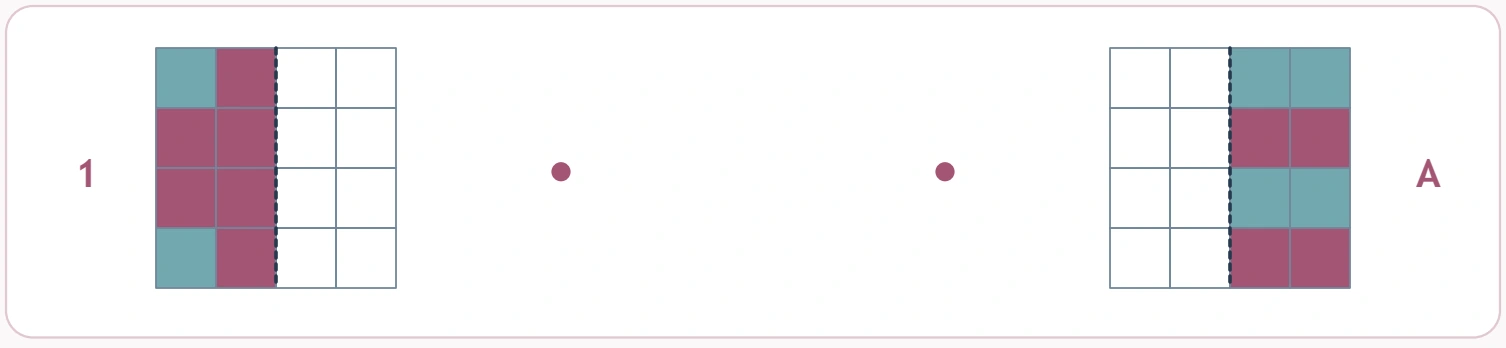
Teal and burgundy cells fill the left halves of four numbered grids. The child seeks the corresponding reflected right halves among A–D. The castle theme names the activity, but there is no castle silhouette to trace or draw.
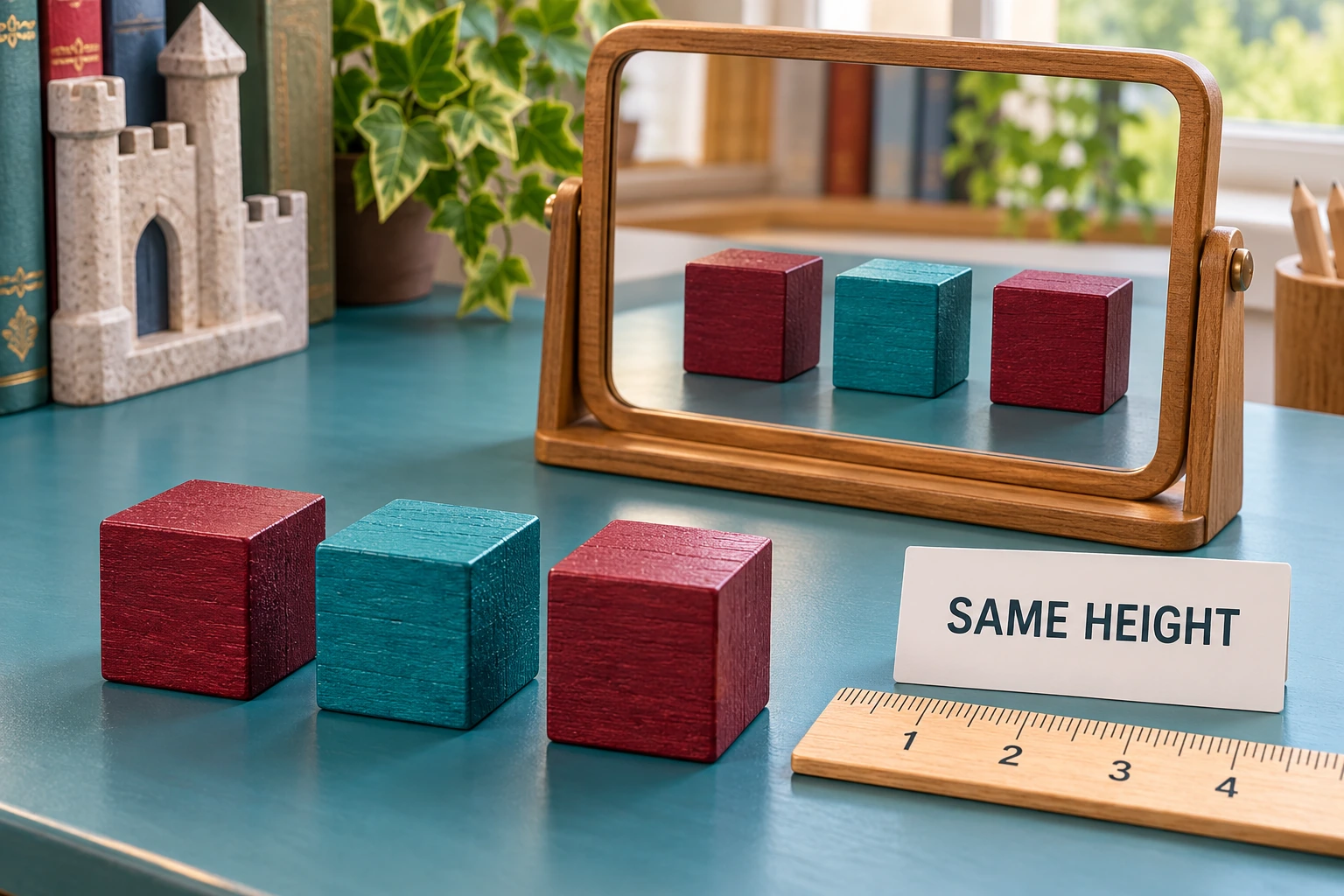
A vertical mirror changes horizontal placement while preserving the height of every cell. Examine one row as a near-middle and outer pair, then look for those colours in reversed order at the same height on a candidate.
What height check reveals
Some rows can look similar across different candidates. Choose a row with a distinctive colour change, use it to narrow the search and then confirm another row. A whole-grid match requires every corresponding coloured cell to agree.
The dotted vertical centre is a reference for imagining reflection. Joining lines connect the selected numbered and lettered grids; the child does not need to colour the empty halves or physically fold the printed page.
Choose a row with useful contrast
A row containing two different colours may distinguish candidates more quickly than a solid-colour row. Let the child explain why their chosen row seems informative, then inspect the remaining rows to confirm the pattern. There is no need to prescribe one fixed top-to-bottom search order. A deliberate starting point can make the comparison manageable without weakening the requirement that every cell ultimately agrees.
6 observations in Castle Mirror Puzzle
Strategic inspection: Which row gives the clearest clue
Here, a distinctive row can narrow several candidates. The prompt “Which row gives the clearest clue?” gives Reed a way to explain strategic inspection to the teaching assistant.
Position over totals: Are the colours in the right places
In Castle Mirror Puzzle, equal colour counts can hide different arrangements. The prompt “Are the colours in the right places?” gives Reed a way to explain position over totals to the teaching assistant.
Reflection language: Which square is farther from the line
In Castle Mirror Puzzle, near-axis and outer describe corresponding cells. The prompt “Which square is farther from the line?” gives Reed a way to explain reflection language to the teaching assistant.
Verifying a hypothesis: Does your candidate survive this row
In Castle Mirror Puzzle, a second comparison can support or reject an early match. The prompt “Does your candidate survive this row?” gives Reed a way to explain verifying a hypothesis to the teaching assistant.
Partner reasoning: Why did you inspect that row first
In Castle Mirror Puzzle, different search orders can lead to the same checked conclusion. The prompt “Why did you inspect that row first?” gives Reed a way to explain partner reasoning to the teaching assistant.
Intentional mark making: Have you checked before joining
In Castle Mirror Puzzle, a line records a comparison already supported by the grid. The prompt “Have you checked before joining?” gives Reed a way to explain intentional mark making to the teaching assistant.
A practical Castle Mirror Puzzle sequence
Distinctive row with Reed
Begin Castle Mirror Puzzle: distinctive row. Select a row that separates otherwise similar candidates. Ask Reed, “Which row gives the clearest clue?” The teaching assistant and Reed can inspect distinctive row together.
Axis distance with Reed
Next inspect Castle Mirror Puzzle: axis distance. Reverse the two positions across the vertical middle. Ask Reed, “Are the colours in the right places?” The teaching assistant and Reed can inspect axis distance together.
Height check with Reed
Then confirm Castle Mirror Puzzle: height check. Keep each coloured cell in its original horizontal row. Ask Reed, “Which square is farther from the line?” The teaching assistant and Reed can inspect height check together.
Whole pattern with Reed
Finally record Castle Mirror Puzzle: whole pattern. Inspect all four rows before drawing the final connection. Ask Reed, “Does your candidate survive this row?” The teaching assistant and Reed can inspect whole pattern together.
Castle Mirror Puzzle adult reference
| Printed clue | Source check |
|---|---|
| Distinctive row | Select a row that separates otherwise similar candidates. |
| Axis distance | Reverse the two positions across the vertical middle. |
| Height check | Keep each coloured cell in its original horizontal row. |
| Whole pattern | Inspect all four rows before drawing the final connection. |
Keep horizontal height stable
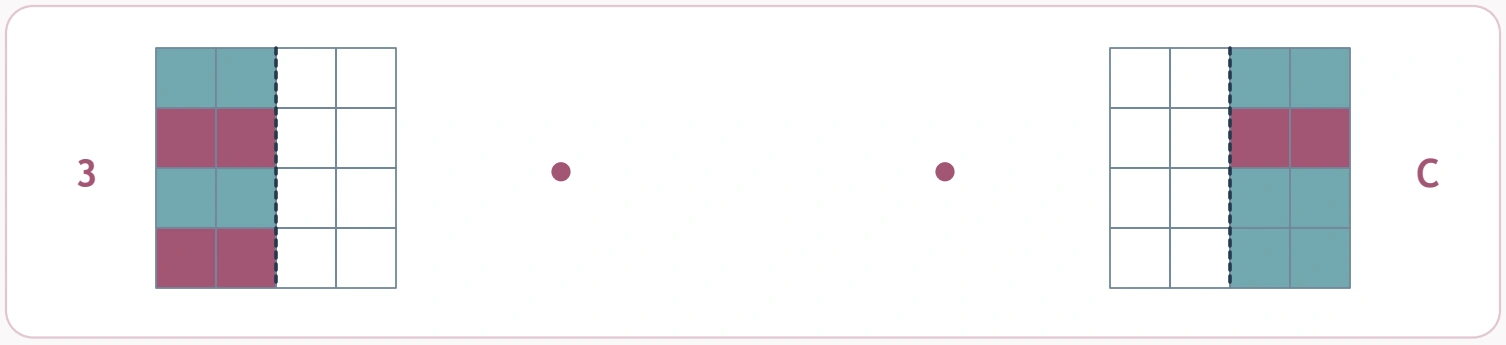
Imagine a tiny window travelling across the vertical middle at the same height. Its colour changes sides but does not jump into the row above or below. This description can support the castle theme without inventing a printed castle outline. Compare the actual teal and burgundy cells, using the window story only to clarify the spatial relationship that the supplied grids show.
Imagine Reed at a home puzzle table
Reed first studies a mixed-colour middle row, rather than the top of every grid. A teaching assistant asks him to explain why that row seems useful. He discovers that a distinctive clue can shorten a search when it is followed by a genuine whole-pattern check. Here, Castle Mirror Puzzle gives Reed a reason to discuss strategic inspection using the Castle Mirror Match clues.
Five play invitations after Castle Mirror Puzzle
Build a castle-window pair
Use coloured blocks as two rows of pretend windows beside a central divider. Construct the opposite windows as a reflection while keeping their heights stable. After this Castle Mirror Puzzle play round, ask the teaching assistant which clue Reed chose to explain.
Choose the best witness row
Prepare two small reflected designs that differ in one row. Ask the child which row would most quickly distinguish them and then check that prediction. Let Reed demonstrate this example before another Castle Mirror Puzzle visit; ask the teaching assistant to listen for Reed’s reasoning.
Compare equal colour totals
Arrange two teal and two burgundy counters differently on two mats. Discuss why equal totals cannot settle a positional mirror question. On a later Castle Mirror Puzzle visit, ask Reed what changed; the teaching assistant can discuss Reed’s evidence.
Send a row message
A child describes a pair as burgundy near the middle and teal outside. A partner builds its reflection using those relationships rather than a left-to-right colour chant. Ask Reed how this example relates to Castle Mirror Puzzle; the teaching assistant can follow the clue that Reed identifies.
Repair the shifted window
Move one reflected block down a row. Let a castle inspector identify the height error and return the block to the position that preserves the mirror relationship. Keep Reed’s own explanation central in this Castle Mirror Puzzle game. Let the teaching assistant hear what Reed observed.
Equal quantities can hide a wrong arrangement
Two candidate halves can contain similar amounts of teal and burgundy while placing those colours differently. Counting colours may describe the design, but it cannot settle a reflection match. Ask where one distinctive burgundy cell sits relative to the middle and a particular row. The child then has a positional claim that can be tested against the candidate rather than a broad impression of similarity.
Castle Mirror Puzzle: height check mistakes
A matching quantity of teal squares does not guarantee the correct mirror partner: their positions matter. Likewise, moving a burgundy cell into a different row breaks reflection even if the total colour counts remain the same. Invite Reed to discuss height check with the teaching assistant.
Classroom partners inspect axis distance
In a comparison station, children choose their own starting row and announce it to a partner. One says top row; another chooses the lowest mixed row. The class can compare the strategies without treating one inspection order as the only acceptable method. For a Castle Mirror Puzzle partner visit, position over totals is this castle mirror puzzle partnership focus.
Share inspection without surrendering the decision
A partner may report one row while the child checks another. Ask both to point to the relevant cells and explain any disagreement. The partner should contribute evidence rather than simply announce a preferred letter. When the two reports agree, return to the whole grid for a final look, keeping the child’s connecting line tied to a decision they helped justify.
Readiness for Castle Mirror Puzzle at ages 4–6
Point across one row with an adult before comparing the full grid. Children who find the colours difficult to distinguish can use a spoken description of the relevant cells while retaining the spatial rule. Suggested range for Castle Mirror Puzzle: ages 4–6. Begin with strategic inspection and adult support.
For a comfortable Castle Mirror Puzzle visit, let Reed show distinctive row before the teaching assistant requests another response. Discuss partner reasoning using the printed Castle Mirror Match example.
A fresh Castle Mirror Puzzle reason to return
Invite the child to justify a rejected candidate on another visit. Explaining one mismatched row can be as informative as naming the correct finished partner. Reed can show the teaching assistant a new whole pattern observation during that short castle mirror puzzle visit.
Save a printable Castle Mirror Puzzle copy
An active eligible member can download the clean Castle Mirror Puzzle PDF through the premium option. Website-domain branding and the watermark are removed, while teal-burgundy grids and their matching instructions stay intact. There are no embedded ads. Keep the original sample separate if you want to compare editions. Printer preview should retain all four numbered designs and all four candidates. Purchasing the $5 twenty-five-sheet collection is another way to obtain this included puzzle.
Castle Mirror Puzzle: another printable to explore
Extend the strategic inspection conversation beyond Castle Mirror Puzzle with Distinctive row before a road-width task; Reflection language and picture-detail tracing; Verifying a hypothesis beside a car-and-flag maze.
Explore Castle Mirror Puzzle alongside NAEYC family-writing ideas and Castle Mirror Puzzle with PBS Parents literacy activities. Keep distinctive row, verifying a hypothesis and intentional mark making connected to the pictured puzzle.
Popular Worksheets
Printable resources families and teachers are downloading now.
 Free
 Free
 Free
 Free