
Rainbow Corner Match: 5 Bright Keep-It-Upright Puzzles
Let rainbow corner decisions open a broader selection. Buy the supplied 25-sheet set for $5 in its clean combined PDF edition. This upright-piece activity shares the download with mazes, picture crosswords, Sudoku codes and other tasks.
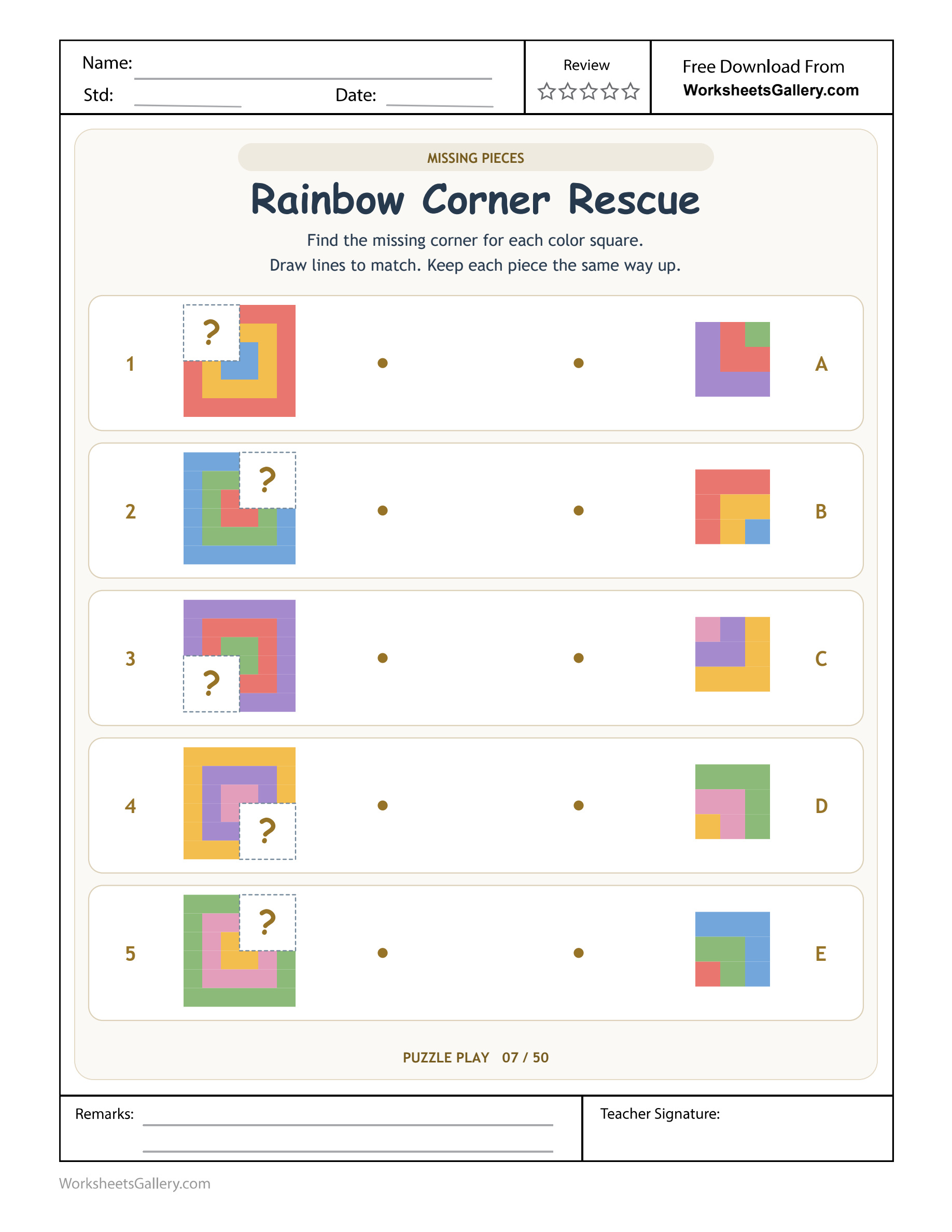
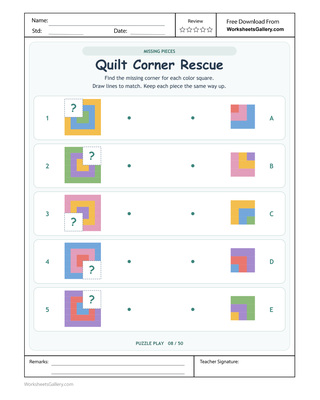
The missing corner looks small, yet two neighbouring edges can give it a very precise job. In Rainbow Corner Match, five colour squares need partners from a lettered choice column. Children compare the patches touching each gap and keep every candidate the same way up, following the source instruction. A piece that works only after turning would solve a different problem. Name the corner location, inspect both joins and let the connecting line record a choice already supported by visible colour evidence.
Rainbow Corner Match: the rule on this particular sheet
Five colour squares each have a missing corner marked by a question mark. The five lettered options supply small replacement pieces. A valid match continues the surrounding pattern in the existing orientation.
The printed instruction explicitly says to keep each piece the same way up. This is a fixed-orientation comparison, so mentally rotating a candidate to make it fit would change the supplied task.

What second boundary reveals
Inspect the colour immediately beside one edge of the missing corner, then the colour beside its other edge. Those two boundary clues are more informative than noticing a bright patch somewhere in a candidate.
A joining line records the selected corner partner. The page does not require scissors, glue or a newly drawn missing section. Looking closely at the visible seams supplies the comparison evidence.
Rainbow Corner Match: second boundary mistakes
Matching one colour anywhere on a piece is insufficient. Also avoid rotating the worksheet or treating each missing corner as though it occurs in the same position. Name the location of the particular gap before comparing its boundaries. Invite Lila to discuss second boundary with the uncle.

Identify this corner before searching
The missing section does not occupy the same location in every numbered square. Say where the gap sits, then inspect the patches touching it. A child who assumes every gap is top-right may search for a piece using the wrong neighbours. Naming the position first makes the subsequent colour comparison specific to the current square and prevents an earlier row from supplying an inappropriate shortcut.
A practical Rainbow Corner Match sequence
Locate the gap with Lila
Begin Rainbow Corner Match: locate the gap. Notice which corner is missing in this numbered square. Ask Lila, “How would this edge continue?” The uncle and Lila can inspect locate the gap together.
First boundary with Lila
Next inspect Rainbow Corner Match: first boundary. Describe the colour patch touching one open edge. Ask Lila, “Has the piece been turned?” The uncle and Lila can inspect first boundary together.
Second boundary with Lila
Then confirm Rainbow Corner Match: second boundary. Check the other adjoining edge before accepting a piece. Ask Lila, “Does it agree at both seams?” The uncle and Lila can inspect second boundary together.
Upright candidate with Lila
Finally record Rainbow Corner Match: upright candidate. Keep the option in its printed orientation while comparing. Ask Lila, “Which corner are we inspecting?” The uncle and Lila can inspect upright candidate together.
Rainbow Corner Match adult reference
| Printed clue | Source check |
|---|---|
| Locate the gap | Notice which corner is missing in this numbered square. |
| First boundary | Describe the colour patch touching one open edge. |
| Second boundary | Check the other adjoining edge before accepting a piece. |
| Upright candidate | Keep the option in its printed orientation while comparing. |

Classroom partners inspect first boundary
Partners divide the inspection: one describes the upper boundary beside a gap, the other describes the side boundary. They combine the two clues before looking at A–E, so a loud first guess does not replace the evidence. For a Rainbow Corner Match partner visit, orientation awareness is this rainbow corner match partnership focus.

Two seams can eliminate a near match
Suppose a candidate continues the blue patch along one boundary but introduces a different colour at the other. The first agreement is worth noticing, but the second mismatch rules the piece out. Ask the child to show both joins, retaining what was observed accurately. This keeps the explanation more precise than saying the entire piece looks wrong without identifying where its colours stop agreeing.
Five play invitations after Rainbow Corner Match
Seat an upright felt corner
Create a simple completed felt square with a removable top-right corner. Replace it while a TOP label remains visible and inspect the two joins. After this Rainbow Corner Match play round, ask the uncle which clue Lila chose to explain.
Give two seam reports
One player describes the top seam, another the side seam. A builder selects a corner using both reports, then checks the completed arrangement. Let Lila demonstrate this example before another Rainbow Corner Match visit; ask the uncle to listen for Lila’s reasoning.

Make an orientation checkpoint
Put an arrow above every loose example piece. Ask the child to catch any piece that has been turned before its colours are compared. On a later Rainbow Corner Match visit, ask Lila what changed; the uncle can discuss Lila’s evidence.
Reject a one-edge match
Offer a candidate that continues one boundary but interrupts the other. The child identifies the failing seam and explains why one matching colour is insufficient. Ask Lila how this example relates to Rainbow Corner Match; the uncle can follow the clue that Lila identifies.
Design a tiny colour patch
Build a four-part colour arrangement from large paper squares and remove one corner. A partner supplies a correctly oriented replacement based on the visible neighbours. Keep Lila’s own explanation central in this Rainbow Corner Match game. Let the uncle hear what Lila observed.
6 observations in Rainbow Corner Match
Part-to-whole reasoning: How would this edge continue
Here, a small corner must continue the larger colour arrangement. The prompt “How would this edge continue?” gives Lila a way to explain part-to-whole reasoning to the uncle.
Orientation awareness: Has the piece been turned
Here, upright candidates preserve the printed comparison rule. The prompt “Has the piece been turned?” gives Lila a way to explain orientation awareness to the uncle.
Combining boundary clues: Does it agree at both seams
Here, two neighbouring edges constrain the missing part. The prompt “Does it agree at both seams?” gives Lila a way to explain combining boundary clues to the uncle.
Spatial description: Which corner are we inspecting
In Rainbow Corner Match, corner locations can be explained with position words. The prompt “Which corner are we inspecting?” gives Lila a way to explain spatial description to the uncle.
Careful rejection: Where does the colour stop agreeing
In Rainbow Corner Match, a single seam mismatch supplies a clear reason to reject. The prompt “Where does the colour stop agreeing?” gives Lila a way to explain careful rejection to the uncle.
Shared observation: What did you see on your edge
In Rainbow Corner Match, partners contribute separate clues to one decision. The prompt “What did you see on your edge?” gives Lila a way to explain shared observation to the uncle.
Same way up is part of the challenge
The fixed-orientation rule means a corner that would fit after turning is still unsuitable as printed. Demonstrate upright with a large separate felt piece and a TOP label if the wording is unfamiliar. Do not rotate the child’s worksheet choices to show a solution. The physical demonstration should clarify the rule while leaving the original five comparisons available for the child to inspect.
Imagine Lila at a home puzzle table
Lila wants to turn a paper corner until it looks suitable. Her uncle points to the upright instruction and places a TOP card beside their separate felt example. They check the two touching edges while leaving the printed choices facing the original way. Here, Rainbow Corner Match gives Lila a reason to discuss part-to-whole reasoning using the Rainbow Corner Rescue clues.
A line is a record of a corner decision
Touch the numbered square, then the chosen lettered piece before drawing. The line can travel diagonally and may cross another connection because the options are shuffled. Inspect the two endpoints and the boundary colours afterward. A smooth mark is welcome, but it cannot substitute for the evidence that the selected upright corner continues the surrounding patches at both joins.
A fresh Rainbow Corner Match reason to return
Revisit a different missing-corner position next time. Ask the child to name the two boundary clues before seeing the old connecting line, giving the comparison a fresh starting point. Lila can show the uncle a new upright candidate observation during that short rainbow corner match visit.
Readiness for Rainbow Corner Match at ages 4–6
Cover extra candidates temporarily if the choice column is overwhelming, while keeping the missing square and its surrounding patches visible. Explain upright with a completed separate example rather than rotating a printed option. Suggested range for Rainbow Corner Match: ages 4–6. Begin with part-to-whole reasoning and adult support.
For a comfortable Rainbow Corner Match visit, let Lila show locate the gap before the uncle requests another response. Discuss careful rejection using the printed Rainbow Corner Rescue example.
Save a printable Rainbow Corner Match copy
Save the premium Rainbow Corner Match edition using an eligible active membership. The printable removes website watermark and domain references, preserves the upright-corner instructions and contains no ads within the PDF. The supplied original can be viewed through its separate sample option. Check the five numbered squares and the complete A–E column in portrait print preview. The $5 collection purchase combines this rainbow task with twenty-four other supplied sheets in one clean document.
Rainbow Corner Match: another printable to explore
Extend the part-to-whole reasoning conversation beyond Rainbow Corner Match with Locate the gap before a road-width task; Combining boundary clues and picture-detail tracing; Spatial description beside a car-and-flag maze.
Explore Rainbow Corner Match alongside NAEYC family-writing ideas and Rainbow Corner Match with PBS Parents literacy activities. Keep locate the gap, spatial description and shared observation connected to the pictured puzzle.
Popular Worksheets
Printable resources families and teachers are downloading now.
 Free
 Free
 Free
 Free