
Shape Code Sudoku: 4 Brilliant Symbols to Reason With
Keep shape-code deductions close to other visual discoveries. Choose the clean 25-sheet collection for $5 to download the full uploaded selection together. This small Sudoku offers one option among the supplied word, route, pattern and comparison puzzles.
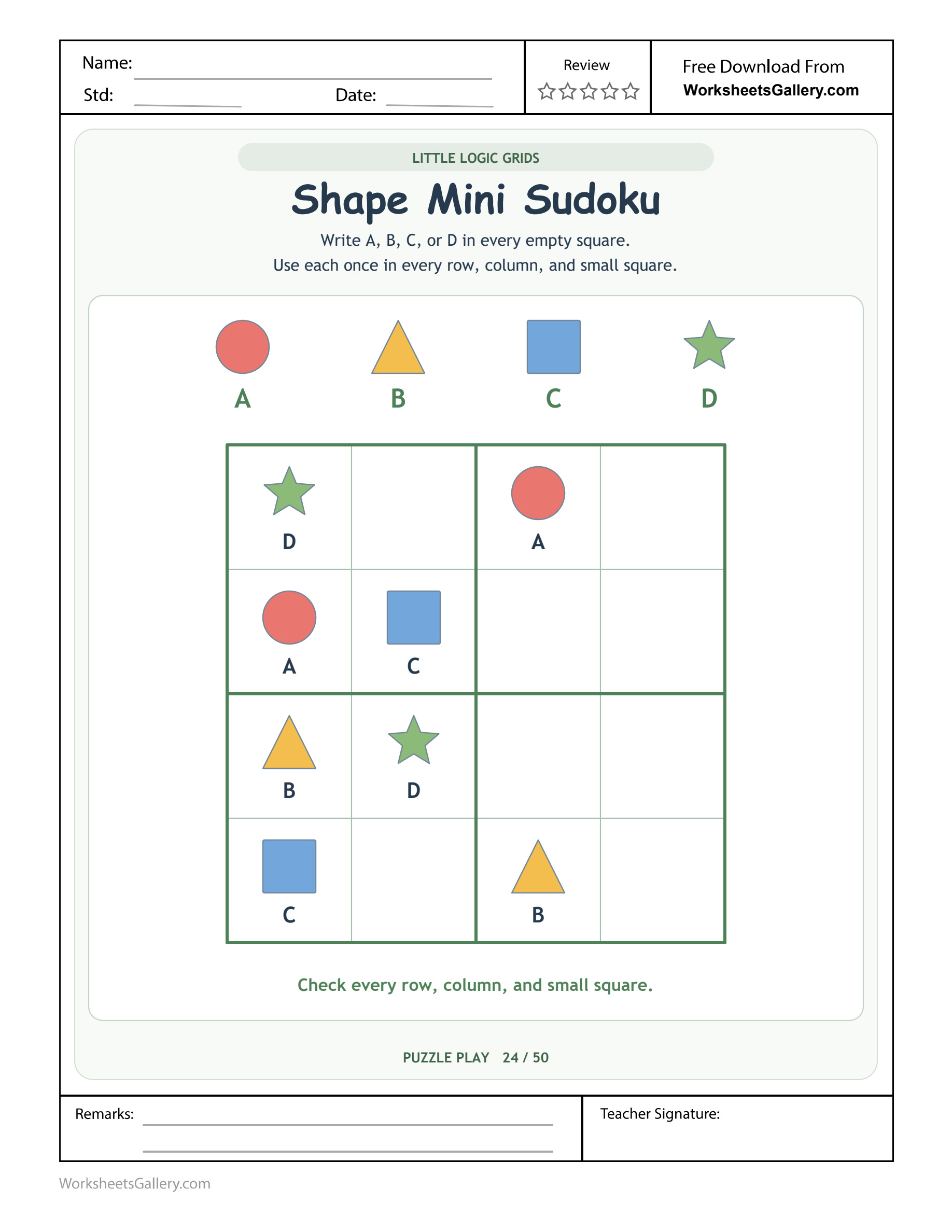
A heavy border around four small cells is part of the Sudoku rule, not just decoration. Shape Code Sudoku asks children to use that two-by-two box alongside each crossing row and column when selecting an A–D code. Circle, triangle, square and star pictures identify the four symbols, but the responses are written letters. An adult can help name missing candidates while the child checks which possibilities conflict elsewhere. One well-explained placement provides a useful start without demanding a full grid of unsupported guesses.
Shape Code Sudoku: the rule on this particular sheet
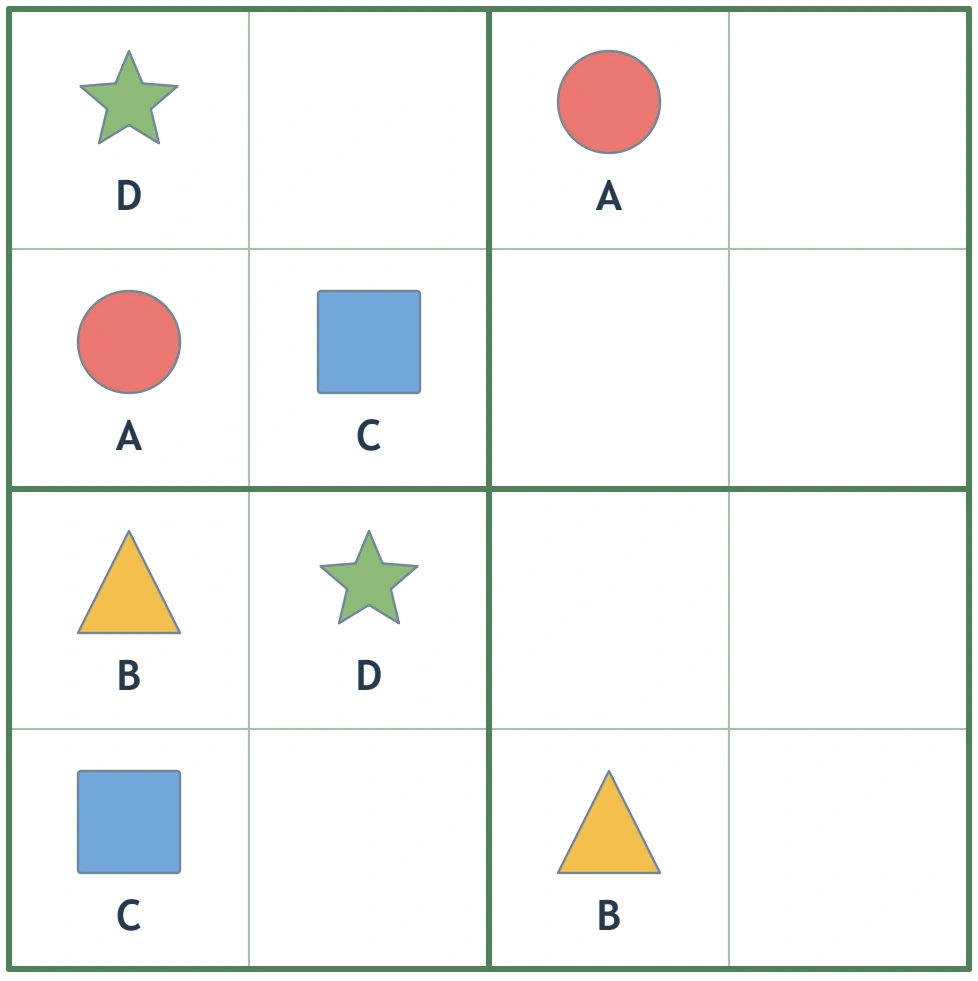
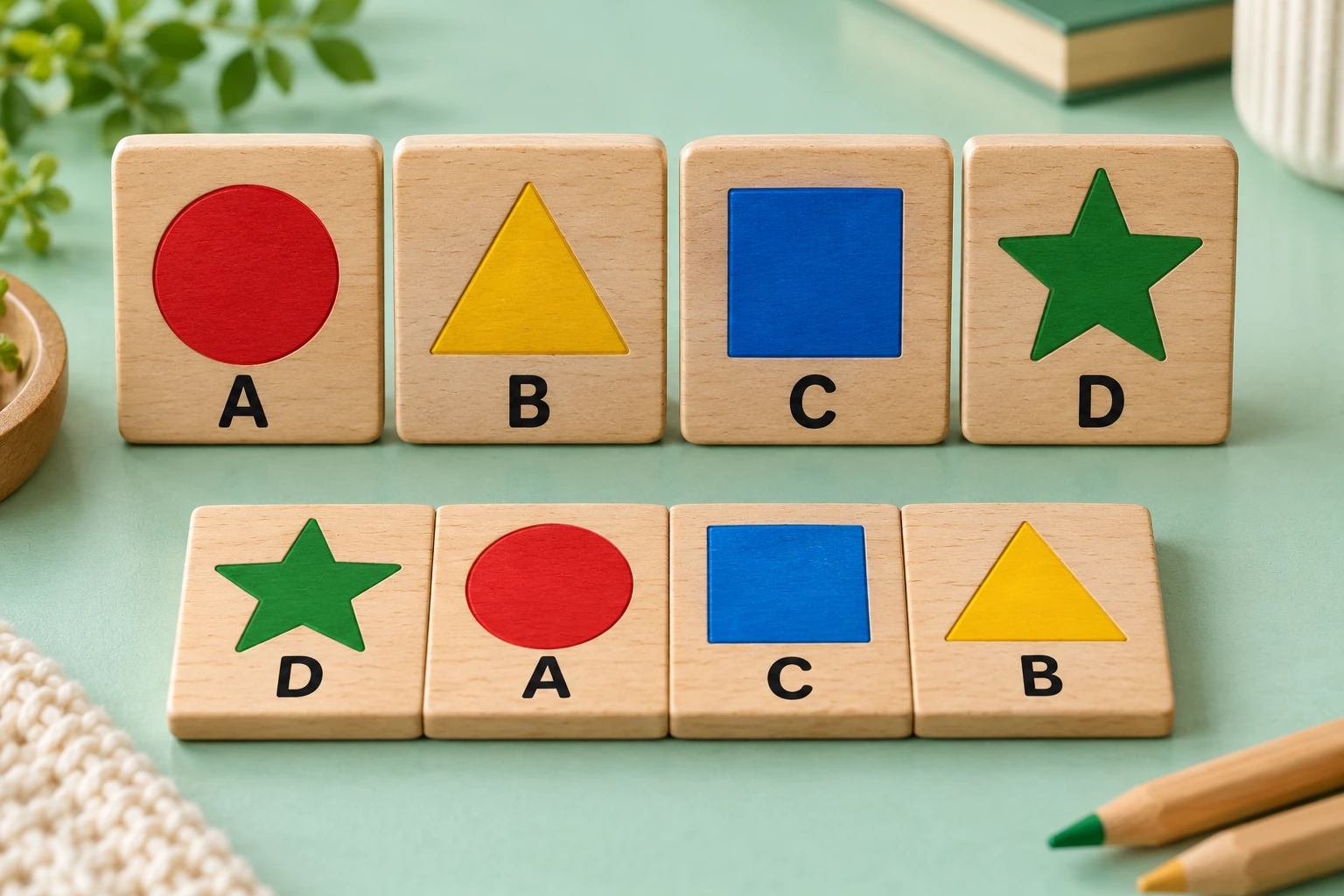
The shape code key is A red circle, B triangle, C blue square and D green star. Children write A, B, C or D in the empty Sudoku cells, using each once per row, column and small two-by-two box.
Eight code positions are given in the four-by-four grid. The empty positions remain intended response spaces. No shape drawing, colouring key or physical cut-out tile activity is required by the printed instruction.

What crossing evidence reveals
Start by inspecting a small box and naming which codes are missing. Compare those possibilities with a crossing row or column, rejecting any code already present in that group before writing a letter.
Shape identity can help a child remember the key, but the constraints use the four codes consistently. A red circle is not an instruction to colour a cell red, and a star picture does not change the once-per-group rule.
A small box is a complete rule group
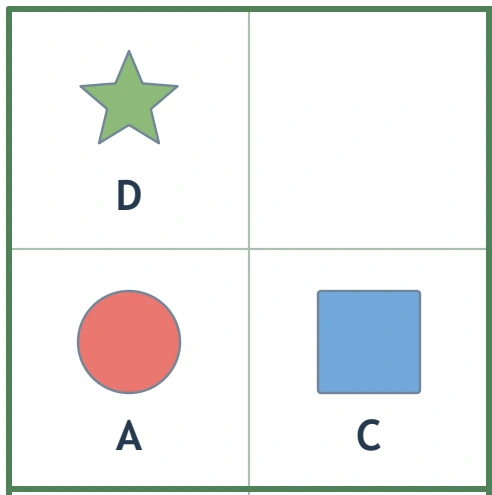
The heavier borders divide the grid into four two-by-two enclosures. Each enclosure needs one of every code, just as a row and a column do. Follow the selected box boundary before naming its missing letters. This makes the third constraint visible for a child who has been checking only horizontal and vertical lines and wondering why a candidate still creates a problem.
Imagine Tessa at a home puzzle table
Tessa names the missing codes in a small box with her grandfather. One candidate repeats a code already present in the crossing column, leaving a better-supported choice. The box becomes a useful starting point rather than another border to overlook. Here, Shape Code Sudoku gives Tessa a reason to discuss using nested groups using the Shape Mini Sudoku clues.
A practical Shape Code Sudoku sequence
Shape key with Tessa
Begin Shape Code Sudoku: shape key. A circle, B triangle, C square and D star name four codes. Ask Tessa, “Which codes are missing from this little square?” The grandfather and Tessa can inspect shape key together.
Small box first with Tessa
Next inspect Shape Code Sudoku: small box first. List codes absent from the selected two-by-two enclosure. Ask Tessa, “Which option conflicts with the column?” The grandfather and Tessa can inspect small box first together.
Crossing evidence with Tessa
Then confirm Shape Code Sudoku: crossing evidence. Use the row and column to reject conflicting candidates. Ask Tessa, “What letter represents the blue square?” The grandfather and Tessa can inspect crossing evidence together.
Letter response with Tessa
Finally record Shape Code Sudoku: letter response. Place one justified capital in the selected empty cell. Ask Tessa, “Have we checked the third group too?” The grandfather and Tessa can inspect letter response together.
Shape Code Sudoku adult reference
| Printed clue | Source check |
|---|---|
| Shape key | A circle, B triangle, C square and D star name four codes. |
| Small box first | List codes absent from the selected two-by-two enclosure. |
| Crossing evidence | Use the row and column to reject conflicting candidates. |
| Letter response | Place one justified capital in the selected empty cell. |
Codes keep shape identity manageable
The key connects a red circle with A, a triangle with B, a blue square with C and a green star with D. Use that key openly whenever a symbol is uncertain. The puzzle asks for letter responses in empty cells, so drawing or colouring a shape is an extra task. Keeping to the codes leaves attention available for the actual constraint reasoning.
5 observations in Shape Code Sudoku
Using nested groups: Which codes are missing from this little square
Here, a small box supplies a second scale of evidence. The prompt “Which codes are missing from this little square?” gives Tessa a way to explain using nested groups to the grandfather.
Candidate comparison: Which option conflicts with the column
Here, several possible codes can be narrowed by crossing information. The prompt “Which option conflicts with the column?” gives Tessa a way to explain candidate comparison to the grandfather.
Symbol consistency: What letter represents the blue square
In Shape Code Sudoku, each shape keeps the same A–D code throughout. The prompt “What letter represents the blue square?” gives Tessa a way to explain symbol consistency to the grandfather.
Rule completeness: Have we checked the third group too
In Shape Code Sudoku, row, column and small box all matter. The prompt “Have we checked the third group too?” gives Tessa a way to explain rule completeness to the grandfather.
Reasoned recording: Why does this code belong here
In Shape Code Sudoku, a letter follows a stated elimination argument. The prompt “Why does this code belong here?” gives Tessa a way to explain reasoned recording to the grandfather.
Shape Code Sudoku: crossing evidence mistakes
A child may follow rows and columns but ignore the heavier small-box boundaries. Trace the relevant two-by-two enclosure with a finger before testing a candidate. Do not substitute shape drawings for the requested A–D response codes. Invite Tessa to discuss crossing evidence with the grandfather.
Missing candidates are not all equally possible
A small box may lack two codes, but one of those can already be present in the crossing column. That conflict eliminates it for the selected cell. Ask the child to point to the existing code that rules the candidate out. This turns an uncertain choice between two letters into a concrete comparison with a visible given rather than an invitation to guess.
Five play invitations after Shape Code Sudoku
Build a completed shape key
Arrange circle A, triangle B, square C and star D cards in one row. Compare each picture with its capital so the code vocabulary is secure before using a grid. After this Shape Code Sudoku play round, ask the grandfather which clue Tessa chose to explain.
Inspect a tiny four-tile box
Place three different code tiles in a two-by-two model and identify the absent fourth. Keep this small example separate from the supplied Sudoku answer. Let Tessa demonstrate this example before another Shape Code Sudoku visit; ask the grandfather to listen for Tessa’s reasoning.
Reject a column conflict
Offer two possible codes for a model cell while one already appears above it. Ask the checker to explain why that code cannot be repeated in the column. On a later Shape Code Sudoku visit, ask Tessa what changed; the grandfather can discuss Tessa’s evidence.
Name the overlooked group
An adult checks only a row and column. A child inspector points to the small box and supplies the third rule that still needs attention. Ask Tessa how this example relates to Shape Code Sudoku; the grandfather can follow the clue that Tessa identifies.
Explain a complete code strip
Use a finished D-A-C-B strip and confirm that each code appears once. Then discuss why a full Sudoku also requires vertical and small-box checks. Keep Tessa’s own explanation central in this Shape Code Sudoku game. Let the grandfather hear what Tessa observed.
Classroom partners inspect small box first
A teacher assigns partners the roles of box reader and crossing-group checker. They compare candidate codes aloud, then write only after the row, column and two-by-two box all accept the proposed letter. For a Shape Code Sudoku partner visit, candidate comparison is this shape code sudoku partnership focus.
A contradiction can identify where to inspect
If a newly written code creates a duplicate, name the affected row, column or small box. Return to the candidate’s reason and compare it with the conflicting given. There is no need to erase several unrelated entries immediately. A local explanation of the error can preserve other sound decisions and show how the three constraints work together on the same square.
Readiness for Shape Code Sudoku at ages 5–7
Use the completed shape key openly and begin with one small group. A child can propose a code orally while an adult helps organise the three checks and records a clearly justified response. Suggested range for Shape Code Sudoku: ages 5–7. Begin with using nested groups and adult support.
For a comfortable Shape Code Sudoku visit, let Tessa show shape key before the grandfather requests another response. Discuss reasoned recording using the printed Shape Mini Sudoku example.
A fresh Shape Code Sudoku reason to return
Return to one small box and ask how crossing information narrowed its candidates. Keep attention on the reason for a code rather than memorising a completed row. Tessa can show the grandfather a new letter response observation during that short shape code sudoku visit.
Save a printable Shape Code Sudoku copy
The premium Shape Code Sudoku printable is available to eligible members with active access. Its PDF removes the website watermark and domain, contains no embedded advertisements and preserves the shape key and three Sudoku constraints. The original upload remains available through a separate sample. Inspect the entire code grid and heavier two-by-two borders before choosing printer scaling. Purchasing the $5 collection provides this shape puzzle with twenty-four other supplied clean worksheets.
Shape Code Sudoku: another printable to explore
Extend the using nested groups conversation beyond Shape Code Sudoku with Shape key before a road-width task; Symbol consistency and picture-detail tracing; Rule completeness beside a car-and-flag maze.
Explore Shape Code Sudoku alongside NAEYC family-writing ideas and Shape Code Sudoku with PBS Parents literacy activities. Keep shape key, rule completeness and error localisation connected to the pictured puzzle.
Popular Worksheets
Printable resources families and teachers are downloading now.
 Free
 Free
 Free
 Free