
Turtle Pond Maze: 4 Gentle Route-Finding Adventures
Follow the turtle maze with a different kind of clue. A $5 bundle purchase provides one clean PDF containing the 25 uploaded activity sheets. This rectangular route is included alongside the other mazes and a broad range of visual puzzles.
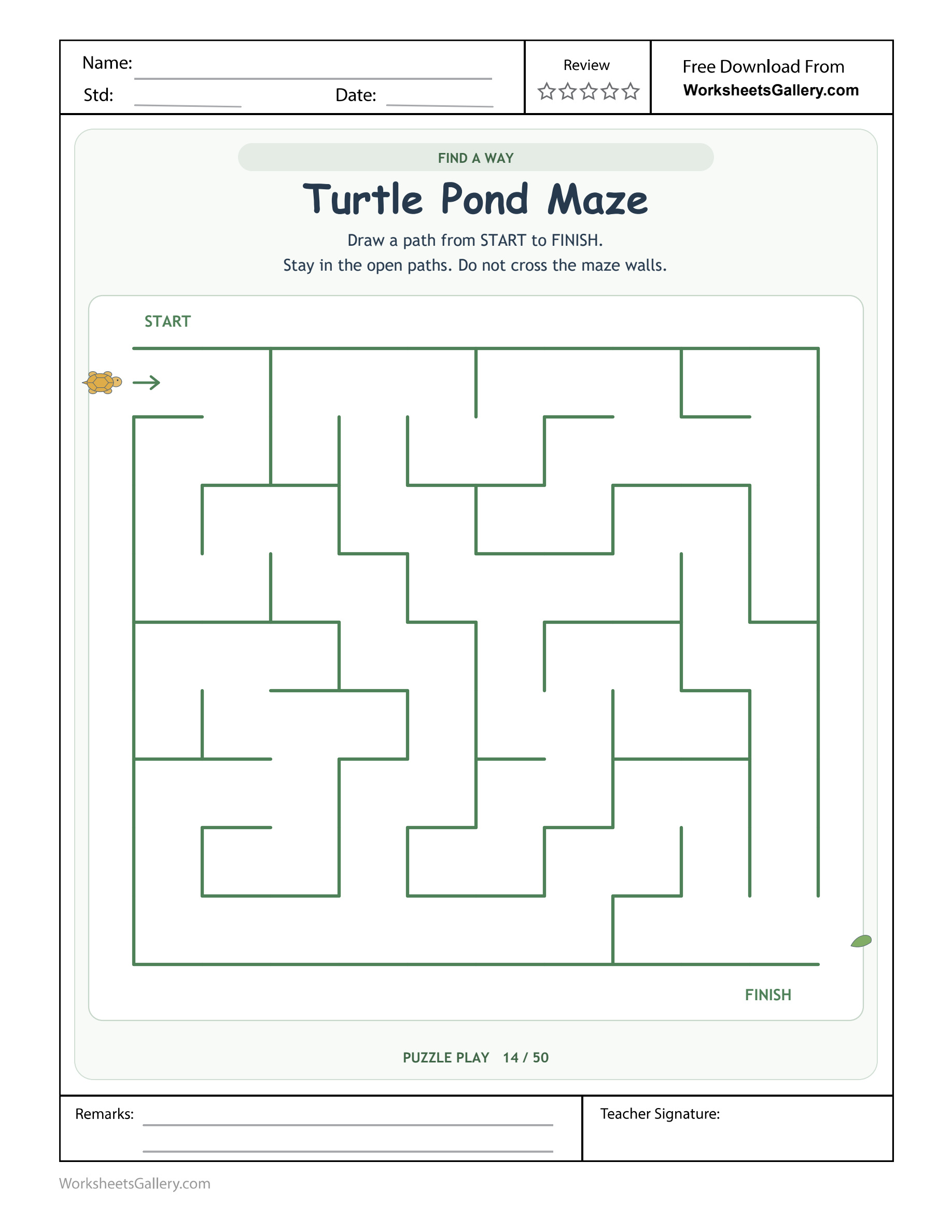
A turtle reaching a dead end has learned something about the pond route. Turtle Pond Maze makes that discovery useful by inviting children to return to an earlier choice and inspect another opening. The rectangular maze runs from an upper-left START near the turtle to a lower-right FINISH beside a leaf. Keep the journey connected and stay within the open corridors. A calm conversation about the previous fork can turn frustration into a specific next action, especially when an adult separates choosing a passage from drawing it neatly.
Turtle Pond Maze: learn from blocked branches
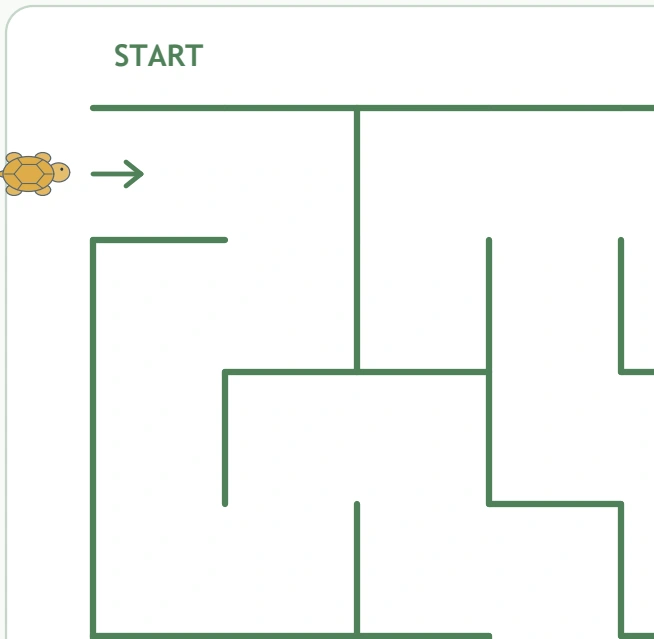
The turtle starts near the upper-left START of a rectangular maze and seeks the leaf beside the lower-right FINISH. Open corridors, not proximity to the leaf, decide which movements are possible.
When a branch ends, identify the last place that offered a genuine alternative. Returning there preserves the maze rule and gives the next attempt a clear beginning instead of sending the pencil through a wall.
What previous choice reveals
Backtracking need not mean erasing every trace of thought. With an adult, a child can point back along the attempted corridor, describe the obstacle and consider the untried branch before deciding how to mark the revised route.
This sheet differs from a dotted tracing path: the route must be selected. The turtle and leaf provide a story purpose, but the actual puzzle is inspecting gaps and respecting the printed barriers.
Find the last genuine alternative
When the turtle reaches a barrier, trace the attempted corridor backwards until a real fork appears. That fork supplies a new decision; a random nearby space does not. Pointing back along the route can keep the journey connected even before the child decides how to revise the pencil line. The adult’s question can focus on an untried opening rather than a general instruction to start over.
6 observations in Turtle Pond Maze
Interpreting setbacks: What has this wall told us
Here, a blocked corridor identifies a route that cannot continue. The prompt “What has this wall told us?” gives Mina a way to explain interpreting setbacks to the aunt.
Tracing a decision history: Where did we have another choice
Here, the previous fork gives a meaningful restart point. The prompt “Where did we have another choice?” gives Mina a way to explain tracing a decision history to the aunt.
Connected route reasoning: Can you follow your route back to START
Here, a journey must remain linked to its starting point. The prompt “Can you follow your route back to START?” gives Mina a way to explain connected route reasoning to the aunt.
Calm explanatory talk: Which passage ended here
In Turtle Pond Maze, an obstacle can be described without judging the child. The prompt “Which passage ended here?” gives Mina a way to explain calm explanatory talk to the aunt.
Pencil control at turns: Where is the next narrow turn
In Turtle Pond Maze, slower movement can preserve corridor boundaries. The prompt “Where is the next narrow turn?” gives Mina a way to explain pencil control at turns to the aunt.
Persistence with a plan: Which branch have we not inspected
In Turtle Pond Maze, another attempt uses information from the first. The prompt “Which branch have we not inspected?” gives Mina a way to explain persistence with a plan to the aunt.
A practical Turtle Pond Maze sequence
Turtle starting point with Mina
Begin Turtle Pond Maze: turtle starting point. Find the upper-left START opening. Ask Mina, “What has this wall told us?” The aunt and Mina can inspect turtle starting point together.
Blocked branch with Mina
Next inspect Turtle Pond Maze: blocked branch. Notice where the open passage actually ends. Ask Mina, “Where did we have another choice?” The aunt and Mina can inspect blocked branch together.
Previous choice with Mina
Then confirm Turtle Pond Maze: previous choice. Return to a fork with an untried gap. Ask Mina, “Can you follow your route back to START?” The aunt and Mina can inspect previous choice together.
Leaf arrival with Mina
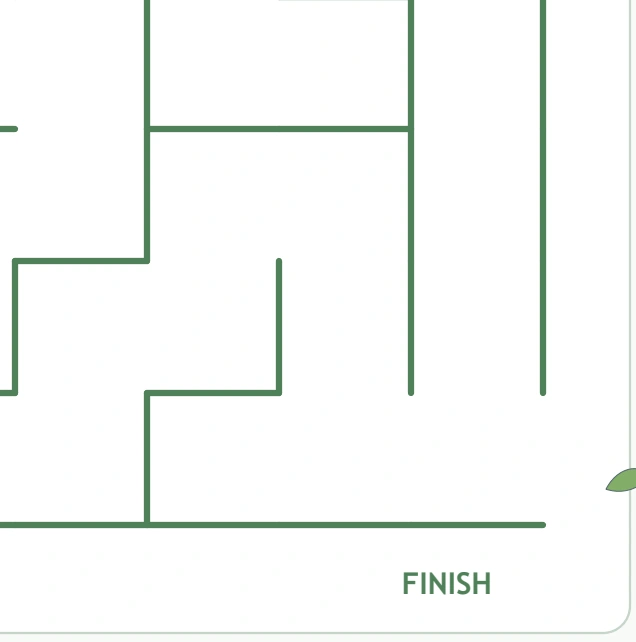
Finally record Turtle Pond Maze: leaf arrival. Reach the lower-right FINISH through a continuous open route. Ask Mina, “Which passage ended here?” The aunt and Mina can inspect leaf arrival together.
Turtle Pond Maze adult reference
| Printed clue | Source check |
|---|---|
| Turtle starting point | Find the upper-left START opening. |
| Blocked branch | Notice where the open passage actually ends. |
| Previous choice | Return to a fork with an untried gap. |
| Leaf arrival | Reach the lower-right FINISH through a continuous open route. |
A dead end can be described calmly
Use the wall as the subject of the explanation: this passage stops here. That wording allows the child to discuss what was discovered without treating the attempt as a personal failure. Ask what the obstacle rules out and where another option remains. The next movement then uses information from the first attempt instead of repeating the same blocked branch or pushing through its boundary.
Imagine Mina at a home puzzle table
Mina reaches a dead end and wants to give up. Her aunt asks which earlier fork still has an unexplored opening. They point back together, and Mina discovers a specific place to restart instead of feeling that the whole page has failed. Here, Turtle Pond Maze gives Mina a reason to discuss interpreting setbacks using the Turtle Pond Maze clues.
Five play invitations after Turtle Pond Maze
Build a leaf detour
Use blocks around a turtle toy and leaf token. Let one branch end visibly, then ask the navigator to return to the fork and try the other. After this Turtle Pond Maze play round, ask the aunt which clue Mina chose to explain.
Make a three-word route report
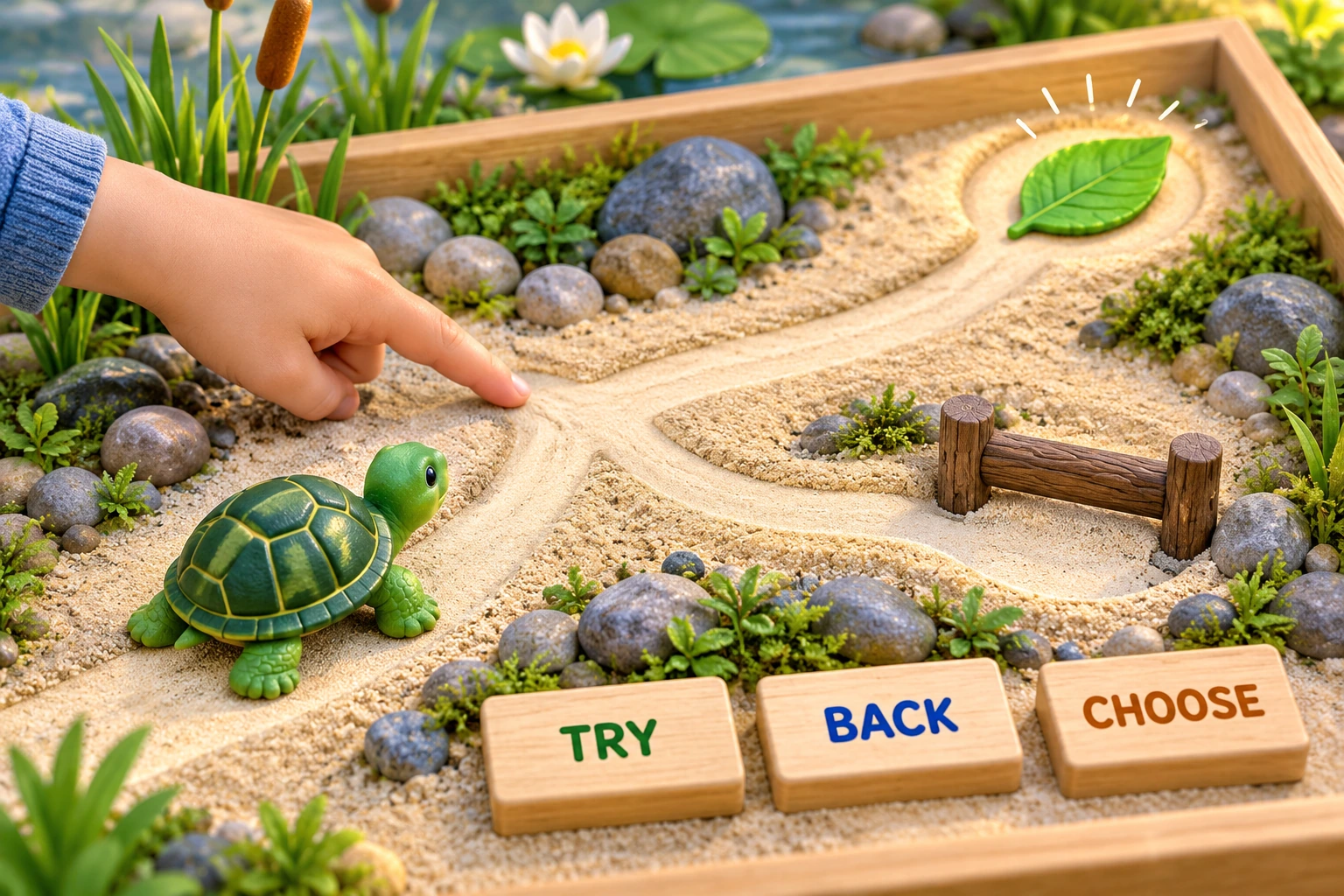
Use completed word cards TRY, BACK and CHOOSE to narrate a short tabletop journey. Each card describes an action rather than labelling an attempt good or bad. Let Mina demonstrate this example before another Turtle Pond Maze visit; ask the aunt to listen for Mina’s reasoning.
Point to the previous fork
After a toy enters a dead end, ask a partner to identify the last available choice. Move back through the existing route instead of lifting over a wall. On a later Turtle Pond Maze visit, ask Mina what changed; the aunt can discuss Mina’s evidence.
Become the connected-path inspector
An adult places two disconnected string segments between turtle and leaf. The child explains why a gap in the journey still needs an open connecting corridor. Ask Mina how this example relates to Turtle Pond Maze; the aunt can follow the clue that Mina identifies.
Celebrate a useful wall
Make a short story in which the turtle thanks a barrier for revealing the wrong branch. Return to practical route evidence after the playful sentence. Keep Mina’s own explanation central in this Turtle Pond Maze game. Let the aunt hear what Mina observed.
Keep the leaf as the actual destination
The lower-right leaf sits beside FINISH, giving the turtle’s journey a visible endpoint. For Turtle Pond Maze, A route that reaches a nearby corridor but remains separated by a wall has not yet arrived. Check the final opening as carefully as an earlier junction. The story goal and the printed maze rule should agree, so the child can explain both where the turtle is going and how it may get there.
Turtle Pond Maze: previous choice mistakes
Starting again from an unrelated corridor can leave a disconnected route. Keep the journey linked to START, and return along the attempted passage before selecting an alternative. Do not treat the leaf picture as permission to jump over the final wall. Invite Mina to discuss previous choice with the aunt.
Classroom partners inspect blocked branch
A teacher invites partners to report a blocked branch as useful information. One child names the barrier and the other locates the previous choice, turning route revision into a shared explanation rather than a competition to avoid mistakes. For a Turtle Pond Maze partner visit, tracing a decision history is this turtle pond maze partnership focus.
A short return can repair a difficult moment
If the child was upset at one blocked branch, revisit that junction alone on another day. Point to the previous fork and discuss the unused opening, without requiring another full-page attempt. This gives the familiar obstacle a different role: it becomes evidence for a revised plan. Stop after a useful explanation if that keeps the turtle journey worth returning to.
Readiness for Turtle Pond Maze at ages 4–6
Offer a finger journey and a short verbal report before expecting a neat continuous pencil line. Read endpoint words aloud while keeping the choice of an alternative passage with the child. Suggested range for Turtle Pond Maze: ages 4–6. Begin with interpreting setbacks and adult support.
For a comfortable Turtle Pond Maze visit, let Mina show turtle starting point before the aunt requests another response. Discuss pencil control at turns using the printed Turtle Pond Maze example.
A fresh Turtle Pond Maze reason to return
Revisit the branch that previously caused frustration. Ask what the wall revealed and where another choice existed, making the return about improved planning rather than forgetting the earlier difficulty. Mina can show the aunt a new leaf arrival observation during that short turtle pond maze visit.
Save a printable Turtle Pond Maze copy
An eligible active member can select the premium Turtle Pond Maze edition for a clean printable PDF. The website watermark and domain are removed; no ads interrupt the turtle route. A distinct original sample preserves the supplied version. In print preview, retain START, the entire rectangular maze and the leaf beside FINISH before choosing the paper setting. The $5 puzzle collection also contains this sheet as one of its twenty-five supplied pages.
Turtle Pond Maze: another printable to explore
Extend the interpreting setbacks conversation beyond Turtle Pond Maze with Turtle starting point before a road-width task; Connected route reasoning and picture-detail tracing; Calm explanatory talk beside a car-and-flag maze.
Explore Turtle Pond Maze alongside NAEYC family-writing ideas and Turtle Pond Maze with PBS Parents literacy activities. Keep turtle starting point, calm explanatory talk and persistence with a plan connected to the pictured puzzle.
Popular Worksheets
Printable resources families and teachers are downloading now.
 Free
 Free
 Free
 Free