
Bee Garden Maze: 5 Brilliant Ways to Plan a Route
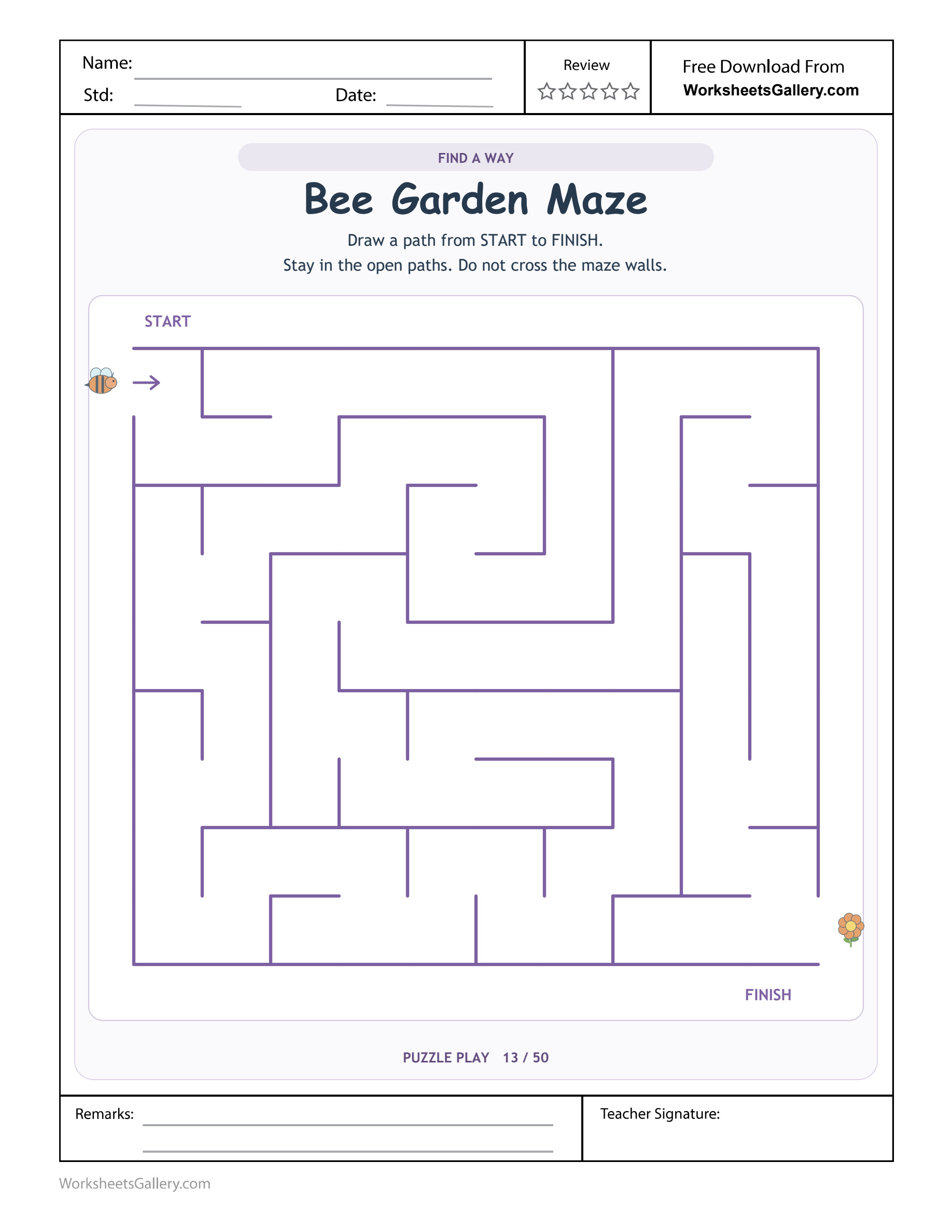
Carry the bee route into a collection of new decisions. The complete clean download costs $5 for the 25 supplied pages. Keep the flower-bound maze beside picture matching and small logic tasks, then choose another challenge when the route is finished.
The bee can see its flower across the page, but a straight-looking shortcut meets the maze walls. Bee Garden Maze gives that journey a practical rule: choose open passages from START to FINISH. An adult can read the endpoint words while the child inspects a junction and decides where a route may continue. Pause before drawing through a turn, and treat a blocked branch as information for the next choice. The useful success is a connected journey through openings, supported by a plan the child can describe.
Bee Garden Maze: the rule on this particular sheet
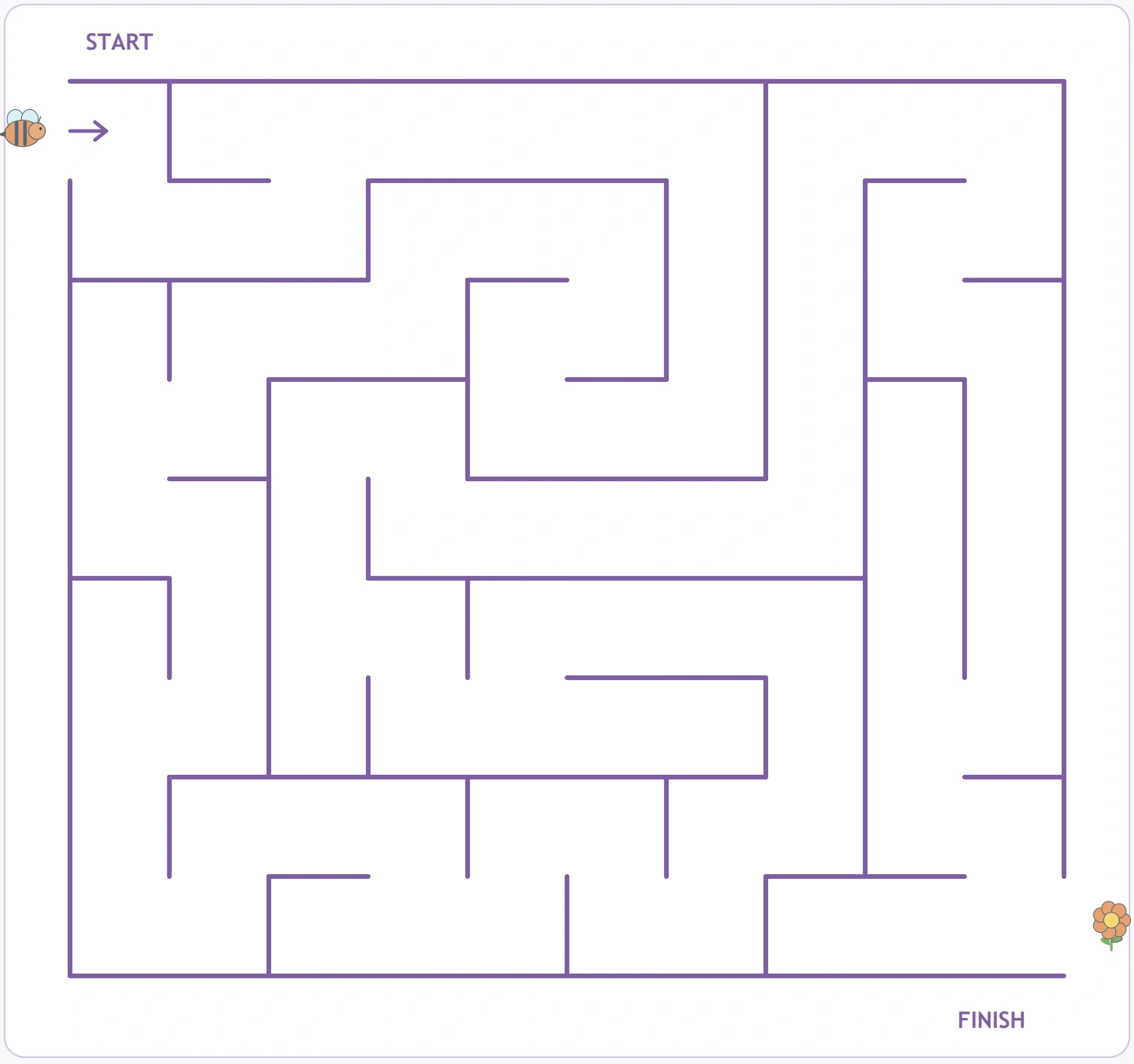
One rectangular maze begins near the bee at the upper-left START and finishes near the flower at the lower-right FINISH. The printed walls determine where a route may travel; seeing the destination does not permit crossing them.
A junction deserves a pause. Inspect a possible opening with a fingertip before committing the pencil to a branch. The useful question is where that passage actually leads, not which direction seems closest to the flower.
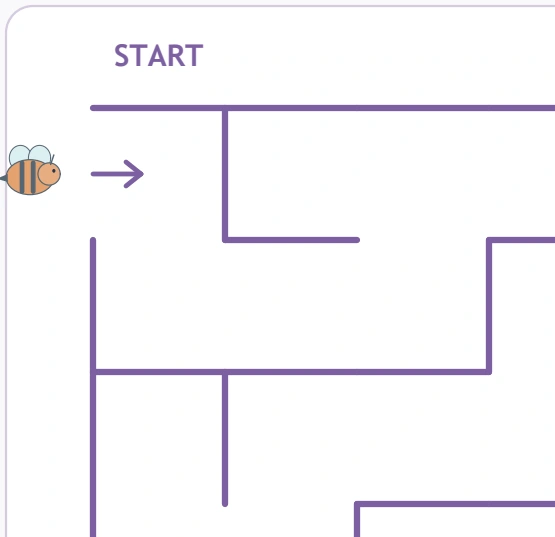
What wall boundary reveals
A route can turn away from the goal temporarily and still be useful. Judge an option by whether its corridor remains open, rather than assuming every downward or rightward movement must be correct.
The sheet asks for a drawn path through the maze. There is no dotted route to trace and no requirement to colour every corridor. A considered route is the response; extra decoration can wait until the planning is finished.
A practical Bee Garden Maze sequence
Bee entry with Theo
Begin Bee Garden Maze: bee entry. Locate START near the upper-left bee before choosing a passage. Ask Theo, “Where does this passage lead?” The grandfather and Theo can inspect bee entry together.
Open junction with Theo
Next inspect Bee Garden Maze: open junction. Inspect the available gaps where the route branches. Ask Theo, “Can the bee pass through here?” The grandfather and Theo can inspect open junction together.
Wall boundary with Theo
Then confirm Bee Garden Maze: wall boundary. Keep the proposed pencil path inside the corridor. Ask Theo, “Which way should we turn at this gap?” The grandfather and Theo can inspect wall boundary together.
Flower finish with Theo
Finally record Bee Garden Maze: flower finish. Confirm that the route reaches the lower-right FINISH opening. Ask Theo, “Shall we pause before this turn?” The grandfather and Theo can inspect flower finish together.
Bee Garden Maze adult reference
| Printed clue | Source check |
|---|---|
| Bee entry | Locate START near the upper-left bee before choosing a passage. |
| Open junction | Inspect the available gaps where the route branches. |
| Wall boundary | Keep the proposed pencil path inside the corridor. |
| Flower finish | Confirm that the route reaches the lower-right FINISH opening. |
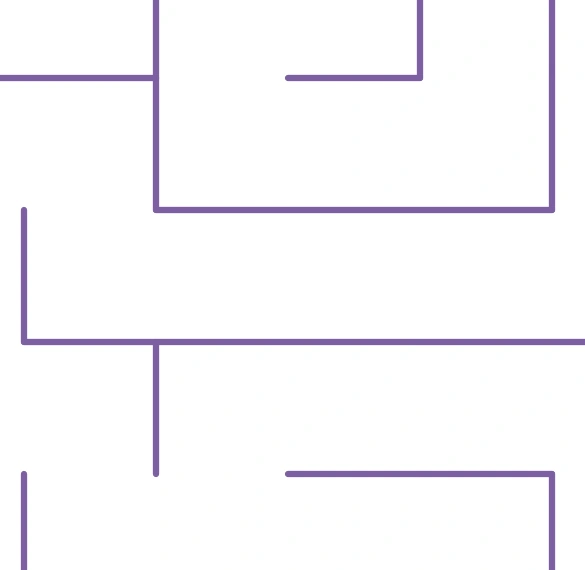
A junction is a place to look ahead
Ask the child to pause where more than one corridor seems available. For Bee Garden Maze, A fingertip can inspect a short branch before a pencil records it. The point is not to foresee the entire maze instantly, but to connect a next move with an actual opening. A child who notices that a passage ends has gathered useful information before committing to a longer drawn route.
Classroom partners inspect open junction
At a route-planning station, partners take turns being navigator and wall inspector. The navigator proposes the next short move, while the inspector confirms that an opening actually exists before the pencil continues. For a Bee Garden Maze partner visit, boundary awareness is this bee garden maze partnership focus.
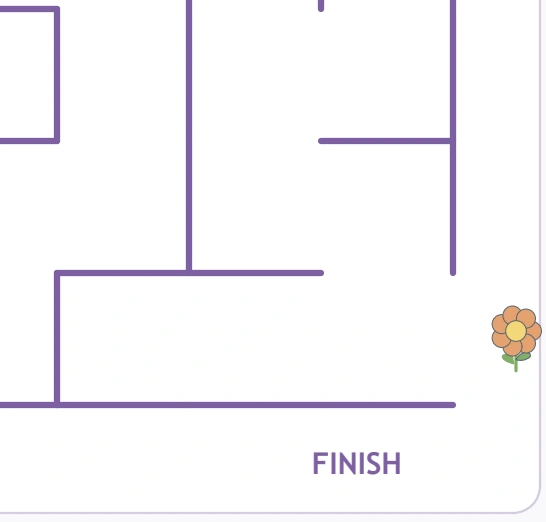
Distance and access are different clues
The flower can be close across a wall while a usable route travels elsewhere. Discuss which movement is permitted rather than which direction appears shortest. This makes the wall rule concrete and gives an indirect path a sensible purpose. An adult can point out the barrier without supplying the whole answer, leaving the child to inspect the nearby gaps and choose a legitimate continuation.
Bee Garden Maze: wall boundary mistakes
Crossing a thin wall creates a shortcut that the maze rule does not allow. If the child reaches a blocked branch, return to the last genuine choice and inspect another opening instead of pushing the line through the barrier. Invite Theo to discuss wall boundary with the grandfather.
6 observations in Bee Garden Maze
Planning ahead: Where does this passage lead
Here, an opening can be inspected before the mark is made. The prompt “Where does this passage lead?” gives Theo a way to explain planning ahead to the grandfather.
Boundary awareness: Can the bee pass through here
Here, the maze wall limits a possible move. The prompt “Can the bee pass through here?” gives Theo a way to explain boundary awareness to the grandfather.
Spatial language: Which way should we turn at this gap
Here, a navigator describes turns and nearby openings. The prompt “Which way should we turn at this gap?” gives Theo a way to explain spatial language to the grandfather.
Pencil pacing: Shall we pause before this turn
Here, slowing at a corner supports a chosen route. The prompt “Shall we pause before this turn?” gives Theo a way to explain pencil pacing to the grandfather.
Useful reconsideration: Where was our last open choice
Here, a blocked branch supplies evidence for another attempt. The prompt “Where was our last open choice?” gives Theo a way to explain useful reconsideration to the grandfather.
Goal tracking: Are we still finding a route to FINISH
Here, the flower remains the destination through indirect travel. The prompt “Are we still finding a route to FINISH?” gives Theo a way to explain goal tracking to the grandfather.
Five play invitations after Bee Garden Maze
Inspect a block junction
Build a short tabletop path with one blocked branch and one open branch. Move a paper bee only after the child identifies the usable opening. After this Bee Garden Maze play round, ask the grandfather which clue Theo chose to explain.
Give the bee a spoken route
A child tells a partner where to move a toy bee through a simple block corridor. The listener stops whenever the instruction would cross a wall. Let Theo demonstrate this example before another Bee Garden Maze visit; ask the grandfather to listen for Theo’s reasoning.
Pause at the flower fork
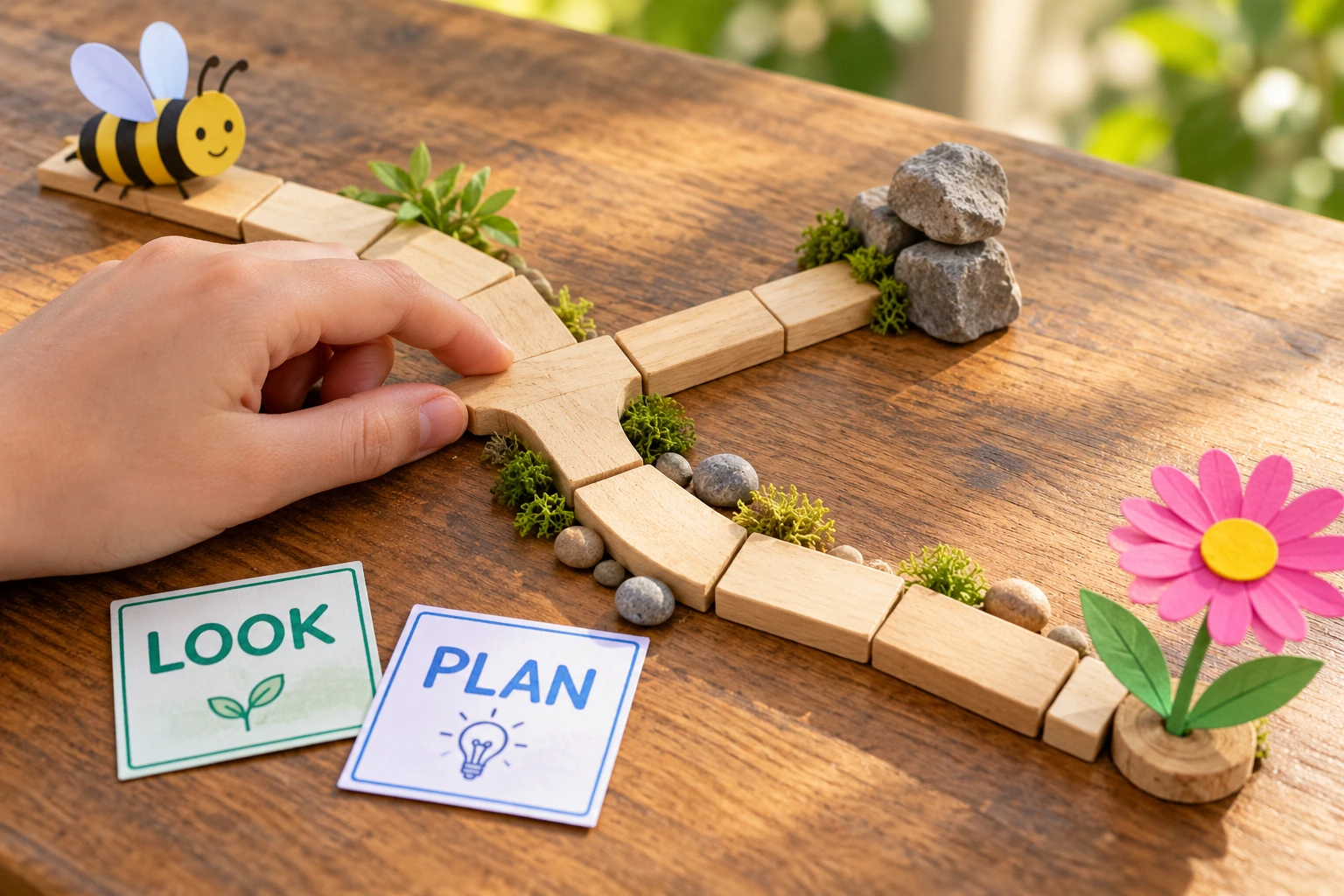
Put a flower token beyond a fork. Ask the navigator to look along both branches before selecting one, then explain what made the chosen route possible. On a later Bee Garden Maze visit, ask Theo what changed; the grandfather can discuss Theo’s evidence.
Become a wall checker
An adult draws a separate tiny route that accidentally crosses a barrier. The child identifies the exact crossing and suggests returning to an earlier gap. Ask Theo how this example relates to Bee Garden Maze; the grandfather can follow the clue that Theo identifies.
Tell the detour story
Make a route that initially moves away from a flower before reaching it. Discuss why an indirect passage can be sensible when a straight-looking move is blocked. Keep Theo’s own explanation central in this Bee Garden Maze game. Let the grandfather hear what Theo observed.
Separate navigation from pencil accuracy
A child may point along a reasonable corridor while drawing a line that touches its edge. Discuss the route choice first, then offer help slowing at the turn. If the intended move crosses a wall, the navigation needs reconsidering; if the intended corridor is open, the next support may concern movement. Those different observations lead to more useful feedback than calling every imperfect mark a maze mistake.
Imagine Theo at a home puzzle table
Theo starts a diagonal line because the flower seems close. His grandfather points to the first wall in its way and asks him to inspect the nearby gap. Looking for a passage changes the task from pointing at the goal to planning how to reach it. Here, Bee Garden Maze gives Theo a reason to discuss planning ahead using the Bee Garden Maze clues.
Give the bee a concise route report
Invite a partner to explain one turn using an opening or wall as evidence. The listener should be able to locate the described junction and verify the move. A report such as through this gap is more useful when the child also indicates which gap matters. The bee story can remain playful while the explanation stays tied to the actual printed corridor.
A fresh Bee Garden Maze reason to return
Invite a new explanation of one important junction on another day. A child who can explain the opening has something useful to share even when the full route is already familiar. Theo can show the grandfather a new flower finish observation during that short bee garden maze visit.
Readiness for Bee Garden Maze at ages 4–6
Try finger planning before pencil drawing and work on a short route segment at a time. An adult may read START and FINISH while the child remains responsible for choosing the openings. Suggested range for Bee Garden Maze: ages 4–6. Begin with planning ahead and adult support.
For a comfortable Bee Garden Maze visit, let Theo show bee entry before the grandfather requests another response. Discuss useful reconsideration using the printed Bee Garden Maze example.
Save a printable Bee Garden Maze copy
To print Bee Garden Maze without website watermark or domain branding, use the clean premium PDF available to eligible active members. No advertisements are embedded in that file. Keep the original sample as a separate reference if needed. Printer preview should show the bee entrance and flower-side FINISH with the complete outer walls, so scaling does not clip a route boundary. The same maze belongs to the combined twenty-five-sheet collection priced at $5.
Bee Garden Maze: another printable to explore
Extend the planning ahead conversation beyond Bee Garden Maze with Bee entry before a road-width task; Spatial language and picture-detail tracing; Pencil pacing beside a car-and-flag maze.
Explore Bee Garden Maze alongside NAEYC family-writing ideas and Bee Garden Maze with PBS Parents literacy activities. Keep bee entry, pencil pacing and goal tracking connected to the pictured puzzle.
Popular Worksheets
Printable resources families and teachers are downloading now.
 Free
 Free
 Free
 Free