
Pencil Maze Plans: 4 Powerful Car-to-Flag Challenges
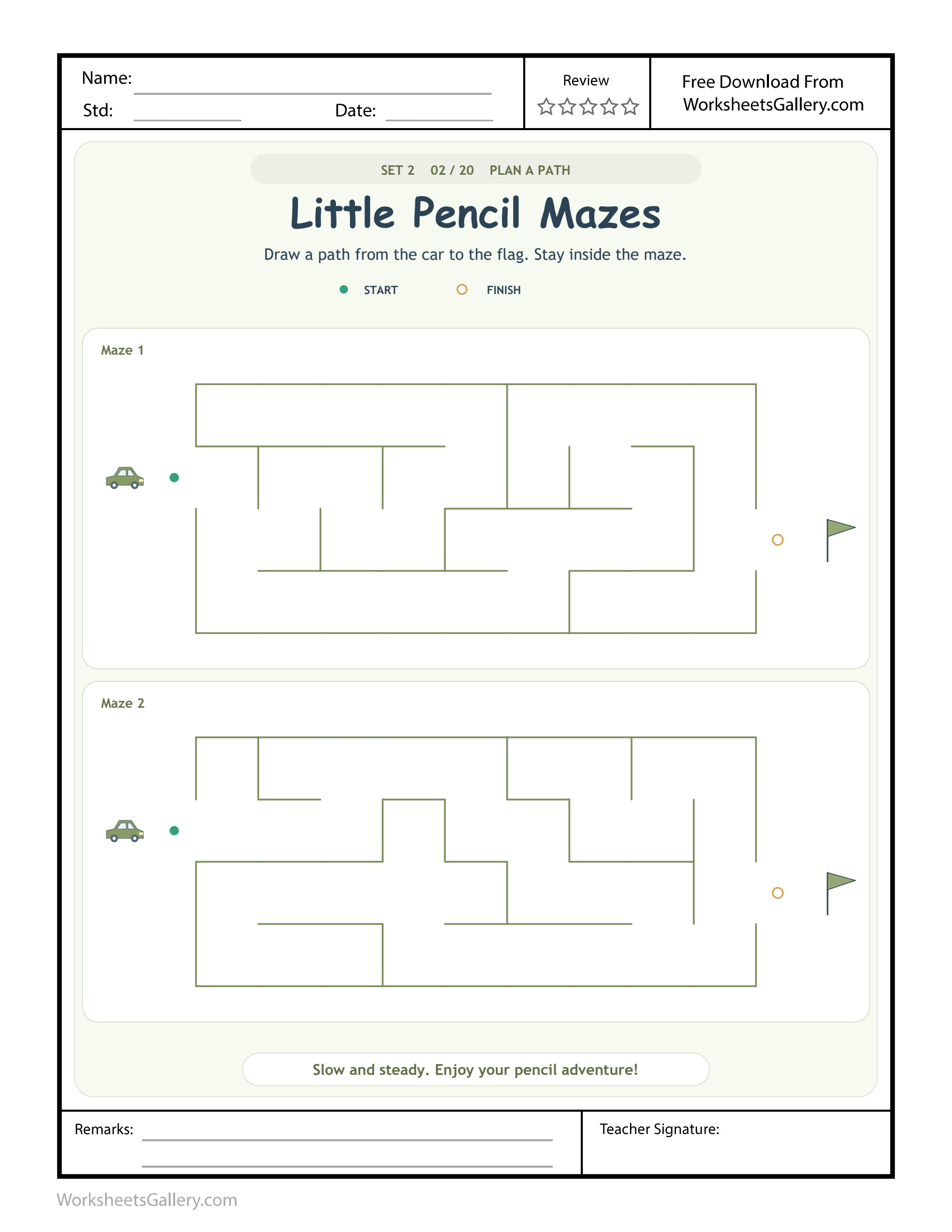
A maze plan can lead to another kind of challenge. The $4 package includes both car-to-flag mazes on this page alongside nineteen other worksheets, all combined into a clean twenty-page PDF.
The little car can see its flag, but a wall stands between wanting to arrive and finding a way through. Pencil Maze Plans turns that moment into a thoughtful preschool drawing activity. Two printed mazes invite children around four to six to inspect openings, predict turns and guide a line toward the finish. There is no dotted solution to follow. With Pencil Maze Plans, a pause can be useful work: the child may be checking whether a corridor really connects before letting the pencil travel into it. The flag can wait for a considered journey.
Leo notices a Pencil Maze Plans opening before starting
Leo is ready to draw straight toward the flag when his father asks him to point to the first opening. He follows the left edge with a finger, discovers a wall, then looks again. Pencil Maze Plans gives them something specific to discuss: which spaces connect, and which only appear promising from a distance?
His father does not draw the answer over the maze. Instead, Leo explores one possible corridor above the paper. When he meets a dead end, he returns his finger to the last choice. Pencil Maze Plans makes changing an idea part of the activity. The eventual pencil line matters, but so does Leo's discovery that the first apparent route may need another look.
Read the maze as connected spaces
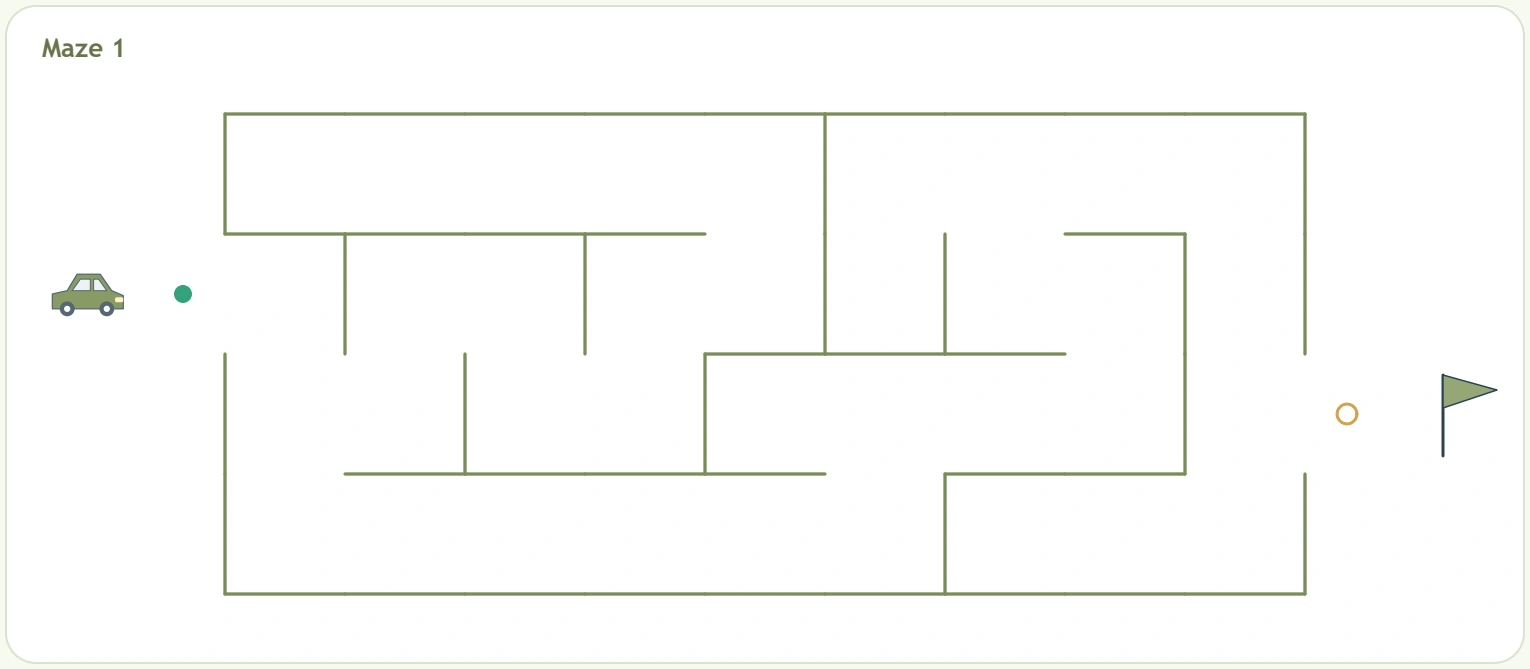
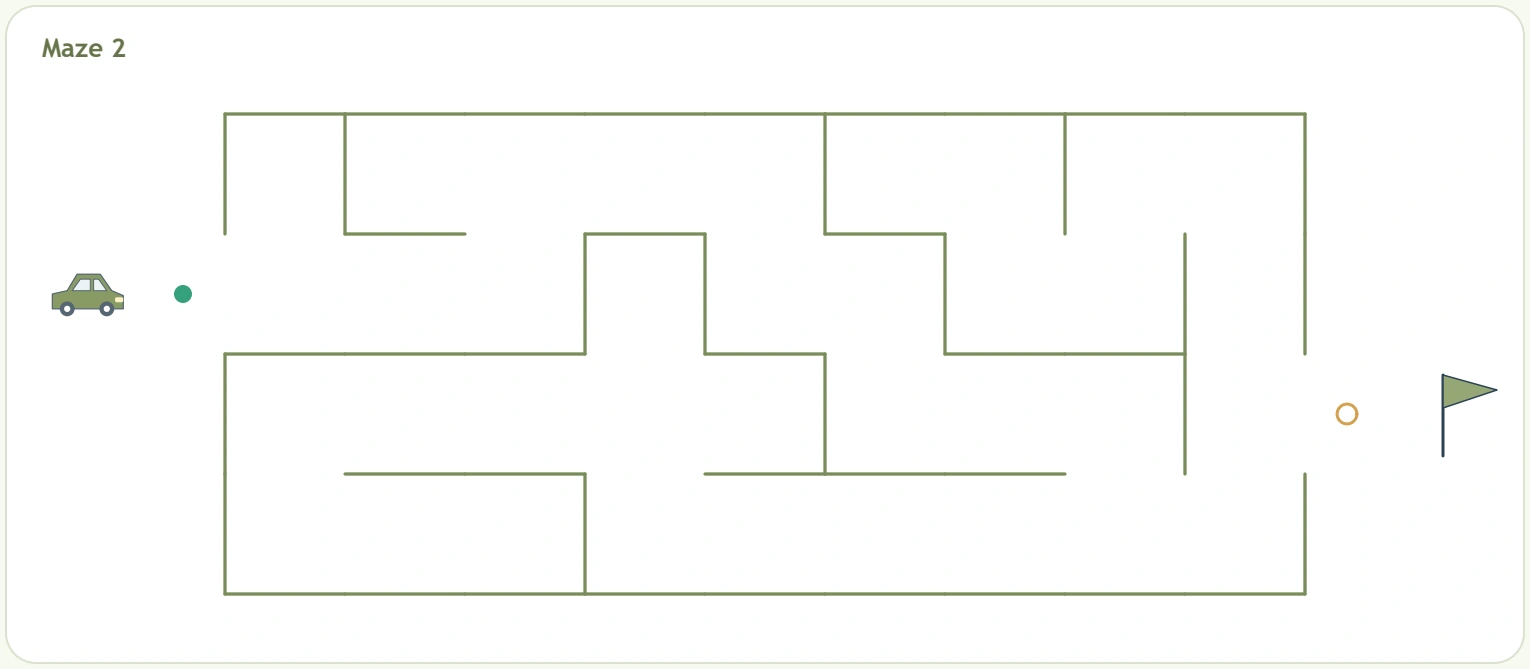
Little Pencil Mazes contains two separate car-to-flag layouts. Each begins beside a small car and a green starting dot, and ends toward a gold ring beside a flag. Pencil Maze Plans asks the child to draw inside the maze while respecting the printed walls. Crossing a wall would change the problem instead of solving the route.
A corridor can turn even when the destination remains on the right. Pencil Maze Plans therefore involves more than moving steadily across a page. Eyes need to inspect the next opening, the hand needs to negotiate a corner, and the child needs to decide which branch is worth exploring. Those jobs can be shared with an adult without handing over every decision.
Six useful things to notice in Pencil Maze Plans
- Route prediction: a child can point along a possible connection before committing a pencil mark to it.
- Wall awareness: Pencil Maze Plans gives a visible reason to change direction instead of cutting across an obstacle.
- Choice checking: a dead end encourages another look at the last opening, rather than a faster push forward.
- Corner control: Pencil Maze Plans offers turns whose direction is determined by the corridor.
- Explanatory speech: children can describe an opening as above, below, beside or blocked while showing what they mean.
- Flexible persistence: revising a route idea can become a satisfying discovery when an adult treats the change calmly.
These observations help an adult choose support. They are not a scorecard for deciding whether a child should already be ready to write letters. A thoughtful finger route and a short explanation may show more planning than a rapidly completed line.
Separate Pencil Maze Plans looking from marking
Before drawing, invite a whole-maze look. Ask where the car begins, where the flag stands and which opening might be useful first. Pencil Maze Plans can start with pointing only. Leave enough quiet time for the child to follow a corridor visually rather than answering immediately on their behalf.
If the layout feels crowded, choose just one maze. Cover the unused second activity with a separate piece of paper while keeping the selected maze fully visible. Pencil Maze Plans becomes easier to discuss when the child knows exactly which car and flag are part of the current problem. Remove the cover when another journey is welcome.
A route-planning conversation with three moments
| Moment | Adult invitation | What the child can show |
|---|---|---|
| Before moving | Where does this opening lead? | A predicted corridor in Pencil Maze Plans |
| At a choice | Can this space reach the next one? | A connection or a blocked branch |
| After arriving | Which turn changed your idea? | A remembered decision from Pencil Maze Plans |
Use a question only when it helps the next action. A child already inspecting the route does not need constant interruption. Pencil Maze Plans allows an adult to listen and watch, then supply one useful prompt when the route becomes uncertain.
Draw through an opening, then check the next one
Begin at the green dot and let the child move along the chosen corridor. There is no need to keep the tool pressed down while trying to solve the entire maze in one breath. Pencil Maze Plans permits looking pauses. The printed requirement is to stay inside the maze, not to complete it without hesitation.
When a line approaches a wall, ask the child to locate the available gap. Point beside the route if clarification is needed, leaving the child's working line visible. Pencil Maze Plans is more informative when the adult can see which connection the child actually selected. A heavily corrected line can hide that original choice.
The second Pencil Maze Plans maze deserves inspection
The lower layout changes its wall arrangement. A turn that worked above may lead elsewhere below. Pencil Maze Plans invites the child to read this new arrangement before borrowing a remembered movement. Start again by locating the car, dot, ring and flag rather than saying, “Do the same thing.”
For children who enjoy following a route but need fewer choices, the flower-watering path sheet can offer a related, more directed journey. Pencil Maze Plans introduces openings and alternatives; choosing between these tasks depends on whether the useful challenge today is maintaining a route or deciding where that route should go.
A classroom navigator explains one decision
At a small-group table, a teacher offers Pencil Maze Plans with one copy per child. Partners can take turns as the person who points and the person who explains an opening. They keep their own pencil marks on their own sheets, so one child's solution does not become another child's compulsory route.
The teacher listens for evidence of connection: “This bit joins that space,” or “It stops here.” A child who cannot yet explain verbally may point to both sides of a gap. Pencil Maze Plans supports that demonstration too. After a turn, the group can compare one useful discovery without announcing a fastest finisher or displaying unfinished work as failure.
Four ways to play with routes away from the page
Make a wall and leave a doorway
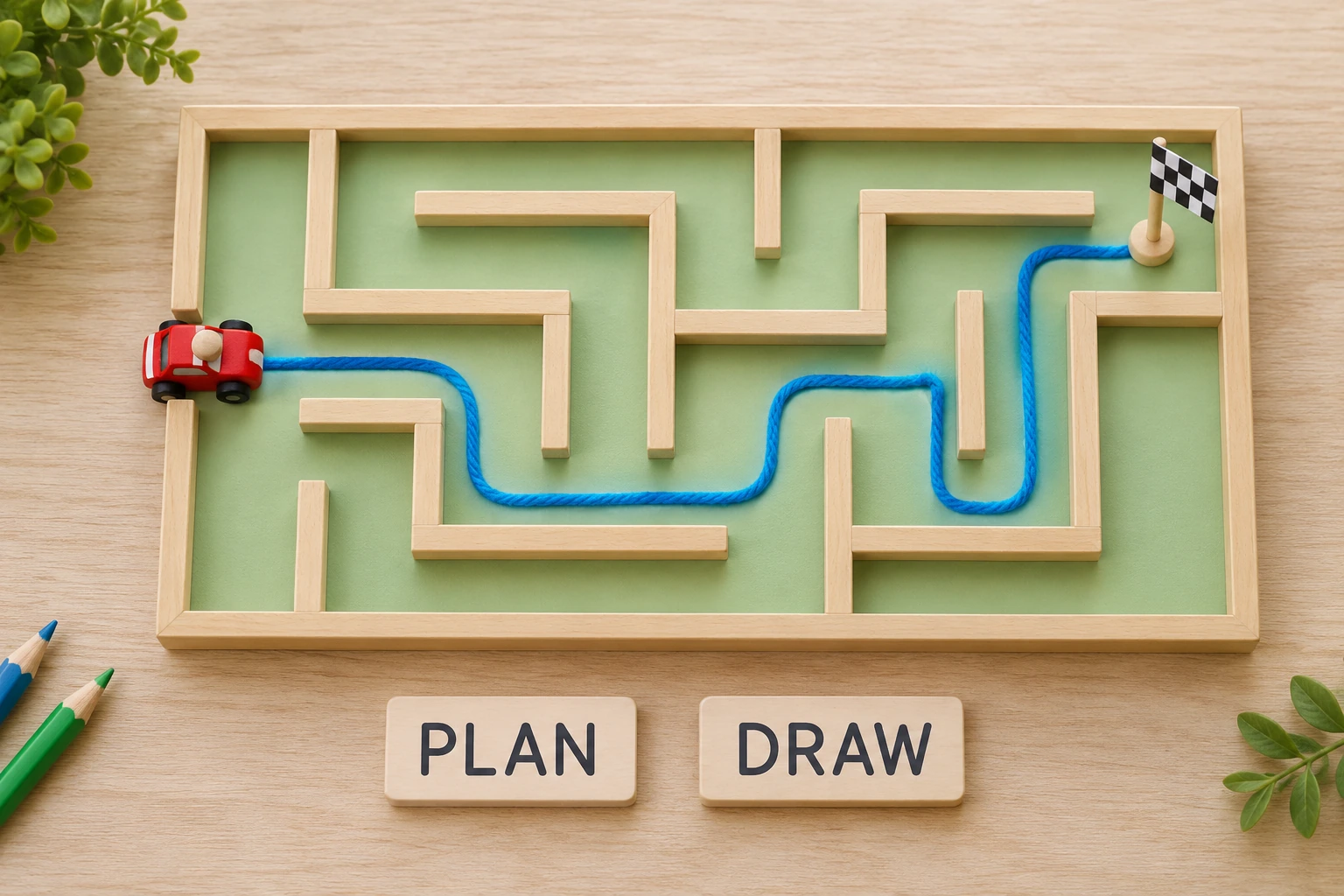
Build a low block wall on a table with one deliberate gap. Move a toy car through the gap, then reposition a block and inspect the new opening. Pencil Maze Plans uses the same distinction between a wall and a passage, while the blocks make it possible to change the arrangement physically. Use a stable, simple layout before adding branches.
Be a flag keeper
An adult places a toy flag beyond two possible corridors made from books. The child explains which passage reaches it and moves the car after explaining. Pencil Maze Plans can follow when the child wants a paper version. Swap roles so the child can build an arrangement and listen to the adult's prediction as well.
Photograph a helpful pause
Use a toy route and pause at a junction. Take a photo only if the child wants a record, then ask them to describe what the driver was checking. Pencil Maze Plans can prompt the same kind of remembered decision after a paper attempt. The story is about choosing an opening, not proving that the route was completed quickly.
Invent a polite detour sign
Make a finished sign saying TURN or LOOK and put it beside a blocked toy road. Let the child move the sign to a place where its message would help. Pencil Maze Plans offers several moments where a driver would need fresh information. Keep signs on separate props so they do not cover the printed maze walls during drawing.
A dead end can supply useful information
The phrase “wrong way” can sound as though the whole attempt has failed. A more precise observation is that a particular corridor stops. Pencil Maze Plans gives the child a reason to return attention to the previous choice. With a finger rehearsal, that change leaves the paper ready for a later drawn decision.
If the child has already marked a branch, discuss it without turning the sheet into an erasing exercise. Pencil Maze Plans can be tried again on another copy when the child wants a new journey. The important question is whether they can see what blocked the connection, rather than whether the first attempt can be made to look untouched.
✎ Adjust the support, not the child's confidence
Children aged roughly four to six may enjoy the two mazes as a shared problem. Younger preschoolers may prefer a large toy corridor or a brief pointing turn. Pencil Maze Plans does not require every child to manage both layouts independently. Choose a comfortable viewing distance and a drawing tool whose line leaves the walls easy to see.
An adult can say look for the opening while tracing the wall's direction in the air. Avoid guiding the child's hand through every turn, because that conceals their own planning. Pencil Maze Plans is intended to invite decisions that the adult can notice, discuss and support.
Common shortcuts that change the task
Jumping across a wall, treating the flag as a straight-line destination, and following the same movements on both layouts all bypass the connection problem. Pencil Maze Plans works when each next stretch belongs to an open corridor. A pause beside a wall may be exactly what the activity needs.
Another unhelpful shortcut is revealing a complete solution before the child has looked. Start with one opening instead. For separate corner practice, consider the robot route with square turns. Pencil Maze Plans combines turning with choosing; practising one component elsewhere can make the combined task easier to understand later.
The mountain trail's visible turning points offer another separate movement comparison. Pencil Maze Plans adds a choice of connections to the act of turning, so explain that distinction when moving between the two activities.
Come back to a remembered Pencil Maze Plans choice
On a later visit, ask which part of the maze the child remembers finding interesting. They might want the other layout, a toy reconstruction, or a fresh attempt at one troublesome junction. Pencil Maze Plans can stay available without becoming a daily requirement. A small reason to return is more inviting than a demand to finish everything.
Broader ideas for meaningful mark-making are available through NAEYC's family writing guidance. The age-four literacy resources at PBS Parents offer another place to browse. Pencil Maze Plans can accompany ordinary play directions, pretend maps and spoken stories about where a vehicle is going.
Save the edition that matches your access
Use the original free sample if you want the branded worksheet version. The clean Pencil Maze Plans PDF is available through this page's premium membership download. Open your account, confirm that a suitable membership is current, and request the premium file. The website supplies the authorised download after those access checks.
Save the Pencil Maze Plans PDF locally and review its complete page in the print dialogue. The premium edition contains no watermark, printed advertisements, website credit or domain, while retaining both maze layouts. Keep the borders and flags within the printed area. Families seeking all twenty new concepts can use the linked collection card; one considered route is a useful first visit even when more pages are available.
Popular Worksheets
Printable resources families and teachers are downloading now.
 Free
 Free
 Free
 Free