
Robot Turn Tracing: 4 Brilliant Corner-Control Tasks
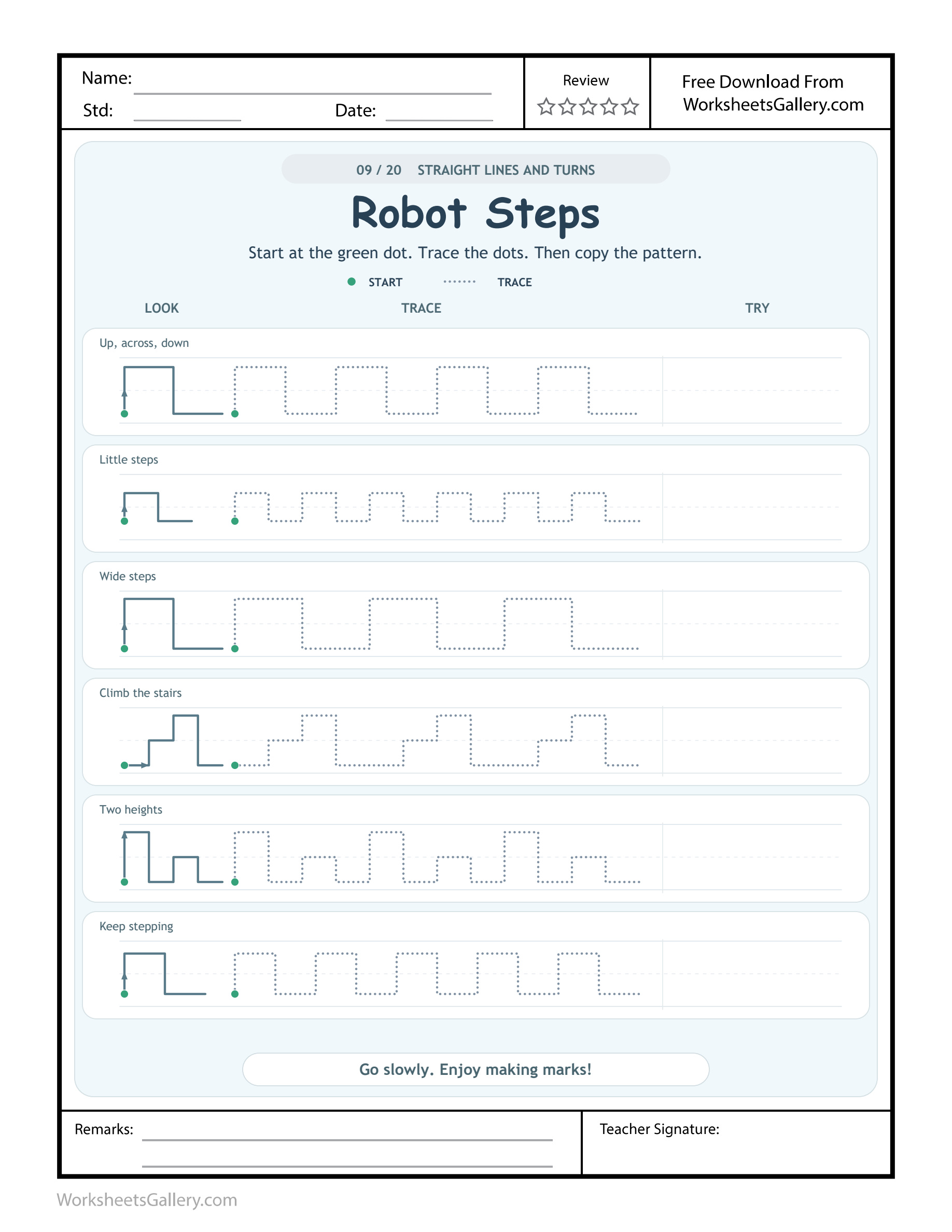
A corner is a place to make a decision. Robot Turn Tracing turns that decision into a visible sequence: move straight, arrive at the bend, then choose the direction of the next segment. Six printed patterns offer square steps, stairs and changing heights, with solid examples, dotted routes and short independent ends. The Robot Steps sheet suits an adult and child who want to inspect a route before drawing it. Instead of making the whole line quickly, pause with your eyes at one corner and ask where the path goes next. That small question gives each turn a purpose.
Robot Turn Tracing starts with a route briefing
Place the sheet upright and find Up, across, down. Its model changes direction where straight sections meet. Follow the green starting point and the printed movement rather than rounding each bend into a wave. The first Robot Turn Tracing inspection can happen without a pencil touching the paper.
Robot Turn Tracing asks the hand to carry out a plan the eyes have read. Saying “across” before an upright line ends can help the learner anticipate the next part, but the spoken direction should describe the actual model. Adults need not turn this into a memory test with a long string of commands.

Four Robot Turn Tracing workshop jobs
These additional Robot Turn Tracing jobs use separate paper and ordinary drawing materials. They explore the decisions behind a corner; they do not add extra instructions to the uploaded worksheet. Choose whichever job addresses the feature the child is currently noticing.
1. Give Robot Turn Tracing a direction announcer
Draw a short squared route on a large card. One person points along it while another announces UP, ACROSS or DOWN just before the relevant turn. Exchange roles after one journey. Robot Turn Tracing becomes a conversation between observation and action, rather than a race to follow another person's voice.
Let the Robot Turn Tracing announcer disagree when an announcement does not fit the card. Inspect the next segment together and correct the direction word. This makes the drawing the source of evidence and gives the younger partner a meaningful chance to guide the adult.
2. Build a Robot Turn Tracing corner inspector
Set out two scrap-paper paths, one with a square bend and one with a rounded bend. The inspector chooses which resembles the robot model and explains with a finger. Robot Turn Tracing inspection can use gestures if words are still emerging. Neither path needs to be labelled a bad drawing; they simply follow different rules.
The Robot Turn Tracing inspector can then draw a new square turn for the adult to inspect. A broad marker on large paper makes the change easier to see than a tiny corrected pencil corner surrounded by eraser marks.
3. Send Robot Turn Tracing through a step studio
Arrange narrow paper strips into a staircase on a tray. Point along the horizontal and upright portions in order. Ask what would disappear if one long diagonal replaced the steps. Robot Turn Tracing offers a reason to preserve the intermediate turns: they are part of the chosen route, not decoration to skip.
Make a Robot Turn Tracing drawing beside the arrangement instead of tracing over loose strips. Compare one section at a time. The activity is about reading successive directions, so the finished staircase need not copy the worksheet's exact dimensions.
4. Open a Robot Turn Tracing height exchange
On a folded card, an adult draws a motif with a taller step beside a shorter one. The child copies the relationship on the other half, then creates a different pair for the adult. Robot Turn Tracing height exchanges ask both partners to look before repeating a familiar movement automatically.
Name the Robot Turn Tracing relationship in everyday language: “this upright part reaches farther.” Avoid measuring every line or judging the two partners by neatness. Their drawings can differ in scale while still communicating the intended change of height.
Six Robot Turn Tracing rows, six inspection questions
The source presents Up, across, down; Little steps; Wide steps; Climb the stairs; Two heights; and Keep stepping. Each has a LOOK model, dotted TRACE portion and TRY continuation. Read the route in front of you rather than assuming that every row changes one measurement in a fixed progression.
| Printed row | Look for | Ask before drawing |
|---|---|---|
| Little steps | Short upright parts | Where does across begin? |
| Climb the stairs | Successive rises | Which step comes next? |
| Two heights | Different upright extents | Which part reaches farther? |
Robot Turn Tracing labels invite investigation. The row called Wide steps still deserves direct observation of its corners and segment lengths; its name alone is not a measurement. Use the printed route as the reference for a short independent version.

Zain reads Robot Turn Tracing like a builder
Zain is drawing a pretend control panel with his teacher. He joins two levels with a diagonal shortcut. She points to the robot-step model and asks whether their design needs a slope or a staircase. He chooses stairs, then taps the places where the direction must change.
Their Robot Turn Tracing visit begins with Climb the stairs. Zain follows one dotted sequence and draws a short new section on scrap paper. His teacher describes the extra corner he retained. The observation connects his pencil mark to his own design decision, rather than simply rewarding compliance with a tracing instruction.

A home sequence for Robot Turn Tracing
Use a Robot Turn Tracing surface with room for the sheet and a separate drawing card. Offer a familiar pencil or crayon, then let the child select a row. An adult can read its label and point to the solid model without beginning the mark for the learner.
- Locate the green start and inspect the first straight portion.
- Point toward the segment after the first corner.
- Try a small dotted portion at a comfortable pace.
- Compare that corner with the model before adding more.
- Make a brief independent mark, or finish by explaining the route.
Robot Turn Tracing at home can occupy a small drawing visit before a larger block-building activity. Keep the goal narrow: perhaps preserving one square bend today. A whole completed page is unnecessary when the useful observation has already happened.
Seven Robot Turn Tracing details adults can notice
- Direction anticipation: the learner looks toward the next segment instead of deciding only after passing the corner.
- Angular contrast: a square bend is distinguished from a smooth curve with the same overall destination.
- Sequence: stair sections are followed in order rather than crossed by a diagonal shortcut.
- Relative height: a taller upright part is noticed beside a shorter neighbour.
- Paper management: the supporting hand steadies the sheet while the drawing hand changes direction.
- Useful language: up, across, down, next and corner describe something visible.
- Independent interpretation: a TRY mark reveals which feature the child chose to carry forward.
These Robot Turn Tracing observations are possibilities for a conversation, not a checklist every child must pass. A learner may explain a staircase clearly while needing a larger space to draw its turns. Understanding a route and controlling a small tool are related but different demands.
Robot Turn Tracing can stay small without becoming rushed

Little steps reduces the height of the upright movement. Shorter Robot Turn Tracing travel can tempt a child to rush through the bend or smooth it away. Invite the learner to inspect one meeting point before continuing. There is no need to make the motion fast simply because the segment is short.
Robot Turn Tracing can be enlarged on separate paper when compact corners feel awkward. Preserve the movement idea while changing its physical demand. The adult's role is to provide a workable opportunity, not to push the child's fingers into a particular grip or move the pencil through every turn.
Robot Turn Tracing in the classroom repair depot
Set up a pretend repair depot with individual drawing cards and the sheet as a reference. Each child chooses a path for a little paper robot: one level change, a staircase or two different heights. An adult writes a dictated direction beside the drawing for a partner to follow.
Robot Turn Tracing in this setting makes a mark useful to someone else. A Robot Turn Tracing partner may ask where to turn when a corner is unclear. The designer can explain, point or add a new version on another card. Avoid comparing children by the number of routes finished; their chosen problems may differ.
Two heights gives Robot Turn Tracing a fresh decision

When a motif becomes familiar, the hand can continue it before the eyes notice a change. Two heights offers a reason to slow the inspection: which upright part is taller, and what follows it? Ask the child to point to that relationship before the independent end.
Robot Turn Tracing feedback can describe a specific choice: “You made this rise shorter than the one before it.” If both rises look equal, discuss the model again without dismissing the retained square corners. One successful feature can remain visible while another becomes the next focus.
Keep Robot Turn Tracing comfortable and purposeful
Many preschool and beginning kindergarten learners, roughly ages three to six, can explore these marks with support. Readiness varies. Pointing, talking and large drawing can precede compact tracing, and an adult can read labels for a child who does not yet recognise the words.
Robot Turn Tracing combines visual attention, spatial planning, hand control and directional language. Pause if the hand tires or frustration takes over. A clear decision about one corner is worth keeping. Repeated erasing, demands for speed and correcting every small wobble can distract from that decision.
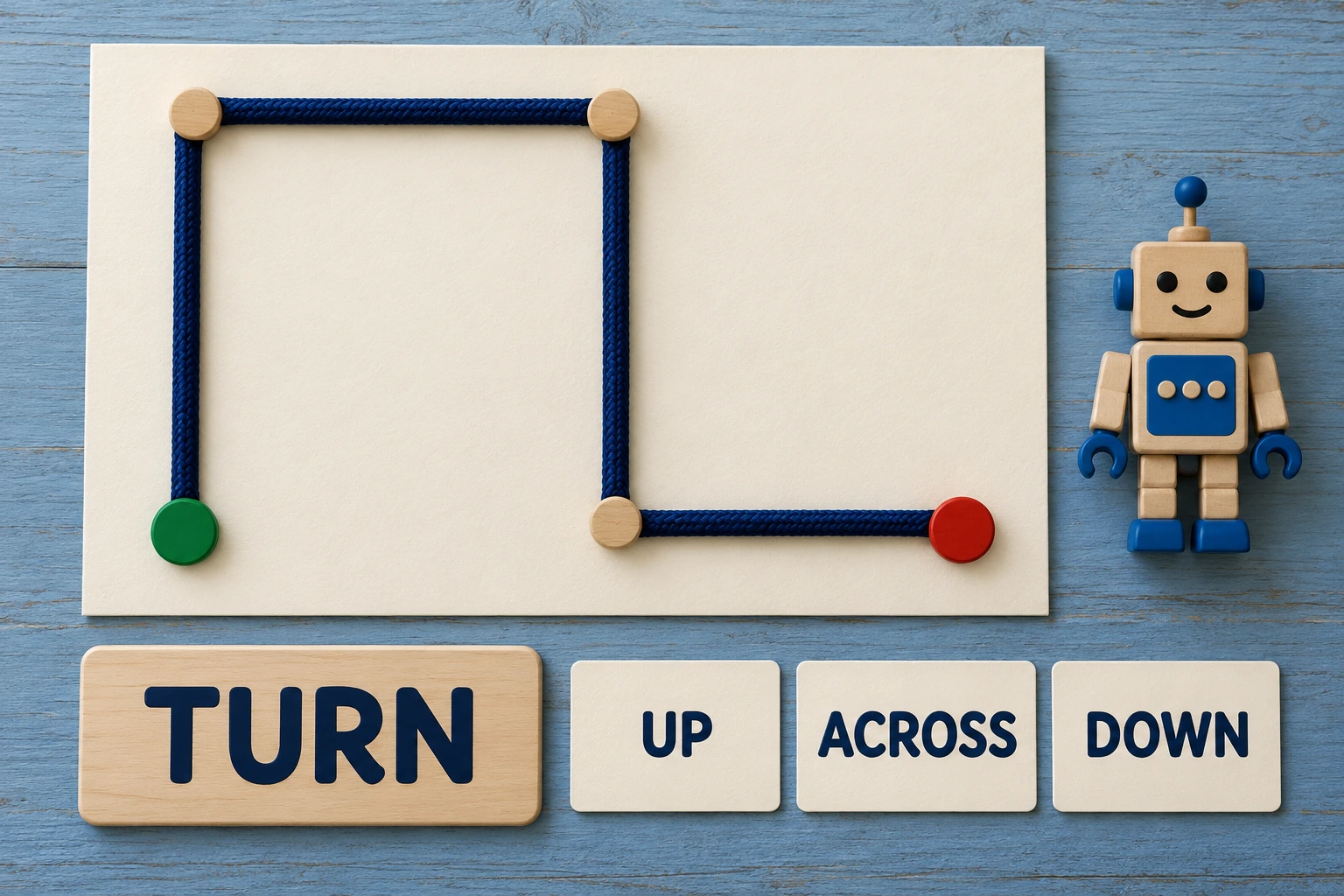
For regular Robot Turn Tracing visits, change the design purpose: a robot walkway, a block-house stair or a control-panel line. Retain one observation from the last visit and choose a fresh attempt when the child is interested. The separate cord scene offers another way to discuss the same corner without using a pencil.
Robot Turn Tracing downloads and later drawing choices
The original sample remains separate from the clean PDF for members. For the unbranded Robot Turn Tracing file, sign in, use the premium download and confirm access through your current eligible plan. Save the PDF, then inspect its single US Letter page in the printer preview. Check that scaling keeps the outer border and all six rows visible. The clean printable has no watermark, website promotion or ads within the file.
When straight-line letters become interesting, try the letter-L change of direction, letter-F line arrangements or a letter-T meeting of strokes. Those symbol tasks introduce their own models. Adults can also explore NAEYC's ideas for everyday writing at home and PBS Parents' literacy activities for age four as wider sources of drawing purposes.
Popular Worksheets
Printable resources families and teachers are downloading now.
 Free
 Free
 Free
 Free