
Rocket Ramp Marks: 5 Wonderful Slant-and-Drop Games
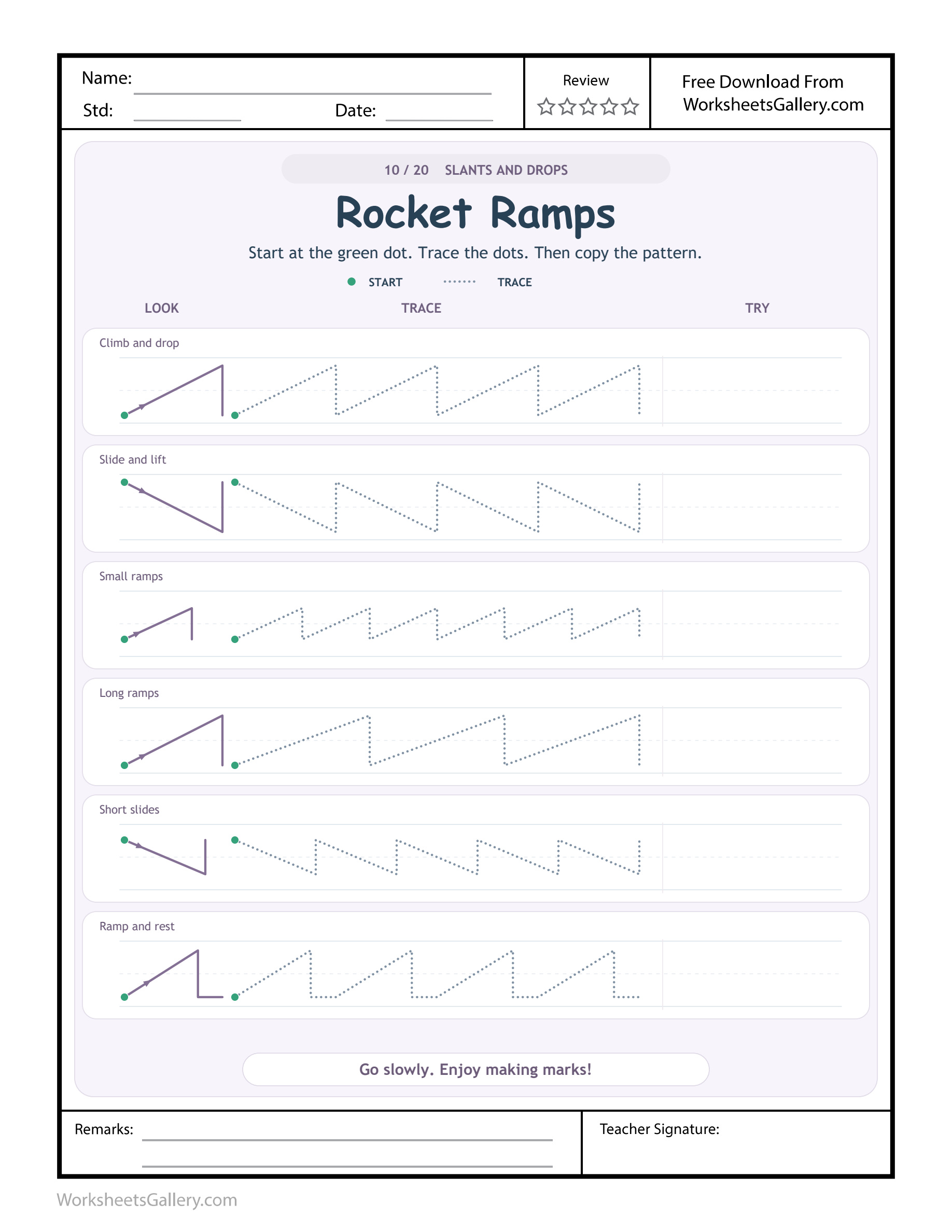
Slant up, then drop straight down: the return matters as much as the climb. Rocket Ramp Marks explores that contrast through six patterned routes, including ascending ramps, descending slides and a final resting stretch. A child can inspect the solid example, follow a dotted portion and carry a chosen movement into the TRY space. The Rocket Ramps worksheet is an invitation to notice how the route resets before another slant begins. An adult can start with a simple finger demonstration, giving the learner time to distinguish an upright return from a second diagonal.
Rocket Ramp Marks makes the return visible
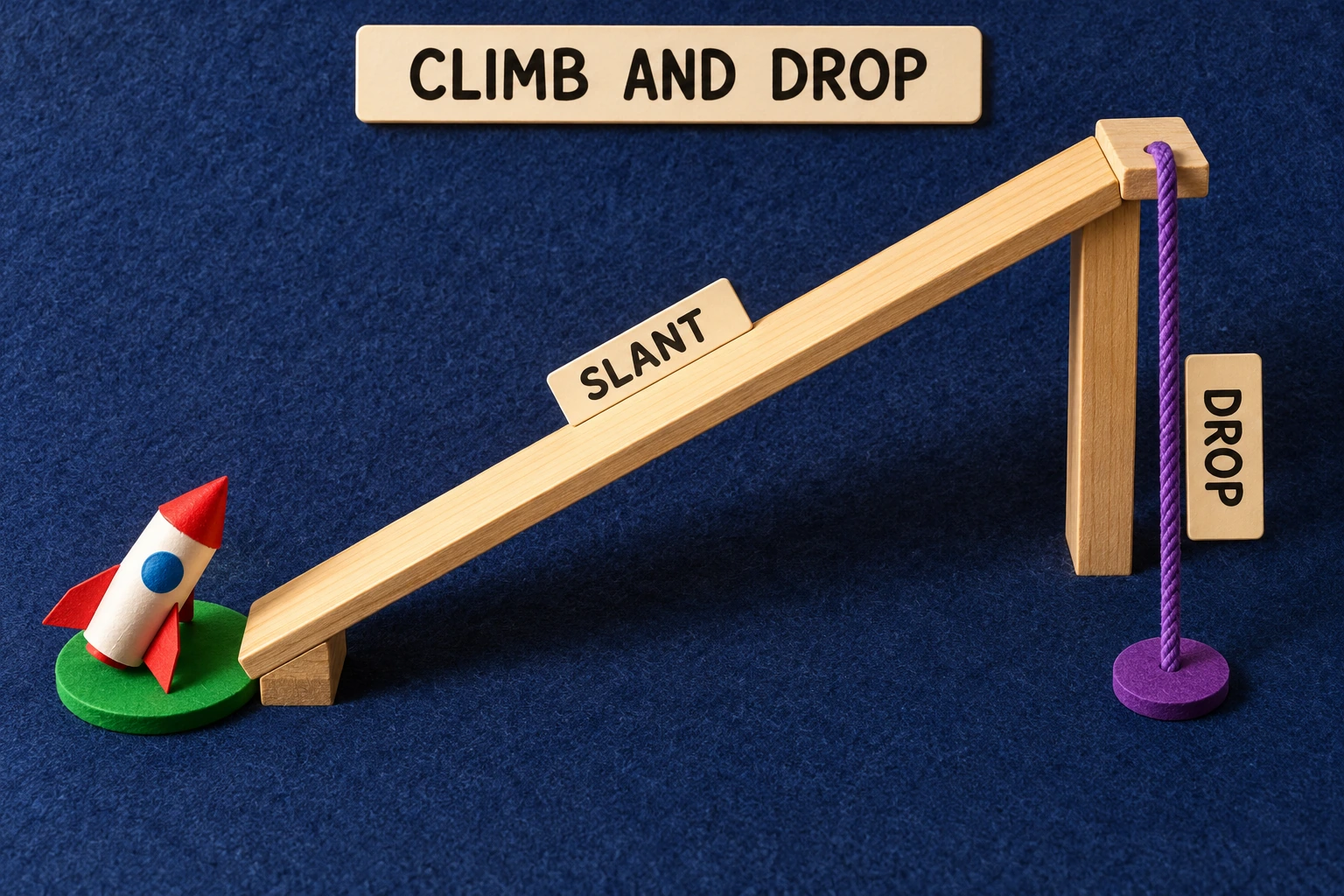
The supporting craft scene labels a sloping piece SLANT and its straight return DROP. Those are two different Rocket Ramp Marks movements. Look at the first source model afterward: the route climbs diagonally and returns vertically. Joining the peak to a distant low point with another diagonal would create a different pattern.
Rocket Ramp Marks uses a rocket theme to give that distinction a memorable setting. It is still prewriting mark practice, rather than a lesson about real rocket flight. Let the child describe the visible line without needing technical space vocabulary or a long explanation before making a mark.
Read the Rocket Ramp Marks launch card before drawing
Six Rocket Ramp Marks labels organise the sheet: Climb and drop, Slide and lift, Small ramps, Long ramps, Short slides, and Ramp and rest. A solid LOOK model introduces each route. Dotted TRACE marks offer a visible path, while the open TRY end leaves room for the learner's version.
Rocket Ramp Marks does not ask for identical triangular mountains on every row. Some slants rise, others fall, and the upright return changes accordingly. The last model includes a level interval. Inspect the selected model rather than carrying the first movement rule through the entire page.

Rocket Ramp Marks offers six useful contrasts
- Slanted versus upright: the child notices that a climb and its reset have different orientations.
- Rise versus slide: a diagonal can travel upward or downward depending on the route's starting point.
- Movement versus rest: a level stretch can interrupt the repeating ramp motif.
- Model versus attempt: the learner selects a feature to preserve rather than copying automatically.
- Watching versus steering: the eyes read what comes next while the hand manages the tool.
- Words versus gestures: climb, drop, slide and lift can be explained by pointing as well as speech.
Rocket Ramp Marks gives adults specific details to recognise. These are opportunities, not promised outcomes from one sheet. A child may readily explain an upright return while still finding the small drawing movement awkward. That difference suggests changing scale or support, not repeating the explanation louder.
Uma chooses a Rocket Ramp Marks reset
Uma and her brother are designing a paper launch station. She draws a rising slope, then another slope back to the baseline. He shows her the first printed model and asks what the line does after reaching the top. She taps straight downward and says, “It drops here.”
Their Rocket Ramp Marks visit stays with that single distinction. Uma follows a dotted ramp and makes a larger version for her launch-station drawing. Her brother names the upright return she kept. They do not need to erase her earlier mountain-shaped line; it can remain a different design beside the new one.
A Rocket Ramp Marks countdown with no timer
At home, prepare a comfortable drawing place with the worksheet, a separate scrap and a familiar tool. Read the chosen label aloud. Point out the start and ask the child to show the return with a finger before drawing the whole motif.
For Rocket Ramp Marks, a useful sequence is look, name, move, compare. Look at one printed example; name its slant and return; move through a short dotted part; compare one feature with the model. The Rocket Ramp Marks sequence supports thought, so avoid turning its four parts into a speed challenge.
Give Rocket Ramp Marks an independent ending when the learner is ready. The TRY portion can contain a brief chosen attempt, and a separate large drawing can be used instead when the compact space is demanding. The child decides when a successful observation is enough for this visit.
Slide and lift changes Rocket Ramp Marks direction

The second model descends on its diagonal and rises on its upright section. Ask the child to point to the slide before the lift. Merely rotating the sheet to make every movement feel like the first row can conceal the difference the model offers.
Rocket Ramp Marks direction words should match the sheet's normal orientation. A learner can turn the paper slightly for comfort, but adults can still discuss which way the printed route travels. Do not demand an immovable page or a particular grip as proof of understanding.
Five Rocket Ramp Marks experiments away from the sheet
Choose one experiment that makes a route feature clearer. All drawings and props belong on separate paper or a safe work surface; the printed activities remain as supplied. The aim is to investigate a movement, not manufacture extra rows of compulsory tracing.
1. Make a Rocket Ramp Marks return comparison
Draw two rising slants on a large card. Give one a vertical drop and the other a diagonal descent. Invite the learner to find the return that resembles Climb and drop. Rocket Ramp Marks comparisons can be answered by pointing before any drawing is requested.
Let the child create a new pair for the adult to inspect. Ask for an explanation of the chosen difference. This gives the younger partner responsibility for a visible design rule instead of a hidden correct answer the adult already controls.
2. Run a Rocket Ramp Marks voice switch
One partner traces a large scrap-paper route with a finger while another says CLIMB, then DROP. On a second card, use SLIDE, then LIFT. Rocket Ramp Marks voice switches draw attention to the reset that follows each diagonal, without requiring the child to memorise a long command sequence.
Change roles and allow corrections. If a word arrives at the wrong segment, stop to inspect that location together. The route, rather than the adult's authority, decides which movement word belongs there.
3. Build a Rocket Ramp Marks strip model
Place one slanted paper strip beside an upright strip on a tray. The learner explains the junction, then sketches a similar pair on another card. Rocket Ramp Marks construction separates the two orientations so they can be inspected before they become one continuous pencil route.
The arrangement need not match the worksheet's size. Remove one strip and ask what part of the drawing idea is now missing. Avoid stacking loose materials into a structure that the child must trace over with a pointed tool.
4. Add a Rocket Ramp Marks resting platform
Sketch a short ramp motif followed by a level portion. The Rocket Ramp Marks designer points to the place where the repeated climbing action pauses. Rocket Ramp Marks resting platforms connect with the final row, but the extra design can use any comfortable scale and does not need a completed rocket picture.
Give the platform a dictated label such as WAIT HERE. A drawing made for a pretend visitor provides a reason for the flat stretch to remain visible instead of being swallowed by another automatic ramp.
5. Exchange Rocket Ramp Marks route tickets
Each partner draws a small route ticket with one diagonal and one upright return. Exchange tickets, describe the movement, then make a fresh version beside the original. Rocket Ramp Marks tickets reveal whether the receiver noticed the return's orientation, even when their drawing is larger or less steady.
Close the exchange by naming one retained feature. Keep the tickets as design ideas for another day; they are not scores to rank or evidence that a child has mastered every writing movement.
A classroom Rocket Ramp Marks engineering conversation
A teacher offers a pretend launch-station drawing area. Children choose a climbing ramp, a descending slide or a ramp with a resting place. They show a partner where the route resets and dictate a short label for that point. Each learner has their own drawing space.
Rocket Ramp Marks remains available as a reference rather than a group copying command. One child may investigate the return while another explores the level interval. The teacher can record their explanations and offer a larger card when compact marks make a sensible plan hard to carry out.
Rocket Ramp Marks can pause between movements

Ramp and rest includes a horizontal section after its slanted and upright parts. Ask the learner to locate that section before extending the pattern. It is easy to continue the most memorable motif and overlook a quieter interval between repetitions.
| Observation | Try this response |
|---|---|
| Two diagonals replace a ramp and drop | Point to the upright return in the model. |
| The slide travels the other way | Find the starting point before naming the slope. |
| The rest interval disappears | Inspect the level section before repeating. |
Rocket Ramp Marks corrections work best when they address one decision. Repeated erasing or tracing over the child's hand can obscure that decision and make a small mark feel like a large test.
Keep Rocket Ramp Marks visits within reach
The sheet is suitable for supported preschool and early kindergarten exploration, often around ages three to six. Age alone does not determine readiness. A child can point, describe or use a large marker route before attempting a compact dotted pattern.
Rocket Ramp Marks involves planning, visual comparison, motor coordination and movement vocabulary. Keep the plan visible while adjusting the drawing demand. If the hand tires, finish with a finger explanation. If frustration grows, stop without requiring one perfect final ramp to earn a break.
Regular Rocket Ramp Marks practice can return through a new design purpose: a lift ticket today, a waiting platform later. An encouraging comment such as “Your drop goes straight down from that peak” identifies a real choice. It gives the child something understandable to revisit.
Take Rocket Ramp Marks into a printable drawing visit
Choose the premium download after signing into an account whose active plan includes this worksheet. Save the clean Rocket Ramp Marks PDF separately from the original sample. It contains no watermark, domain branding or embedded advertisements. Open the one-page US Letter printable before printing and inspect whether the border and TRY ends fit within your printer's usable area. Change print scaling if they are clipped; web-page advertisements are outside the saved worksheet.
For later symbol interests, explore letter-A slants, the meeting slopes of letter V or letter-M direction changes, following each letter's own formation model. Broader adult inspiration is available through NAEYC's family writing suggestions and the PBS Parents age-four literacy pages.
Popular Worksheets
Printable resources families and teachers are downloading now.
 Free
 Free
 Free
 Free