
Balloon Loop Trails: 6 Brilliant Above-Line Activities
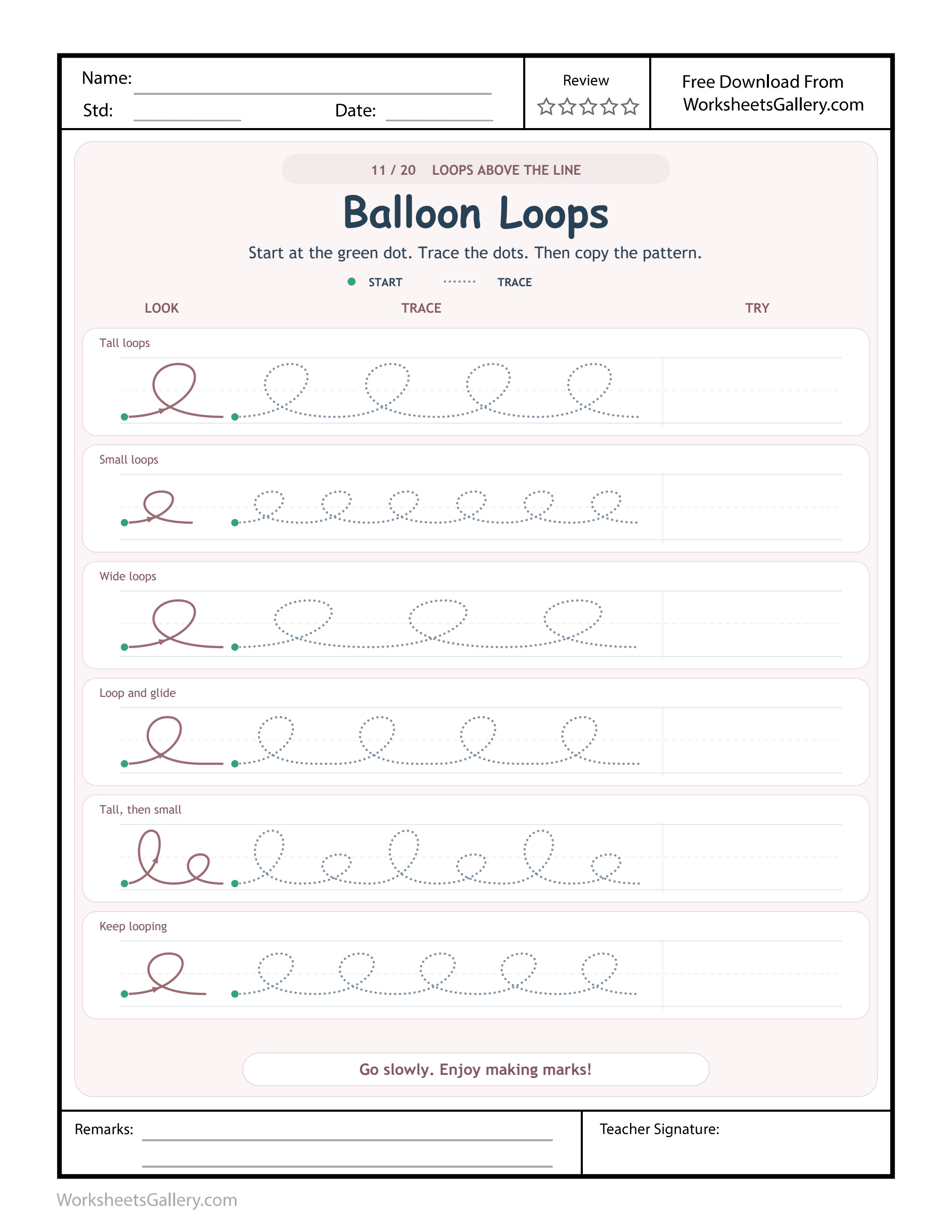
Imagine a ribbon rising above its travelling line, crossing itself and moving onward. Balloon Loop Trails invites children to inspect that enclosed upper opening before trying the movement with a pencil. The Balloon Loops sheet presents six variations, from tall loops to a loop followed by a glide. Each row offers a solid model, dotted practice and an independent end. Start with the crossing rather than the height: a large open arch and a closed loop may rise equally far, yet follow different routes. One careful look can make that difference easier to discuss.
A Balloon Loop Trails invitation for the drawing table
Set out Balloon Loop Trails as a collection of routes to investigate. The learner can choose a taller opening, a broader one or a loop with a long exit. An adult reads the selected label and asks the child to show where the line crosses before any tracing begins.
Balloon Loop Trails does not require drawing balloon pictures or writing a particular letter. The theme provides a setting for the movement. Keep the printed loop as the reference while allowing the child to explain its route in ordinary words, gestures or a larger drawing beside the page.
Follow Balloon Loop Trails into an opening and out again
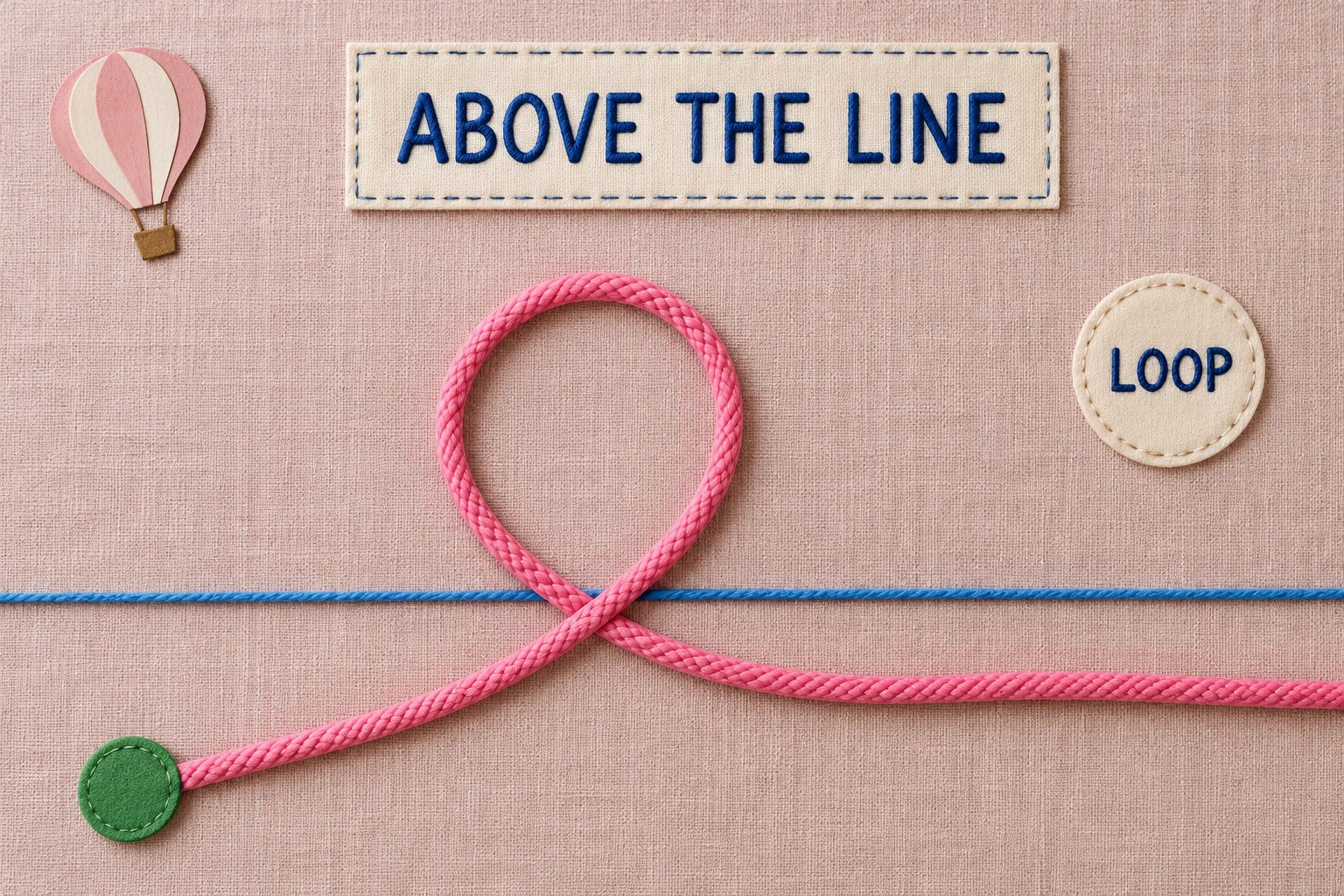
The first model rises into an upper turn and returns through a crossing near the travel level. The route then continues toward the next motif. Its enclosed space is an important visual feature: removing the crossing changes the loop into an open arch.
For Balloon Loop Trails, ask “Where does this line meet itself?” A finger can pause at that point while the adult follows the rest with their eyes. Do not insist on a continuous fast motion. A pause for inspection can support a more deliberate next movement.

Six Balloon Loop Trails experiments with a travelling ribbon
These off-sheet Balloon Loop Trails experiments are optional companions. Use separate cards and drawing materials, and choose a comfortable scale. Their Balloon Loop Trails purpose is to make an opening, crossing or exit more noticeable before the learner returns to a small printed route.
1. Balloon Loop Trails opens a window finder
Draw one open arch and one crossed upper loop on scrap paper. Ask which encloses a window. The child can point through that opening with an imaginary viewfinder made from fingers. Balloon Loop Trails window finding focuses on closure without asking for a perfect copied shape.
Invite the child to draw a new pair for the adult. A lopsided loop can still have a clear enclosed opening, so recognise that feature before commenting on smoothness or size.
2. Give Balloon Loop Trails a crossing marker
Lay a cord in an upper loop on a tray, with a short crossing and an onward exit. Place a small labelled CROSS card beside the meeting point. Balloon Loop Trails cord models let the learner inspect the crossing from above without an adult moving the child's pencil.
Sketch the cord route on separate paper if desired. The word card belongs beside the route, not over it, so the feature being discussed stays visible. Keep loose cord within the supervised table activity.
3. Send Balloon Loop Trails a glide message
An adult draws a loop leading into a level line. The child chooses where a little paper message could travel after leaving the loop. Balloon Loop Trails glide messages connect a curved opening with its straighter exit, rather than automatically beginning another loop immediately.
Write the child's dictated message beside their drawing. The extra words give the mark a communication purpose. They are not a reading demand or an instruction to squeeze writing into the worksheet's TRY section.
4. Hold a Balloon Loop Trails height conversation
Make a taller loop next to a smaller one on a card. Ask the learner what stays the same and what changes. Balloon Loop Trails height conversations can notice two enclosed openings while comparing how far each rises above the travel level.
Change roles so the child designs a pair for the adult. Use relative language rather than a ruler; the intention is to preserve a visible relationship, not reproduce a prescribed measurement.
5. Create a Balloon Loop Trails broad-window design
Offer a card with space for one wide upper loop. The child decides how broad its opening will be and where the exit goes. Balloon Loop Trails broad-window designs explore width while keeping the crossing and above-line position in view.
Compare with Wide loops on the sheet afterward. The child's design may use a different scale. Ask which model feature inspired it, allowing the learner to identify a meaningful connection in their own work.
6. Trade Balloon Loop Trails route postcards
Partners each draw one loop route for the other to describe. The receiver finds the opening, crossing and continuation before making a new version. Balloon Loop Trails postcards give a listener a reason to inspect the whole route rather than recognise only its tall outline.
End by telling the designer which feature was easy to follow. Keep the exchange conversational; it is not a handwriting contest, and the adult's card need not become the standard every child must match.
Choose a Balloon Loop Trails row for a reason
Tall loops, Small loops, Wide loops, Loop and glide, Tall, then small, and Keep looping are the six source labels. Each introduces a solid LOOK example beside dotted TRACE work and an open TRY continuation. Select a feature rather than treating the rows as a compulsory endurance sequence.
| Selection | A useful inspection |
|---|---|
| Wide loops | Find the broad opening above the route. |
| Loop and glide | Locate the exit before another turn. |
| Tall, then small | Compare neighbouring loop heights. |
Balloon Loop Trails row names guide a conversation; the actual model supplies the drawing information. Notice where its line crosses and continues instead of guessing the route from the label alone.

Kavi gives Balloon Loop Trails a greeting-card job
Kavi wants a looping ribbon on a pretend invitation. His mother notices that his first drawing is a series of open humps. She asks whether he wants arches or enclosed ribbon loops, then shows him the upper opening in the solid worksheet example.
Their Balloon Loop Trails visit lasts for one dotted motif and a separate invitation drawing. Kavi chooses a crossed loop, explaining that the ribbon can now “go through here and out.” His mother describes the visible opening without demanding that every curve on the card have the same height.
Six Balloon Loop Trails observations worth recording
- Closure: the learner notices that the route encloses an opening.
- Crossing awareness: two parts of the same line meet before the route continues.
- Position: the opening stays above its travelling level rather than dropping below it.
- Variation: height or width can change while the loop remains recognisable.
- Coordination: the drawing hand steers while the supporting hand can stabilise the page.
- Explanation: a child uses rise, cross, opening or glide to describe a visible choice.
Balloon Loop Trails combines spatial thought, visual comparison, motor control and language. These aspects do not develop at an identical pace. A clear verbal or gestural explanation can be meaningful even when the small pencil route is still uneven.
Let Balloon Loop Trails leave the loop deliberately

Loop and glide changes from turning to level travel. Ask the child to find the exit before starting the dotted section. The quieter straight portion deserves attention because it changes the rhythm of the motif without adding another enclosed opening.
Balloon Loop Trails copying is an act of choosing what to retain. If a learner adds an extra loop where the model glides, compare that place together. They may have remembered the exciting loop while overlooking its continuation. Focus on the new exit decision instead of rejecting the whole mark.
A home Balloon Loop Trails routine with room to decide
Begin on a steady table with a familiar tool and enough space for the child's arms. Read the selected row, locate the green start and follow the solid route with a finger. Ask one question about the crossing, then invite a short dotted attempt.
After Balloon Loop Trails tracing, let the learner point to the feature they intended to keep. Offer a TRY continuation or a larger scrap-paper version. Finish with that explanation rather than requiring every dotted loop to be filled before the activity counts as useful.
For regular Balloon Loop Trails visits, change the drawing purpose: an invitation ribbon, a pretend sign border or a route postcard. Return to one remembered feature and allow the child to choose a new variation. Familiarity can grow through meaningful drawing without repeatedly completing the entire page.
Two Balloon Loop Trails heights in one motif

Tall, then small pairs a higher opening with a lower one. Inspect both before extending the pattern. The task is not simply to repeat a loop shape; it is to notice the relationship between neighbouring versions and decide how to carry that relationship forward.
Balloon Loop Trails feedback might sound like “Your second opening rises less than the first.” That describes evidence the child can see. If both loops are equal, recognise any retained crossing and ask which height change they would like to investigate next.
Balloon Loop Trails in a classroom ribbon studio
A teacher provides individual cards for a shared pretend celebration display. Children choose a wide loop, a tall-and-small pair or a loop with a glide. They point to their source model, draw a short border and dictate a label explaining the chosen movement.
Balloon Loop Trails supports different design decisions within the group. One learner may explain an opening by pointing, while another talks about the exit. Offer a larger card or a finger demonstration when needed, and avoid ranking the borders by speed or uniformity.
Keep Balloon Loop Trails open to different learners
Supported preschool and early kindergarten learners, commonly around three to six, may enjoy these routes. Readiness matters more than a birthday. Adults can read labels, accept gestural answers and offer broader movements before compact tracing. The task is mark exploration, not a requirement to read the printed words.
Common Balloon Loop Trails difficulties include leaving an arch open, placing the loop below the line, losing the exit or overlooking a size change. Choose one feature to inspect. Keep the crossing visible without insisting on a flawless outline. Stop when fatigue or frustration replaces curiosity, and return with a manageable drawing choice later.
Save Balloon Loop Trails for a future drawing occasion
The downloadable original sample and the clean member PDF are separate files. To obtain unbranded Balloon Loop Trails, log in and choose the premium download available through your eligible active membership. Save and open the printable PDF, then check the whole US Letter page in print preview. Keep every border edge and TRY end within the printable area. The clean edition includes no watermark, website name or advertisements inside its page.
Later symbol explorations could include letter-O closure, letter-Q outline and tail or a letter-G curved route, each with its own formation instructions. Adults seeking wider drawing contexts can visit the NAEYC home-writing resource and PBS Parents' collection for early literacy.
Popular Worksheets
Printable resources families and teachers are downloading now.
 Free
 Free
 Free
 Free