
Star Garden Strokes: 5 Brilliant Point-and-Curve Games
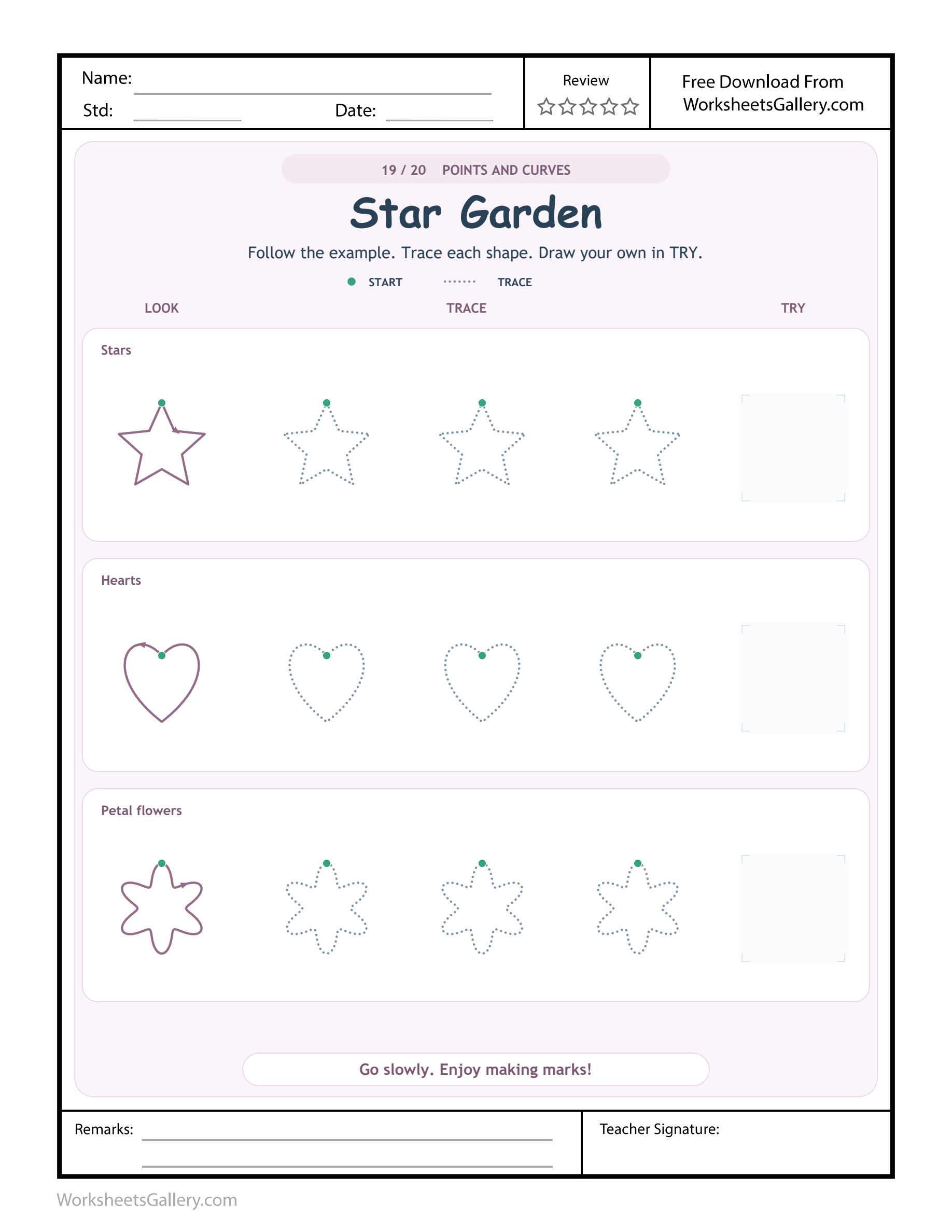
The edge tells your hand what kind of turn comes next. Star Garden Strokes compares a pointed star, a two-lobed heart and a rounded petal flower, rather than giving every outline the same steering rule. The Star Garden sheet includes solid models, dotted boundaries and spaces for independent versions. Begin by looking closely at one small stretch of edge. Does it meet at a sharp point, dip inward or bend smoothly around a lobe? That observation can guide a finger journey before a child chooses a pencil attempt or a larger drawing elsewhere.
A Star Garden Strokes field notebook
Treat Star Garden Strokes as a set of contours to investigate. The Star Garden Strokes source names its rows Stars, Hearts and Petal flowers. Each shows a solid example alongside three dotted versions, with an independent TRY window at the row's end. There are nine guided outlines to choose from, not a requirement to finish nine at once.
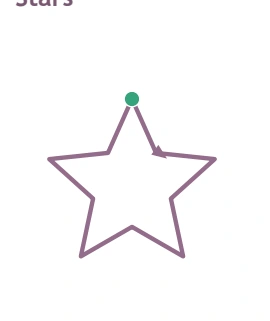
Star Garden Strokes begins with a five-point outer star boundary. The route follows its edge; it is not a pentagram made by crossing straight lines through the middle. Locate the green beginning and inspect the first change of slant before deciding how to move.
Riya asks Star Garden Strokes to decorate a message
Riya and her mother are making a pretend garden-club invitation. Riya wants a star badge and a heart beside her message. She draws both with sharp little peaks. Her mother places the heart model nearby and asks which parts bend instead of meeting at points.
Their Star Garden Strokes visit becomes an edge conversation. Riya points around one upper heart lobe, tries a dotted boundary and returns to her invitation. Her mother recognises the rounded lobe she retained, while leaving the star's deliberate corners as a different design choice.
Star Garden Strokes gives their home drawing a meaningful contrast. Riya does not need identical badges or a finished decorative page. She can explain why one outline uses points and another uses curves, with her mother writing a dictated invitation word beside the designs.
Star Garden Strokes examines the star's changing slants

An outward tip is followed by an inward join before the next tip. Look ahead at these changes rather than drawing a familiar star symbol from memory. A Star Garden Strokes learner can point to one tip and the inward place beside it before tracing a short portion.
Star Garden Strokes star feedback should name a route choice. “You followed the outside edge around that point” describes something visible. It does not require every slant to have an exact length, nor does it turn a wavering line into a reason to discard the whole attempt.
A Star Garden Strokes contour comparison
| Contour | Look ahead for | Avoid adding |
|---|---|---|
| Star | Tips and inward joins | Crossing centre lines |
| Heart | Two upper lobes and a lower point | Sharp peaks around every bend |
| Petal flower | Six rounded lobes | A required stem or inner circles |
Star Garden Strokes uses the uploaded models as the reference. The flower is a single six-petal outer boundary; the child is not asked to assemble separate petals or complete an unfinished plant picture. Keeping that task clear leaves room for optional creative drawings on other paper.
Seven Star Garden Strokes observations for a notebook
- Contour attention: inspect a local edge instead of relying only on the shape's name.
- Point recognition: notice abrupt changes at a star tip or heart's bottom.
- Curve recognition: distinguish a rounded lobe from a sharp corner.
- Start planning: locate the marker belonging to the chosen model.
- Closure: carry the boundary back to its beginning.
- Motor adjustment: change steering when the kind of edge changes.
- Description: explain a visible point, dip, lobe or rounded section.
Star Garden Strokes combines cognitive comparison, visual attention, hand coordination and language. A child may explain a curve clearly before managing it in a small pencil space. Separate that understanding from the physical precision of the current attempt.
Five Star Garden Strokes activities for edge explorers
The following activities use spare paper and adult-written labels where useful. They extend the contour conversation rather than adding compulsory tracing. Pick an activity that makes one currently interesting feature easier to inspect or communicate.
1. Star Garden Strokes opens a point-and-curve gallery
Draw a pointed contour and a rounded contour on separate cards. The learner places POINTS or CURVES beside a feature that matches the word. Star Garden Strokes galleries let a child classify a visible turn through pointing before drawing another outline.
The child can create a new gallery card for the adult. Discuss the actual edge, accepting a mixed design that contains both kinds of turn instead of forcing every drawing into one simple group.
2. Give Star Garden Strokes a heart-lobe conversation
Sketch a large heart on a card and ask the learner to follow one upper lobe, then locate the lower point. Star Garden Strokes heart conversations reveal that a single boundary can combine gradual curves with a sharper change.
Invite the child to draw a fresh heart for a pretend message. Describe one chosen curved stretch rather than expecting the two sides to be perfectly symmetrical. The message gives the contour a recipient.
3. Star Garden Strokes sends a star-edge itinerary
Draw a broad five-point outer star. A partner follows its boundary with a finger, pausing to indicate an outward tip and an inward join. Star Garden Strokes itineraries emphasise the perimeter instead of taking a shortcut through the centre.
Switch roles and let the child explain the next turn. No timer is necessary. The useful event is a deliberate inspection of the connected edge, not a fast journey around a familiar symbol.
4. Make Star Garden Strokes a petal-border request
Pretend a garden club needs a rounded flower badge. The designer inspects the six-petal source outline, then draws a separate badge and dictates a label. Star Garden Strokes requests connect a soft outer boundary with a communication purpose.
A receiver points around the lobes and asks which curve the designer noticed first. The extra drawing need not contain a stem, inner circle or other features absent from the printed exercise.
5. Trade Star Garden Strokes mixed-edge postcards
Partners each draw a little border using one point and one rounded bend. Exchange postcards and explain where the steering changes. Star Garden Strokes postcards allow an invented route while retaining a precise comparison inspired by the sheet.
If a receiver is unsure, the designer can point to the intended region or make a larger version. Clarifying a message becomes the reason to revisit the drawing rather than an adult demand for more marks.
Star Garden Strokes follows the heart from its upper dip

The heart's green start belongs near the central upper dip. Its route moves around curved lobes and toward the lower point. Inspect that beginning rather than copying the star's uppermost tip as a universal starting rule.
Star Garden Strokes can focus on one upper lobe during a visit. If the child makes every turn angular, compare that lobe with a star tip. If the outline stays open, closure can become a different conversation later. Correcting every feature together makes the drawing problem harder to identify.
Star Garden Strokes at home, one contour at a time
Set the page where the child's arms have comfortable room. Offer a familiar crayon or pencil and keep separate larger paper nearby. Read the selected row's name, locate its model and follow a short stretch with a finger before inviting dotted work.
For Star Garden Strokes copying, ask which feature the learner wants to keep. Offer the TRY window with the model still visible, or a larger version elsewhere. Compare the chosen point or curve rather than measuring every side of the outline.
Finish Star Garden Strokes when the observation is clear or the child needs a break. Save an explanation such as “this petal bends all the way round.” That gives a future visit a starting idea without requiring the whole page to be completed again.
Star Garden Strokes in a classroom badge workshop
A teacher provides individual cards for pretend garden-club badges. Children choose a star, heart or petal contour, identify a feature in the source and make a separate design. They dictate a short badge label and explain a chosen turn to a partner.
Star Garden Strokes supports different decisions within the group. A child may show closure while another talks about pointed tips. Offer adult label reading and gestural answers. Record the feature each designer intended instead of ranking badges by neatness, symmetry or quantity.
Star Garden Strokes lets petal edges remain rounded
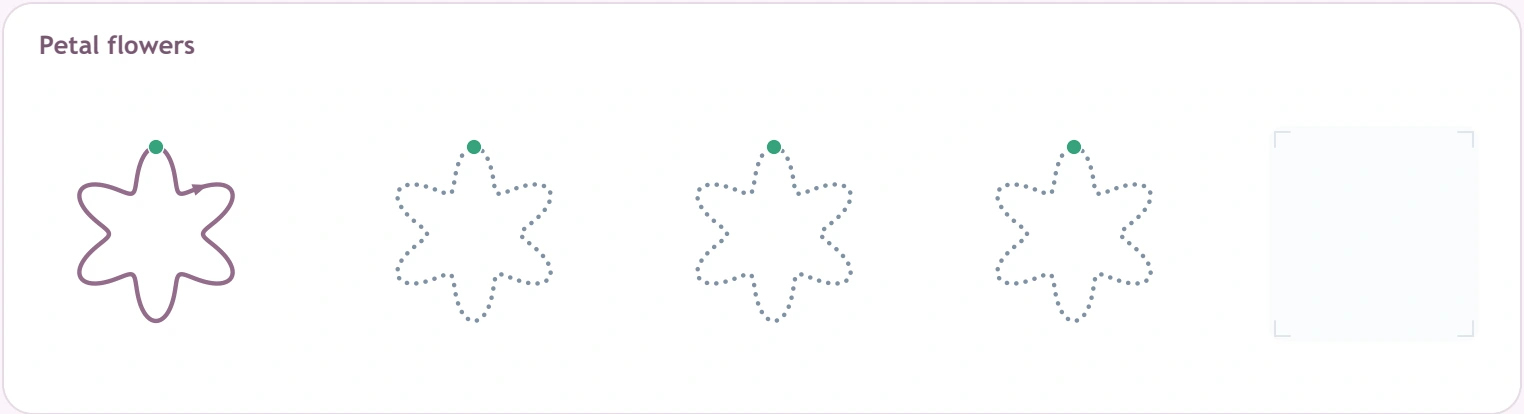
The third row follows six soft lobes around one outer boundary. Its turning behaviour differs from the star's angular edge. Ask the learner to find a rounded lobe before beginning, particularly after working on the pointed row.
Star Garden Strokes errors can come from carrying one successful movement into a new contour without reinspection. A new edge deserves a new look. Recognise retained features, then choose one change to discuss. A larger fresh card may help more than repeatedly tracing over the same small mark.
Star Garden Strokes can return through another message
Adult-supported preschool and early kindergarten learners, often around ages three to six, may explore these outlines. Their experience with tools and compact turns varies. Large pointing routes can come first, and the adult can read all labels without making word recognition part of the task.
Regular Star Garden Strokes practice can return through a new invitation badge or mixed-edge postcard. Let the learner choose a contour and a reasonable ending. Stop for tired hands, frustration or lost interest; a meaningful explanation can remain the successful part of a short visit.

Star Garden Strokes printable choices and related interests
For the member's unbranded edition, log in with a currently eligible plan and select the premium download. Save the clean Star Garden Strokes PDF separately from the original sample. It is printable without a watermark, domain promotion or embedded ads. Open its US Letter page before printing and inspect whether the entire border and every TRY window fit the print preview; adjust scaling if necessary. Website adverts are outside the PDF itself.
Later letter interests might include letter-W changes of slant, letter-S turning curves or letter-O closure, following each letter's own model. Adults can browse NAEYC's suggestions for family writing and PBS Parents' literacy activity collection for other reasons to make meaningful marks.
Popular Worksheets
Printable resources families and teachers are downloading now.
 Free
 Free
 Free
 Free