
Pattern Parade Paths: 6 Powerful Mixed-Movement Games
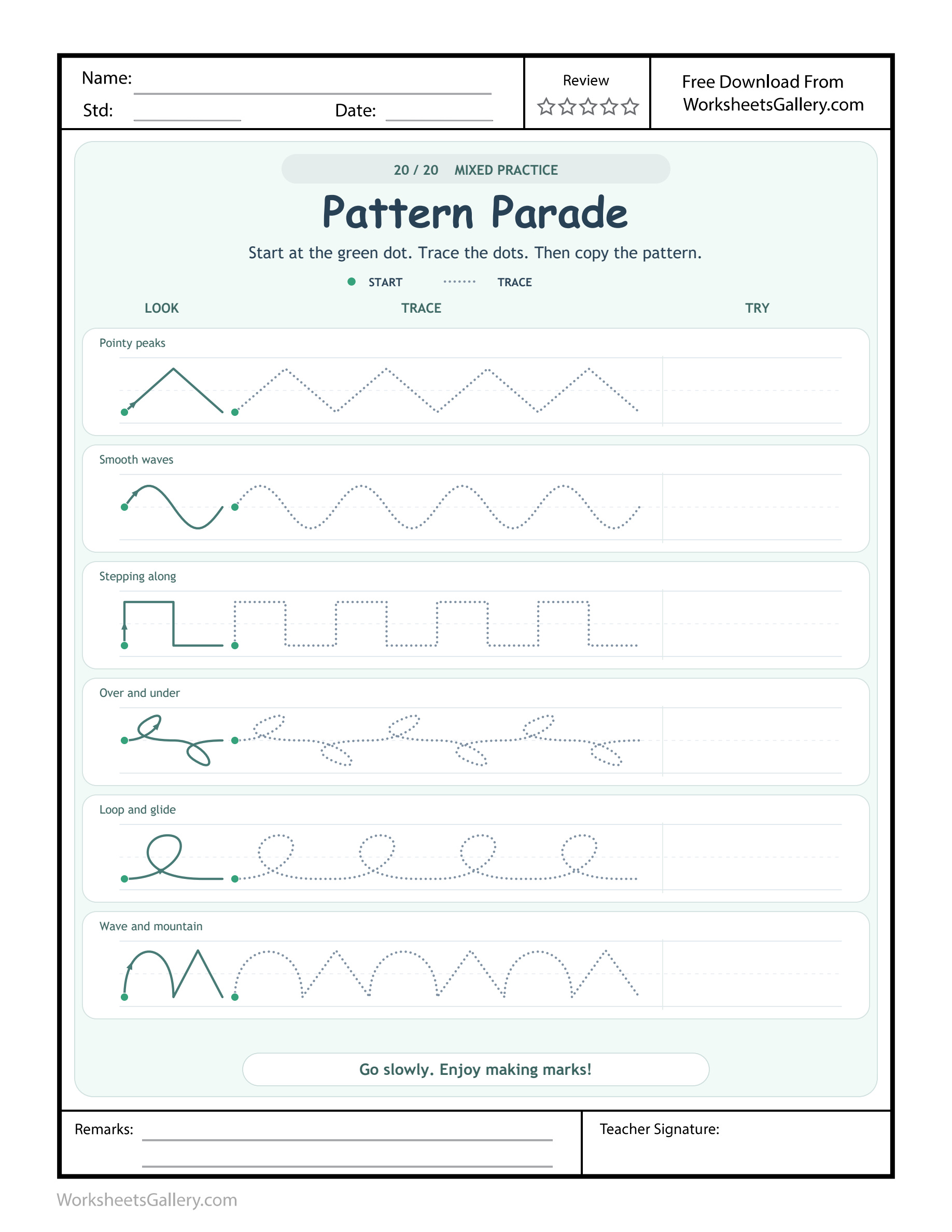
The parade changes its step, so the pencil needs a fresh plan. Pattern Parade Paths brings pointed peaks, smooth waves, square steps and crossed loops onto one sheet, with a mixed final route. The Pattern Parade worksheet offers solid examples, dotted practice and independent continuations for six rows. A learner can inspect the next model before carrying a familiar movement into it. Begin by asking what kind of turn is coming: sharp, rounded, squared or crossed? The aim is to notice a change in the visible route and choose a movement that fits it.
Pattern Parade Paths pauses for a new instruction
Following one Pattern Parade Paths pattern successfully can make it tempting to continue the same movement everywhere. This sheet offers a reason to stop and look again. The Pattern Parade Paths source labels change from Pointy peaks to Smooth waves, then Stepping along, Over and under, Loop and glide, and Wave and mountain.
Pattern Parade Paths does not ask the learner to race through a mixed test. Select one contrast that interests them. An adult can read the row labels while the child points to the part of the model that shows how the next route differs.
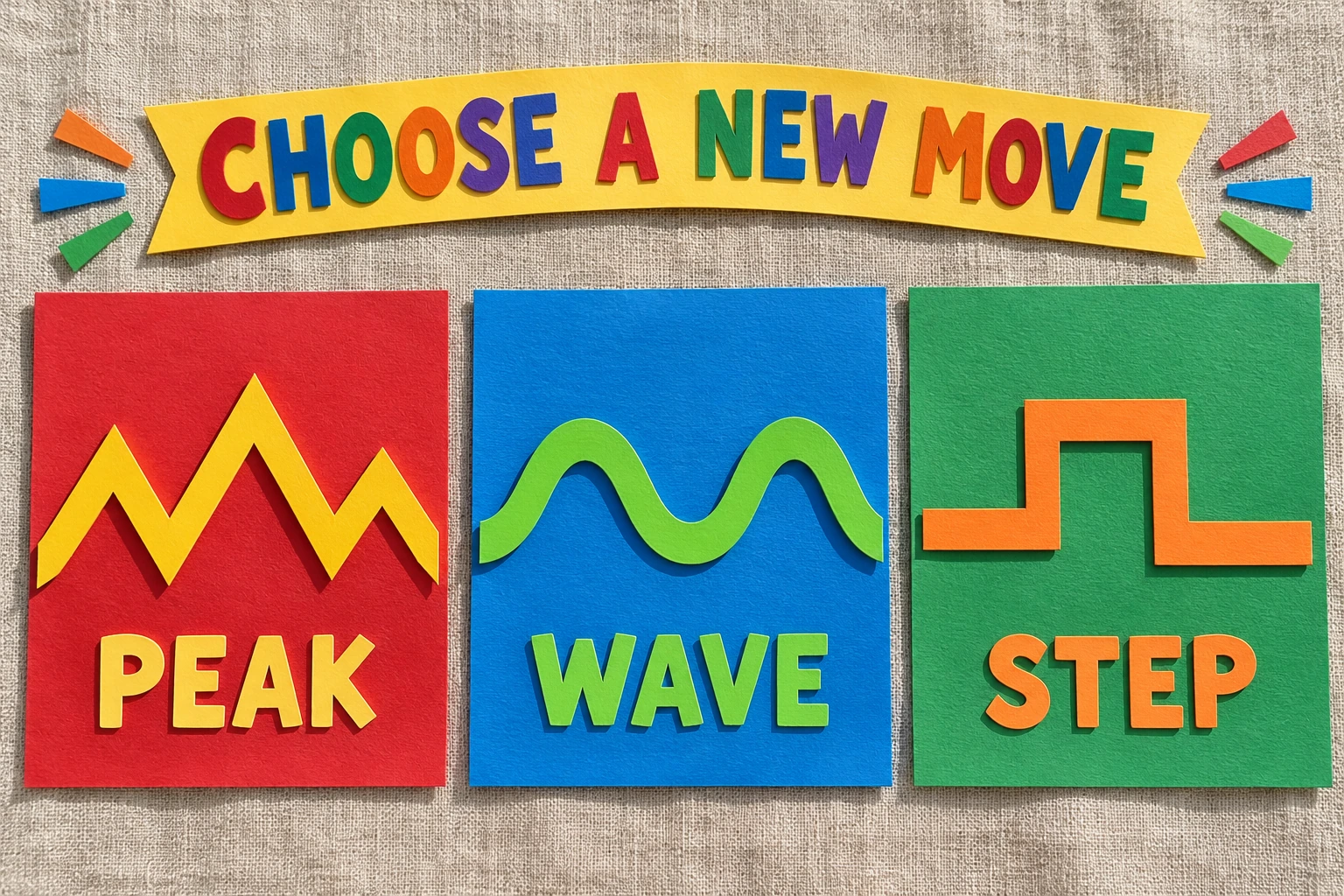
Pattern Parade Paths first contrasts sharp and smooth

Pointy peaks uses slanted lines meeting at corners. Look ahead to an upper point and a lower meeting before beginning the dotted portion. The child can describe the changes through gestures rather than memorising formal movement names.

Pattern Parade Paths changes its steering in Smooth waves. These bends turn gradually instead of meeting as angular peaks. Repeating the first row's sharp movement here would change the selected model, even if the route still travels up and down overall.
Sameer gives Pattern Parade Paths a parade-banner purpose
Sameer and his aunt are designing a pretend celebration banner. He draws sharp peaks along one edge, then asks for a softer border below. His aunt places the wave model nearby and asks how the line changes direction there.
Their Pattern Parade Paths visit focuses on that single contrast. Sameer points around a rounded bend, follows a short dotted wave and makes a separate banner strip. His aunt describes the smooth turn he chose rather than asking every decoration to match in size.
Pattern Parade Paths gives their home scenario a reason to compare movements. The banner can carry a dictated word such as WELCOME. The child decides which border suits the message, while the worksheet remains a reference rather than a compulsory finished art project.
A Pattern Parade Paths route-selection chart
Each Pattern Parade Paths row contains a solid LOOK example, dotted TRACE guidance and an open TRY continuation. The independent end welcomes a short chosen version. Inspect the actual model: the last row's name includes wave, but its visible motif joins a rounded arch with a pointed mountain.
| Route family | Inspect before drawing |
|---|---|
| Peaks and waves | Sharp joins or gradual bends? |
| Steps | Which straight segment follows? |
| Loops | Where does the connected line cross? |
| Mixed final motif | Where does rounded become pointed? |
Pattern Parade Paths uses the source as evidence. A familiar label or remembered movement should not replace looking at the route. This is especially useful when a child has just practised a different pattern successfully and expects the next row to behave the same way.
Six Pattern Parade Paths games for movement designers
Use separate drawing cards for these optional games. Each gives a movement switch a communication purpose. Pick one relevant contrast, leaving the uploaded examples and intentional TRY spaces available for the learner's own later choices.
1. Pattern Parade Paths opens a turn-choice kiosk
Offer a pointed zigzag card and a rounded wave card. A partner requests SHARP or SMOOTH, and the learner selects the matching route. Pattern Parade Paths kiosks make the contrast visible before introducing another small pencil attempt.
Exchange roles so the child can make the request. An adult-written label beside each card supports discussion without requiring independent reading or an empty pretend sign waiting for unspecified text.
2. Give Pattern Parade Paths a step announcer
Draw a large squared route and ask a partner to announce the next straight direction before each corner. Pattern Parade Paths announcements connect the visual model with words such as up, across and down, rather than carrying a waving action into the steps.
If a direction does not fit, inspect the card together. The visible route decides the next segment. The game is a conversation about planning, not a test of how quickly a child obeys spoken commands.
3. Pattern Parade Paths sends a crossing message
Make a loop route on a separate card and mark its beginning. The receiver follows it with a finger, explaining where the line crosses and continues. Pattern Parade Paths messages give a crossover a reason to be understandable to someone else.
Let the designer clarify by pointing or drawing a broader version. A clear route explanation can be valuable even if the small pencil line remains uneven or the two openings differ in size.
4. Build a Pattern Parade Paths glide ticket
Draw one loop followed by level travel and dictate GLIDE beside the exit. Ask the receiver where turning ends and the quiet straight portion begins. Pattern Parade Paths tickets make that less conspicuous section part of the intended message.
The child can make a fresh ticket for an adult. Discuss whether the glide remains visible rather than counting how many loops fit on the card. A short design can communicate the whole chosen idea.
5. Pattern Parade Paths opens a mixed-border studio
Offer large paper for a rounded arch followed by a pointed peak. Ask the designer to show where their steering changes. Pattern Parade Paths borders relate directly to the last source motif while allowing a comfortable scale and an independent decorative purpose.
Add a dictated label such as ROUND THEN POINTED. The label describes the visible order; it does not turn the extra design into a handwriting exercise or fill the worksheet with adult-supplied answers.
6. Trade Pattern Parade Paths instruction postcards
Each partner draws a short route using one chosen movement family. Exchange postcards and identify the rule before making a new version. Pattern Parade Paths postcards ask the receiver to inspect first instead of assuming the previous card's movement continues.
If the drawing combines two rules, the designer can explain the switch. Keep the exchange open to a purposeful mixed design rather than forcing every mark into a single category or ranking the partners by neatness.
Pattern Parade Paths turns into square steps

Stepping along joins upright and horizontal sections at corners. Look toward the next segment before steering. A diagonal shortcut across several corners would change the route, while rounded joins would carry the wave rule into a different model.
Pattern Parade Paths feedback can describe the retained feature: “You kept that upright part before going across.” If a child rounds the corner, inspect that particular join rather than treating the whole attempt as an undifferentiated mistake.
Seven Pattern Parade Paths decisions adults can notice
- Reinspection: the learner looks at a new model before drawing.
- Turn contrast: sharp and smooth changes are distinguished.
- Segment planning: straight sections in a step route are followed in order.
- Crossing awareness: the connected line guides a loop continuation.
- Quiet intervals: a level glide is retained rather than replaced by another motif.
- Mixed rules: one route can contain both rounded and pointed movement.
- Explanation: a child tells a partner what changed and where.
Pattern Parade Paths connects cognitive comparison, visual attention and language with motor adjustment. A child can understand a rule switch while needing more drawing space to enact it. These observations are useful possibilities, not a score sheet for readiness.
Pattern Parade Paths at home starts with a chosen contrast
Give the learner a comfortable work area, the upright page and a familiar drawing tool. Read two relevant labels, inspect their solid examples and point to the difference. Invite a short dotted attempt in one selected row rather than assigning the entire sheet first.
For Pattern Parade Paths independent work, retain the model and offer the TRY end or larger scrap paper. Ask which feature the child meant to preserve. Stop after a clear explanation when that is enough, keeping the unused routes for another drawing occasion.
Pattern Parade Paths follows a connected crossing

Over and under changes the route again, alternating openings around the travel level. A crossing may present several visible directions, but the connected path supplies the continuation. Inspect it with a finger before asking the pencil to travel through.
Pattern Parade Paths mistakes can arise from a successful old habit carried into a new row. Notice whether the child used rounded waves, squared steps or repeated loops where another rule was shown. Identify the mismatch specifically so the next conversation has a clear purpose.
A classroom Pattern Parade Paths banner committee
A teacher invites children to design short borders for a shared pretend celebration. Each child chooses a movement family, points to its source inspiration and makes an individual strip. Partners describe the rule and ask about any visible switch.
Pattern Parade Paths allows different contributions: a sharp border, a smooth route or a mixed arch-and-peak design. Adults read labels, accept gestures and offer broader paper. Record the choices children explain rather than requiring identical borders or comparing the number of motifs completed.
Pattern Parade Paths changes rule within its final row

Wave and mountain shows a rounded arch followed by an angular peak. Look at both before extending the motif automatically. The row name does not ask for an entire sinusoidal wave, and a chain of only mountains would lose the contrasting rounded part.
Pattern Parade Paths can retain that order in a brief independent version. Notice the switch before repeating. A child who remembers one part has something useful to keep while inspecting the other. Avoid correcting size, direction, smoothness and sequence all at once.
Pattern Parade Paths stays manageable across visits
Preschoolers and beginning kindergarten children, often roughly three to six years old, can explore these routes with an adult. Their tool experience varies. Finger demonstrations, label reading and enlarged drawings can support participation before compact tracing is comfortable.
Regular Pattern Parade Paths visits can return through a different banner request or postcard. Keep one observation from the previous visit and choose a fresh purpose. Pause for fatigue or frustration; a child's explanation of a new rule can be a worthwhile ending even without a completed row.
Pattern Parade Paths printable access and future choices
The original sample and the unbranded member PDF remain distinct. To save clean Pattern Parade Paths, sign in with a plan that currently includes this premium download and select its member attachment. Open the saved US Letter printable and check its border and all independent ends in the printer preview. Adjust scaling if a page edge is lost. The clean file includes no watermark, website name or embedded ads; any advertisements on the site stay outside the PDF.
Later symbols can include letter-S changing curves, letter-W slants or letter-L corners, using their own formation models. Wider adult ideas are available through NAEYC's guide to supporting writing at home and PBS Parents' early literacy collection.
Popular Worksheets
Printable resources families and teachers are downloading now.
 Free
 Free
 Free
 Free