
Ocean Wave Tracing: 6 Brilliant Smooth-Movement Games
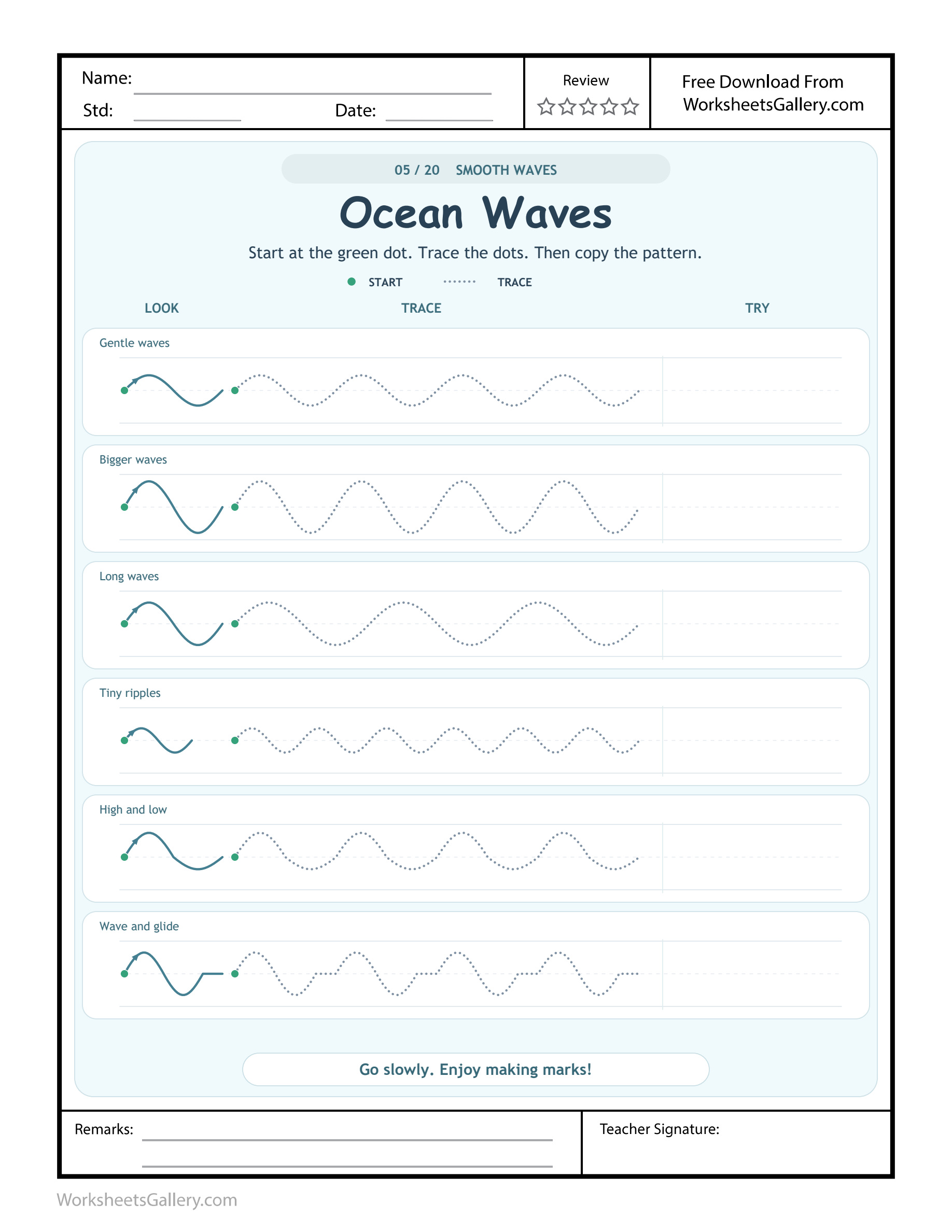
A wave turns without making a corner. Ocean Wave Tracing invites children to explore that difference through rounded rises, low curves and a short gliding finish. The Ocean Waves worksheet offers six named patterns, each with a solid example, a dotted route and space to continue independently. Its small green markers identify beginnings, while the curve ahead suggests how the hand will steer. Give a learner time to look at the route before following it. The useful question is whether the movement gradually changes direction, not whether a first attempt perfectly matches every printed dot.
Ocean Wave Tracing follows the bend between dots
Ocean Wave Tracing dots mark a route rather than a list of separate places to jab the pencil. Show the child how a finger can travel along a short section, rounding the crest and trough. Ask what the path does next. The answer may be a gesture instead of a sentence.
Ocean Wave Tracing gives that gradual change a clear purpose. A rounded turn differs from a pointed zigzag. The Ocean Wave Tracing learner can slow down at a bend without converting it into a sharp corner. If tracing a whole row is demanding, choose one rise and fall and leave the rest available for another visit.

Ocean Wave Tracing provides six invitations rather than six deadlines
Gentle waves, Bigger waves, Long waves, Tiny ripples, High and low, and Wave and glide name the printed rows. Look at each model for the actual route and spacing. The labels can support conversation without requiring an adult to treat every row as a measured step in a difficulty scale.
Ocean Wave Tracing uses LOOK, TRACE and TRY across its practice bands. The left Ocean Wave Tracing example shows a movement, the middle offers dots to follow, and the open right-hand end invites a short copy. The learner need not finish every dotted repetition before considering a self-made wave.
Ishan makes an Ocean Wave Tracing coastline
Ishan and his older sister arrange a blue paper sea beside a pretend boat. He draws a wavy edge on spare paper and asks whether a wave can be wider without being taller. She stretches a loose paper curve sideways to make the question visible, then they inspect the worksheet's named examples.
Ocean Wave Tracing gives their conversation a route to try. Ishan chooses one pattern and describes a high part and a low part before moving his pencil. His sister asks him to point to the bend he most wanted to keep. The discussion begins with his design question, rather than with an adult finding something wrong in his drawing.
Ocean Wave Tracing height and width are different observations

An Ocean Wave Tracing curve can extend farther upward or downward, and it can travel farther sideways before turning back. These are different spatial features. Use the printed model as the immediate reference rather than demanding that a child measure or name dimensions. “This bend goes higher” may be enough when that difference is visible.
For Ocean Wave Tracing, compare only one feature at a time. If the learner is exploring rounded turns today, exact proportions can wait. If they are observing height, accept a wave that keeps the chosen high-low relationship even when its horizontal spacing differs from the example.
Six Ocean Wave Tracing benefits an adult can look for
- Gradual steering: a rounded bend asks the hand to change direction over a curve rather than at one pointed meeting.
- Visual anticipation: looking a short distance ahead can help the learner prepare for the next rise or dip.
- Stable attention: following a selected wave gives the child one route to stay with while nearby lines remain separate.
- Spatial comparison: noticing height, width or a gliding ending makes observation more precise than calling every row simply wavy.
- Movement language: words such as rise, dip, round and glide let a partner understand the intended mark.
- Independent interpretation: a small TRY continuation reveals which feature the learner carried from the model into their own drawing.
Ocean Wave Tracing also involves tool control and paper stability. Those physical demands can be supported while the child supplies the intended route. The activity offers practice, not a guarantee of handwriting fluency after a particular number of waves.
A home Ocean Wave Tracing session can stay very small
Read the instruction aloud, locate a green beginning and point to the chosen model. Let the child trace a short part with a finger if wanted. Offer a visible-marking tool on a steady surface, then invite a dotted curve. Ask whether the child wants to continue before presenting another row.
Ocean Wave Tracing can shift from supported following to a small independent continuation. The adult may demonstrate a similar movement on a different sheet, leaving the source's TRY end for the learner. Cover unused bands if they distract. A brief pause to inspect the next curve is part of planning, not a sign that the activity has stopped working.

Ocean Wave Tracing can become a classroom sea-panel project
A teacher asks a few learners to choose different wave ideas for a pretend class sea display. One Ocean Wave Tracing learner likes a broad rise, another prefers tiny ripples, and another wants a wave with a level ending. They explain their selections with fingers on the models before drawing on individual scrap cards.
The Ocean Wave Tracing page stays available as a reference. When the cards are assembled, the teacher invites descriptions of the different routes rather than a judgement about whose line is best. A child who rounds the bends clearly but finds small spaces difficult might choose a larger drawing card. Their observation and physical control can be noticed separately.
An Ocean Wave Tracing guide to describing a curve
| Look for | A useful drawing question |
|---|---|
| Rounded crest | How does the line change from rising to falling? |
| Rounded trough | Where does it turn upward again? |
| Relative height | Which part sits higher or lower than the guide? |
| Gliding ending | Where does the route stop curving and travel level? |
Ocean Wave Tracing does not need every question asked after every attempt. Choose one that fits the child's interest and the route currently being explored. A pointing answer can be as informative as a long explanation.

Six Ocean Wave Tracing activities for a miniature sea studio
1. Give Ocean Wave Tracing a rounded-turn inspection
Draw one wave and one zigzag on separate cards labelled ROUND and POINTED. Ask which card resembles a selected source row and what happens at its highest part. Ocean Wave Tracing makes the distinction visible without requiring a technical definition. Let the child demonstrate the difference with a finger before choosing an optional drawing turn.
2. Make an Ocean Wave Tracing wide-or-tall experiment
On spare paper, an adult draws two smooth curves that differ in one feature. Invite the learner to choose which is taller or spreads farther sideways. Ocean Wave Tracing can inspire a new curve using that chosen relationship. Keep the task an informal comparison, not a measurement lesson or a demand to reproduce exact dimensions.
3. Design an Ocean Wave Tracing paper shoreline
Offer a card labelled SEA EDGE and ask the child to add a short smooth route for an imaginary coastline. They choose where it rises and dips. Ocean Wave Tracing becomes a reason to communicate a design. Compare the card with one worksheet example afterwards, allowing the child's coastline to remain their own interpretation.
4. Narrate Ocean Wave Tracing with a moving voice
Let a child say rise and dip while a partner points along a chosen model. Reverse the jobs. The words should follow the visible route, with enough time for the pointer to reach each bend. The purpose is coordinated description; there is no need to turn the task into a fast chant or a memorised performance.
5. Find the Ocean Wave Tracing glide change
Inspect the final row and name the point where the curve gives way to a short level segment. On another card, draw a wave followed by a glide and label it WAVE THEN GLIDE. Ask the learner to show both movement types. Their route can be short while still containing the meaningful change.
6. Choose an Ocean Wave Tracing studio signature
Invite each child to select one wave feature for a small named display card: shallow, high, low or gliding. They make a short mark and tell an adult what it represents. Ocean Wave Tracing supports a drawing decision with an audience, while the adult can write the child's dictated description beside it.
Ocean Wave Tracing ends with a change to level travel

Wave and glide includes a short straight ending after its rounded movement. The task is not to curve automatically all the way through the available space. Look at the model again when the rule changes, then make a brief TRY version if the learner wants that challenge.
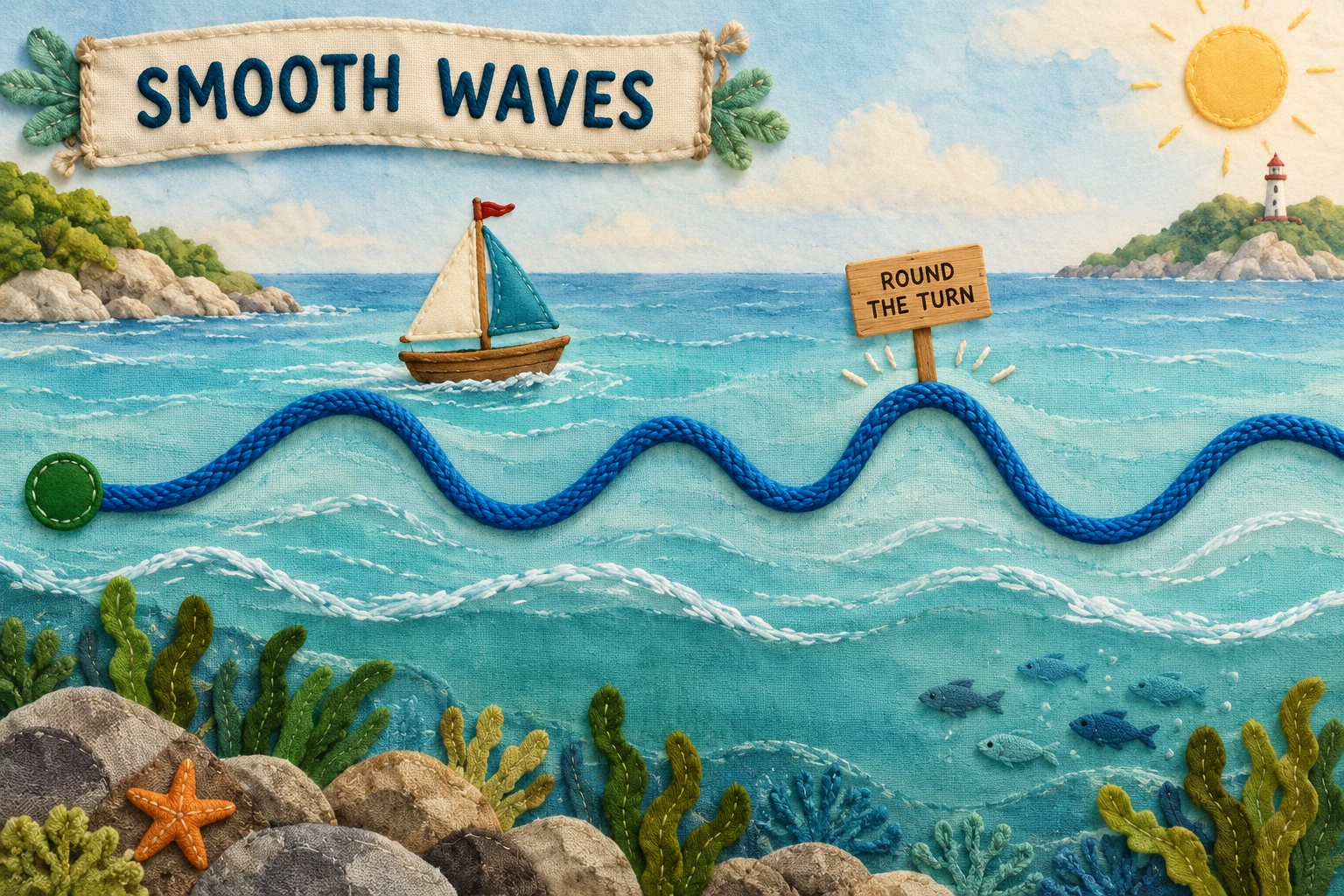
The separate Ocean Wave Tracing fabric scene models smooth crests and troughs with readable movement words. Ocean Wave Tracing keeps its source models and drawing opportunities intact; the supporting illustration simply offers another way to talk about a rounded turn.
Keep Ocean Wave Tracing comfortable and responsive
For many supported learners between about three and six, a small wave route can fit preschool or early kindergarten mark making. Interest and manageable control matter more than completing a particular row at a particular age. Offer larger paper if a compact curve feels cramped, and allow a finger demonstration when a pencil is not appealing.
Common Ocean Wave Tracing slips include making peaks pointed, stopping at every dot or carrying a curve through the gliding end. Ask about the next visible part of the route. One feature can be the focus of a fresh attempt. Avoid correcting height, spacing, pressure and direction all at once. “That turn stayed round” identifies a useful action without judging the entire page.
Another Ocean Wave Tracing visit can have another purpose
Return later to choose a different model, describe a low turn or make one self-designed wave. A few minutes of purposeful observation can be sufficient. Other mark-making experiences keep the week varied, so the learner does not need to rehearse the same page repeatedly to show regular interest in drawing.
When appropriate later, letter-S tracing, letter-C practice and a letter-U route offer different uses for curves. Adult reading can include PBS Parents' literacy suggestions at four and writing-at-home ideas from NAEYC. Ocean Wave Tracing can remain a playful drawing choice before letters are a relevant goal.
Print an Ocean Wave Tracing copy with clear fine guides
Retain the original sample if its source presentation is useful. The separate premium download supplies a clean version after account login with an eligible active plan. Its worksheet has the website branding and watermark removed, and no ads appear within the printable activity. Advertising on the viewing website is separate from that PDF.
Ocean Wave Tracing fits a portrait Letter-size sheet. Check the saved file’s preview for six complete bands and an intact frame before choosing a printer scaling option. Keep the dotted paths readable and the TRY ends open. Let the learner choose one meaningful curve rather than beginning with an obligation to fill every available space.
Popular Worksheets
Printable resources families and teachers are downloading now.
 Free
 Free
 Free
 Free