
Loop Crossing Play: 5 Brilliant Over-and-Under Tasks
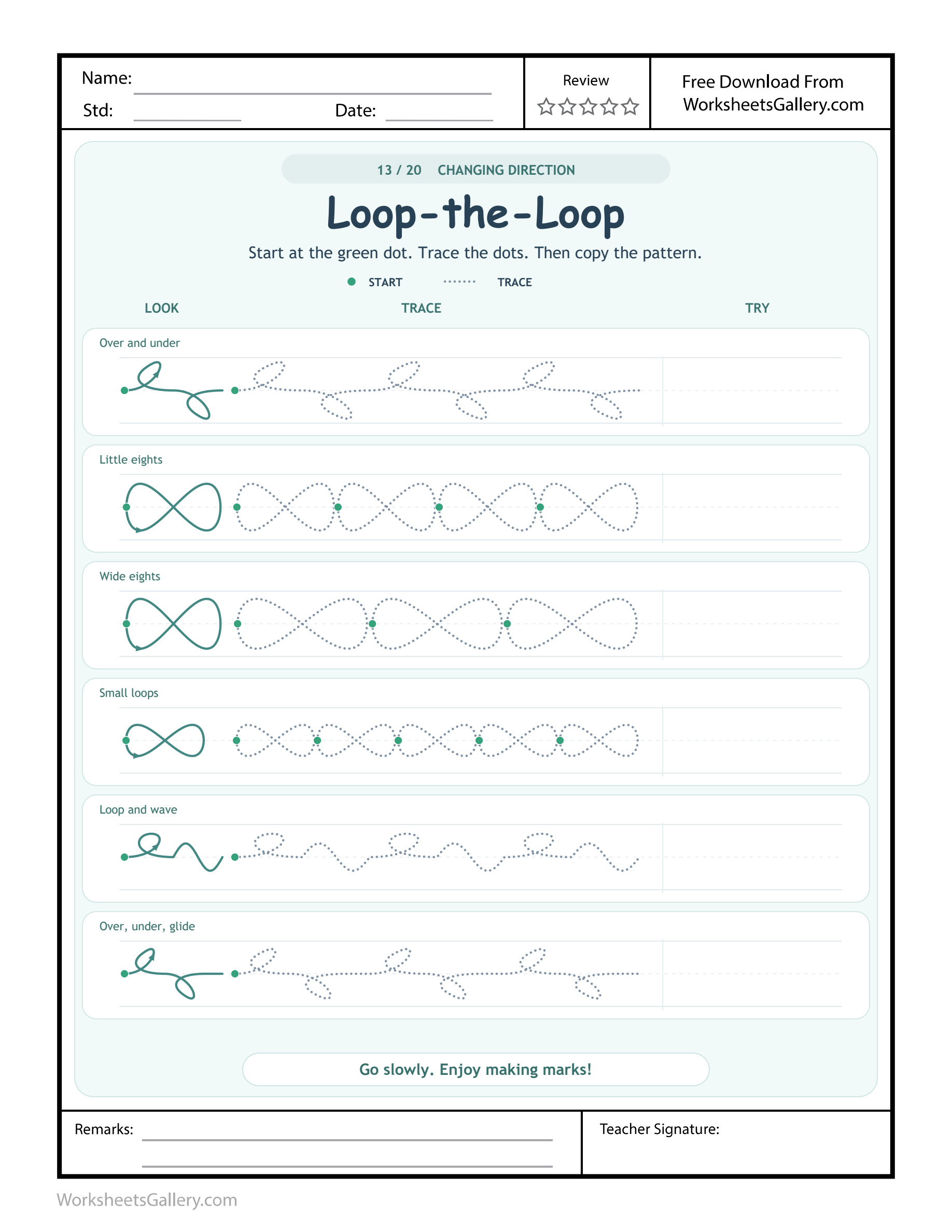
A crossing offers more than one visible direction, but the drawn route still has an order. Loop Crossing Play invites children to follow that order through upper and lower loops, sideways eights and gliding exits. The Loop the Loop worksheet contains six rows, with solid examples beside dotted work and independent ends. Some motifs begin separately at their own green dots; others form a travelling pattern. Look closely before deciding how to move. The aim is to read the route in front of you, not to recognise a familiar outline and draw from memory.
Loop Crossing Play asks where the route continues
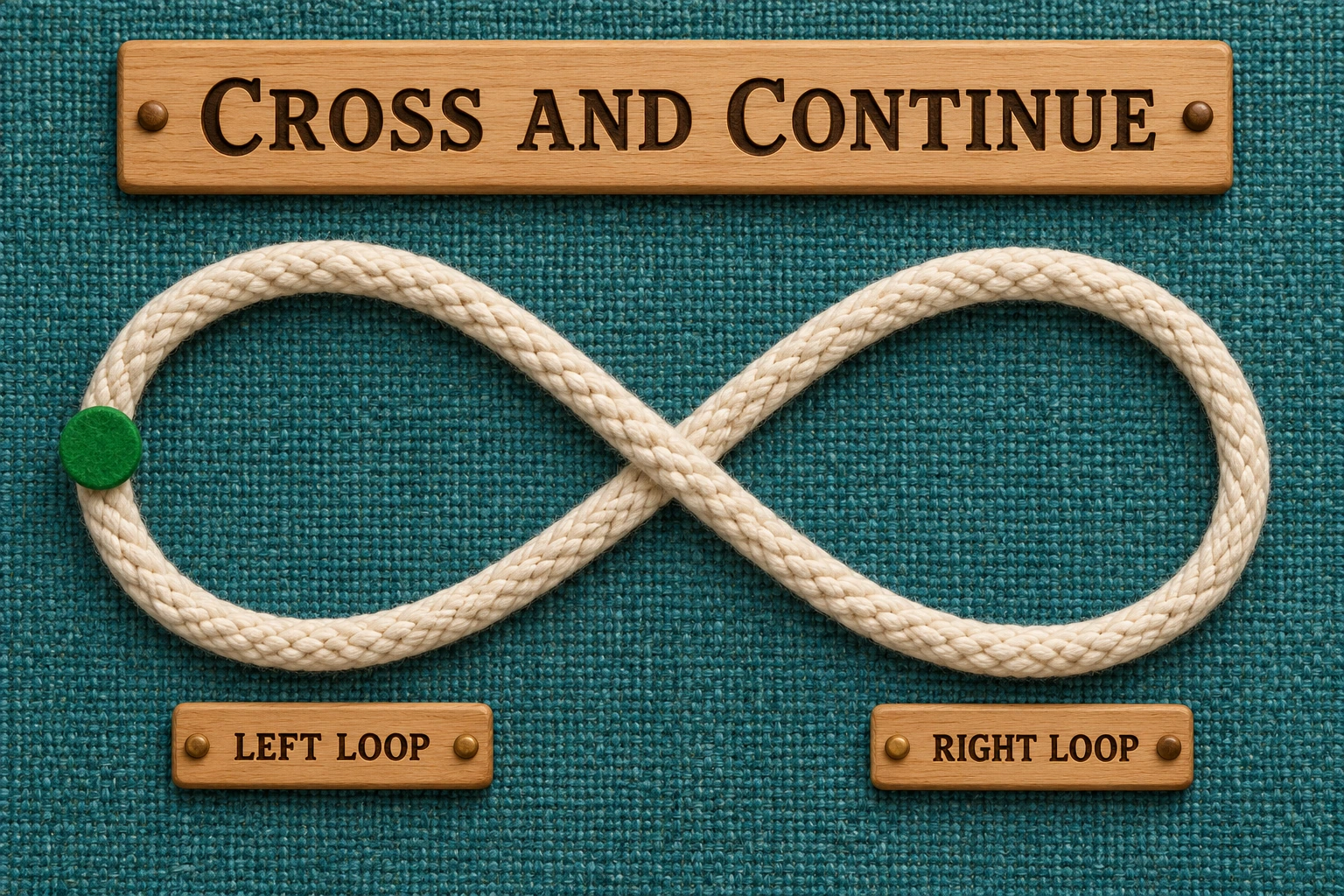
The Loop Crossing Play cord scene shows one sideways double loop. Its centre crosses, yet the cord remains a single route rather than a knot or two unrelated circles. A finger can follow one part toward the middle, pause and inspect the continuation before moving around the other opening.
Loop Crossing Play uses this physical model as a conversation starter. It is not numeral-eight handwriting. The sheet includes sideways figures and mixed travelling motifs, each with its own visible starting information. Keep that distinction clear when a child says the outline reminds them of a number.
Loop Crossing Play has two kinds of beginning
Over and under, the first source row, travels through alternating upper and lower openings. Little eights, Wide eights and Small loops present individual sideways-eight motifs with their own green starts. Do not invent a connecting baseline that joins those separate figures into one uninterrupted exercise.
Loop Crossing Play therefore begins with a start-marker inspection. Ask whether the selected Loop Crossing Play model travels onward or finishes as an individual figure. The Loop Crossing Play learner can point to the next green dot when a new motif begins. Recognising a restart is as useful as recognising a continuation.

A Loop Crossing Play route-reader's kit
| Notice | Question |
|---|---|
| A green beginning | Does this figure start separately? |
| A central crossing | Which connected segment comes next? |
| A wave or glide | Has the movement rule changed? |
For Loop Crossing Play, these questions replace a long spoken command sequence. Let the visible route supply the information. An adult can read labels while the child examines the geometry, so reading ability does not become an unnecessary barrier to drawing.
Rehan gives Loop Crossing Play a message route
Rehan and his grandfather make a pretend delivery map for two little paper houses. Rehan draws a sideways double loop and asks how a messenger would get around both openings. His grandfather follows slowly with a finger, asking what happens when the path meets itself.
Their Loop Crossing Play conversation leads to one dotted figure on the worksheet. Rehan returns to his map and adds a labelled beginning. He explains the crossing to his grandfather, who deliberately asks for clarification rather than taking over the drawing. The map gives the route a recipient and a reason to be understandable.
Six Loop Crossing Play observations beyond neatness
- Route continuity: follow the connected line through a meeting point.
- Restart awareness: distinguish separately begun motifs from a travelling sequence.
- Enclosed space: notice two openings within a sideways double loop.
- Changing movement: recognise when a crossing gives way to a smooth wave or level glide.
- Spatial language: use over, under, across, next and around in a visible context.
- Independent planning: choose a short continuation based on the inspected model.
Loop Crossing Play engages visual tracking, attention and motor coordination alongside language. These demands can be adjusted separately. A child may explain the route while preferring a large marker version because the compact crossing is still difficult to steer.
Loop Crossing Play follows the source's changing sequence
The six labels are Over and under, Little eights, Wide eights, Small loops, Loop and wave, and Over, under, glide. Each Loop Crossing Play row offers a LOOK model, TRACE guidance and TRY opportunity. Inspect how the model behaves instead of assuming the row name describes every segment.

Loop Crossing Play can be approached one row at a time. A learner investigating separate starts need not also investigate a gliding exit that day. Keeping one question in view makes the drawing decision clearer and leaves other variations available for a later visit.
Five Loop Crossing Play investigations for partners
Use separate drawing cards for these optional investigations. They do not replace the source examples or fill its intentional practice spaces. Choose an activity that gives the learner a reason to inspect a crossing, a restart or a changed exit.
1. Loop Crossing Play opens a crossing checkpoint
Draw a large sideways double loop and mark its beginning. A partner follows it with a finger, stopping just before the centre to show the next connected segment. Loop Crossing Play checkpoints make route reading visible without demanding a fast continuous pencil movement.
Exchange roles. If the partners disagree, follow the line together from the beginning. The drawing supplies evidence, so the adult does not need to hide a correct answer behind a quiz question.
2. Give Loop Crossing Play a fresh-start station
Make three separate sideways figures on a card, each with its own coloured start. The learner explains when to lift and begin a new figure. Loop Crossing Play stations draw attention to repeated independent motifs rather than adding an invented line between them.
The child can then design a station for the adult. Inspect whether each beginning is visible; identical figure size is unnecessary. This connects a marker with an action someone else can understand.
3. Loop Crossing Play sorts openings and routes
Offer a card with an open wave and another with a closed sideways double loop. Ask which encloses two spaces and where the route crosses. Loop Crossing Play sorting focuses on visible features, allowing a pointed answer before another drawing attempt.
Let the child invent an additional example on scrap paper. Discuss the feature it retains rather than forcing every new mark into one of the adult's original cards. The investigation can welcome an unexpected but explainable design.
4. Send Loop Crossing Play a changed-exit postcard
Sketch a loop leading into a wave on one postcard and a loop leading into a level glide on another. A receiver describes the exit before copying a short version. Loop Crossing Play postcards make the continuation part of the message, rather than allowing the loop to dominate attention.
Add a dictated WAVE or GLIDE label beside the chosen design. Meaningful words belong next to the illustration, while its route remains clear enough for a finger to follow.
5. Make Loop Crossing Play a two-house journey
Draw two little houses beside a large double-loop route. The child chooses a start and narrates a delivery around both openings. Loop Crossing Play journeys give the crossing an imaginary purpose, without claiming the worksheet contains houses or a built-in story problem.
Ask the listener to repeat the route with a finger. If the explanation is unclear, the designer can point or draw a fresh version. Communication becomes the reason to revisit the mark, rather than a request for more tracing solely to fill a page.
Loop Crossing Play can change width without changing identity

Wide eights retains two enclosed side openings and a crossing while changing the horizontal extent. The individual green markers still matter. Inspect a single figure before starting another, even if the shape now feels familiar.
Loop Crossing Play comparisons can use “farther across” instead of a measurement demand. A child's independent figure can differ in size while retaining its double opening and crossing. Ask which relationship they intended to preserve before deciding what support would help next.
A home Loop Crossing Play route-reading visit
Place the page upright on a stable surface. Read a row together and identify whether its motifs have separate starts. Follow the solid example with a finger, inspect one crossing, then invite a small dotted attempt using a familiar tool.
After Loop Crossing Play tracing, compare one chosen feature. Offer a TRY continuation or a large scrap-paper version. Allow the child to stop with an explanation; completing every motif is not required to make the visit worthwhile.
Regular Loop Crossing Play can return through route cards, pretend deliveries or a new exit. Keep one remembered observation from the earlier visit and change the drawing purpose. Repeating a meaningful decision is different from demanding the same whole page again.
Loop Crossing Play notices a wave after a loop

Loop and wave combines a crossing movement with a smoother bend. Locate the exit before extending the motif. If the learner draws only repeated loops, point to the place where the source changes behaviour and ask what should follow there.
Loop Crossing Play feedback can sound like “You crossed here and then let the line wave.” This identifies two connected choices. A learner who kept the crossing but missed the wave has still retained a feature worth acknowledging.
Loop Crossing Play in a classroom route exchange
A teacher sets up a message-route exchange with individual cards. Children choose separate double loops or a travelling loop pattern and add dictated labels. Partners follow each route and ask the designer where to restart or continue.
Loop Crossing Play gives the teacher specific observations to record: a child noticed a green restart, retained two openings or explained a changed exit. Offer pointing, a larger drawing surface or label reading as needed. Avoid comparing children by speed, compactness or the number of patterns completed.
Let Loop Crossing Play end in a deliberate glide

Over, under, glide ends its upper-and-lower movement with level travel. That quiet section can be overlooked after several exciting crossings. Ask the learner to locate the glide before attempting the TRY end, then discuss whether their new mark retained it.
Loop Crossing Play commonly goes astray through missed restarts, an accidental shortcut at the crossing or an exit replaced by another loop. Inspect one feature rather than erasing the entire attempt. Make the next decision visible.
Loop Crossing Play for different hands and attention spans
Adults can offer Loop Crossing Play during preschool or beginning kindergarten; three to six is a broad suggested age range rather than a fixed starting deadline. A birthday is not a readiness score. Pointing and broad drawing can precede compact tracing, and labels can be read by an adult.
Loop Crossing Play should leave room for pleasure in explaining a route. Stop for tired hands or rising frustration, and return when a manageable question interests the child. The supplied clean PDF has no watermark, website branding or embedded ads. For that member edition, sign in with an active plan granting access, select the premium file and save it separately from the original sample. Inspect the complete US Letter page in printer preview before choosing scaling that preserves its edges and practice ends.
Later symbol choices include letter-X crossings, letter-Q outline details and letter-O closure, each following its own model. Adult ideas also appear in NAEYC's home writing suggestions and PBS Parents' age-four literacy collection.
Popular Worksheets
Printable resources families and teachers are downloading now.
 Free
 Free
 Free
 Free