
Butterfly Dip Paths: 4 Powerful Below-Line Tracing Games
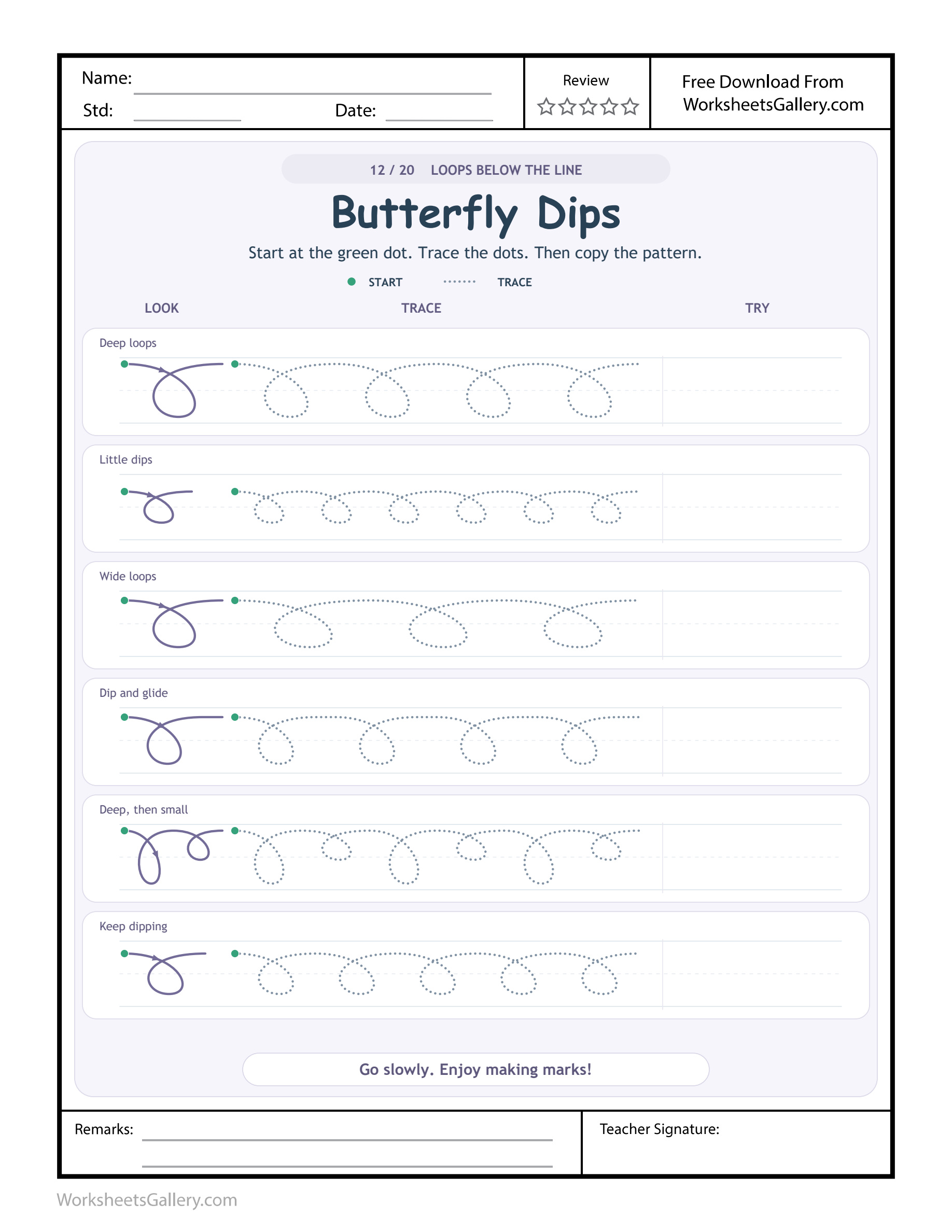
Below the travelling line, a loop makes a little pocket of space. Butterfly Dip Paths draws attention to that lower opening and to the crossing that allows the route to continue. The Butterfly Dips worksheet contains six patterned rows with different depths, widths and exits. Children can examine a solid example, follow dotted guidance and try a short continuation of their own. Begin by locating the opening rather than naming a letter or drawing a butterfly. The question is about a path: where does it dip, cross and return to onward travel?
What makes Butterfly Dip Paths different from a scoop?
An open scoop rounds a low bend without crossing itself. The lower loop on this sheet encloses space before continuing. Both Butterfly Dip Paths comparisons travel downward and upward, so noticing the crossing gives the learner a more precise way to tell them apart.
Butterfly Dip Paths starts with Deep loops. Follow the model from the green beginning and inspect where its returning line meets the earlier part. An adult can point to the enclosed opening while the child follows the rest with a finger. The opening belongs below the travelling level.

Butterfly Dip Paths troubleshooting begins with looking
If an attempt becomes an open bowl, inspect the crossing before asking for another drawing. If the loop rises above the route instead, look at the position of its opening. These are different decisions, and each calls for a different conversation.
| What you see | Inspect | Next choice |
|---|---|---|
| Open scoop | The meeting of the line | Point through the enclosed opening. |
| Upper loop | Opening position | Show the lower dip. |
| Equal dips | Deep, then small | Compare neighbouring depths. |
Butterfly Dip Paths corrections should keep the learner involved. Ask them to locate the feature in question rather than drawing over every mark. A wobbly Butterfly Dip Paths line may retain the intended lower opening; recognise that success before adding a new demand.
Esha gives Butterfly Dip Paths a hanging-ribbon purpose
Esha and her aunt are designing a pretend garden invitation. Esha wants a ribbon that dips below its border, but her first marks are open bowls. Her aunt places the source model nearby and asks which route makes an enclosed space beneath the edge.
Their Butterfly Dip Paths investigation begins with pointing. Esha follows one crossing, tries a dotted loop and draws a larger ribbon on her invitation. She calls its lower opening a “hanging pocket.” Her aunt accepts the description and asks where the ribbon travels next, connecting the enclosed space with its exit.
Butterfly Dip Paths gives this home scenario a manageable aim. They keep one lower loop clear instead of requiring a chain of identical marks. The invitation includes Esha's other drawing ideas, so the exercise becomes one resource within a purposeful picture.
Six Butterfly Dip Paths labels are choices
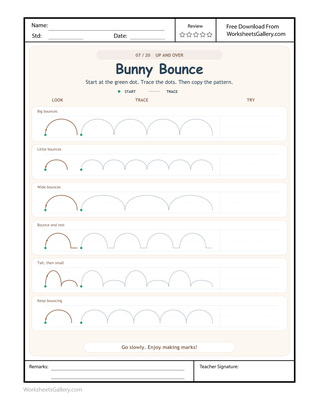
The rows are Deep loops, Little dips, Wide loops, Dip and glide, Deep, then small, and Keep dipping. Each has a solid LOOK model, a dotted TRACE section and an open TRY ending. Adults can read the labels while the learner inspects the shape.
Butterfly Dip Paths does not require all six rows at once. Choose a route for the feature it offers: perhaps a lower opening, a gliding exit or two depths. A short visit with a clear observation can reveal more than a page filled without looking.
The Butterfly Dip Paths TRY space welcomes an independent continuation, not a demand to fill every millimetre. A child may choose a brief version or a larger attempt elsewhere. Keep the model available so independence means making a decision, rather than remembering an unseen route.
Seven Butterfly Dip Paths possibilities for learning
- Lower-space awareness: notice where an opening sits relative to its travelling line.
- Closure: distinguish a loop from an open rounded bowl.
- Crossing: locate where the route meets itself before moving onward.
- Depth comparison: describe a deeper dip beside a shallower neighbour.
- Visual planning: inspect the next portion before reaching it.
- Motor coordination: drawing and supporting hands take different roles.
- Language choices: below, opening, return and glide describe visible events.
Butterfly Dip Paths offers discussion possibilities, not a developmental test. A child can understand below while needing a broad marker route to express the idea. Pointing, explaining and compact drawing supply different information about an attempt.
Four Butterfly Dip Paths games for separate paper
Set aside the worksheet for an optional game. Use comfortable cards, broad drawing tools or a supervised cord model. These games explore a specific route feature while leaving the uploaded dotted exercises unchanged. One game can be enough for a drawing visit.
1. Butterfly Dip Paths opens a pocket detective desk
Sketch an open U and a crossed lower loop on two cards. The detective finds the enclosed lower pocket, then shows where its boundary closes. Butterfly Dip Paths detectives can answer with a finger, making the distinction visible before the fine drawing demand is introduced.
Ask the child to prepare the next pair for the adult. Their loop may lean or vary in size; inspect whether it encloses the intended opening. Keep the chosen rule clear without treating every line difference as an error.
2. Give Butterfly Dip Paths a below-line theatre
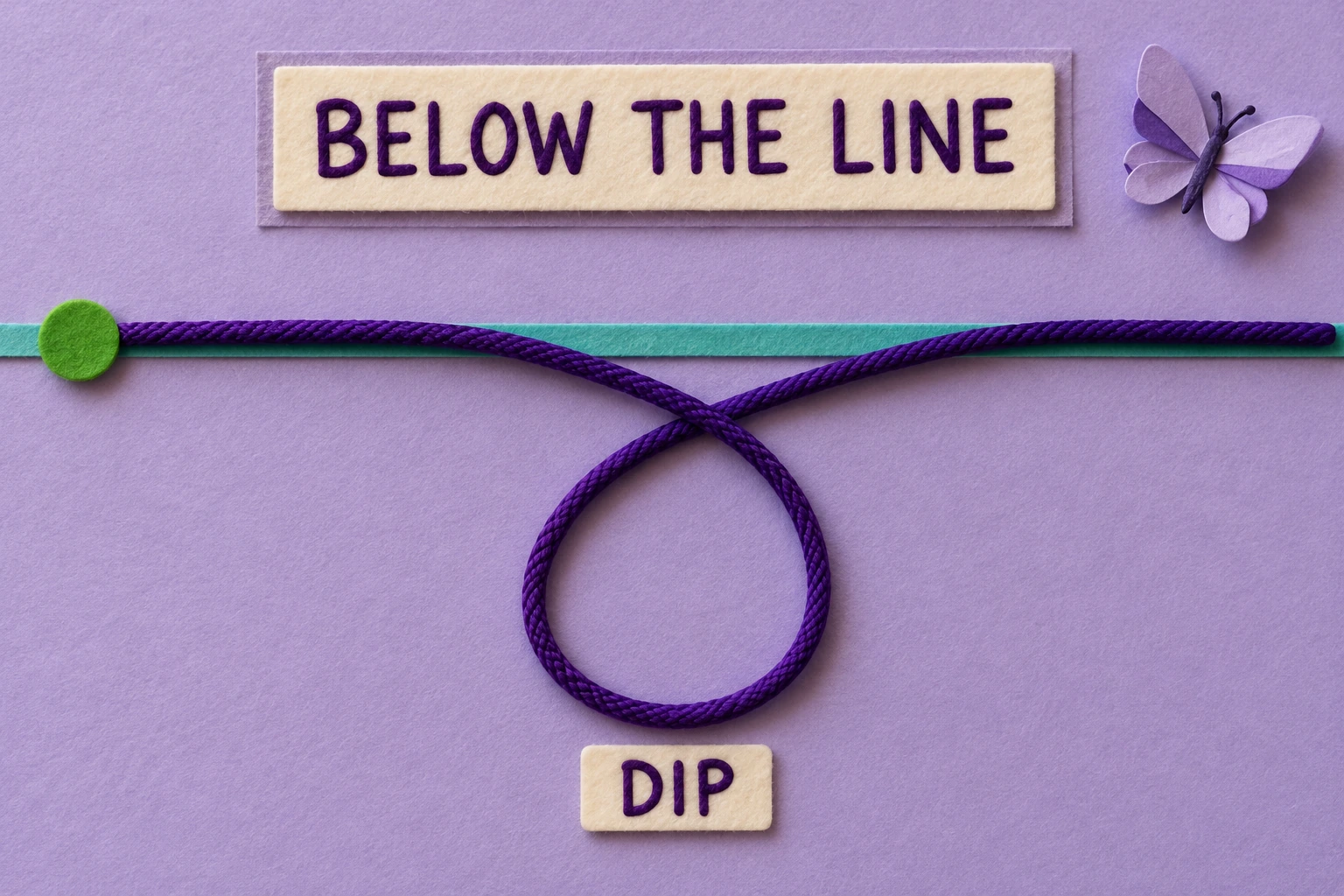
Draw a horizontal guide on a large card and add one lower loop. Write BELOW beside its opening. The learner tells a story about a ribbon dipping under an imaginary fence. Butterfly Dip Paths theatre uses spatial language in a visible setting.
The story need not explain real butterfly flight. It is a pretend route with a lower loop. Ask where the ribbon returns and continues, so the scene keeps both position and movement in view.
3. Butterfly Dip Paths sends a depth duet
Partners draw a deep dip beside a smaller one, taking turns to choose which comes first. The receiver points to the difference before making a new pair. Butterfly Dip Paths duets investigate Deep, then small without demanding identical distances.
Use a folded card to separate model and response. Describe which opening reaches farther down. A larger or uneven copy can still communicate the intended contrast and give the pair something precise to discuss.
4. Make Butterfly Dip Paths a quiet-exit message
Draw a lower loop leading into a level glide. The child dictates a message beside the exit, perhaps KEEP GOING. Butterfly Dip Paths messages give the straight continuation a purpose instead of allowing another loop to replace it automatically.
Trade the message with a partner. The receiver follows the route with a finger and explains where the turning ends. A route someone else can read becomes a small act of communication, rather than another compulsory tracing row.
Butterfly Dip Paths compares depth within one motif

Deep, then small puts different lower-loop depths together. Inspect the pair before copying; a familiar loop action can otherwise continue unchanged. Ask which opening reaches farther below the route and what follows it. Comparing does not require a ruler.
Butterfly Dip Paths feedback might recognise two enclosed openings before discussing their depths. If both are equal, acknowledge that closure and choose the contrast as a next investigation. Separating observations helps the learner understand which feature to keep and which they might change.
For Butterfly Dip Paths, “You kept both openings underneath” describes a visible choice. The child can find the evidence in their own drawing. Encouragement becomes understandable when it points to a decision rather than offering only a general verdict of good or bad.
A home Butterfly Dip Paths visit in five decisions
Choose a stable drawing place and a familiar tool. Select one row, with the adult reading its name. Locate the green beginning, inspect the lower opening and follow a short dotted section. Finally invite a TRY mark or a larger scrap-paper route.
During Butterfly Dip Paths work, retain the model for reference and allow pauses. Adults need not hold the child's fingers or steer the tool to secure a smooth result. Offer help with paper position, label reading or route discussion instead.
Close Butterfly Dip Paths with the learner's explanation of one feature. Save that observation for another day: “You wanted a lower pocket.” Revisit through a new drawing purpose when interest returns, rather than repeatedly requiring the sheet to be completed on schedule.
Butterfly Dip Paths becomes a classroom border studio
A teacher invites children to design borders for pretend garden notices. Each chooses a lower-loop feature: depth, width or a gliding exit. They draw on individual cards and dictate a label that tells a partner what to inspect.
Butterfly Dip Paths classroom talk includes pointing as well as speech. A partner follows the route, asks where the opening closes and listens to the designer. The adult offers larger spaces when needed and records decisions instead of ranking children by neatness or amount finished.
Butterfly Dip Paths welcomes manageable challenge
Ages three through six cover many learners who may enjoy an adult-supported Butterfly Dip Paths visit during preschool or kindergarten. Readiness varies. Adults read labels and accept gestural answers; reading the words is not a requirement for participating in the drawing activity.
Butterfly Dip Paths links visual attention, spatial concepts, planning and language with hand control. Understanding can lead the small pencil movement. Offer a finger route when the child knows where to go but finds the compact turn demanding. Pause for tired hands, crowded posture or growing frustration.
Keep Butterfly Dip Paths emotionally light through a meaningful choice and a clear stopping point. The labelled scene provides another view of a lower opening without requiring another pencil attempt. Enjoying an explanation is also part of sharing a drawing activity.
Bring Butterfly Dip Paths back as a clean printable
Use the premium file option while logged into a membership account with current access to this worksheet. The unbranded Butterfly Dip Paths attachment is distinct from the original sample. Download the PDF, open it and inspect the full US Letter page before printing. Adjust scaling if an edge or independent section is clipped. The clean page contains no watermark, domain text or embedded ads; website advertising stays outside the saved file.
For later symbols, consider letter-G practice, letter-J routes or letter-U formation, using their own models. Adults can browse NAEYC's writing opportunities at home and the PBS Parents literacy collection for wider drawing contexts.
Popular Worksheets
Printable resources families and teachers are downloading now.
 Free
 Free
 Free
 Free