
Master Letter U Tracing: 7 Brilliant Steps for Confident Writing!

Help your little ones discover the joy of handwriting with this comprehensive tool designed for Letter U tracing. This printable resource offers a clean, distraction-free environment for preschoolers and kindergarteners to refine their fine motor control. By focusing on the curved motion required for the letter U, children develop the essential hand-eye coordination needed for future literacy success. Whether you are a parent at home or a teacher in a classroom, this resource provides a structured path from large-scale motor movements to precise, line-based letter formation without the clutter of ads or watermarks.
Why 7 Essential Reasons Letter U Tracing Matters for Early Learners
Learning to write the alphabet is more than just memorizing shapes; it is about building physical strength in the hands and cognitive connections in the brain. When a child engages in Letter U tracing, they are learning to control a continuous curved stroke, which is significantly different from the straight lines of letters like T or L. This specific movement helps prepare the wrist for the fluidity required in cursive and advanced print later on. Furthermore, mastering the Letter U contributes to a broader understanding of letter families and how different strokes combine to form the entire alphabet. This foundational practice is crucial for developing legible handwriting and reducing frustration as children progress to more complex writing tasks.
- Fine Motor Refinement: Navigating the curve of the U requires steady pressure and constant direction changes, strengthening the small muscles in the hand and fingers.
- Phonemic Awareness: Connecting the visual shape with the "uh" sound (as in umbrella) bridges the gap between writing and reading, enhancing early literacy skills.
- Visual-Spatial Skills: Understanding how the letter sits within the lines helps children grasp spatial relationships on a page, which is vital for overall organization in writing.
- Confidence Building: Completing structured rows gives children a sense of achievement as they move from guided to independent writing, fostering a positive attitude towards learning.
- Concentration: The repetitive nature of Letter U tracing encourages kids to stay focused on a task from start to finish, improving attention spans.
- Letter Recognition: Frequent tracing ensures the child can distinguish the uppercase U from similar letters like V or O, solidifying their alphabet knowledge.
Strategic Features of the Letter U Tracing Worksheet
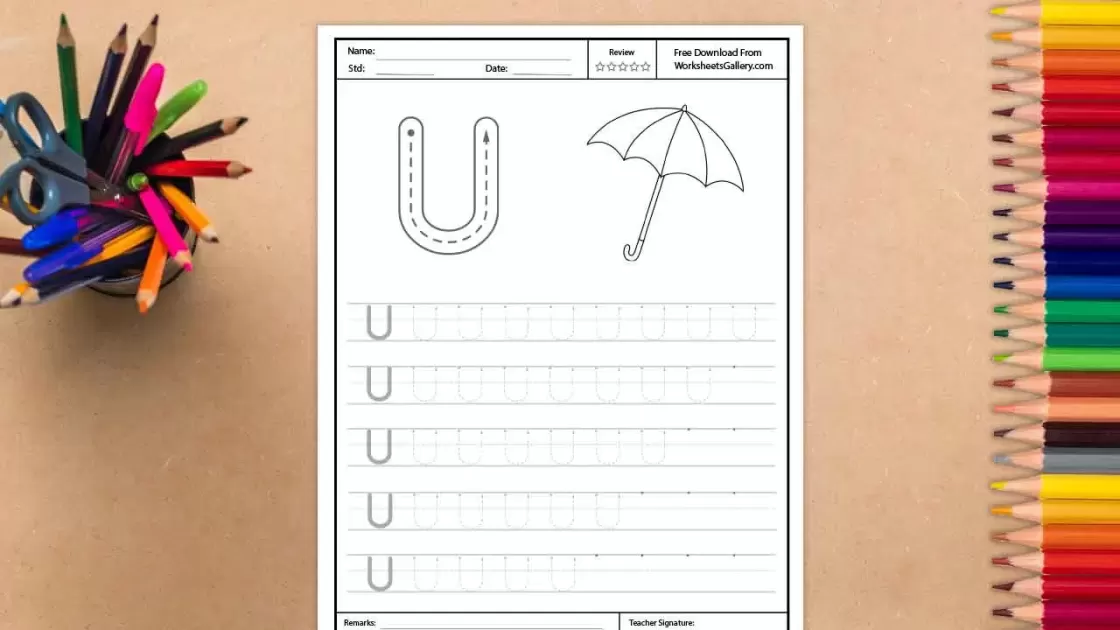
This specific worksheet is designed with a logical progression. It begins with a large, bold guide that shows exactly where to start and which direction to follow. This is crucial for Letter U tracing because many children naturally want to start from the bottom. The inclusion of a large umbrella illustration serves as a mnemonic device, grounding the letter in a real-world object that kids recognize and enjoy. This visual aid not only makes the learning process more engaging but also reinforces the letter-sound connection, a cornerstone of early reading development. The clear, uncluttered design minimizes distractions, allowing children to focus solely on the task of tracing and forming the letter U correctly.
The Learning Sequence
Our Letter U tracing page follows a proven pedagogical path:
- The Anchor Image: A large umbrella for coloring and phonics association, making the learning experience interactive and memorable.
- The Large Guide: A massive U with a starting dot and directional arrows, providing clear visual cues for correct stroke formation.
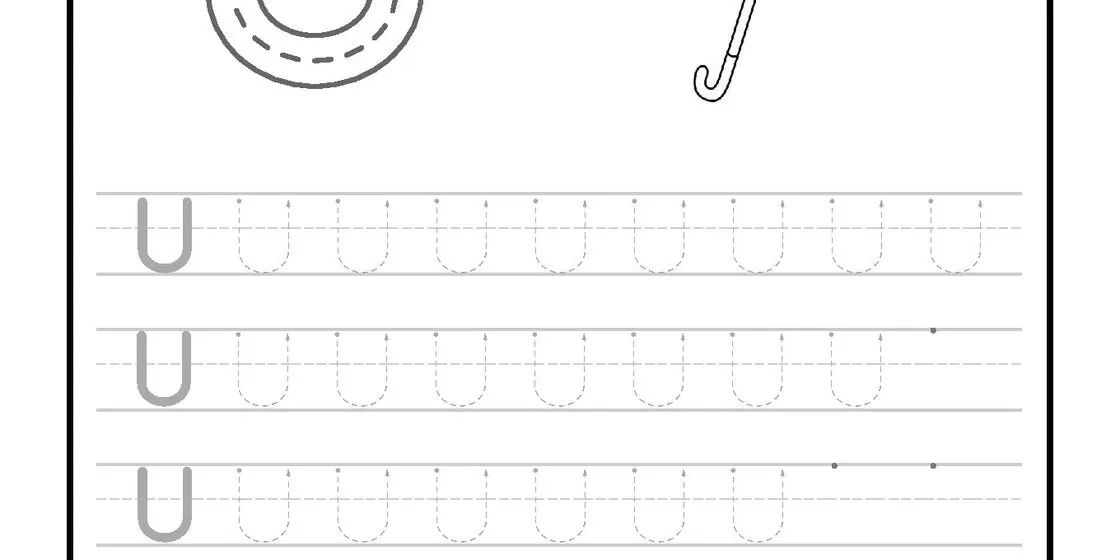
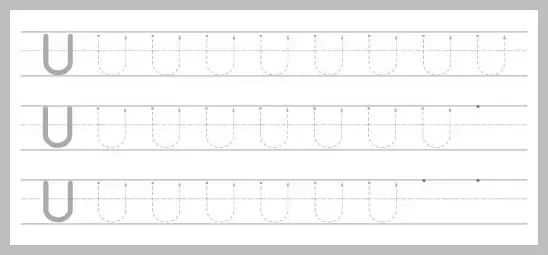
- Fully Guided Rows: Dotted lines that provide a total safety net for the hand, gradually building muscle memory and control.
- Gradual Release: Rows that transition into starting-point dots, requiring the child to form the curve independently, fostering self-reliance in writing.
Practical Scenarios: From Home to Classroom
Home Learning Success
Imagine a rainy afternoon where you are looking for a productive indoor activity. You can print this Letter U tracing sheet and sit with your child at the kitchen table. Instead of just tracing, you might talk about things that start with U. "Look at the umbrella! What else starts with that sound? Maybe an underpass or an uncle?" This turns a simple writing exercise into a rich language-building moment. Use a daily tracing schedule to make this a habit rather than a chore. Consistent practice at home, even for short periods, significantly reinforces the skills learned and helps children develop a positive routine around learning.
Classroom Center Integration
In a preschool setting, you can laminate several copies of this Letter U tracing worksheet to create a reusable dry-erase station. This allows multiple students to practice throughout the day. It is an excellent addition to a "Letter of the Week" curriculum. Teachers find that the clear layout helps students work independently while the educator focuses on small groups for motor skill assessment. The worksheet's design supports differentiated instruction, allowing children to progress at their own pace and receive targeted support when needed. It also serves as a valuable tool for assessing a child's readiness for more advanced writing tasks.
Cognitive and Motor Skill Development
When a child performs Letter U tracing, their brain is working hard to coordinate the small muscles in the fingers with the signals from the visual cortex. This is known as graphomotor development. The "U" shape is particularly interesting because it lacks sharp angles, requiring a smooth, sweeping motion that is quite relaxing once mastered. This continuous motion is a precursor to cursive writing and helps develop the fluidity needed for efficient and comfortable handwriting. Furthermore, tracing also enhances cognitive skills such as pattern recognition and sequencing, as children learn to follow a specific order of strokes to form the letter correctly.
| Skill Area | Benefit of Letter U Tracing |
|---|---|
| Bilateral Integration | Using one hand to stabilize the paper while the other traces, promoting coordination between both sides of the body. |
| Crossing Midline | Ensuring the arm and eyes move smoothly across the page center, which is crucial for reading and writing across a full line. |
| Pincer Grasp | Strengthening the grip on a pencil or crayon during Letter U tracing, essential for developing proper pencil control. |
| Hand-Eye Coordination | Synchronizing visual input with motor output to accurately follow the tracing lines. |
| Proprioception | Developing an awareness of body position and movement, allowing for controlled and precise strokes. |
Creative Games and Extended Activities
Don't let the learning stop at the edge of the paper! Here are five ways to extend the Letter U tracing experience:
- Sky Writing: Have your child trace a giant Letter U in the air using their whole arm before they pick up a pencil. This builds "muscle memory" for the shape and engages larger motor groups.
- Umbrella Art: After finishing the Letter U tracing, let them decorate the umbrella with "raindrops" made from blue fingerprints or glitter. This adds a creative element and reinforces the letter's association.
- Sensory Tracing: Fill a tray with salt or sand. Ask the child to use their finger to replicate the U shape they just traced on the worksheet. This provides a tactile learning experience that can be very effective for some learners.
- Under-the-Table Club: Tape the Letter U tracing sheet to the underside of a low table. Let the child lie on their back and trace it—this builds incredible shoulder stability and offers a novel perspective.
- Letter Hunt: Give them a highlighter and ask them to find every Letter U in a short paragraph from a picture book. This activity enhances letter recognition in different contexts and improves visual scanning skills.
- "U" Word Brainstorm: Challenge your child to think of as many words as they can that start with the Letter U. Write them down together to reinforce phonics and vocabulary.
Common Mistakes to Watch For
During Letter U tracing, you might notice a few common hiccups. Some children try to draw two separate vertical lines and connect them at the bottom. This creates a boxy shape rather than a curve. Encourage them to keep the pencil on the paper for the entire movement, emphasizing the continuous, smooth arc. Another common issue is starting from the bottom right and moving upward. Gently remind them that we always start at the top, following the big dot in our guide, which establishes proper stroke order. Observing these patterns allows for timely correction and helps prevent the formation of incorrect habits that can be harder to break later on.
How to Encourage Regular Practice
Keep sessions short and sweet. Ten minutes of focused Letter U tracing is far more effective than an hour of forced writing. Celebrate the effort rather than just the perfect result. If they stay inside the lines even once, point it out! You might also use incentive charts to mark each day they complete a worksheet, providing positive reinforcement. Making learning a positive and rewarding experience is key to fostering a lifelong love of writing and learning. Therefore, consistency is more important than duration when building new skills.
Ready for Download: No Watermarks, No Hassle
We believe that educational resources should be accessible and clean. That is why our Letter U tracing PDF is provided in a high-resolution format without any intrusive watermarks or advertisements. To get started, simply click the download link, print it out on standard A4 or Letter-sized paper, and you are ready to go. For the best experience, use a slightly thicker paper if your child enjoys using markers, as it prevents bleeding through to the table. This ensures a durable and enjoyable tracing experience, allowing your child to focus entirely on developing their handwriting skills without any distractions.
Summary of Learning Goals
By the time your student finishes this Letter U tracing activity, they should be able to:
- Recognize the uppercase Letter U.
- Follow top-to-bottom writing flow.
- Identify the 'U' sound in 'Umbrella'.
- Maintain a consistent curve while tracing.
- Develop fine motor control for pencil grip.
- Exhibit improved hand-eye coordination.
Popular Worksheets
Printable resources families and teachers are downloading now.
 Free
Free
 Free
Free
 Free
Free
 Free
Free