
Scoop Curve Practice: 6 Powerful Down-and-Around Games
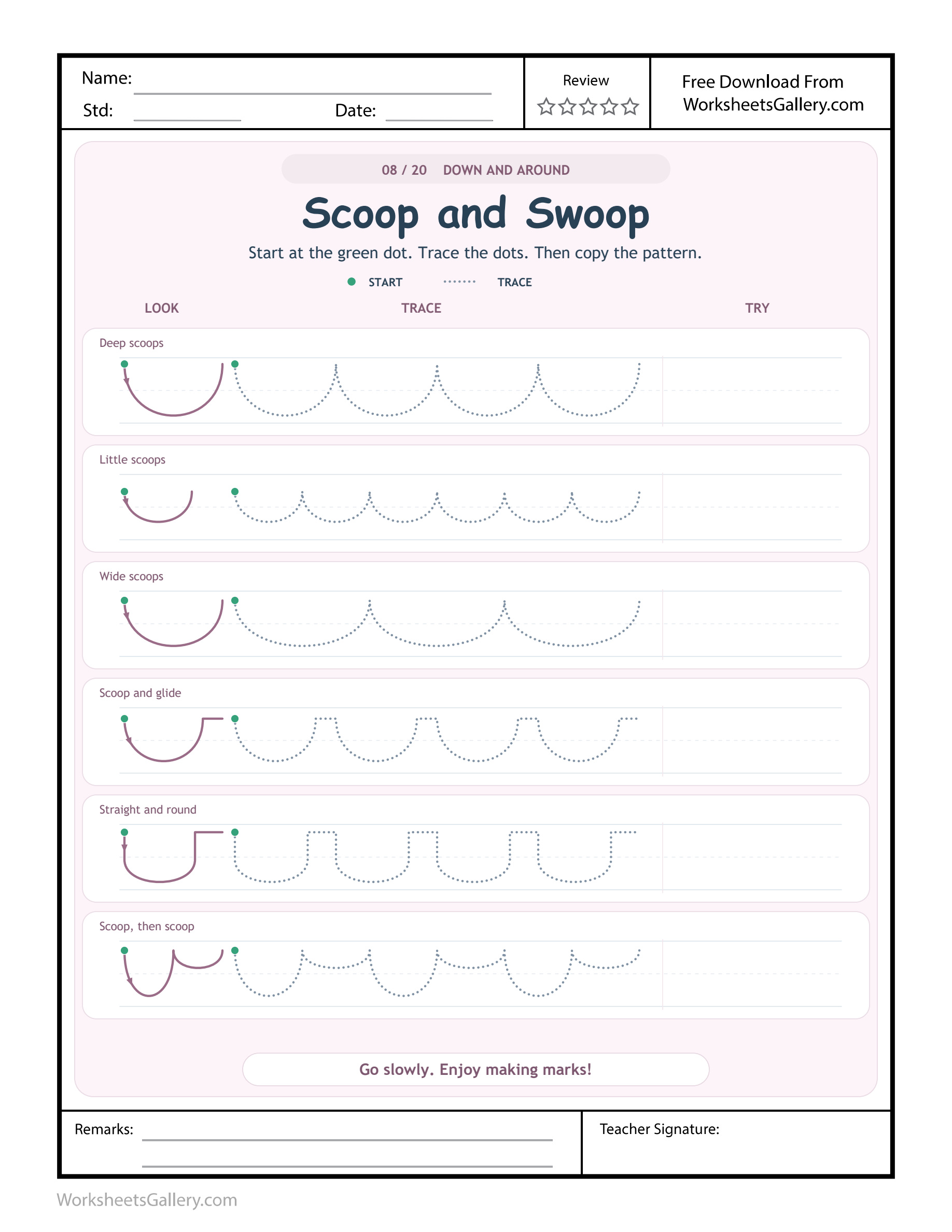
Where does a descending line decide to rise again? Scoop Curve Practice makes that change visible in a rounded bowl. The Scoop and Swoop worksheet offers six routes that move down, around a low turn and upward, sometimes adding straighter portions or a different-sized second scoop. Solid models, dotted practice and short TRY spaces give the learner several kinds of support. Begin by looking at the bottom of one curve. It is a bend to travel around, rather than a sharp point to touch before changing direction. That distinction gives a small mark a clear purpose.
Scoop Curve Practice turns through a rounded bottom
Follow the first solid model from its green beginning. The route descends on the left, curves through its lowest part and rises on the right. Its underside is rounded in Scoop Curve Practice. Drawing a pointed V would retain downward and upward travel but change the kind of turn between them.
Scoop Curve Practice therefore asks a more precise question than whether the line went down and up. How did it make that change? The adult can show a rounded bend and a pointed meeting on scrap paper, leaving the learner time to inspect the difference before choosing a pencil attempt.

Tara gives Scoop Curve Practice a boat-maker question
Tara sketches a little paper-boat shape for a pretend pond. Her father asks what makes its bottom round rather than pointed. She follows the low curve with a finger and says it “keeps turning.” They place the drawing beside the first worksheet model to compare the movements.
Their Scoop Curve Practice conversation does not need an exact copy of the boat. Tara chooses a dotted scoop to explore the same rounded turn. After drawing, she points to the bottom she wanted to preserve. Her father asks whether she would like a deeper curve or a wider one on another piece of paper, giving her observation a new design purpose.
Read Scoop Curve Practice as six named routes
The source labels are Deep scoops, Little scoops, Wide scoops, Scoop and glide, Straight and round, and Scoop, then scoop. Each row contains a solid LOOK example, a dotted TRACE pattern and an open TRY end. Inspect the printed shape rather than assuming that every label creates a numerical size progression.
Scoop Curve Practice is not an instruction to close every bowl into an oval. The opening remains part of this movement. The child can use the model to plan a short independent scoop without adding a top line, a stem or a completed object picture that the source never requested.
Seven Scoop Curve Practice learning possibilities
- Inspect a turning region. The learner locates the low part where descending travel gradually changes into rising travel.
- Distinguish curve from point. A smooth bowl and a V-shaped corner can share an overall direction change while looking different.
- Retain an opening. Recognising an open scoop keeps it distinct from a complete closed outline.
- Notice a mixed route. Straight sections and curved sections can belong to one planned mark.
- Describe relative features. Deep, little and wide provide everyday words for discussing the example in view.
- Coordinate a controlled movement. The hand steers a visible route while the other hand may help keep the paper still.
- Make an independent interpretation. A TRY attempt shows which feature the child chose to carry from the model.
Scoop Curve Practice offers occasions for these observations, not a fixed number of repetitions that guarantees writing skill. A child's spoken explanation can reveal a useful idea even when their first pencil curve is uneven.
Set Scoop Curve Practice up as a small home exploration
Read the chosen row's label and find its starting dot. Ask the child to point out the lowest part and where the line rises afterwards. A short finger rehearsal is available if useful. Offer a comfortable tool and a stable drawing surface, then invite one dotted bowl.
For Scoop Curve Practice, look at the result with the learner before asking for another. They may want to round the bottom more gradually, try the open area or stop. An adult can model a similar shape elsewhere without taking over the worksheet's TRY space. Keep the number of attempts related to interest rather than to all the repetitions printed in the row.
What changes in the Scoop Curve Practice fifth row?

Straight and round includes a more upright beginning, a rounded lower part and a level ending. The model therefore asks the hand to change its movement rule within one route. Ask the learner where straight travel gives way to curving, then where the curve finishes.
Scoop Curve Practice can use that inspection without demanding formal geometry terms. “Down, round, up, across” may be a useful description when it matches the route being shown. The words should follow what is visible; they are not a general chant that replaces looking at every new model.
A Scoop Curve Practice comparison table
| Visible feature | Question for one attempt |
|---|---|
| Low rounded bend | Did the line turn gradually through its bottom? |
| Open upper space | Was the scoop left open rather than closed? |
| Straighter portion | Where did the movement rule change? |
| Different-sized neighbour | What relationship belongs to the pair? |
Choose just one Scoop Curve Practice question at a time. A learner concentrating on the lower bend may not yet want to compare sizes or plan an additional level segment. That focused observation can still give the next mark a meaningful goal.
Six Scoop Curve Practice activities for a curve workshop
1. Compare Scoop Curve Practice bowl bottoms
Draw a rounded U-shaped curve and a pointed V on separate cards labelled ROUND and POINT. Ask the child which low turn resembles the chosen source model. Scoop Curve Practice can begin with pointing and explanation before any tracing. The cards compare movement features rather than asking the learner to identify or write the letters their outlines may resemble.
2. Give Scoop Curve Practice a low-turn spotlight
Use a large scoop drawn on spare paper. Invite the learner to place a finger near the region where the route is lowest, then travel through it toward the rising side. Scoop Curve Practice makes the bend an area to steer through rather than a single dot to stab. A broad crayon version can follow if the child wants to explore it.
3. Build a Scoop Curve Practice open bowl
Arrange a thick strip of paper into a rounded open bowl shape on a card labelled SCOOP. Ask what would change if its ends met across the top. Scoop Curve Practice can then return to the source's open model. The child's physical construction supplies a comparison without filling or covering a printed tracing route.
4. Narrate a Scoop Curve Practice movement switch
Choose Straight and round and let one partner describe a short part while another points to it. Swap roles at the transition from straight to curved travel. The description needs to fit the visible model. Keep the exchange short enough that the child can still look at the route, rather than remembering a long chain of instructions.
5. Design a Scoop Curve Practice contrasting pair
On separate paper, make one deeper scoop and one smaller neighbour. Ask the learner how the pair relates to the last worksheet row. Scoop Curve Practice invites observing a relationship between shapes without requiring identical measurements. The maker can choose which feature to retain in a brief independent pair of their own.
6. Give Scoop Curve Practice a pond-edge message
The child draws a short rounded bay for an imaginary paper pond. An adult adds the words ROUND BAY beside it. Invite the designer to explain where the mark descends, turns and rises. Scoop Curve Practice becomes one possible source of movement ideas for an expressive drawing, rather than a demand that the extra picture look like a worksheet answer.
Scoop Curve Practice can change size within a motif

The final source model pairs a deeper bowl with a smaller scoop. Look at both before repeating the motif automatically. A short TRY attempt can preserve that contrast while remaining the learner's own version of the route.
Scoop Curve Practice copying involves observation as well as physical control. If a child draws two equal scoops, ask what they noticed in the model. They may have focused successfully on keeping rounded bottoms while not yet attending to the size relationship. That gives the adult a precise next conversation instead of a reason to reject the entire attempt.
Scoop Curve Practice in a classroom design studio
A teacher offers a small group a choice of source features for paper pond designs. One learner selects a deep curve, another a small scoop and another a straight-then-round route. They point to their inspiration, draw on individual cards and dictate a short label for a shared display.
Scoop Curve Practice stays available as a reference during the activity. A teacher may notice a child keeping a low curve open after previously closing every outline. Another child may need a larger space for the turn. Respond to those particular choices, and avoid comparing the children's drawings by smoothness or speed.
A Scoop Curve Practice illustration names the low bend
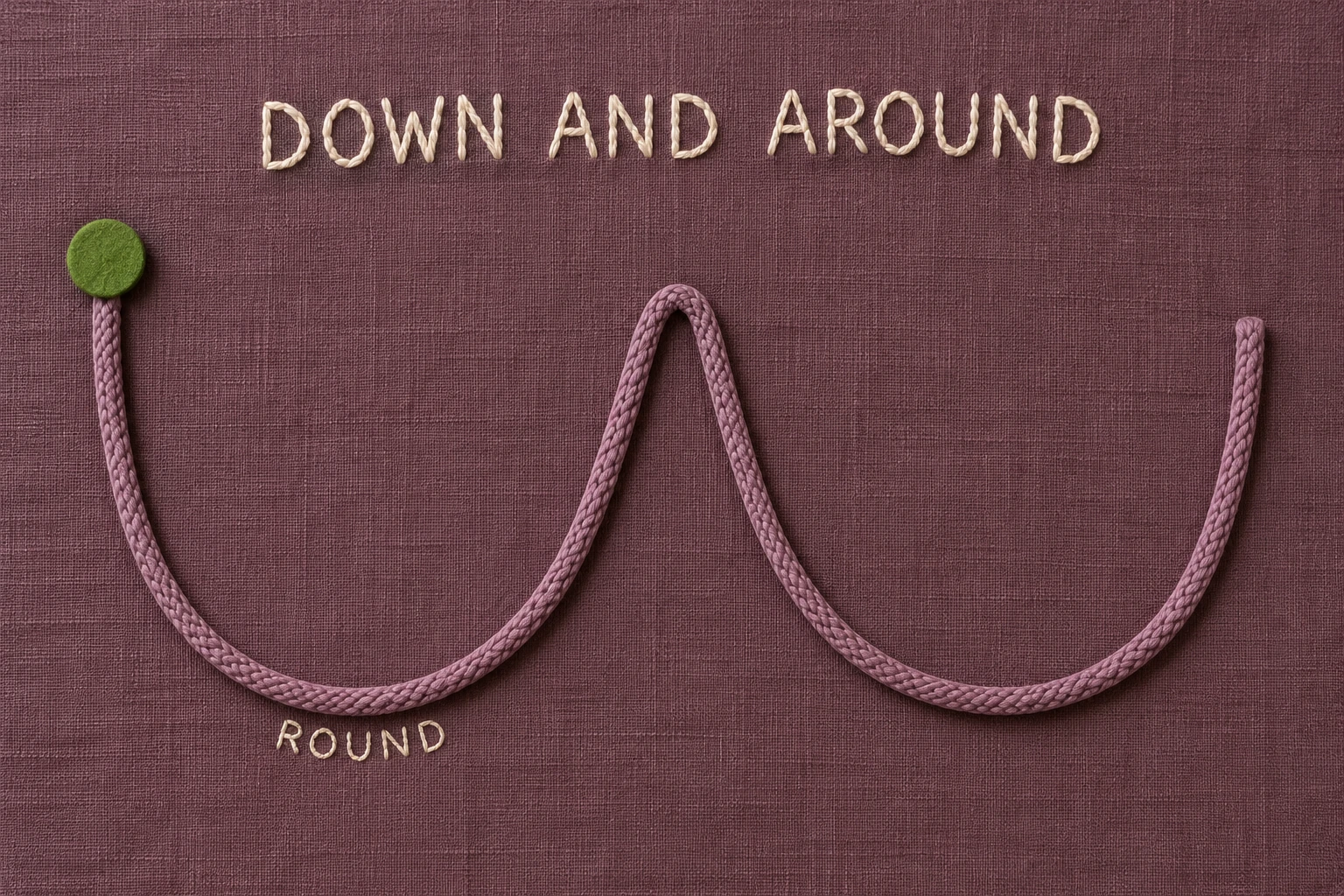
The separate cord model shows open bowls with readable DOWN AND AROUND wording. Its rounded lower turns provide another discussion view. Scoop Curve Practice keeps the uploaded worksheet unchanged; the supporting scene does not fill its intentional independent spaces or alter the printed model.
Keep Scoop Curve Practice suitable for the current learner
Preschool and early kindergarten mark makers, often between three and six, can explore the sheet with adult help. A small rounded movement and a willingness to look at a model are more useful starting points than a strict age expectation. Let an adult read the labels and offer pointing when a spoken answer is difficult.
Scoop Curve Practice joins attention, spatial observation, language and motor control. A child can understand a rounded bottom while finding the compact pencil movement demanding. Offer a larger separate version, shorten the route or return later. Retain the chosen drawing idea while adjusting its physical demand.
Let Scoop Curve Practice feedback describe the turn
Watch for a sharp bottom, an added closing line, a skipped straight portion or an unobserved size change. Ask the learner to show the corresponding model feature before another attempt. Correcting every Scoop Curve Practice difference at once can make it unclear which decision matters now.
For Scoop Curve Practice, “You kept turning through the bottom” recognises a visible movement. A later visit might focus on openness or a mixed straight section instead. Regular drawing can involve varied tools and purposes; repeatedly filling every dotted scoop is not the only way to return to the idea.
Optional Scoop Curve Practice connections and printing
Later letter tasks can include a letter-C curve, letter-U tracing or letter-J practice when those symbols interest the learner. Adults can browse NAEYC's home-writing activity guidance and the age-four literacy collection at PBS Parents for wider opportunities.
Scoop Curve Practice has an original sample and a distinct clean member attachment. To download the unbranded PDF, use the premium option after signing in and confirming that your membership grants access to this download. The printable contains no watermark, domain promotion or embedded ads. Its single US Letter sheet should be checked in print preview so every row and page edge survives scaling. Any site advertising is outside the file. Keep the TRY areas ready for the learner's own rounded decisions.
Choose one Scoop Curve Practice bend for the next drawing conversation, then let the learner explain that choice.
Popular Worksheets
Printable resources families and teachers are downloading now.
 Free
 Free
 Free
 Free