
Bunny Arch Trails: 5 Brilliant Over-the-Top Activities
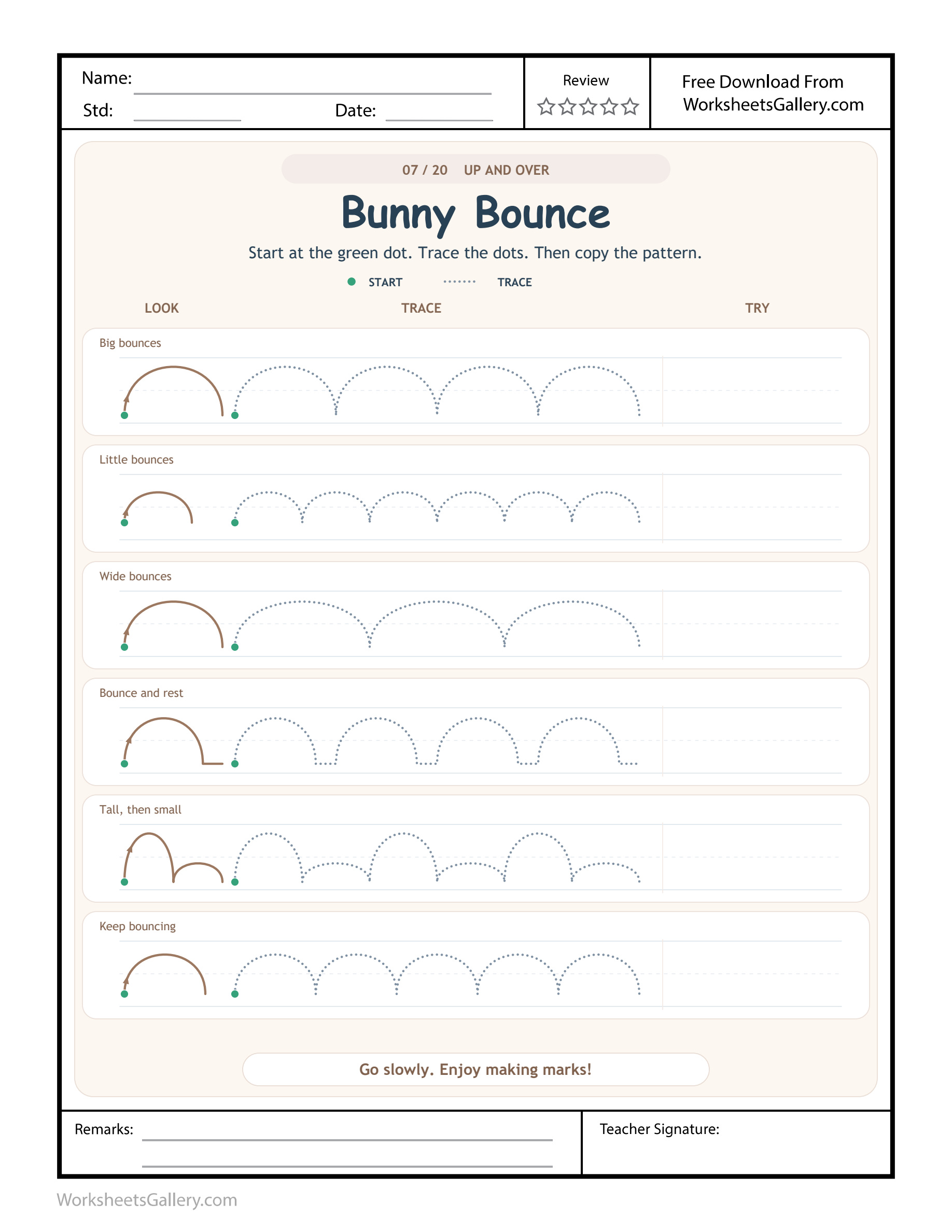
Up, over and back down: a bunny bounce gives a rounded arch a simple story. Bunny Arch Trails follows that movement through six rows of guided patterns and short independent continuations. The Bunny Bounce sheet includes larger and smaller examples, a rest after a curve and a motif that changes height. Its arches remain open underneath; they are not closed circles or crossed loops. Let a child inspect one rounded top and show where it returns before drawing. A clear beginning and return can make one little bounce worth exploring without completing the whole page.
Bunny Arch Trails travels above an open space
Place a finger near the first green dot and follow the solid model upward, over its rounded top and back down. The two sides belong to one arch. The line does not travel around to close an oval, and it does not cross itself before continuing.
Bunny Arch Trails gives the learner a useful shape relationship to retain. Rise, round the top, return. The arch may be wider or narrower on an early attempt while still communicating that relationship. Exact matching can wait while the child discovers how the upward side changes into the returning side.

Arun gives Bunny Arch Trails a garden-stage role
Arun's grandmother prepares a small paper stage for a pretend rabbit. He draws an arch for its journey and notices the space underneath. She asks whether the rabbit has come back to ground level. He points to the end, then decides to add a second bounce on the separate stage card.
Their Bunny Arch Trails conversation begins with his design. They consult the worksheet for another way a bounce could look, choosing the row with a short rest. He describes that resting stretch before making a dotted attempt. The source provides movement ideas for his play without needing to become a page he must finish for the story to continue.
Find the six Bunny Arch Trails examples
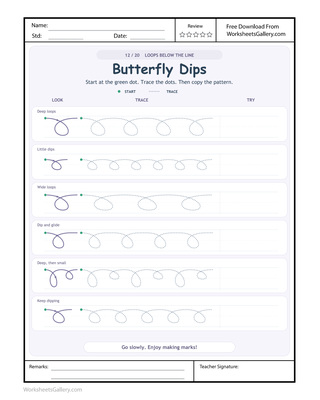
Big bounces, Little bounces, Wide bounces, Bounce and rest, Tall, then small, and Keep bouncing are the printed invitations. Inspect the model in each row for the route actually shown. The names give a way to discuss features; they do not require formal measuring or a fixed sequence through all six.
Bunny Arch Trails supplies a solid LOOK model at left, a dotted TRACE pattern centrally and a TRY extension at right. The open end is deliberate. A child can look back at the model while making a small independent continuation rather than waiting for an adult to add more dots there.
Five Bunny Arch Trails opportunities inside a rounded mark
A rising side and returning side show that one mark can gradually change its vertical direction.
The learner can distinguish an arch from an enclosed outline before trying either with a tool.
Recognising a low return makes room to plan another bounce or a short rest.
Words such as over, return and taller help the child explain the route to a partner.
A TRY mark gives visual observation a chance to guide the learner’s own hand.
Bunny Arch Trails involves attention and tool control as well as shape knowledge. A child can understand the open arch before producing an even curve, so an adult should listen to explanations alongside looking at the marks.
A Bunny Arch Trails home turn in a few actions
Read the selected row's name, locate its green beginning and follow the model with eyes or a finger. Ask where the bounce returns. Offer a pencil or crayon on a stable surface, then invite a short dotted section. Pause afterwards to let the child decide what they want to notice next.
During Bunny Arch Trails, an adult may demonstrate a similar arch on another sheet. Leave the worksheet's independent space for the learner. They might choose to copy one bounce, explore the rest segment or stop after the guided turn. Keep that choice connected to interest and manageable movement rather than to finishing a row quota.
Bunny Arch Trails leaves room for a rest

Bounce and rest adds a short level interval after the curved return. That flat is part of the model, not an accidental gap. Ask the child to show where curving changes to level travel. If the next arch starts too early, inspect the resting stretch together before another attempt.
Bunny Arch Trails can use a quiet pause in the spoken description: “up and over, down, rest.” The words are a guide to the visible example. They should not become a fast chant that makes the learner rush past the small level section they were trying to observe.
A Bunny Arch Trails comparison card for adults
| Feature | What to discuss |
|---|---|
| Rounded top | The direction changes gradually over the arch. |
| Low return | The bounce comes back down before another begins. |
| Resting segment | Some level travel follows the curve. |
| Tall, then small | Neighbouring arches have different heights. |
Use Bunny Arch Trails observations selectively. A learner exploring open shape today does not need separate corrections about height, spacing and rhythm after every stroke. Choose the feature that makes the most sense for the next small invitation.
Five Bunny Arch Trails games for a paper performance
1. Give Bunny Arch Trails an open tunnel
On spare paper, draw one arch and one closed oval. Ask which leaves an open underside for the pretend rabbit route. Bunny Arch Trails gives that comparison a purpose beyond naming shapes. The child can show the rising and returning sides with a finger before making an arch of their own beside a written TUNNEL label.
2. Plan a Bunny Arch Trails resting place
Make a card labelled REST and place it beside a short level segment drawn after an adult's arch. Invite the learner to describe where the bounce finishes and the rest begins. Bunny Arch Trails then offers an independent sketch of the two-part idea. The extra card helps name a movement change; it should not cover or fill the worksheet's TRY area.
3. Compare Bunny Arch Trails high and low visitors
An adult draws a taller arch followed by a smaller one on a separate practice strip. A child points to which rises farther and gives the pair a spoken travel description. Bunny Arch Trails can connect that observation with Tall, then small. The learner need not copy exact dimensions to retain the two-height relationship in a fresh mark.
4. Pass a Bunny Arch Trails stage direction
One partner says “one bounce, then rest” while another draws on scrap paper. Compare the instruction with the result. Ask what would need to change for two bounces with no rest. This makes the number and order of movement ideas meaningful, while keeping the drawing sequence brief enough for a preschool conversation.
5. Create a Bunny Arch Trails story strip
Let the learner choose two or three short arch ideas for a pretend rabbit performance. An adult writes a title such as BUNNY VISIT beside the marks. Ask the maker to narrate where the rabbit rises, returns or rests. Bunny Arch Trails supplies inspiration while the child's own strip remains an expressive drawing rather than a copied answer key.
Bunny Arch Trails in a classroom mini-theatre
A teacher invites children to choose one source feature for a small individual stage card. One may use a tall-small pair; another may prefer an arch and rest. Before drawing, each learner points to the model that inspired the choice. The group can later describe the cards without ranking their neatness.
Bunny Arch Trails can reveal a useful distinction when a child rounds the top confidently but turns the return into a closed loop. Ask them to show the open underside of the intended model. A larger finger demonstration may clarify the difference more directly than asking for several additional rows of pencil practice.
A Bunny Arch Trails illustration makes openness visible
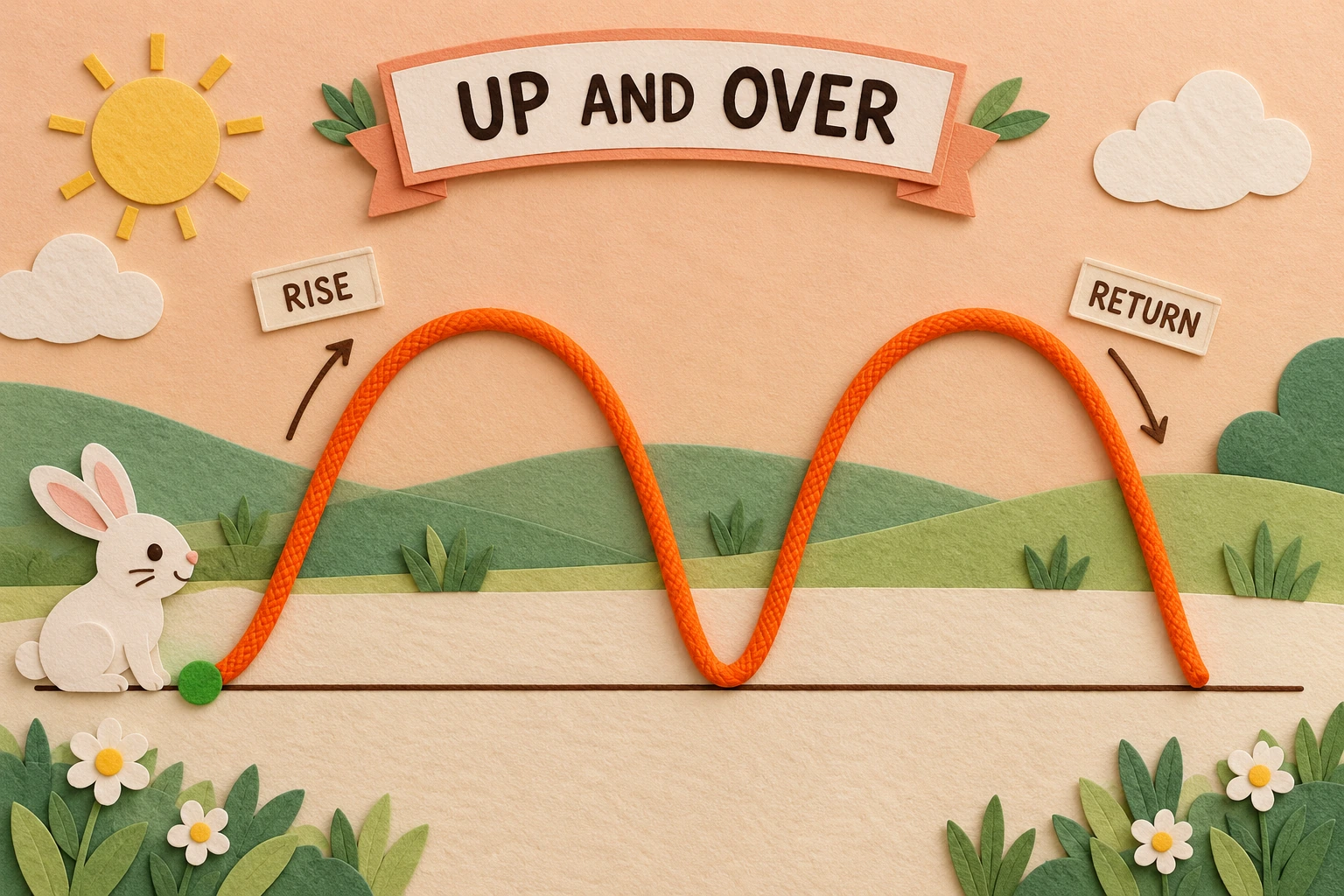
The separate crafted route has open arches and readable RISE and RETURN words. Bunny Arch Trails uses it to discuss a rounded top and a low return. Its bunny context is a story aid; the actual worksheet remains a pattern-tracing sheet with unchanged practice spaces.
Choose a Bunny Arch Trails amount that fits
Supported children around three to six may enjoy the task in a preschool or kindergarten drawing area. Begin with a manageable curve and a tool the child wants to use. Reading the row names independently is unnecessary. An adult can supply them while the learner chooses a visible route.
Bunny Arch Trails asks the eyes to anticipate a turn, language to describe it and the hand to carry it out. Those demands do not always develop together. Offer a bigger separate arch or a finger route if the small printed space is difficult. Preserve the drawing purpose while adjusting the amount of work.
Keep Bunny Arch Trails feedback attached to a feature
Common slips include making the rounded top pointed, closing the arch into a loop, skipping a rest or carrying one height through a tall-small model. Point to the relevant feature and ask what the line does there. Leave time for the learner's own inspection before demonstrating another route.
For Bunny Arch Trails, “Your bounce returned before the rest” describes something the child can see. A later visit can explore another feature instead of repeating every dotted line. Stop when interest fades, and let a successful short explanation count as part of the session even if there are few pencil marks.
Bunny Arch Trails can lead toward other curves later
When letter shapes become a useful interest, letter-U tracing offers a different rounded turn, letter-J practice includes a hook and letter-O tracing provides a closed outline. Those tasks can wait until the child wants a letter purpose for their marks.
Adults may explore family writing ideas from NAEYC or literacy activities for four-year-olds at PBS Parents. Bunny Arch Trails is one drawing choice within that broader range of play and communication.
Save a Bunny Arch Trails copy for a fresh attempt
The retained original sample can contain its source branding. The premium attachment is a separate clean PDF, available through this page's member download when an eligible membership is active on the signed-in account. Its worksheet has no watermark or domain promotion and includes no advertising inside the printable activity.
Bunny Arch Trails uses one portrait US Letter sheet. In the print preview, confirm that the saved sheet shows all its bands and fine dots. Adjust the scale to your paper while retaining the border. Advertising on the site does not appear inside this worksheet file. Leave the TRY ends ready for the child's own arches, and begin with one bounce they are interested in planning.
A Bunny Arch Trails return can begin with a finger demonstration before a fresh pencil mark.
Popular Worksheets
Printable resources families and teachers are downloading now.
 Free
 Free
 Free
 Free