
Flower Path Practice: 4 Wonderful Long-Route Games
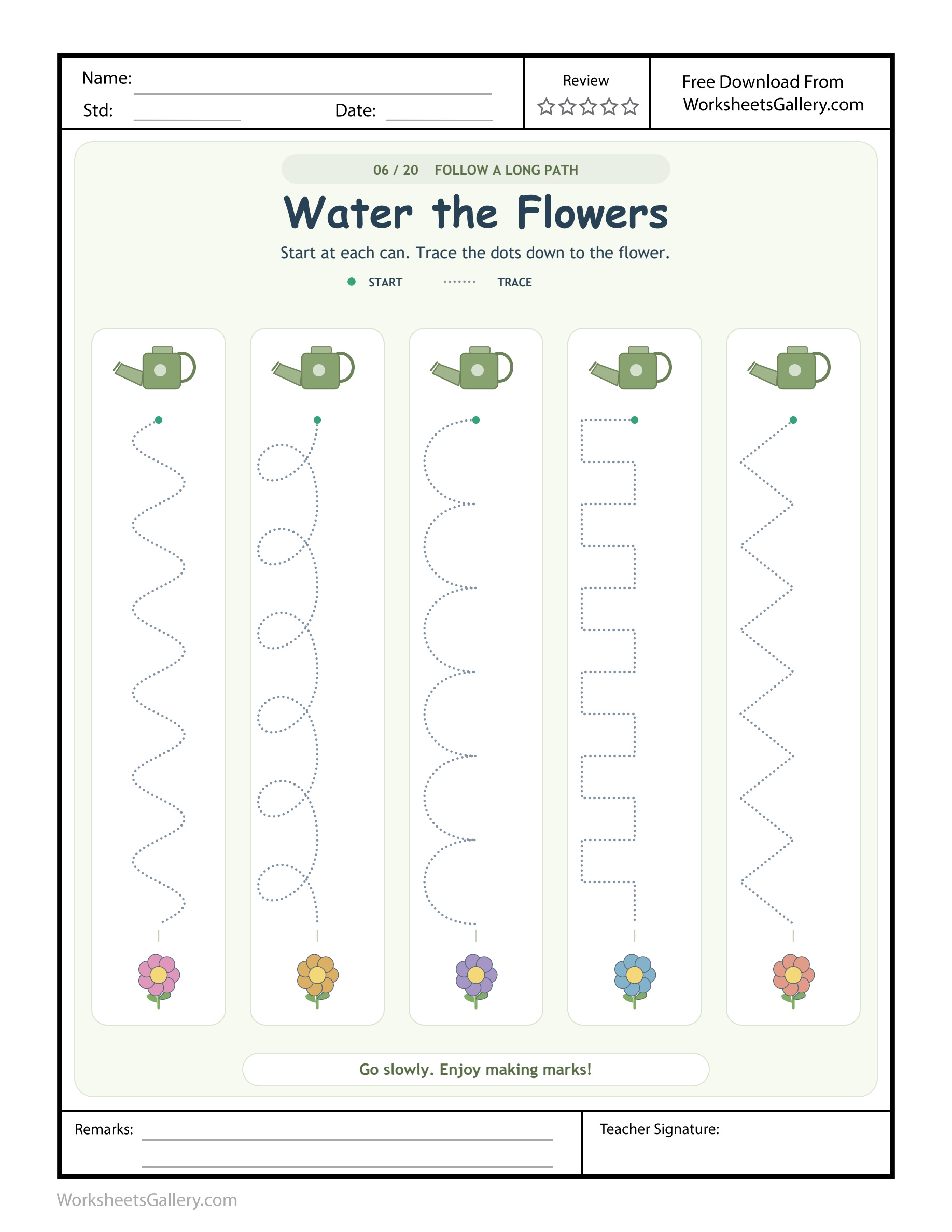
Five flowers wait beneath five watering cans, but the pencil only needs to follow one route at a time. Flower Path Practice uses those long journeys to explore staying with a chosen path and finding a place again after a pause. The Water the Flowers sheet includes winding curves, loops, broad rounded turns, square steps and a zigzag. Each dotted column leads downward toward its own flower. Let the child choose a destination, inspect the route and begin with a manageable section. A pause can become part of the plan rather than the end of the activity.
Give Flower Path Practice one destination
Ask the Flower Path Practice learner to choose a watering can and find the flower beneath its column. A finger can indicate the whole journey before a tool begins. The purpose is to connect this beginning with this ending while following the route supplied between them.
Flower Path Practice has five long paths rather than the usual LOOK, TRACE and TRY row arrangement. There is no separate independent-copy column. Its green starts appear under the cans, and the dotted routes continue toward the flowers. An adult does not need to invent additional answer spaces or require a new freehand copy to make the printed task complete.

Plan a Flower Path Practice pause before one is needed
A long Flower Path Practice route can ask more sustained attention than a small shape. Offer permission to stop after a short section and look again. If the tool leaves the page, the child can locate the end of the mark already made, identify the next connected dots and continue from there.
Flower Path Practice can therefore include recovery as well as persistence. The goal is not to prohibit every lift or interruption. A child who returns to the intended path after checking their place has made a useful decision. Requiring a full restart whenever attention shifts can obscure that achievement and make the route feel much longer.
Pia gives Flower Path Practice a garden-helper plan
Pia's uncle asks which flower she wants to water first in their pretend garden. She chooses the pink one and follows a short part of its winding route. When she pauses to tell him about a real flower outside, he leaves the paper where it is and asks where the drawn journey is waiting.
Pia inspects the end of her mark and points to the next dots. Their Flower Path Practice session continues from that place. Her uncle comments on how she found the route again, then asks whether she wants another section. They do not turn a spontaneous conversation into a reason to redo the entire path.
Read Flower Path Practice columns as different steering jobs
This Flower Path Practice table names visible route features for adult discussion. These descriptions are a guide to the pictures, not additional printed labels the child is expected to read.
| Column from left | Visible route feature |
|---|---|
| First | A winding path changes sideways direction gradually. |
| Second | Repeated loops revisit nearby space. |
| Third | Broad rounded turns continue downward. |
| Fourth | Horizontal and upright segments meet at corners. |
| Fifth | Slants alternate through a descending zigzag. |
Flower Path Practice allows a learner to select one of these jobs. The five paths are alternatives to explore, not an instruction to sustain the same movement for an entire session. Point out a new route feature if the child chooses another column later.
Four Flower Path Practice games for a small garden crew
1. Give Flower Path Practice a destination ticket
Make a separate ticket labelled FLOWER and ask the learner to place it beside the chosen flower without covering its route. They show which can belongs to that destination. Flower Path Practice now begins with a deliberate selection. Remove the ticket if it distracts from drawing; the pretend helper role should clarify the task rather than add another thing to manage.
2. Become a Flower Path Practice place finder
An adult draws part of a simple winding route on spare paper and lifts the tool. Ask the child to show where the next section should begin. Flower Path Practice makes returning to a place something worth exploring. Let the learner point to the end of the existing mark, then follow its next connected segment before using a pencil themselves.
3. Speak a Flower Path Practice corner report
Choose the stepped fourth column. A partner describes one upcoming direction change while the learner points to it. Swap the roles after a small section. Flower Path Practice uses language to anticipate the next move, with the printed route available to check the message. Keep the report short enough that remembering speech does not become harder than following the path.
4. Design a Flower Path Practice garden label
On an extra card, the child draws a short route from a can symbol toward a flower symbol. An adult writes WATER HERE beside the destination. Ask the maker how the route should be followed. This small independent design is a separate extension, not a new requirement added to the five source paths. It can remain much shorter than the printed columns.
Flower Path Practice loops need a connected-route check

The second Flower Path Practice column contains loops that bring the mark close to earlier or upcoming sections. A learner may be tempted to jump to a nearby dot simply because it looks close. Inspect the connected route ahead, and use a finger rehearsal around one loop when that distinction is unclear.
Flower Path Practice is not a maze with a choice of branches. Each column supplies a particular dotted journey. The useful question is which segment continues the current route. Let the child move slowly through one loop rather than insisting that all the loops be traced without any pause.
Seven Flower Path Practice behaviours to notice
- Choosing deliberately: locating one can and its flower gives the long route a specific purpose.
- Tracking a connected path: attention follows the selected dots instead of shifting to whichever column looks nearest.
- Looking ahead: noticing a curve, loop or corner can prepare a change in movement.
- Recovering a place: finding the end of an existing mark makes a pause manageable.
- Using direction words: a short description lets a partner understand the next portion of the route.
- Coordinating tool and paper: steering while the page remains stable supports a purposeful trace.
- Judging an amount of work: choosing another section or deciding to rest can keep the session responsive.
Flower Path Practice offers these possibilities without measuring a child's general attention span. Interest, familiarity with the tool and the chosen route can all affect one particular attempt. Describe what happened during that attempt rather than applying a broad label to the learner.
A Flower Path Practice home setup can reduce distractions
Use a clear table where the selected path is easy to see. Read the short instruction aloud, find the green beginning and preview the flower destination. The child may choose a crayon or pencil that leaves a visible mark comfortably. Cover neighbouring columns with plain paper if they compete for attention.
For Flower Path Practice, agree that a short section is enough to begin. After it, ask whether the learner wants to continue. A different column can wait. A home activity does not need to resemble a timed test; the adult can listen to the child's explanation and observe the route without imposing a completion deadline.
Flower Path Practice steps invite a classroom route coach
In a classroom garden station, one child traces while a partner acts as a route coach. The coach points near the next corner without covering the dots or touching the writer's tool. After a brief section they exchange roles, making the directing and drawing jobs available to both.

Flower Path Practice coaching should be descriptive, not a stream of commands. A teacher can model “the next part goes across” and then leave quiet time for the drawing. If the writer skips diagonally across a step, inspect that specific corner together. More shouting or faster instructions will not explain the missing segment.
Flower Path Practice zigzags call for another movement plan

The fifth Flower Path Practice route alternates slants while heading down the page. Its pointed changes differ from the winding first column and the square fourth column. If the learner chooses it after another path, invite a fresh look at the first few segments rather than assuming the previous hand movement will fit.
Flower Path Practice can use that comparison without requiring formal names for every line type. A child can show a sharp change with a gesture. An adult may supply the word zigzag afterwards, keeping vocabulary attached to the path the learner actually inspected.
A Flower Path Practice scene keeps the task singular
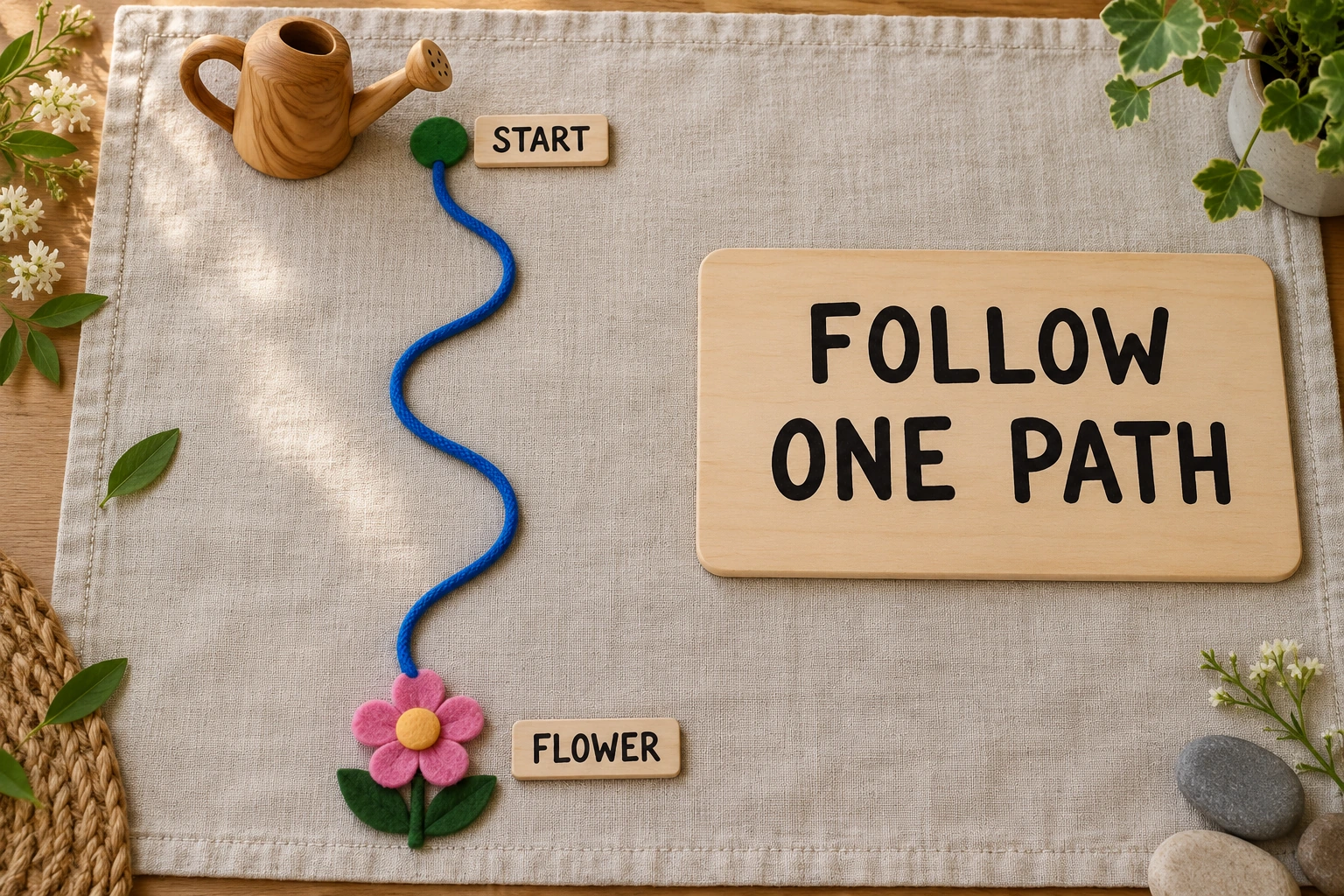
The separate Flower Path Practice garden illustration shows one can, one flower and a winding cord with readable route labels. Flower Path Practice uses that reduced model to discuss beginning, continuing and arriving. It does not replace the five source columns, and no additional marks are added to the original dotted paths.
Match Flower Path Practice length to today's readiness
The sheet can be used with supported preschool or kindergarten mark makers, broadly ages three to six. A full printed route may be too much for a particular first session. Offer a short section, a finger journey or a larger separate model when helpful. Interest in purposeful drawing is a more useful starting point than an expectation based solely on age.
Flower Path Practice involves seeing the route, remembering its purpose, describing a next move and directing a tool. Those are several demands at once. A smaller amount of tracing can preserve the real task. A learner can show understanding without filling every column, and a break does not cancel the work already done.
Keep Flower Path Practice errors specific and revisits inviting
Watch for switching columns, jumping across a loop, cutting diagonally through a square step or forgetting where a paused mark ended. Ask the child to show the selected route and its next connected dots. That question addresses the visible difficulty more precisely than asking for greater concentration in general.
For Flower Path Practice feedback, try “You found where your route was waiting.” On another day, return with a new job: choose a destination, coach one corner or recover a place. Brief revisits with a changing purpose can be useful without making the longest possible trace the measure of success.
Find a Flower Path Practice follow-up by movement
Later, a letter-J hook activity offers a shorter curved route, letter-T practice uses straight movements and letter-S tracing provides changing curves. Introduce letters only when they suit the learner's purpose.
For adults, NAEYC's family writing resource and PBS Parents' age-four literacy ideas offer wider reading. Flower Path Practice can be part of varied drawing play with different tools, stories and amounts of paper work.
Download Flower Path Practice and preserve the whole garden
The source sample and clean member PDF are attached separately. Choose the original if its uploaded presentation is wanted. For the clean version, sign into a membership-eligible account with a plan currently active, then select the premium file. The member worksheet has no domain advertising or watermark, and contains no ads inside the printable activity.
Flower Path Practice is a one-sheet US Letter document. Open the saved PDF's print view and check that every can, route and flower remains within the frame. Fit it appropriately if using another paper size. Website advertisements do not belong to the downloaded worksheet. Keep the five paths intact, choose one destination and let the learner decide how much of that journey to explore.
Popular Worksheets
Printable resources families and teachers are downloading now.
 Free
 Free
 Free
 Free