
Kite Slant Routes: 6 Brilliant Direction-Change Games
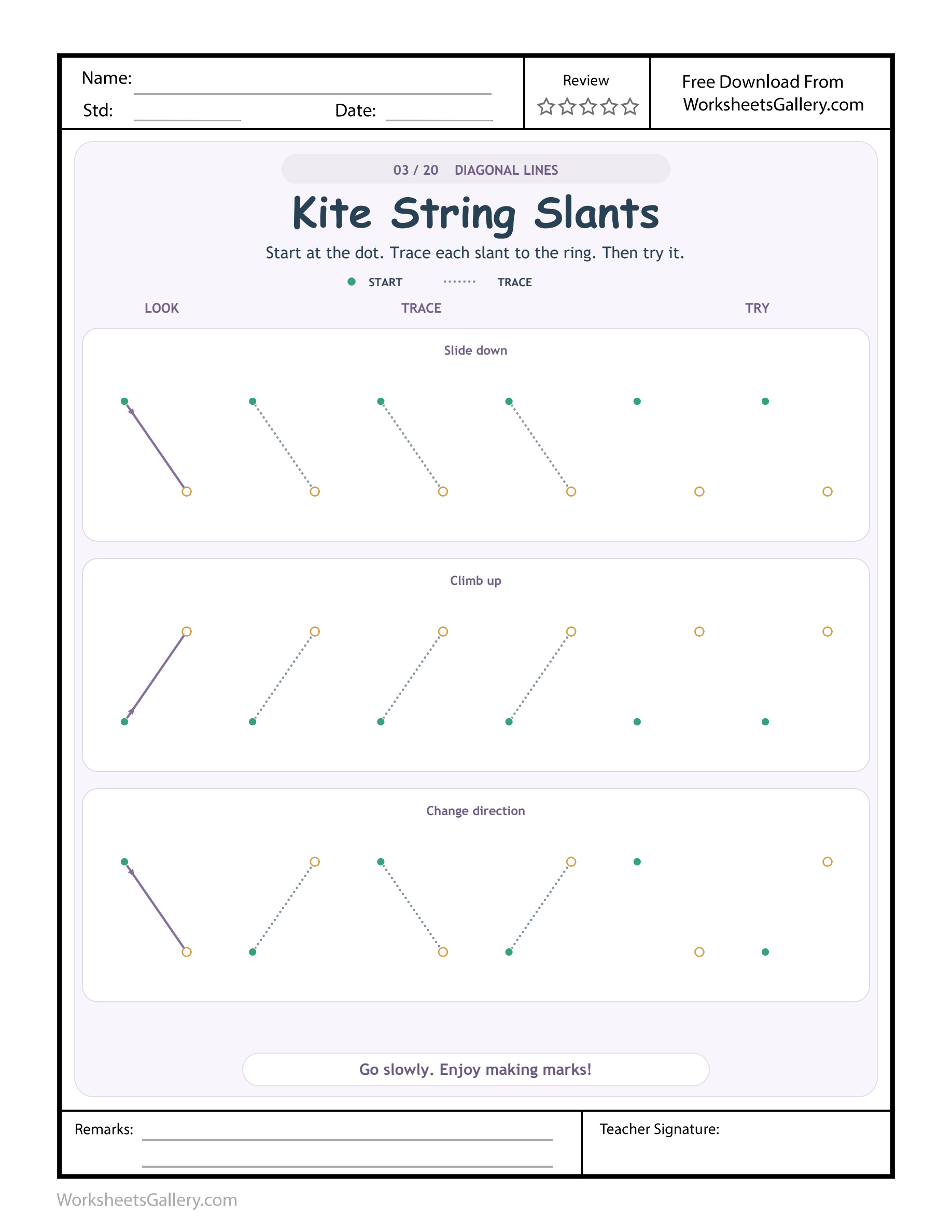
Which end of a slant is its beginning? Kite Slant Routes asks the learner to find out before moving the pencil. Some green dots sit above their rings, while others sit below. The Kite String Slants page therefore includes descending lines, ascending lines and a band that changes direction between attempts. A familiar-looking diagonal does not always call for the same movement. Read its markers, choose a starting place and travel toward the orange ring. That small moment of observation makes the route intentional rather than an automatic slide from the top of the paper.
Kite Slant Routes begins with a marker question
Invite the child to point to green before touching a drawing tool to the page. Then find the orange ring belonging to that same slant. Ask whether it is higher or lower than the start. These two landmarks provide the information needed for this particular trip.
Kite Slant Routes follows the source instruction to travel from dot to ring. A child does not need to read the row labels unaided; an adult can supply “Slide down” or “Climb up.” The visible green beginning decides the route. The page is practising directional marks rather than identifying or spelling a letter.

Three Kite Slant Routes bands tell different movement stories
The upper band begins high and finishes lower. The middle band begins low and finishes higher. In Change direction, new starts alternate between those relationships. Each Kite Slant Routes band contains one solid example, three dotted slants and two independent opportunities with endpoints retained.
Kite Slant Routes gives nine dotted attempts and six open attempts overall. The independent spaces are part of the lesson, so they should remain available for the child's own slants. It is reasonable to use only a few attempts in a sitting. Understanding one upward start can be a meaningful session even when other routes are untouched.
Asha changes her Kite Slant Routes plan
Asha and her grandfather pretend the page holds strings for a paper-kite display. She slides down every dotted line in the first band. At the second band she reaches toward its upper ring first, assuming that every string begins high. Her grandfather asks her to find the green dot before deciding.
That Kite Slant Routes dot is lower. Asha describes the journey as climbing. They trace it in the air from the low start toward the ring, then she makes one pencil attempt. The useful change is in her plan: a new marker has supplied new information. Her grandfather comments on that observation rather than making the earlier assumption into a reprimand.

Give Kite Slant Routes a short direction vocabulary
Kite Slant Routes words such as down, up, higher, lower, start and finish can support the task. Pair one word with one visible relationship. A long explanation about diagonals may be less useful than asking the child to point from the green marker toward its ring and say which way they will go.
In Kite Slant Routes, spatial language and hand movement can develop at different rates. A learner may demonstrate an upward route without yet saying “ascending.” Accept pointing and everyday words. The adult can model a fuller sentence after the child has shown the relationship, keeping the explanation connected to the source rather than to an isolated vocabulary drill.
Five Kite Slant Routes learning opportunities
- Inspect before acting. Finding the green start interrupts an automatic movement and makes room for a considered plan.
- Relate two positions. The learner compares a beginning with a destination rather than naming high or low without a reference.
- Adjust the movement. A new start can call for an upward slant after a downward one, linking observation to action.
- Describe a route. Short direction phrases let a partner understand what the learner intends to draw.
- Use support selectively. A solid example and dotted trial can inform an independent line while the child's own hand supplies its path.
Kite Slant Routes also gives attention a precise job: keep the selected start and finish together. Pencil steering, page stability and visual tracking work toward that relationship. An adult can observe them without assuming that one completed sheet measures every part of early writing.
Six Kite Slant Routes games for a direction workshop
1. Hunt the Kite Slant Routes green beginning
Choose a band and ask the child to find only the green starts, leaving the pencil aside. For each one, point to its matching ring. Kite Slant Routes becomes a visual search with a reason: determine where a particular movement would begin. Keep the search to a few positions so the learner still has interest for an optional drawing turn afterwards.
2. Sort Kite Slant Routes direction words
Make two separate cards labelled DOWN and UP, with an example slant drawn on each. A child matches a selected source route to the word that fits its dot-to-ring journey. Kite Slant Routes uses the writing surfaces meaningfully, while an adult can read the words aloud. The learner's decision comes from the landmarks, not from being able to decode the labels.
3. Correct a Kite Slant Routes wrong-start tour
An adult deliberately calls an upper ring “the green beginning.” Invite the child to inspect that claim and explain the actual start. Kite Slant Routes gives them a clear piece of evidence to use when disagreeing. They can point, name the colour or show the trip with a finger before deciding whether to draw it.
4. Speak a Kite Slant Routes two-move message
Use separate paper with one downward slant and one upward slant, each marked with green and orange endpoints. The learner gives a partner a short message describing the two journeys in order. Compare that message with the final source band. This game adds remembering and sequencing, while keeping the amounts small enough for a clear explanation.
5. Build Kite Slant Routes with two strips
Lay two straight paper strips diagonally, one falling left to right and one rising. Mark a green beginning and an orange finish on each separate practice mat. Ask how the strips differ when followed from green. Kite Slant Routes can then return to the printed examples. The Kite Slant Routes physical comparison is optional support, not a replacement tracing answer placed over the worksheet.
6. Design a Kite Slant Routes string label
On an extra drawing card, a child chooses whether a pretend kite string climbs or slides and makes one matching diagonal. An adult adds the chosen word, UP or DOWN, beside it. Ask the Kite Slant Routes maker to explain the start and destination. The invented display gives the directional mark a purpose while leaving the source's existing models and open attempts unchanged.
Watch the Kite Slant Routes downward example

The first band provides a high beginning and a lower destination. The learner can follow one dotted line and then compare it with a nearby solid example. Ask whether the intended direction was retained before discussing exact size or waviness. A small slant does not need to become a test of ruler-straight accuracy.
Kite Slant Routes can be introduced at home with one clear phrase and a single trial. Show the markers, let the child state a plan and offer the tool. Afterwards, ask whether the route went where intended. A new line deserves another look at its own start, even if the preceding attempt was comfortable.
Kite Slant Routes changes its cue in a classroom display
A teacher places an UP card near the middle band and asks a pair to explain why it belongs there. One learner describes the green marker; another points to the higher ring. They can exchange jobs for the upper band. Drawing may follow the conversation, but the explanation itself is useful evidence.
In Kite Slant Routes, a classroom child may successfully draw both slants while mixing up the words. The Kite Slant Routes teacher can support vocabulary without requiring more pencil repetitions. Another child may say the direction correctly but start at the wrong end physically. That learner needs a fresh marker check. Similar-looking results can arise from different support needs.
An adult Kite Slant Routes guide to the final band
| Markers | Direction | Ask |
|---|---|---|
| Green above orange | Slide downward toward the ring. | Was the upper marker chosen first? |
| Green below orange | Climb upward toward the ring. | Did the learner revise the starting plan? |
| A new pair appears | Inspect the new endpoints again. | Was the previous direction carried over automatically? |

Kite Slant Routes does not ask for continuous zigzags across all the spaces. Each separate slant has its own start and ring. Lift between independent attempts when beginning the next one, rather than connecting the endpoints into a new pattern the source did not supply.
A Kite Slant Routes scene for comparing starts
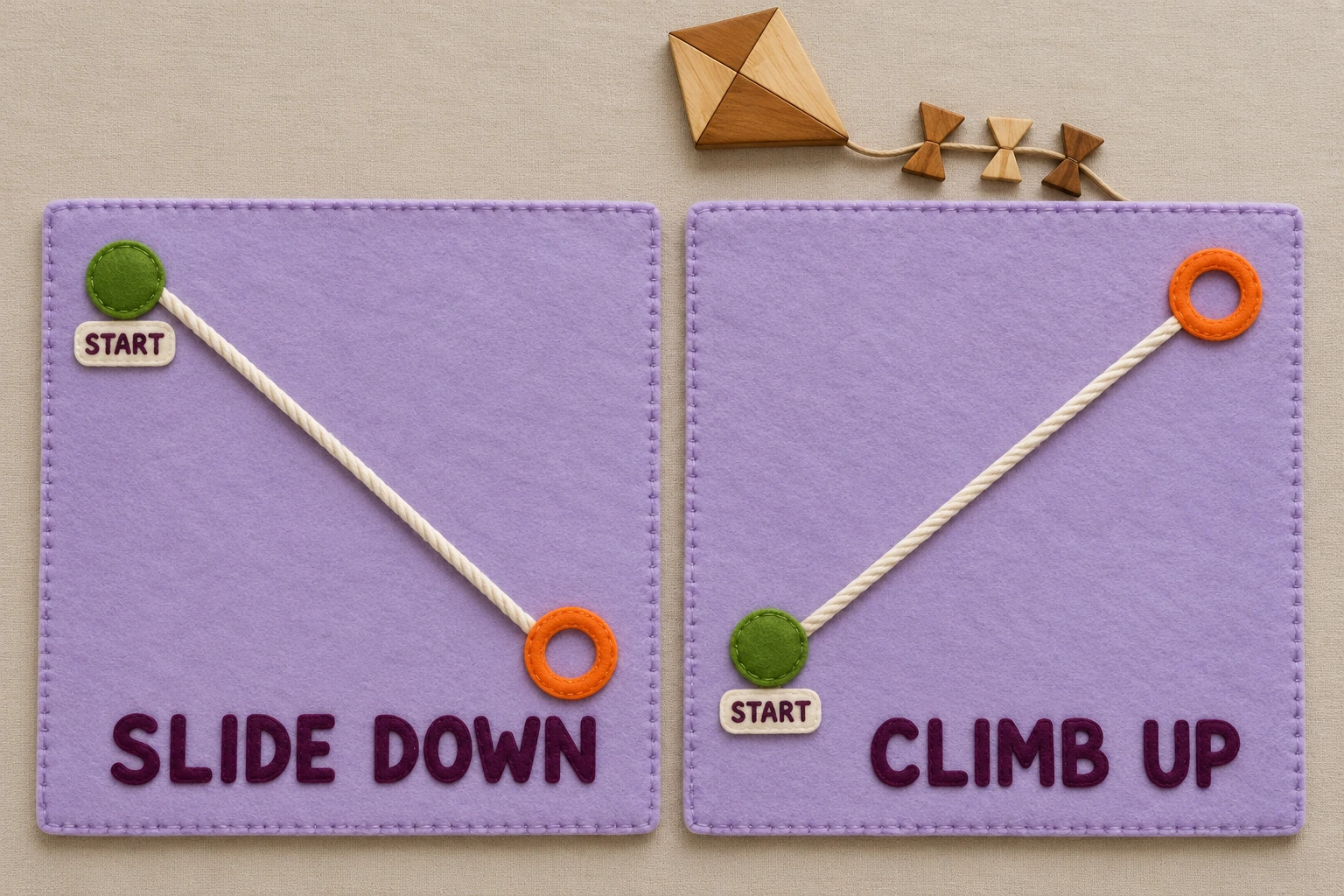
The separate labelled display contrasts a descending cord with an ascending one. Its START tokens identify different heights, and the orange rings mark their destinations. Kite Slant Routes uses this model for direction talk; the uploaded worksheet's intentional practice gaps remain open for the learner.
Kite Slant Routes can be adapted without changing its question
Children in preschool or kindergarten, approximately ages three through six, may use the page with support when purposeful slants interest them. Offer a finger route or a larger scrap-paper version before small pencil marks if helpful. There is no requirement to read the instruction text independently.
Kite Slant Routes mistakes commonly include starting at a ring, assuming every line descends or linking separate attempts together. Ask for the start marker first. Recheck the cue before increasing the number of trials. A tired learner can finish with a spoken explanation. “You changed your plan when green moved” recognises a specific act of observation.
Let Kite Slant Routes lead to a chosen next task
Revisit one mixed-direction pair on another day rather than repeating the full sheet. The child might become the direction-card chooser, explain a route to someone new or try an open slant after a dotted one. Keep the purpose different enough to make the return worth discussing.
Later, letter-V tracing offers a joined-slant form, while letter-Z practice adds horizontal sections. A simple number-one page gives another mark-making context. Adults can consult NAEYC's writing-at-home resource and PBS Parents' literacy activities at four. Kite Slant Routes remains a drawing invitation before any later letter task is introduced.
Download Kite Slant Routes for an unhurried print attempt
The original sample is retained separately from the clean premium file. Use the sample for its supplied presentation, which can include website branding. For the premium edition, log in through an account with an active eligible membership and choose this page's premium PDF. The printable member copy is free of watermark and domain advertising, with no ads embedded among its exercises.
Kite Slant Routes uses US Letter proportions on one page. Inspect the saved PDF in print preview and preserve every start marker, ring and page edge when selecting paper scaling. Website advertising is distinct from the file. Leave TRY clear, select a small number of journeys, and let the next green dot invite a new decision.
Popular Worksheets
Printable resources families and teachers are downloading now.
 Free
 Free
 Free
 Free