
Road Tracing Play: 4 Wonderful Car-to-Flag Tasks
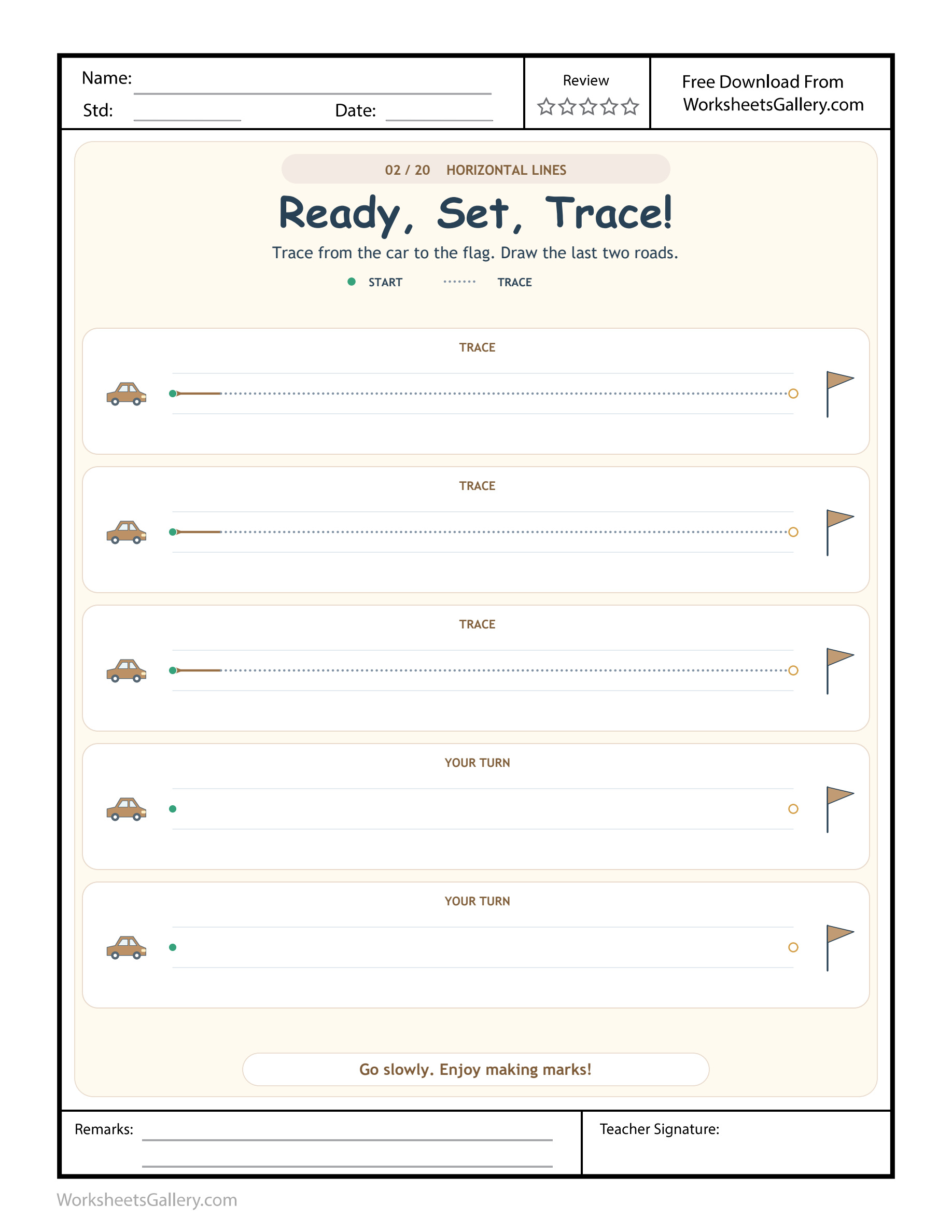
The fourth road looks familiar until the child searches for its dotted middle. Road Tracing Play uses that change to introduce a small independent drawing decision. Three guided roads lead from cars toward flags, then two YOUR TURN roads keep the endpoints while leaving the route for the learner to supply. The destination remains visible; only one kind of help disappears. Explore that difference before expecting a straight line, and let the child decide whether another supported trip or an open attempt feels useful today. A thoughtful choice belongs in the activity too.
What changes in Road Tracing Play?
The Road Tracing Play source is Ready, Set, Trace!, a horizontal-line worksheet with five long lanes. Each starts beside a car at the left and finishes near a flag at the right. A green dot marks the beginning, and an orange ring marks the destination. Light upper and lower guides remain on every road.
Road Tracing Play changes the centre support after the third lane. The first three have dotted routes and short solid starting examples. The fourth and fifth Road Tracing Play lanes do not supply that dotted centre. The child is invited to draw a route, not search for missing print. Pointing out the difference can prevent understandable uncertainty.
A Road Tracing Play comparison worth making first
Use the table as a quick adult reminder of what the child can still consult. An independent attempt does not mean that all visual support has vanished.
| Roads | Available support | Learner’s task |
|---|---|---|
| First three | Beginning, destination, dotted middle and pale boundary guides | Follow the supplied horizontal journey. |
| Last two | Beginning, destination and pale boundary guides | Plan a horizontal route between the landmarks. |
In Road Tracing Play, the car and flag give the line a reason to travel. They are not pictures to count or objects to connect in numerical order. The mark-making question is how to move across the selected road while keeping its destination in view.

Dev notices the Road Tracing Play dots have gone
Dev tells his aunt that the fourth road is unfinished. She asks him to compare it with the first and read the YOUR TURN label together. He finds the green start and the orange finish in both. They discuss what remains and what he will now decide for himself.
Road Tracing Play becomes a manageable change in support. His aunt offers an air-drawn rehearsal above the page, then lets him choose the road. Dev's line bends slightly but reaches the intended area. They talk about that purposeful connection before considering whether he wants another attempt. The missing middle becomes an invitation instead of a defect to repair.
Four Road Tracing Play activities for a pretend journey
1. Become a Road Tracing Play support detective
Ask the child to name one thing that stays on every road and one thing that changes. They might find cars throughout and dots only on the first three. Road Tracing Play gives close observation a useful purpose before pencil movement. Let the detective explain the difference to an adult, without insisting on the exact words “guided” or “independent.”
2. Plan a Road Tracing Play trip in the air
Choose an open road and move a finger just above the paper from its start toward the finish. Let the learner describe whether the trip travels across, up or down. Road Tracing Play then offers a pencil attempt if wanted. The rehearsal should stay brief; repeatedly practising above a road can become tiring before the intended mark has even begun.
3. Give Road Tracing Play a destination message
On separate paper, an adult draws a car-side beginning and a flag-side finish. The child supplies one road and dictates a short message such as “This car goes to the flag.” Add the words to the paper. Road Tracing Play now makes a drawn route part of communication, with the adult modelling the message while leaving the child's line as their own.
4. Compare two Road Tracing Play journeys kindly
Make two adult examples on scrap paper: one travelling across toward its flag and another turning away halfway. Ask which matches the stated trip, and why. Focus on the destination rather than tiny imperfections. Road Tracing Play can develop an observing role without inviting a child to judge classmates' marks or decide whose line is the neatest.
Road Tracing Play begins with one comfortable lane
Read the directions aloud and let the learner find a car. Settle the sheet on a clear surface so the whole lane is visible. Offer a tool that makes a readable mark, then point to the green dot and the far destination before beginning. There is no need to establish a racing mood because the subject includes cars.
For Road Tracing Play, demonstrate one slow horizontal movement if needed. Invite the child to follow a dotted route, inspect the result and decide whether another supported trip would help. Move to an open road when appropriate. Starting with the independent lane is also possible for a learner who already understands the route and prefers to draw it.
Six Road Tracing Play learning opportunities
- Noticing a changed task: the learner observes that a familiar-looking lane now asks them to supply its middle route.
- Planning across space: looking from one endpoint to the other establishes an intended direction before the mark begins.
- Maintaining a destination: attention returns to the flag-side ring instead of following every nearby picture.
- Using visual guides flexibly: pale boundaries and endpoints can still help when the dotted centre is absent.
- Explaining a choice: saying why a guided or open road was selected gives the adult useful information about confidence and support.
- Coordinating the hands: steering a tool while keeping the page steady makes a small drawing action purposeful.
Road Tracing Play supports observation of these behaviours without proving general writing readiness from a single sheet. A child may understand the task verbally and still need more room for the physical movement.
A Road Tracing Play classroom garage changes its prompt
At a classroom writing station, a teacher offers a child a guided lane and an independent lane to compare. The child chooses which to try, and a partner describes the remaining landmarks. They switch roles after one route. The partner can point without holding or steering the writer's hand.
Road Tracing Play may show that one learner wants the adult to redraw dots in every open lane. The teacher asks whether looking at the completed model nearby would be enough for a small attempt. If not, the child can use another supported route or practise on a larger scrap page. The independent invitation remains available for a later visit rather than becoming a demand.
Look at the Road Tracing Play fourth road closely

The YOUR TURN area contains an intended space for a route. It is not an answer-key omission. Let the learner inspect the endpoint relationship and make a mark they can explain. A slightly wavy across-road journey can still show a useful plan, even while steering control is developing.
Road Tracing Play does not need a ruler for these first mark-making attempts. A ruler would change the task toward using an external straightedge. If the child wants to explore that tool separately, give it a different purpose later. For this attempt, the question is how their own movement connects the visible landmarks.
A Road Tracing Play scene with clear endpoint words
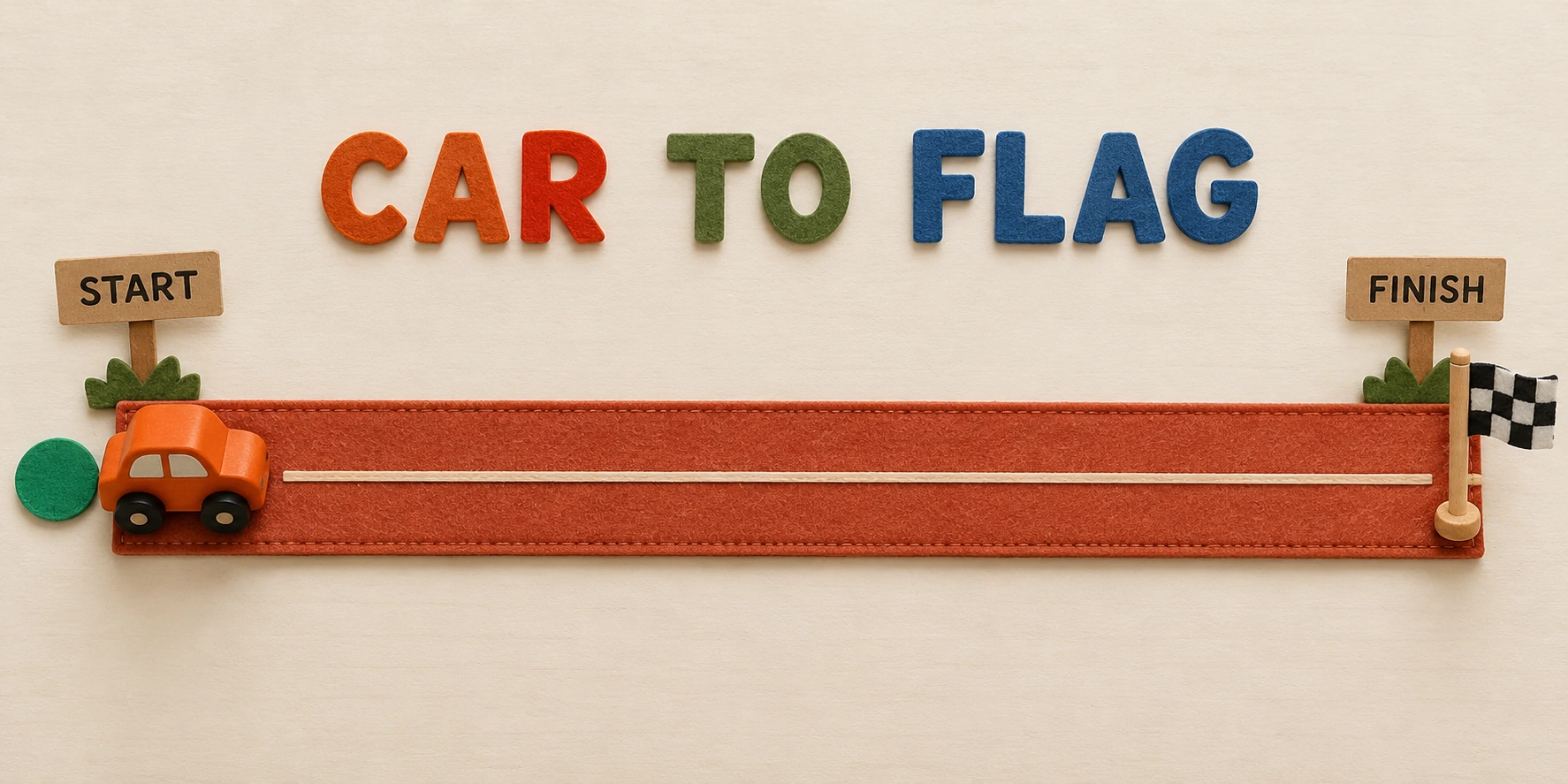
The separate tabletop illustration uses a straight route and readable START and FINISH signs. It gives the adult another way to describe the car-to-flag direction. Road Tracing Play keeps every original worksheet lane unchanged; the scene's model does not complete the child's independent spaces.
Road Tracing Play mistakes can identify the missing support
If a child starts at the flag, ask them to locate the green beginning. If they turn toward the wrong lane, cover the unused roads briefly. If they hesitate because there are no centre dots, compare the fourth road with a guided one and explain the drawing invitation again.
Road Tracing Play corrections should address the observed issue. A tilted line, an uncertain start and a lost destination are different things to notice. Pick one. An independent attempt does not need to become a list of faults. Ask the learner which part of their journey they would like to change next, or accept that they are ready to stop.
Choose Road Tracing Play by interest and readiness
The activity can suit supported mark makers in the broad three-to-six age range, including preschool and kindergarten settings. The useful starting sign is interest in making a short purposeful mark. Reading the labels independently is not required; an adult can supply those words while the child finds the landmarks.
Road Tracing Play involves visual tracking, a remembered goal and language about direction as well as pencil control. Let those demands be supported separately. A larger practice road can provide more movement space, while a finger demonstration can clarify the route. Avoid insisting that every child must fill all five lanes because the page happens to contain them.
Keep Road Tracing Play from becoming a speed test
Cars invite excitement, but speed can pull attention away from the destination. Offer a “careful driver” role whose job is to describe the route and park near the finish. “You knew where this road was going” is feedback about an observable decision, not a promise that all future marks will be easy.
Return to Road Tracing Play with another purpose: compare supports, choose a lane or explain a drawn road. A short session may use only one of these. Save the remaining routes for interest that returns naturally, rather than making repeated completion the measure of regular practice.
Later Road Tracing Play connections can be optional
When letter forms become interesting, tracing a capital T offers a different use for a horizontal stroke. The letter-L page introduces a directional turn, and letter-F tracing uses more than one across stroke. These are later possibilities, not prerequisites for enjoying roads.
For adult reading, explore PBS Parents' age-four literacy collection and home-writing support from NAEYC. Road Tracing Play can sit alongside drawing, pretend signs and other writing experiences chosen for the child.
Save Road Tracing Play as a printable PDF
Choose the original sample if you want the source presentation. A different attachment provides the clean member edition with website-name and domain branding removed and no watermark. Sign into an account with an eligible membership currently active, then use the premium download for that version. The clean worksheet PDF has no ads embedded in its activity.
Road Tracing Play is laid out on one US Letter sheet. Before printing the saved file, check that all five roads fit inside the preview frame. Use suitable scaling for another paper size. Web-page advertising remains separate from this printable. Keep the last two road centres open so the learner can make the independent journeys the source intended.
Popular Worksheets
Printable resources families and teachers are downloading now.
 Free
 Free
 Free
 Free