
Rain Line Practice: 5 Brilliant Start-and-Stop Games
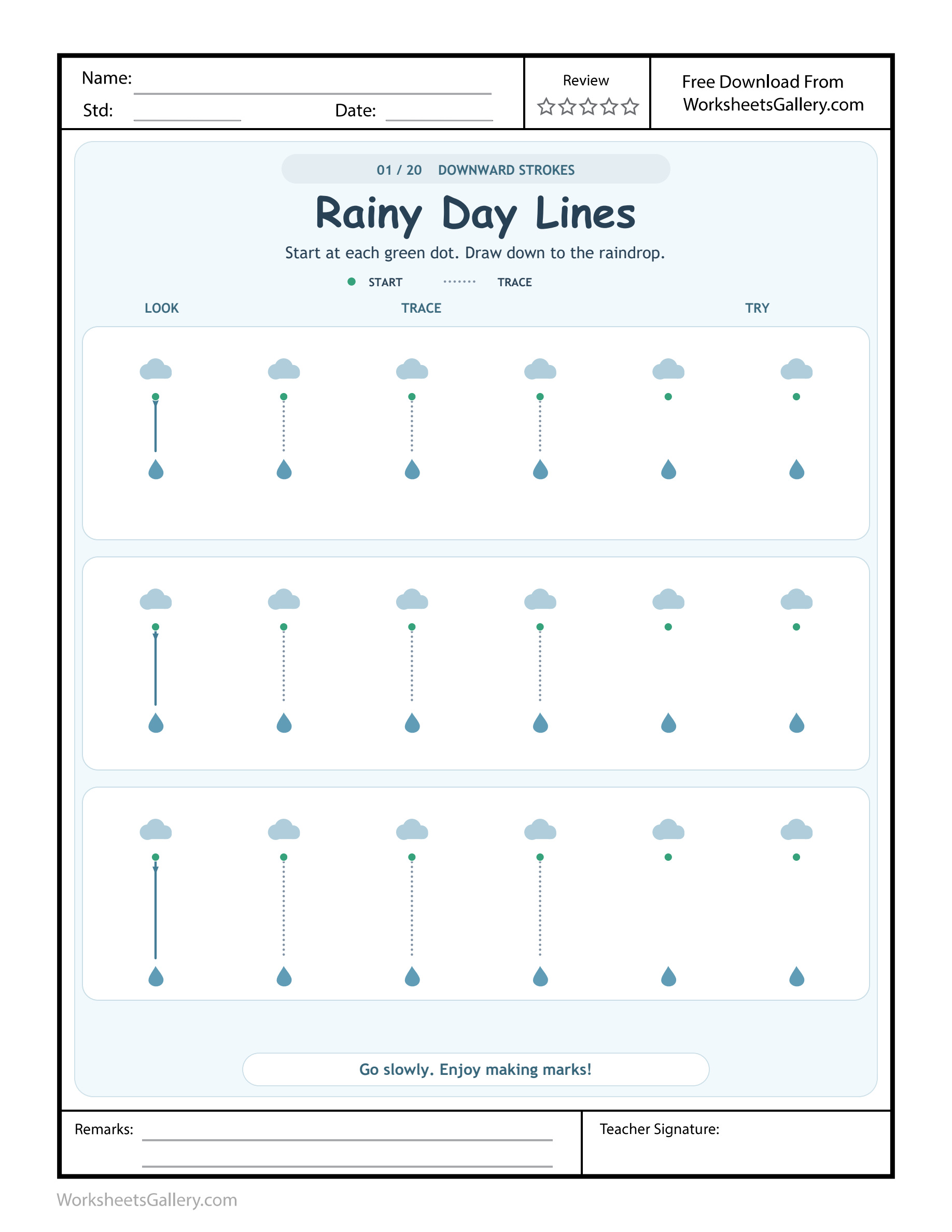
A rain line has a beginning and an ending, even before it belongs to a letter. Rain Line Practice makes those two decisions visible with green starting dots beneath clouds and raindrops waiting below. The Rainy Day Lines sheet offers solid models, dotted routes and open attempts across three roomy bands. A child can first look, then follow, then plan a mark without the dotted middle. Keep the invitation small: find one beginning, travel downward and notice when the journey is finished. That is enough purpose for a thoughtful first attempt.
Before Rain Line Practice, choose the stopping place
An adult often notices whether a line is straight. The child may be concentrating on a different question: where should the pencil stop? Point to the raindrop before beginning. Let the learner show its position, then return attention to the green dot above.
Rain Line Practice links that visual plan with a downward movement. The paper is not asking for a fast shower of random strokes. One intended route can be more informative than a page of hurried marks. Its destination gives the child a reason to slow the movement as the pencil approaches the lower picture.
Three Rain Line Practice jobs share the same band
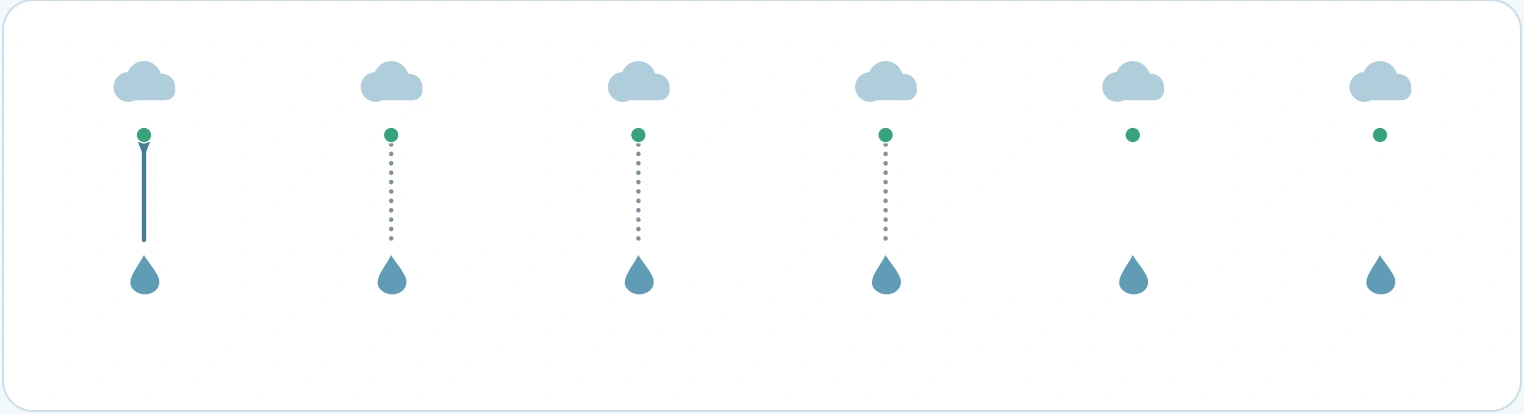
The Rain Line Practice LOOK area supplies a solid demonstration at the left. TRACE provides three dotted journeys. TRY leaves two routes without a dotted middle, while keeping green beginnings and raindrop destinations. Each of the three bands repeats that arrangement, giving nine dotted trials and six independent possibilities across the sheet.
Rain Line Practice does not require a learner to complete all of those possibilities at once. Show how the supports differ and choose an appropriate amount of work. The open spaces are purposeful drawing invitations; an adult need not fill them with extra tracing dots before the child has a chance to try.

A Rain Line Practice weather report from Mira
Mira tells her father that her pencil is “still raining” after a line has passed the drop. He asks her to become the weather controller for one new route. Before making the mark, she points to where it will begin and where the rain should finish.
Their Rain Line Practice conversation changes the goal from making a perfectly straight stroke to controlling a meaningful journey. Her next line wobbles slightly, but she stops near its destination. Her father notices that specific change. He saves straightness as another possible observation instead of asking her to correct every feature of the same attempt.
Set up Rain Line Practice with room to move
Place the page where the child can see its top and bottom comfortably. Offer a pencil or crayon that makes a visible mark without excessive effort. Let the learner settle the paper with the other hand if helpful, and keep the writing area free of competing worksheets.
For Rain Line Practice, first demonstrate on scrap paper or trace a model with a finger. Say a short movement phrase such as “start, down, finish.” Invite one dotted route, then ask whether the child wants another supported line or an independent attempt. A pause between strokes allows a fresh look at the next green beginning.
Read Rain Line Practice progress through observable choices
Finding the green dot shows the learner has selected a place to begin rather than starting wherever the pencil lands.
A top-to-bottom journey connects a spoken direction with a visible mark.
Ending near the intended destination makes the mark a planned action with a finish.
Trying an untraced route gives the learner a chance to use the model without following its middle dots.
Words such as above, below, start and stop help a partner understand the movement.
Small steering adjustments and paper-holding movements serve a concrete drawing intention.
Rain Line Practice provides opportunities to observe these choices. It is not a promise that one sheet will establish fluent handwriting, and a finished page alone does not reveal how much help was given.
A Rain Line Practice observation table for grown-ups
Choose one feature to discuss after a stroke. This table helps keep the response specific rather than asking for a generally “better” line.
| What you notice | Possible next invitation |
|---|---|
| Starts below the green dot | Find the green beginning together before touching pencil to paper. |
| Continues past the raindrop | Point out the finish before the next journey. |
| Leaves the dotted middle | Try one finger rehearsal and a slower fresh stroke. |
| Hesitates in TRY | Look back at the solid example, then choose whether to attempt it. |
In Rain Line Practice, a single observation can guide a short follow-up. Avoid interpreting every wobble as the same problem. Looking at the destination, directing the tool and knowing when to end are related but separate parts of the task.
Use Rain Line Practice in a classroom cloud station
A Rain Line Practice teacher places one copy at a small drawing station and invites a learner to choose a cloud. Another child acts as the route describer, pointing to the green start and the raindrop finish without taking over the pencil. They exchange roles after one line.
Rain Line Practice can reveal that a child understands “down” clearly when speaking but loses the destination while drawing. The teacher can make the next invitation a destination preview. This is more useful than demanding a whole new row simply because the first mark did not look as expected. Keep private notes about support rather than ranking children's lines publicly.
Five Rain Line Practice games with a small drawing purpose
1. Give Rain Line Practice a weather-controller voice
On separate paper, make a green beginning and a lower drop. The child announces “rain starts” before drawing and “rain stops” when reaching the destination. Rain Line Practice becomes an action the learner directs. Let the speaker control the pace; an adult should not shout a sudden stop that turns a considered movement into a surprise reaction game.
2. Plan a Rain Line Practice route with a finger
Invite the learner to hover a finger from the chosen green dot toward its drop before using a tool. Ask what will happen first and last. Rain Line Practice then gives a visible plan a brief rehearsal. Finger movement is an optional preparation, not another worksheet that must be completed before the child earns a pencil turn.
3. Make a Rain Line Practice finish inspection
Draw two sample downward marks on scrap paper, one ending near a drop and another continuing far below it. Ask which one matches the stated journey. Rain Line Practice can involve judging an adult's example without correcting the child's own work. Talk about the endpoint specifically, leaving differences in line thickness or minor waviness outside this game's question.
4. Offer a Rain Line Practice cloud choice
Let the child choose a dotted route or an open TRY route and explain which support they want. Keep both options available. The learning decision concerns whether to follow a supplied middle or plan one independently. A supported choice is a useful choice; it does not need to be presented as a lesser performance than the independent alternative.
5. Send a Rain Line Practice paper shower
On a separate pretend weather card, the child draws two or three short downward rain marks for a family member. Label the card RAIN so its writing surface has a meaningful word. Ask the maker to show the beginnings and endings. This extra drawing gives the movement a communicative purpose while the worksheet itself retains its original practice structure.
Rain Line Practice can outgrow the dotted middle
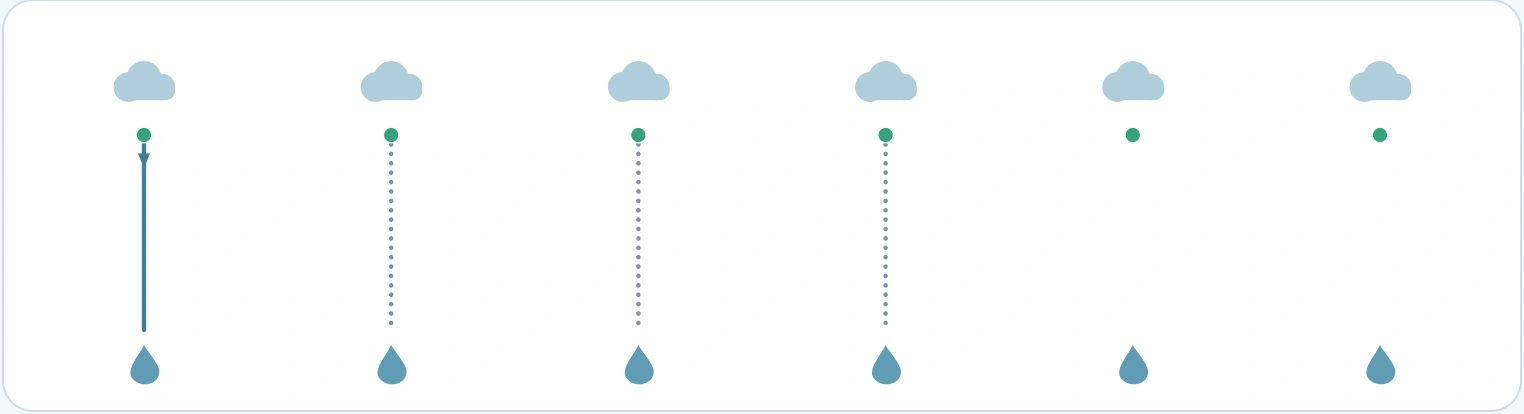
The Rain Line Practice independent pair still supplies useful landmarks. Invite the learner to look from the green dot to the drop and decide how the mark will travel. The line may be slightly angled or uneven on an early attempt; discuss whether it began and ended intentionally before demanding several improvements.
Rain Line Practice can remain at this stage for more than one visit. A child who understands the route but dislikes the tool may prefer a larger movement on scrap paper. A child who enjoys the dotted route may choose another supported turn before attempting TRY. Neither choice requires changing the source page.
A separate Rain Line Practice scene names the movement
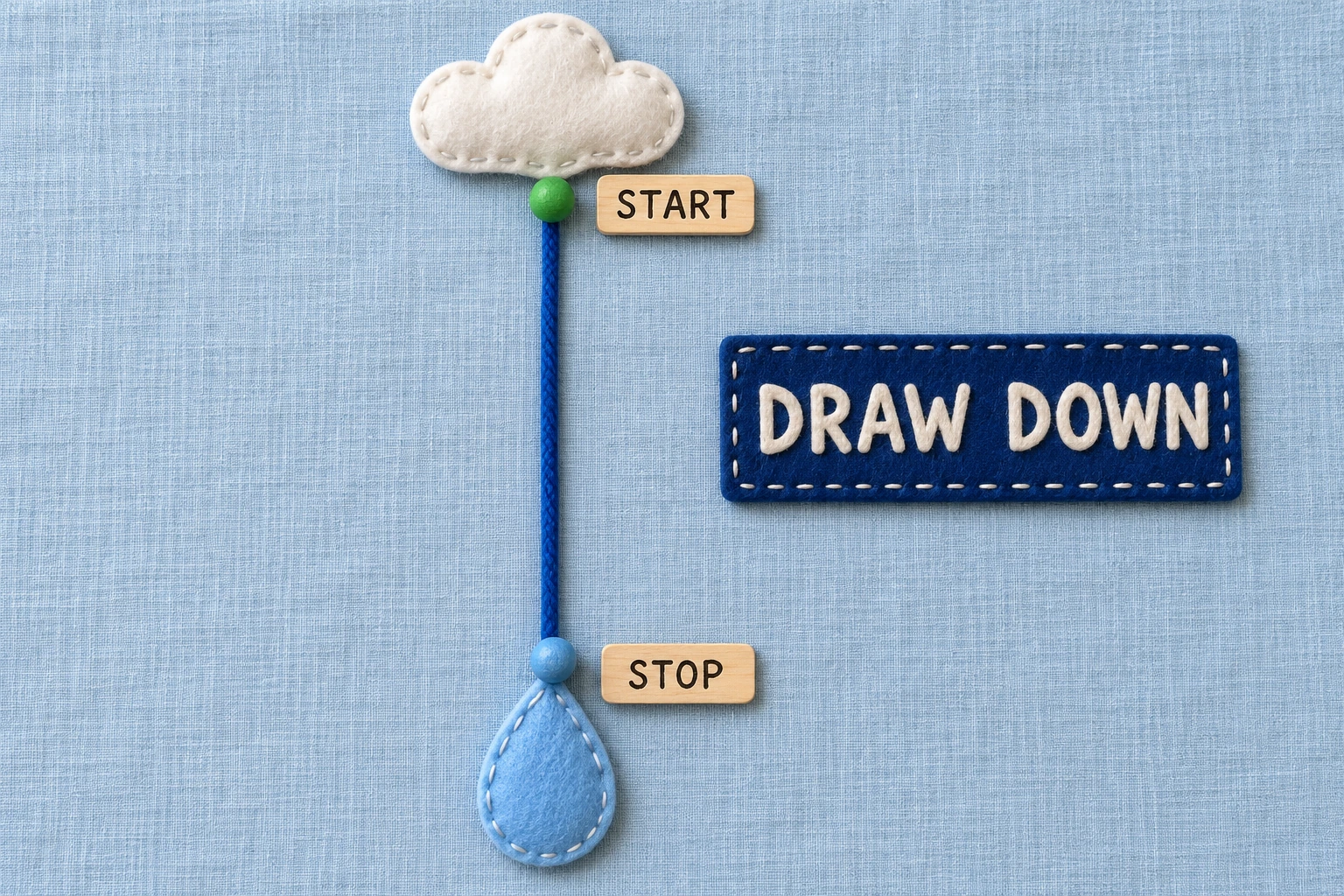
The crafted Rain Line Practice cloud-and-drop model isolates a straight downward route with readable START and STOP labels. Rain Line Practice uses it for discussion, while the faithful worksheet views keep their own intentional drawing spaces. The illustration is not a completed answer version of the paper task.
Rain Line Practice fits readiness better than a deadline
For children roughly three to six, this supported mark-making invitation can fit a preschool room or an early kindergarten session. Begin when a short mark-making invitation feels manageable. Some children can discuss a destination before controlling a small pencil stroke; others prefer showing the route with a finger. Allow that difference without turning the activity into an age test.
Rain Line Practice asks attention to hold a goal, eyes to track a route, language to name it and hands to carry it out. It is one part of a varied drawing experience. The letter-L tracing page can be a later straight-line connection when letters interest the child, rather than an immediate requirement.
Keep Rain Line Practice welcoming on another day
Try one brief visit for choosing a start, another for noticing the finish and a later one for an independent line. Change the observation before adding more repetitions. A child can enjoy being the weather planner even when only a few marks are made. “You found your stopping place” identifies an action worth noticing.
For different mark purposes, consider number-one tracing or letter-T practice if those forms are relevant later. Adults can browse NAEYC's home-writing suggestions and PBS Parents' literacy ideas for age four for a wider range of experiences. Rain Line Practice need not become the only kind of mark making in the week.
Print Rain Line Practice with its landmarks intact
The original sample keeps the uploaded presentation, including source branding. A separately prepared premium attachment removes the website name, domain and watermark. To obtain that clean member edition, use your account and an eligible active membership, then select this page's premium PDF option. The printable activity contains no ads; advertising on a web page is separate from the downloaded sheet.
Rain Line Practice occupies one US Letter page. Save the file and inspect the entire frame in your PDF print preview. If using another paper size, select scaling that preserves the clouds, green dots, drops and footer border. Leave the independent routes clear. Offer one considered rain journey, then let the child's response determine whether another would be useful.
Popular Worksheets
Printable resources families and teachers are downloading now.
 Free
 Free
 Free
 Free