
Path Copy Thinking: 6 Brilliant Look-and-Draw Activities
A copied path can sit beside a new decision. The twenty-page collection gathers this grid-copy task and the remaining supplied concepts. Its $4 purchase provides one clean printable download.
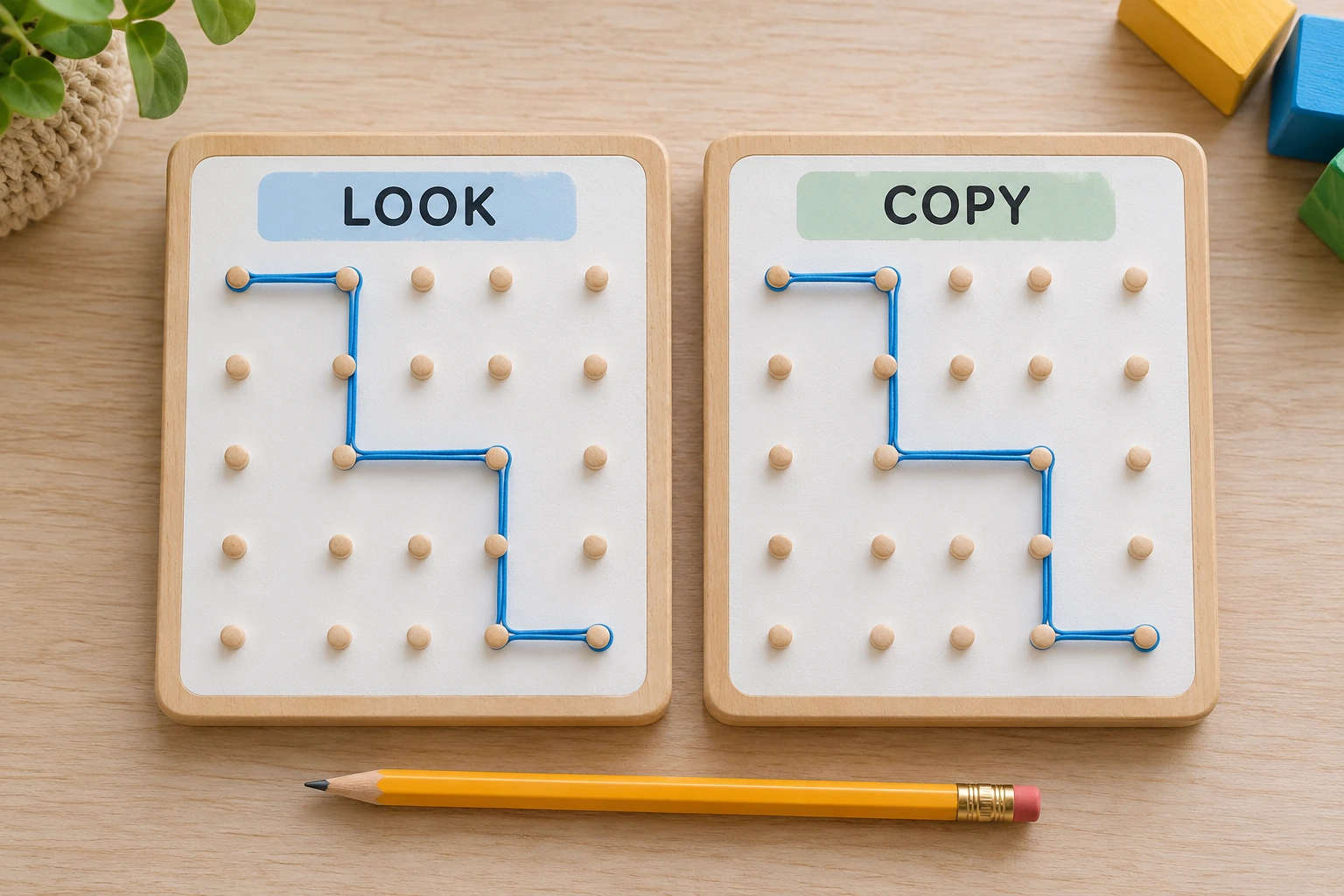
Looking back can be part of a successful drawing. Path Copy Thinking uses three visible route models and three neighbouring dot areas to invite careful comparison. Children around four to six inspect a path on the left, then create its counterpart on the right, beginning at the green dot. The model remains available throughout. Path Copy Thinking gives each glance a purpose: check the next direction, notice where a corner belongs, or compare the distance to a turning point. The challenge is to reproduce a route thoughtfully, with useful information still in view.
Path Copy Thinking is a comparison task
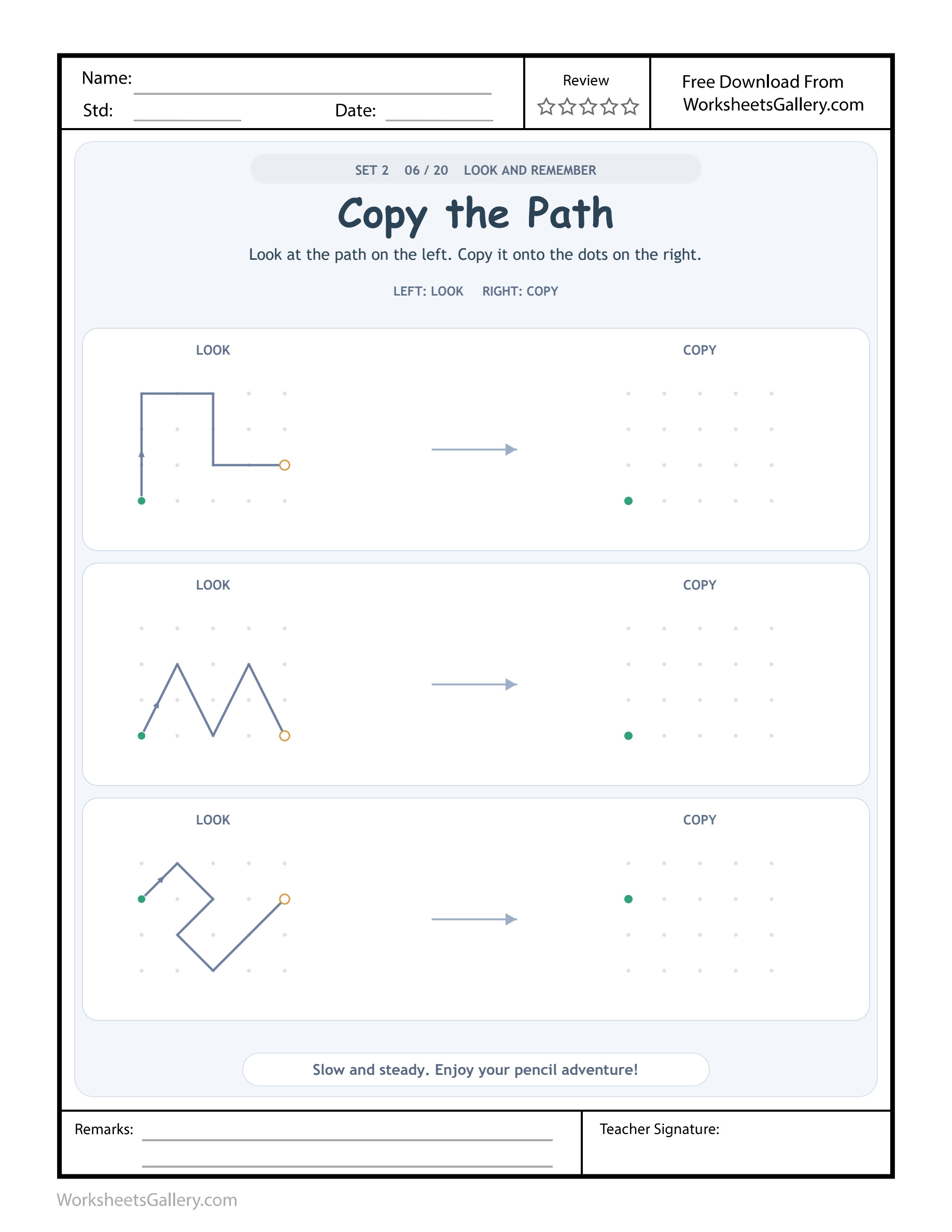
The Copy the Path sheet presents a stepped route, a zigzag and an angular route. Each left-hand example sits beside an independent right-hand dot area. Path Copy Thinking asks the child to use that example, rather than follow a complete dotted answer on the copy side. The pale dots provide reference positions while leaving the new line to be drawn.
Although the header includes the words LOOK AND REMEMBER, the printed instruction says to look at the left path and copy it onto the right dots. It does not require covering the model. Path Copy Thinking can therefore involve repeated looking. An adult should not add a memory test unless a separate game is deliberately being proposed later.
Start by finding two corresponding beginnings
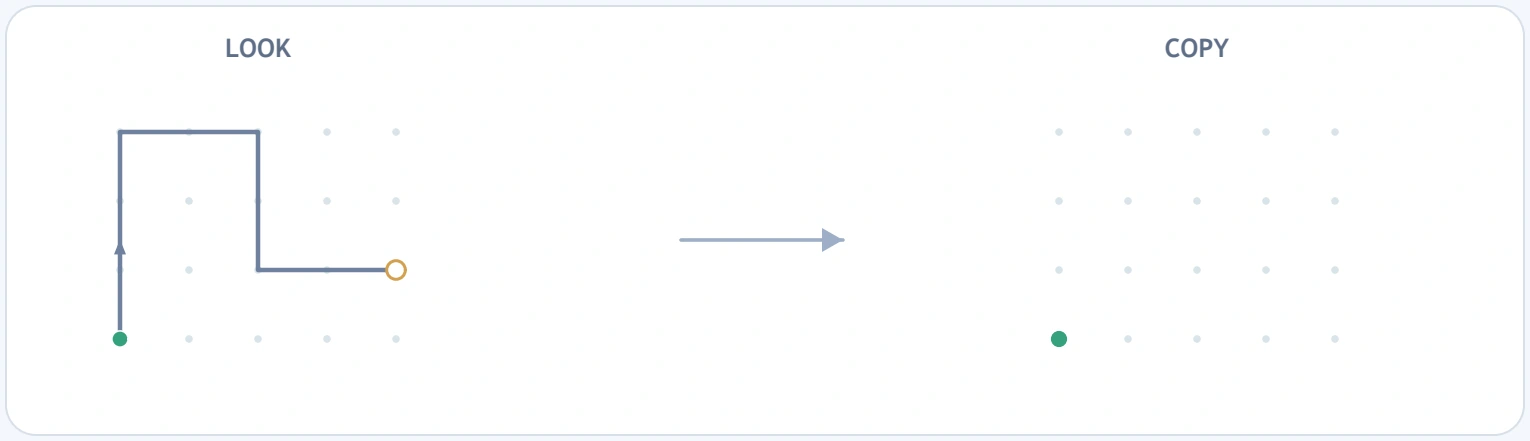
Locate the green dot under the left model, then its partner in the right-hand area. Path Copy Thinking begins with that relationship. Ask the child to describe the first direction from the model's start. An upward beginning cannot be copied by starting horizontally just because the right grid has space in that direction.
Move a finger above the model while the child follows with their eyes. Then return attention to the copy start. Path Copy Thinking becomes manageable when the child considers one stretch and one turn, rather than trying to reproduce the entire route in a single uninterrupted action. The example stays ready for another look.
Arlo checks a corner instead of guessing
At the classroom drawing table, Arlo traces the first model with his eyes and begins on the right. At the top of the first stretch he hesitates. His teacher points back toward the model without naming the next turn. Path Copy Thinking gives Arlo a place to find the information himself.
He notices that the model changes direction before coming down again. He points to the turn on each side, then continues his own line. Path Copy Thinking has allowed a useful pause. His teacher describes the action specifically—he checked the model—rather than praising him for doing the route from memory or for finishing faster than a neighbour.
Six benefits tied to visible choices
- Correspondence: Path Copy Thinking links a place on the model with a place in the copy area.
- Turn order: a child notices which change comes before the next stretch.
- Spatial language: up, down, across and beside can describe an observed route.
- Measured attention: Path Copy Thinking gives short looking pauses a useful role within the drawing.
- Tool control: straight stretches and angled changes invite different hand adjustments.
- Self-checking: the child can compare the emerging line with the still-visible example and decide what to do next.
These are practical observations, not a guarantee about later handwriting. A copy with an uneven line may still preserve the route's important directions. Ask which feature the child was trying to match before judging whether an attempt needs another cue.
Read a zigzag through its peaks and valleys
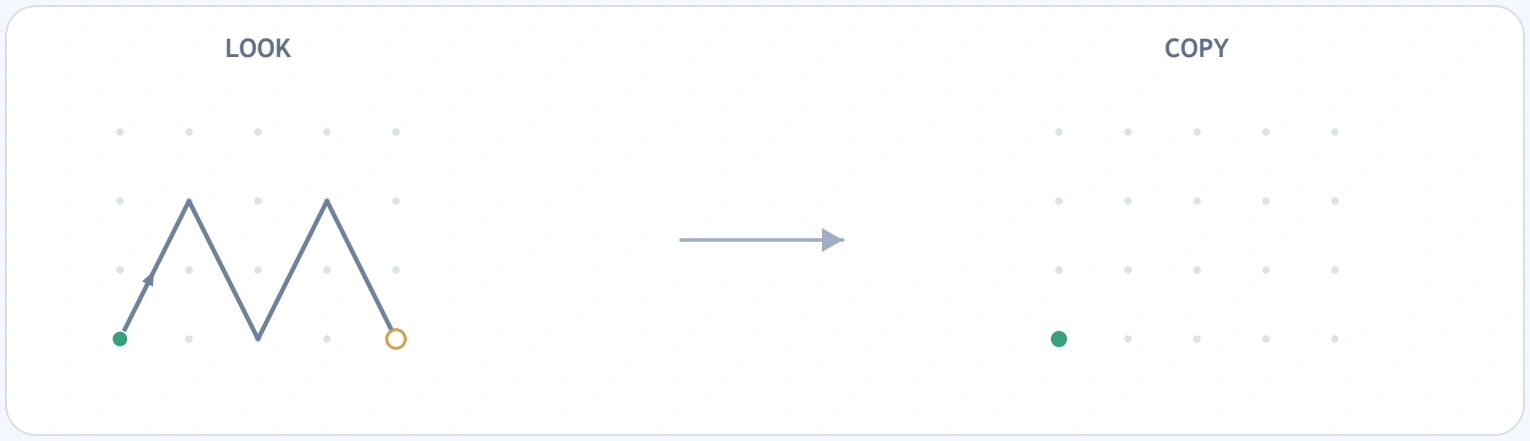
The middle model changes between rising and falling slants. Path Copy Thinking makes the turning positions important; continuing one slope too far changes the location of the next peak. Invite the child to point to each change before drawing a corresponding stretch on the right.
The mountain trail's zigzag turns offer another way to explore that movement. Path Copy Thinking adds the separate demand of transferring a model to a neighbouring area. If the child wants a direct guide under the pencil, use the tracing task for that purpose and explain why the copy area looks different.
Three Path Copy Thinking models, three reading questions
| Model | Question before the next mark | Comparison afterward |
|---|---|---|
| Stepped | Which way does the next straight stretch go? | Path Copy Thinking preserves the sequence of corners. |
| Zigzag | Where does this slope turn? | Path Copy Thinking compares peaks and low points. |
| Angular | Which corner comes after this diagonal? | Path Copy Thinking checks the changing direction. |
Keep the questions available rather than asking all of them at once. The child only needs information useful for the next action. A brief point to the model may be enough when spoken directions would become distracting.
Prepare a home copying corner
At home, put the sheet beside a comfortable pencil and leave the left model unobstructed. An adult can sit on the child's non-drawing side if that keeps both areas easy to see. Path Copy Thinking depends on looking between them, so a hand or sleeve covering the example changes the task.
Choose one route together. Name the beginning, inspect its first stretch, and let the child draw before adding more words. Path Copy Thinking can be shared through pointing if directional vocabulary is still emerging. An adult may supply a word after the child shows the direction, without turning each corner into a spoken-answer test.
The angular route rewards another look
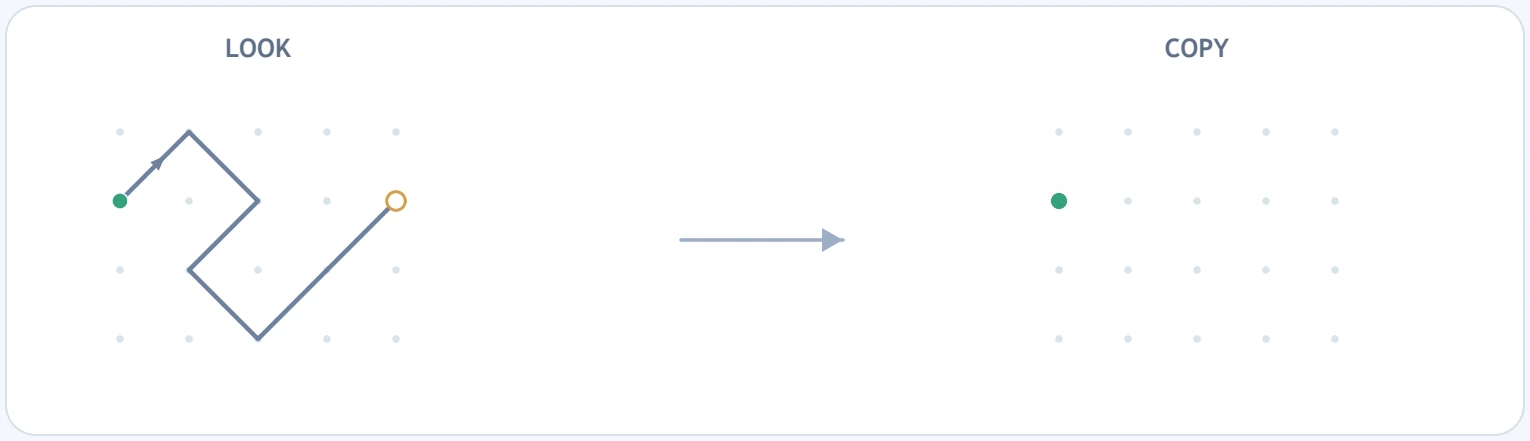
The bottom model contains several diagonal changes that make its order less obvious than a repeated zigzag. Path Copy Thinking invites a child to inspect each corner rather than assume the next movement repeats the last. A small arrow on the model can help show travel direction, while the child still needs to reproduce the route independently.
If a segment seems misplaced, compare its beginning and ending with the model before considering erasure. Path Copy Thinking can show whether the difficulty concerned direction, location or the length of a stretch. Those are different observations, and each may call for a different kind of support on a later attempt.
Six copy-and-compare games beyond the sheet
Pair two finished cord routes
Arrange two identical completed cord paths on separate mats. Invite the child to point to corresponding corners. Path Copy Thinking can follow as a pencil activity, but the tactile comparison is useful on its own. Keep both models visible and let the child choose which corner to discuss first.
Be a route describer
Draw a short finished route on separate paper and describe one stretch together. The child can point while the adult supplies a direction word. Path Copy Thinking offers longer examples when the child wants them. Swap roles so the adult listens to the child's description rather than supplying all the route language.
Match a corner with a gesture
Use an elbow or two craft sticks to show a turning relationship, then find a similar change in a finished drawing. Path Copy Thinking makes corners useful places to pause and compare. The gesture is a discussion prop, not a requirement to force a precise angle with the child's arm.
Set up a model visitor
A toy visitor travels to the model whenever it needs information, then returns to the copy mat. Path Copy Thinking can borrow that story to make looking back feel ordinary. The visitor is never penalised for checking again; the game celebrates finding information rather than keeping it hidden.
Choose a helpful checkpoint
After making a separate route, select one corner as a checkpoint and mark it with a named card. Explain why it would be a useful place to look again. Path Copy Thinking supplies several possible checkpoints without requiring every dot to become a stop. The child can choose the feature they find most memorable.
Host a route correspondence tour
Place a finished model beside a child's willing-to-share copy. The artist guides a visitor through matching beginnings and turns. Path Copy Thinking can end with an explanation of one successful relationship, even if another stretch differs. Let the child decide whether to keep the drawing for a later comparison.
✎ Avoid adding difficulty by hiding information
Covering the model, demanding a continuous stroke, and racing through the turns add rules absent from the copying instruction. Path Copy Thinking already involves coordination between looking and drawing. Begin with the source task before proposing a separate challenge, and make any new game's rule explicit.
Another common difficulty is copying only the overall silhouette while losing a turn. Use the reminder check the next change. Path Copy Thinking lets the child inspect a small relationship at a time. A demonstration belongs on separate paper so it does not replace the independent line in the child's response area.
Support ages four to six through the task itself
Children who enjoy dot patterns and directional pictures may be interested in these routes. Path Copy Thinking can be approached with an adult naming directions, with finger comparison, or with one printed row at a time. It is not a requirement that every child of four should copy all three models independently.
For a child who wants direct guidance first, the robot's square-corner routes offer related movements. The rocket slant-and-reset activity provides another directional comparison. Path Copy Thinking is appropriate when transferring information between model and drawing area becomes an appealing next question.
Return to the feature that made the child curious
Ask which turn was worth checking rather than how many routes were finished. On another visit, the child may choose a different model or explain a previous attempt. Path Copy Thinking can remain available without becoming a requirement to reproduce the same line more neatly every day.
Family ideas can extend beyond worksheets. NAEYC discusses everyday support for young writers; PBS Parents groups literacy material by age four. Path Copy Thinking can sit beside pretend maps, drawn instructions and ordinary pictures made for a real listener.
Print the route models and copy areas together
The free option supplies the original worksheet sample. To use the clean Path Copy Thinking PDF, open the premium download with the account that holds your eligible current membership. The site's access checks release the protected file after authorisation. Save it, open the PDF and inspect all three rows in the print preview.
The clean Path Copy Thinking edition contains no domain, website name, watermark or printed advertising. It keeps the original route examples, dots and response areas. Print with every page edge inside the available margins. The linked twenty-page collection provides the other new concepts through its separate purchase option. Keep the model visible when the child begins the copying task.
Popular Worksheets
Printable resources families and teachers are downloading now.
 Free
 Free
 Free
 Free