
Picture Dot Order: 4 Powerful Join-and-Close Games
Number order is one route through the collection. This join-and-close sheet appears in the $4 premium pack with nineteen other prewriting worksheets. The single combined PDF removes their promotional branding.
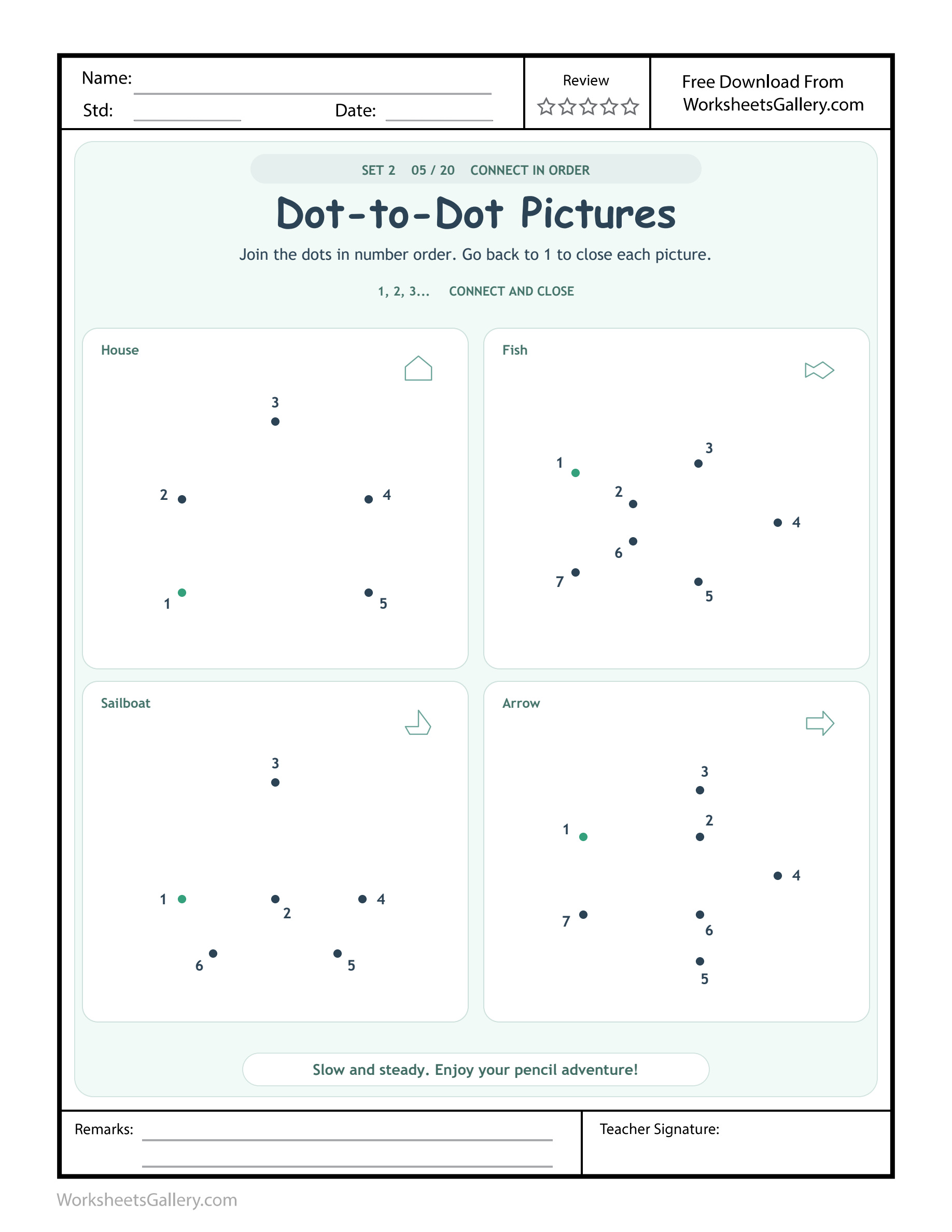
The last number is not quite the end of these pictures. Picture Dot Order asks children to join numbered points and then return to 1, closing the outline they have made. The Dot-to-Dot Pictures sheet offers a house, fish, sailboat and arrow, each with a small finished shape to inspect. Around ages four to six, children can explore how number sequence guides a drawing rather than simply names a set. Picture Dot Order makes the final joining line a useful discovery: a nearly finished picture still has one connection to make.
Picture Dot Order begins with a shape clue
Each panel has a small outline example near its top corner. It gives the child a picture to anticipate without supplying a dotted route between the larger numbered points. Picture Dot Order brings counting and drawing together, but the child still needs to locate the next numeral and decide where the pencil should travel.
Ask which panel looks interesting and inspect its miniature example. The child may predict a house roof or a fish tail before joining anything. Picture Dot Order can begin with that visual guess, followed by a search for the green number 1. Keep the other panel choices available without insisting that all four be completed in one visit.
The Picture Dot Order house has five places
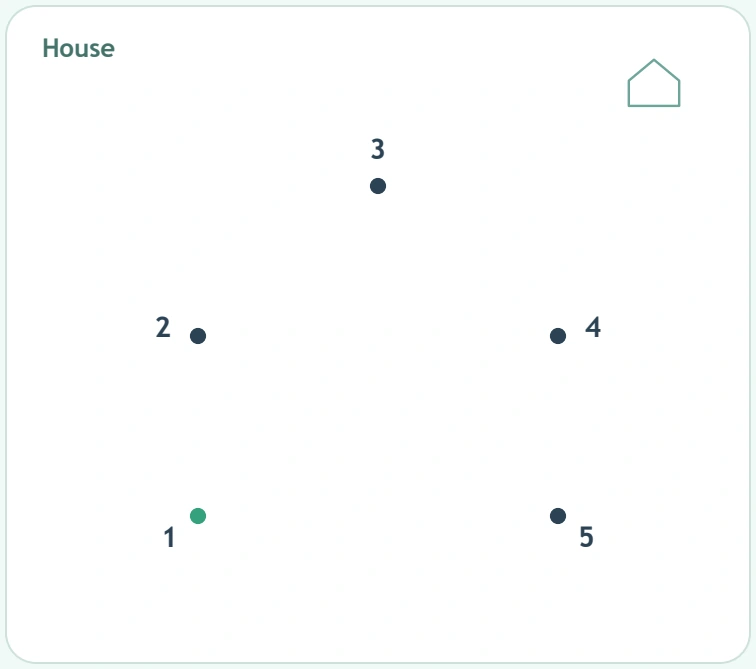
The house uses five numbered points. Starting at 1, children connect 2, 3, 4 and 5, then make the final link back to 1. Picture Dot Order gives the roof its peak through the sequence of points. Joining whichever point is nearest would produce a different outline, even if the pencil travelled smoothly.
Point to each numeral before drawing if the child wants a rehearsal. Picture Dot Order does not require the counting words to arrive faster than the eyes can find the corresponding place. A pause while locating 3 or 4 is useful checking. The route belongs to the number sequence, not to a race around the panel.
Picture Dot Order includes four distinct point sets
| Picture | Numbered points | After the last point |
|---|---|---|
| House | 1 through 5 | Return to 1 to close the house. |
| Fish | 1 through 7 | Make the final connection back to its start. |
| Sailboat | 1 through 6 | Join the sixth point to 1. |
| Arrow | 1 through 7 | Close the outline at the first point. |
Picture Dot Order changes the arrangement as well as the number of points. Read the chosen panel separately, even after another has been completed. The child's eyes need to locate a new sequence in a new layout. Picture Dot Order keeps that looking step important throughout the page.
Elena discovers a Picture Dot Order opening
Elena draws the house with her older brother nearby. At 5 she puts her pencil down and calls it finished. Her brother asks her to compare it with the small example. Picture Dot Order gives them a visible clue: the outline still has an opening between its last point and its first.
They read the instruction about going back to 1. Elena points to the opening and says the house needs its bottom. She makes the final line herself. Picture Dot Order has turned a reminder into a specific observation. Her brother asks who will live there, and she supplies a story before deciding whether to try another panel.
Six Picture Dot Order connections worth noticing
- Numeral locating: Picture Dot Order gives a practical reason to find the next number in a scattered arrangement.
- Ordered action: the child links one point at a time rather than joining all visible dots at once.
- Direction changes: each next point can require a new angle or a shorter movement.
- Visual prediction: Picture Dot Order supplies small shape clues that can be compared with an emerging outline.
- Closure awareness: the final return to 1 makes an opening and a joined boundary easy to discuss.
- Explanatory language: first, next, last and back describe actual decisions made during the drawing.
These experiences can be observed without turning the sheet into a formal number test. When numeral identification is demanding, an adult can name the next one and let the child find it. That keeps locating and drawing available as the child's own actions.
Seven fish points shape the Picture Dot Order search
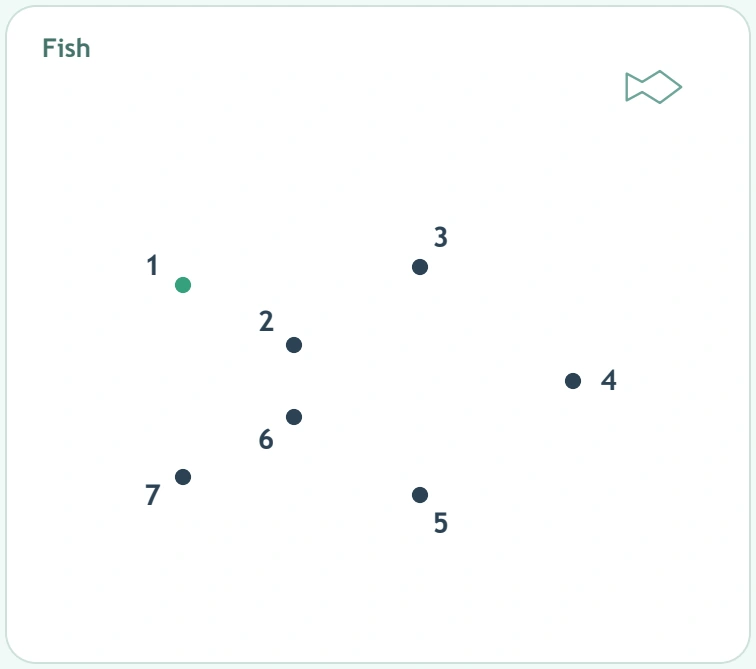
The fish panel contains seven points in a more irregular arrangement than the house. Picture Dot Order asks the child to inspect the numerals instead of guessing a familiar fish outline. A short connection near the tail can matter as much as a longer journey across the body.
Avoid drawing a complete solution in advance. Picture Dot Order provides enough information through its labels and small example. If the child loses their place, ask which numeral they last reached, then locate the next one together. That is more helpful than telling them to restart the whole fish because of one uncertain connection.
Put the next numeral within the child's attention
Begin by choosing a panel, finding 1 and locating 2. Offer the pencil only when the child understands which two points will be connected first. Picture Dot Order can then proceed one link at a time, with the drawing hand resting when a new number needs to be found.
At home, a separate scrap card showing the next numeral may help an adult give a clear cue without covering the worksheet. Picture Dot Order keeps the printed numbers in their original places. Do not add extra dots or renumber the source page, because that changes the very sequence the child is trying to follow.
A classroom mapmaker explains the next stop
A teacher calls each panel a tiny map whose stops have numbers. Children choose their own Picture Dot Order panel and point to the next stop before drawing. A partner can listen to the number sequence, while the child holding the pencil retains responsibility for finding the point on their own copy.
After finishing, ask which link changed the outline most noticeably. Picture Dot Order may prompt an answer about the roof, fish tail or arrow point. A child who prefers pointing can show the feature rather than explain it verbally. Keep the discussion about the selected connection, instead of comparing how many pictures classmates have completed.
The sailboat needs its sixth-to-first return
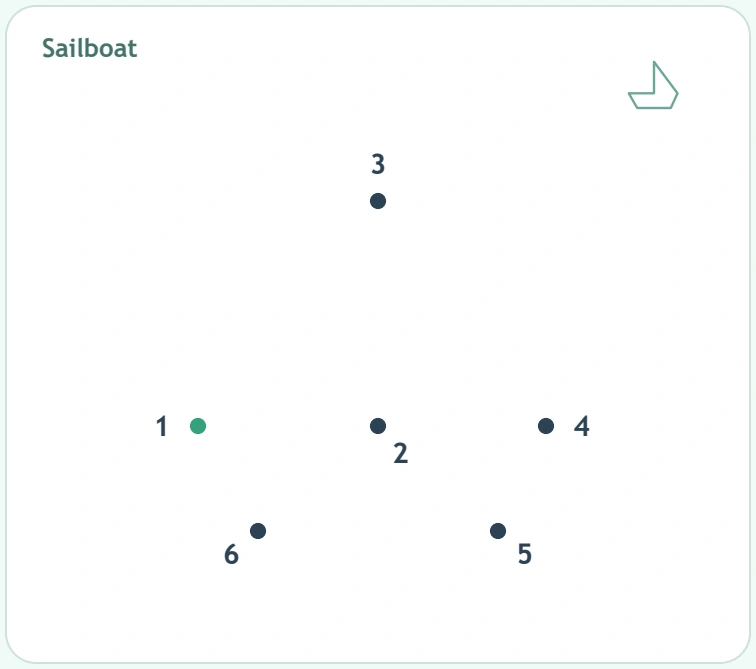
The sailboat uses six numbered locations. Picture Dot Order combines the angled sail and lower boat shape through those points, then closes the route at 1. A child can inspect the miniature example after several links and predict which part will appear next. Leave that prediction open until the next point has been found.
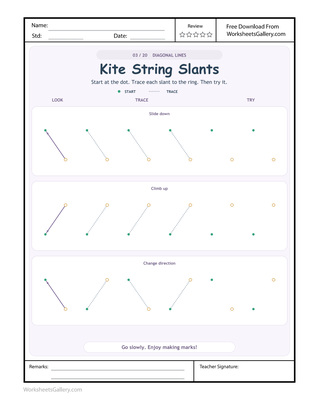
For a different exploration of slants, the kite-string direction sheet offers guided routes. Picture Dot Order adds numeral-based choices and a closing connection. Make that distinction clear when using both resources, so the child knows whether the next movement comes from a guide or a numbered point.
Five games that make order tangible
Make a three-stop closed cord shape
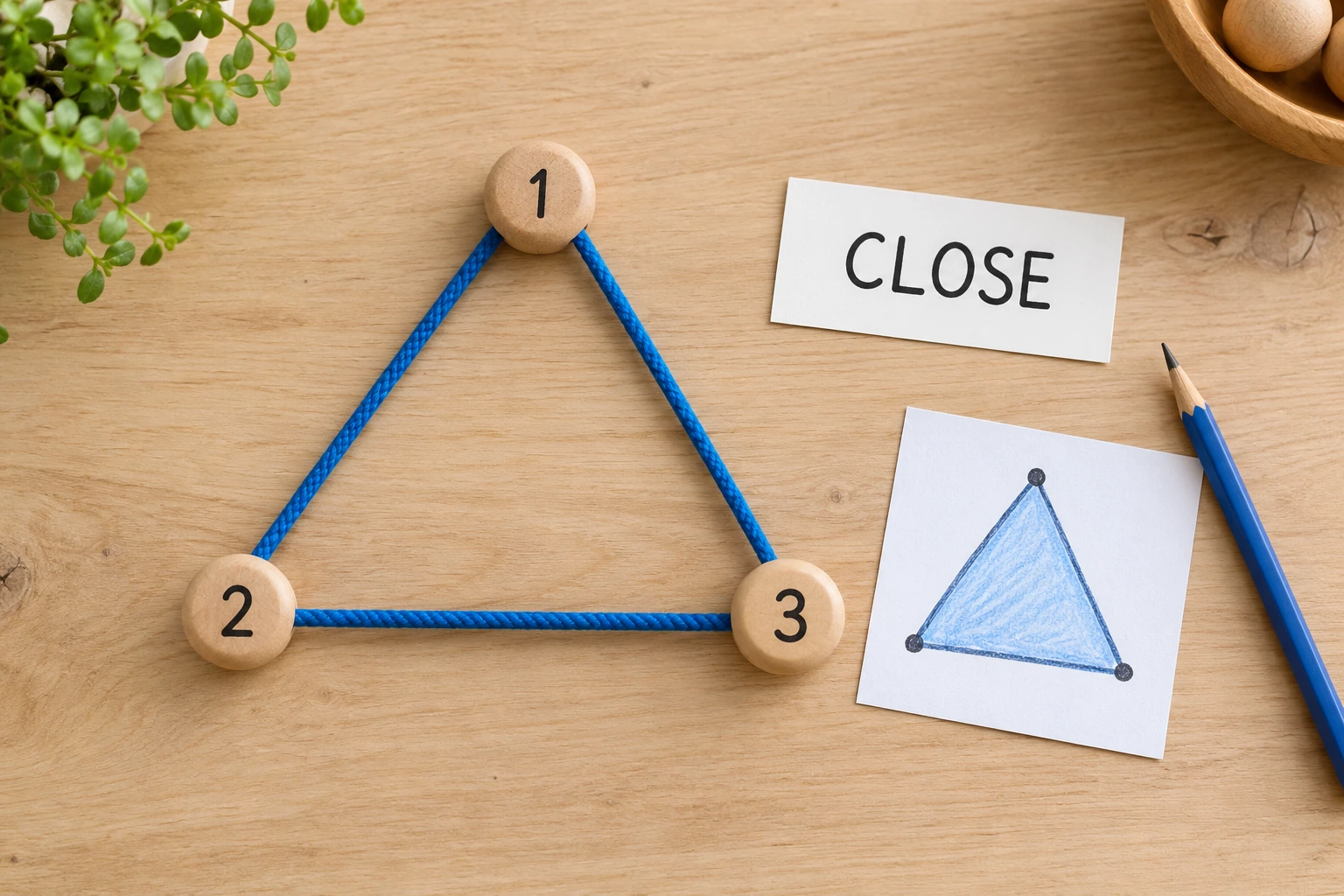
Set out three large labelled cards, 1, 2 and 3, in a triangle and lay a cord between them in order. Return the cord to 1. This is a separate warm-up, not a copy of a Picture Dot Order panel. The smaller number of stops can make the closing idea easy to inspect before using the worksheet's longer sequences.
Be a next-number announcer
One person names a starting numeral and the other announces the next. Use a few large cards on the table so the child can point while speaking. Picture Dot Order can follow when finding numbers on the page is appealing. Swap roles and let the child listen to an adult's careful search rather than always being the person questioned.
Find the open gate
Draw a separate almost-closed shape and ask where its imaginary gate remains open. Add the final line only after the child has pointed. Picture Dot Order uses a similar visible opening when the last-to-first connection is missing. Keep this demonstration away from the actual panel so it clarifies the idea without supplying the child's answer.
Tell a stop-by-stop journey
Give each number card a pretend place, such as a garden or a dock, and tell a short journey in order. Picture Dot Order turns its numbered stops into a particular outline, while the spoken journey can be imaginative. The activity can end with conversation rather than another printed attempt if that is where the child's interest goes.
Curate the finished-outline table
Place completed drawings where a willing visitor can inspect one chosen feature. The child explains which numbered connection created it. Picture Dot Order offers a chance to discuss a mark's purpose instead of asking whether the whole page is neat. Let the child choose the drawing and decide whether to keep it for a later story.
An arrow still follows numbers, not a guessed shortcut
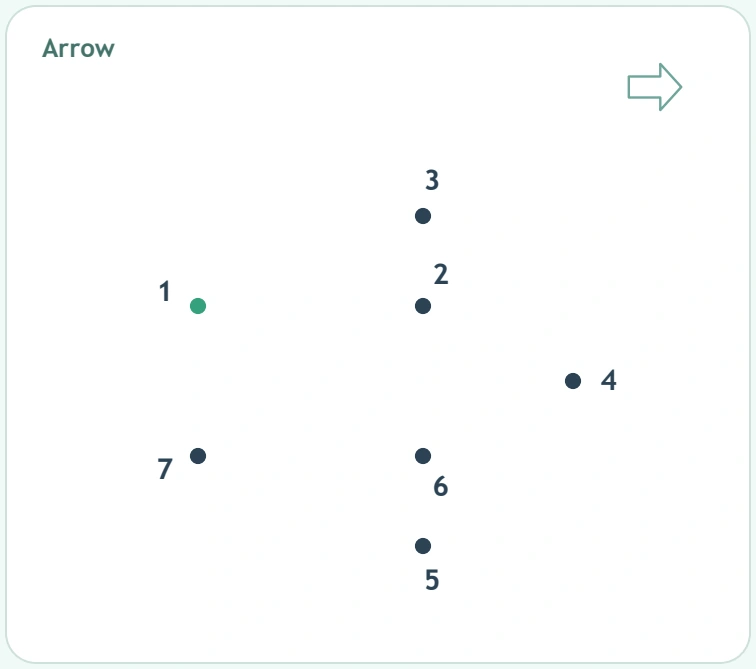
The arrow panel uses seven points, with short changes around its head and stem. Picture Dot Order asks for the labelled sequence even when the intended picture seems obvious. Looking only at the little arrow example can tempt a child to sketch a familiar shape without attending to the numbered layout.
Invite a point-by-point inspection first. Picture Dot Order can include saying the next numeral quietly as the eyes locate it. A separate mountain turning-point activity can support discussion of angled changes, while the arrow panel keeps its own ordered-joining rule.
✎ Slow the count when the eyes need time
Common difficulties include skipping a numeral, joining a nearer point instead of the next one, and stopping at the final number without closing the shape. Picture Dot Order makes each of those choices visible. Ask the child to inspect the last completed link before deciding what support is needed.
The useful phrase is find the next number, then join. Picture Dot Order need not be chanted at a fixed pace. Adults can reduce the spoken sequence to one next numeral, and children can take a looking pause between links. Repeated erasing or an adult-drawn complete answer can obscure what the child has already understood.
Match the invitation to four-to-six-year-old learners
Children who recognise some numerals and enjoy picture puzzles may find the page engaging with light adult support. Picture Dot Order can also be shared by having the adult name each next numeral while the child locates it. If the scattered positions feel too busy, use the five-point house first or enlarge the complete sheet.
The bubble closure activity offers a related discussion of returning toward a starting place without the numbered search. Picture Dot Order brings both ideas together. Select the task according to the child's current interest rather than treating the number of completed panels as evidence of progress.
Return for a new picture, not a faster count
Keep a note of which final connection the child noticed. On another visit, ask whether they want a different outline or a chance to explain the one they remember. Picture Dot Order can be revisited through prediction, pointing or drawing; every return need not repeat the same sequence with a speed goal.
Adults can browse family writing experiences described by NAEYC and PBS Parents material grouped for four-year-old learners for wider family activities. Picture Dot Order is one purposeful mark-making choice among pretend maps, signs and stories that children invent during play.
Save Picture Dot Order with its points intact
Choose the original free sample or request the clean Picture Dot Order premium edition through the membership control. The premium file is released to an account with an eligible active plan after the website checks access. Download the PDF to your device and inspect the entire page before printing, especially the small numerals near each point.
The clean Picture Dot Order version has no website name, domain, printed ads or watermark. Its number labels, small outline examples and four activity areas remain unchanged. Preserve the full border in your print settings. A linked collection card offers the other nineteen concepts in the $4 pack; the closing line still belongs to the child, whichever edition you choose.
Popular Worksheets
Printable resources families and teachers are downloading now.
 Free
 Free
 Free
 Free