
Mirror Half Drawing: 5 Brilliant Across-the-Line Ideas
A reflected half has nineteen companion lessons. The clean collection includes this mirror task within its twenty-page PDF. Choose the $4 package when you want all supplied prewriting concepts in one file.
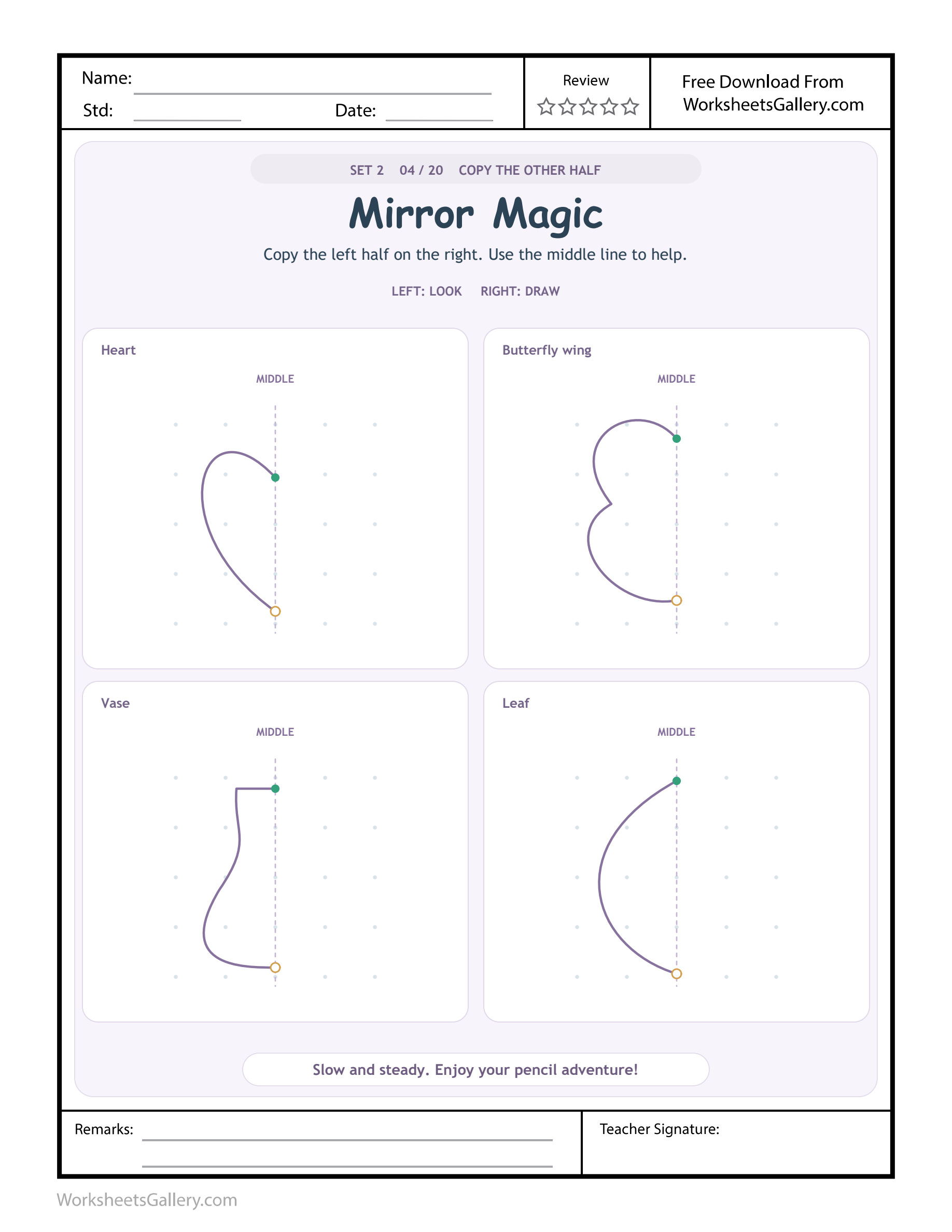
Fold a paper heart in half and its two sides can seem to greet each other across the crease. Mirror Half Drawing brings that comparison onto a printable page with four unfinished shapes. A heart, butterfly wing, vase and leaf each have a supplied left half and space for a corresponding right half. For children around four to six, Mirror Half Drawing offers a careful looking challenge before it becomes a pencil task. The vertical middle line stays visible, helping a child compare how far a curve reaches out and where it returns.
Find the Mirror Half Drawing middle before starting
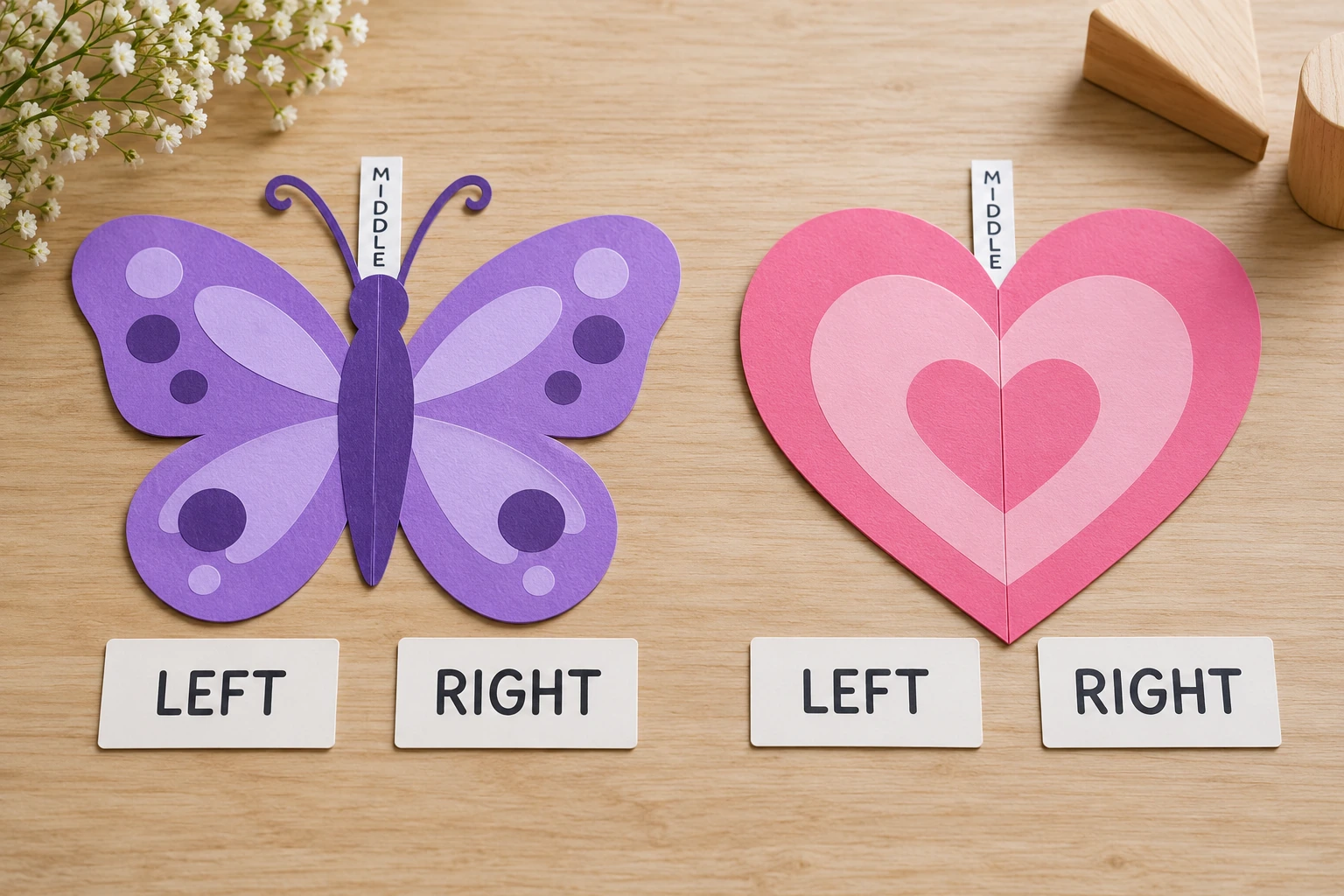
Start by pointing to the vertical guide in one panel. It is labelled MIDDLE and separates the printed left half from the right-hand drawing area. Mirror Half Drawing uses that line as a reference. The right curve needs to face its partner across the middle, rather than repeat the same left-facing curve farther along the page.
Try a paired hand gesture: move one hand outward from an imagined centre and let the other travel outward on its own side. Mirror Half Drawing becomes easier to explain when the child sees two related movements. Keep the explanation practical. There is no need to begin with formal terminology before noticing the printed shape.

Four Mirror Half Drawing partners to examine
| Panel | Comparison to explore |
|---|---|
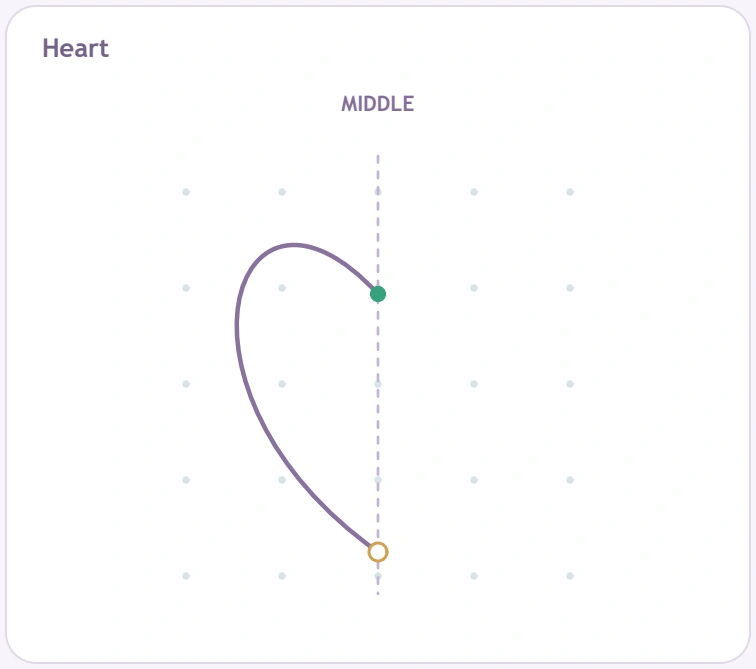
| Heart | A rounded shoulder reaches away from the middle and returns toward the lower point. |
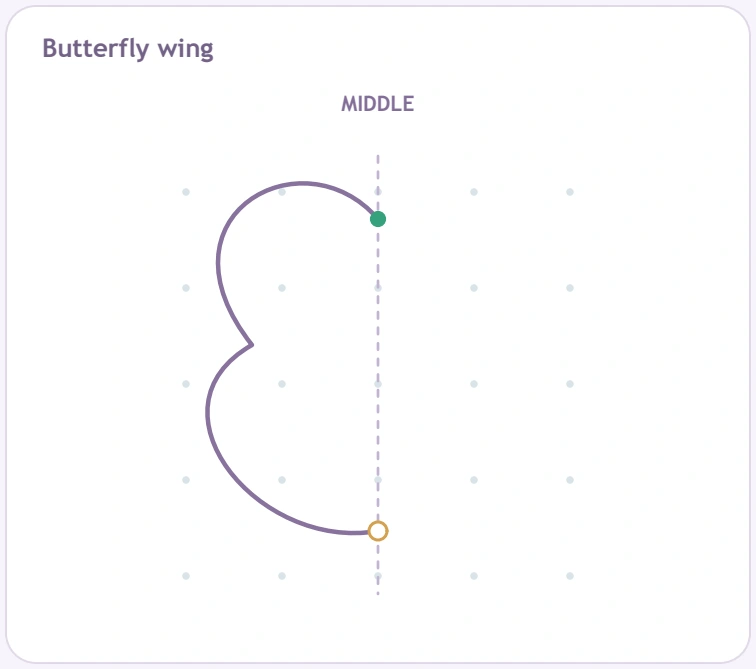
| Butterfly wing | Two bulging parts meet at an inward change. |
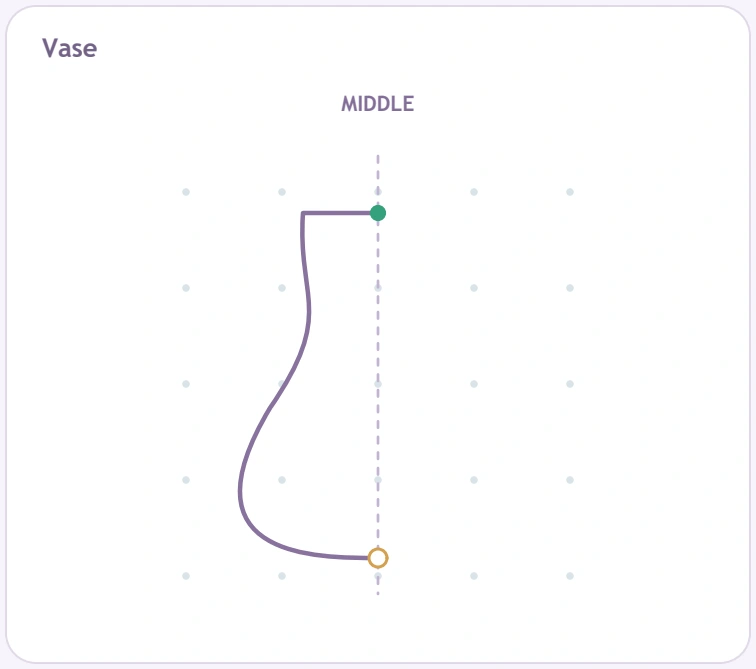
| Vase | A narrow upper section opens into a wider lower body. |
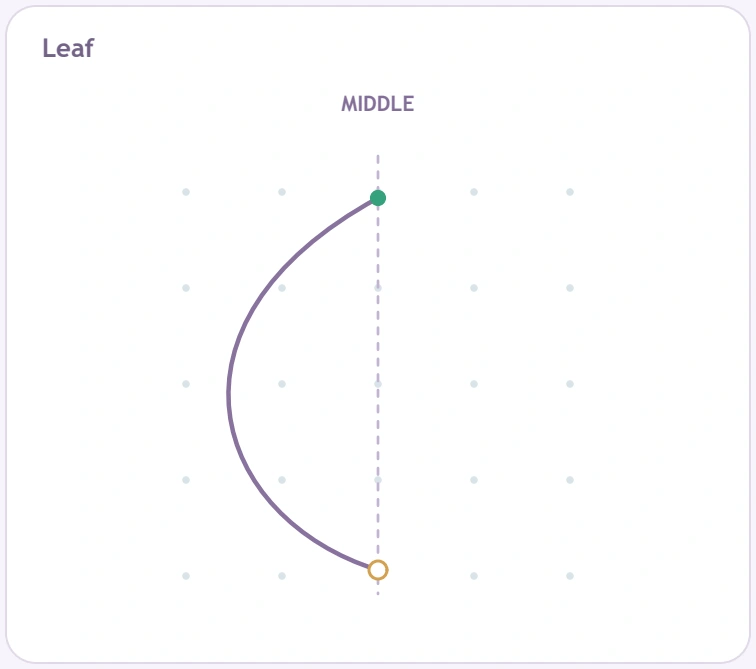
| Leaf | A long curved side connects the two central endpoints. |
Mirror Half Drawing keeps the model beside the response area. A child can look back as often as useful. The dot guides offer positions to compare, without making a complete dotted answer for the right half. Mirror Half Drawing therefore asks for an observed response, not simply another tracing journey.
Kian's Mirror Half Drawing heart
Kian's mother folds a separate finished paper heart and opens it again. Kian notices that the crease stays between the two rounded sides. They put that example beside Mirror Half Drawing and look at the heart panel. His mother asks where the right side might reach its widest place.
Kian points farther out than the printed left curve. They compare the distances from the middle with their fingers, then he chooses a closer point. Mirror Half Drawing has prompted a revision before any mark is made. When he draws, the two sides are not identical, but he can explain which features he tried to make correspond.
Five Mirror Half Drawing observations beyond perfect symmetry
- Locating a reference: Mirror Half Drawing gives the child a fixed middle from which to compare both sides.
- Comparing distance: a curve can be discussed as near to or far from the central guide.
- Noticing changes: the butterfly's inward turn differs from the leaf's long outward curve.
- Coordinating looking and drawing: Mirror Half Drawing invites repeated glances between a model feature and the new mark.
- Explaining a decision: a child can point to the part they wanted to match and describe their own attempt.
A rough but considered partner can show careful comparison. Avoid judging the whole panel by whether it looks precisely balanced to an adult. The useful question is which relationship the child noticed and how that relationship influenced the next line.
Read the wing's inward turn slowly
The butterfly panel has two outward areas with an inward meeting between them. Mirror Half Drawing gives that change a clear visual role. Ask the child to point to the widest upper part, then the narrower middle, before attempting the corresponding side. Those points can be noticed separately rather than described all at once.
A child may smooth the entire wing into one large bulge. Mirror Half Drawing can then prompt a comparison with the supplied half: where does the printed edge move back toward the centre? Use a finger to indicate the location without replacing the child's drawing. An adult can demonstrate a similar change on separate paper if requested.
Make the first attempt small enough to discuss
Choose one panel and keep its full guide area visible. Sit so the child can see both halves without an adult's arm covering the model. Mirror Half Drawing begins with looking across the line, so an obstructed view changes the task. Offer a stable sheet and a pencil whose mark does not hide the pale guide dots.
Locate the green start and lower ring together. Ask the child where the new side should begin and return. Mirror Half Drawing allows short looking pauses between those points. Leave time for the child to inspect the model again, rather than treating a glance away from the pencil as lost concentration.
Mirror Half Drawing at a classroom comparison table
A teacher puts a finished folded-paper shape on a small table and offers the four worksheet panels as choices. Children can explain which half they want to complete before starting. Mirror Half Drawing becomes a shared looking activity while each child retains their own drawing decisions. A partner can point to a reference feature without drawing the answer.
The teacher might record a child's phrase such as “this side goes out here.” That explanation can show what the child understood even when the curve is uneven. Mirror Half Drawing need not end in a display of the most balanced results. A discussion of different attempts can remain specific, respectful and focused on the visible relationships.
The Mirror Half Drawing vase changes width
The vase's supplied side stays relatively narrow near the top and becomes wider below. Mirror Half Drawing asks the child to notice that changing width rather than draw a constant straight side. Compare two heights first: one near the neck and one through the broad body. Ask where each partner edge might sit across the middle.
For a separate exploration of changing curved shapes, the oval orientation sheet offers another comparison. Mirror Half Drawing adds the central reference line, so explain that the two tasks ask different questions. One explores a whole outline; this sheet asks for a partner to a supplied half.
Four mirror games that start with finished examples
Fold, open and describe
Make a complete paper heart and fold it through its centre. Let the child open it and point to corresponding places. Mirror Half Drawing can follow if they want a drawn version. Use the fold to support comparison, without expecting the worksheet to behave like a cut-paper template or asking the child to trim along its guide.
Be the opposite-side storyteller
An adult moves a hand outward on one side of an imaginary middle. The child gives the other side a matching movement while inventing a creature with two wings. Mirror Half Drawing supplies one butterfly example, but the air story can be broader and playful. Swap who leads after a short movement so both people practise watching.
Find partners on a completed shape
Place a finished large leaf drawing on the table with a marked centre. Point to one place on its left edge and ask the child to show the corresponding right place. Mirror Half Drawing then offers a smaller paper comparison. Keep the completed demonstration separate, allowing the child to decide how their own worksheet response will look.
Curate a two-sided gallery
Collect finished paper shapes made during play and give them descriptive names: wide heart, narrow vase or long leaf. Mirror Half Drawing can inspire the vocabulary, while the gallery welcomes variations. Invite a visitor to ask the artist about one corresponding pair of features. The explanation can be spoken, pointed or acted out with hands.
The leaf can be read from endpoint to endpoint
The leaf panel gives a long curve joining points on the middle line. Mirror Half Drawing can begin with a question about its widest place, then return attention to the two endpoints. A child who sees only the widest area may forget to bring the line back. Looking at all three references supplies a more complete plan.
The star-and-contour activity provides a separate context for noticing edges and changes. Mirror Half Drawing makes comparison across a centre its main problem. Choose the related resource when exploring whole contours is more appealing than constructing a matching half.
✎ Common misunderstandings have visible clues
Copying the left shape in the same direction produces a repeated shape, not an opposing half. Starting well away from the middle can leave the two parts disconnected. Mirror Half Drawing lets you discuss either situation by pointing to the printed reference. Ask what the child intended before deciding which cue would help.
Another common difficulty is demanding exact dot-by-dot matching while speaking too quickly. Keep the phrase look across the middle available as a brief reminder. Mirror Half Drawing needs time for comparison. It does not require correcting every wobble or erasing a thoughtful attempt until the paper becomes crowded.
Suitable support for four-to-six-year-old observers
The dot guides and incomplete outlines can interest preschool and early kindergarten children who enjoy comparing pictures. Mirror Half Drawing may be more manageable with one familiar shape and an adult nearby. For a younger child, a folded finished example or paired hand movement can carry the same conversation without a pencil demand.
Enlarging a page can help when the model is hard to inspect. Keep the complete chosen panel and central line intact in the print area. Mirror Half Drawing is a visual comparison invitation, not a measure of a child's artistic talent. Offer a rest when the child loses interest rather than adding a requirement to finish all four partners.
Return to a relationship the child remembers
On another day, ask whether the child remembers the heart's rounded shoulder or the vase's wider body. A specific feature provides a reason to revisit Mirror Half Drawing. Let them choose a different panel, compare an old attempt, or make a new paper shape. Repetition can bring a new observation instead of a demand for identical results.
The shape-building sheet's straight and rounded features can supply a third related drawing context. For family reading, NAEYC offers home writing ideas and PBS Parents provides an age-four literacy collection. Mirror Half Drawing can accompany those ordinary conversations about meaningful marks and pictures.
Download the clean Mirror Half Drawing activity
Select the original sample for the unchanged branded worksheet, or use the premium option for the clean Mirror Half Drawing edition. Premium access requires a suitable current membership on the account requesting the file. Once authorised, download and save the PDF, then open its print preview to check the page border and all four panels.
The premium Mirror Half Drawing file removes the watermark, website name, domain and printed advertising while preserving the actual half shapes and guide dots. Print the complete sheet at a comfortable size for the child. The collection card connects to the twenty-page pack if you want the other concepts in one purchase. A single well-observed partner is enough to begin.
Popular Worksheets
Printable resources families and teachers are downloading now.
 Free
 Free
 Free
 Free