
Obstacle Pencil Weaving: 4 Brilliant Routes Around Pegs
A route around pegs has other skills beside it. Choose the $4 collection to keep this weaving activity with nineteen different worksheets. The purchased download is a combined clean PDF of the supplied set.
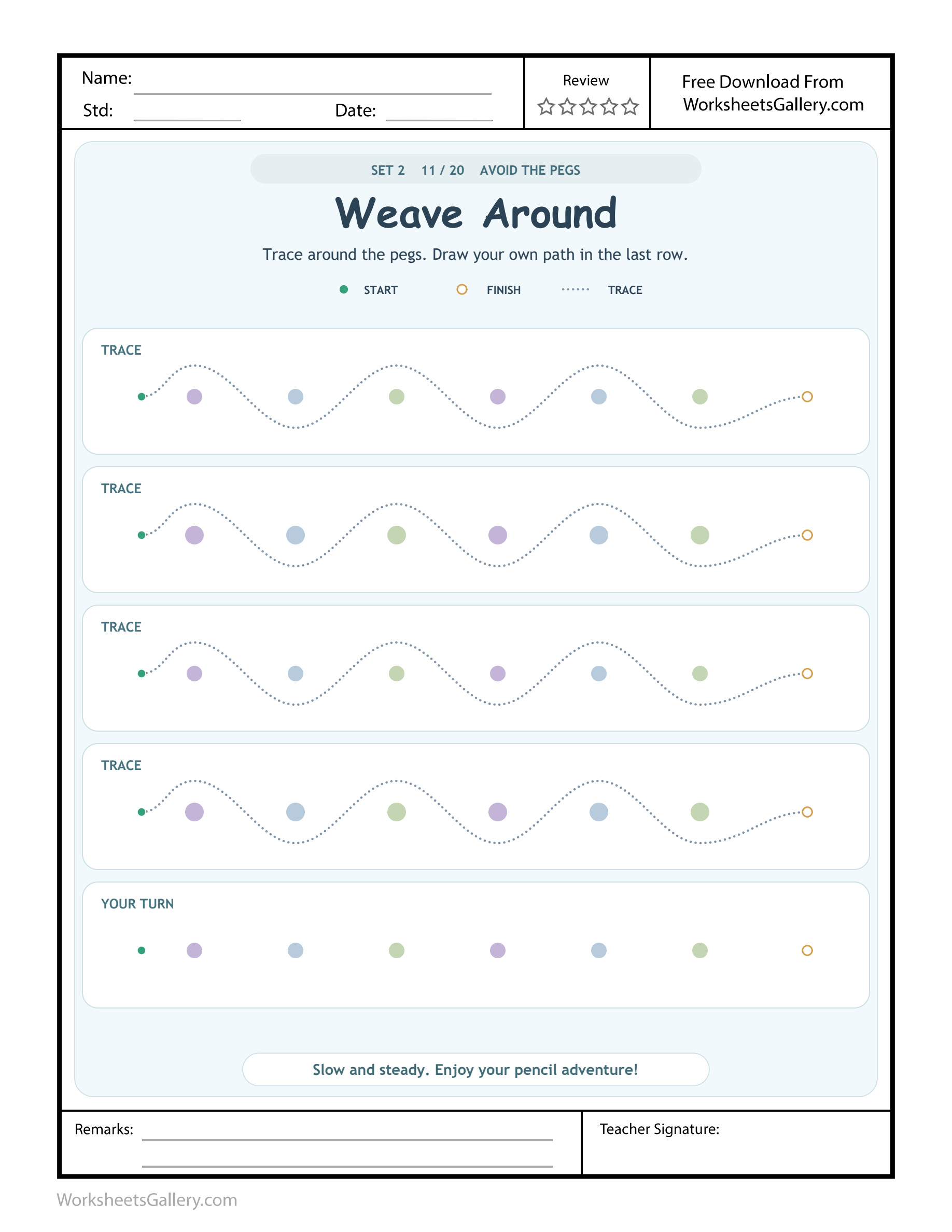
The coloured pegs are things to pass, rather than places to aim for. Obstacle Pencil Weaving invites children around three to six to guide a line around those obstacles while keeping a little space between the route and each peg. The Weave Around worksheet offers four dotted examples, followed by a final row for an independently chosen path. Obstacle Pencil Weaving gives curves a practical purpose: they create clearance. A child can look ahead, change direction and decide how to reach the finish without treating every object on the page as a destination.
Obstacle Pencil Weaving makes room around an object
Look at one coloured peg and the dotted line nearby. The line bends around it instead of passing through its centre. Obstacle Pencil Weaving makes that relationship the main question. The child is tracing a route in the guided rows, while also noticing what the route avoids.
The last row changes the support. It contains a start, pegs and a finish, but no complete dotted answer. Obstacle Pencil Weaving leaves the child to plan a route there. A sensible independent path may differ from the earlier examples, provided it reaches the finish while going around the obstacles.

Five rows with two kinds of invitation
| Part of the sheet | Available information | The child's decision |
|---|---|---|
| First four rows | A dotted route from green dot to gold ring | Follow its bends while noticing peg clearance. |
| Final row | Start, obstacle pegs and finish only | Choose an independent Obstacle Pencil Weaving route. |
Obstacle Pencil Weaving changes from following to planning without removing the obstacles. Keep that difference clear before the last row. The task is not to remember and reproduce the fourth example exactly, and the printed sheet does not require one exclusive route through the independent area.
Theo discovers an early Obstacle Pencil Weaving bend
Theo and his uncle make a toy path around three blocks before looking at the worksheet. Theo moves a cord straight toward the first block, then pulls it sharply aside. They notice how little space remains. Obstacle Pencil Weaving offers a printed comparison: the dotted curve starts changing direction before it reaches the peg.
Theo points to that approaching bend and follows it with a finger. His uncle asks what the line is making room for. Obstacle Pencil Weaving gives Theo a useful answer he can show: the coloured obstacle beside the curve. They try one pencil row, then return to the toy path to make a wider turn.
Six observations to make beside the route
- Obstacle awareness: Obstacle Pencil Weaving distinguishes a peg to avoid from an endpoint to reach.
- Look-ahead planning: a child can notice the next bend before the tool reaches the obstacle.
- Curve control: the hand changes direction while preserving a continuous useful route.
- Clearance comparison: Obstacle Pencil Weaving makes near, around and between visible relationships.
- Independent choice: the final row offers a route-planning response rather than another complete tracing guide.
- Explaining a path: a child can describe which peg prompted a turn and why.
These observations can be valuable even when the pencil line is uneven. Ask what the child was trying to avoid before offering a judgement about the whole row. Their explanation may show a considered plan that the hand is still learning to carry out.
Inspect the next peg before following the next curve
In the guided rows, look at where the dotted route changes direction relative to each peg. Obstacle Pencil Weaving can be rehearsed by pointing just above the paper. A child may notice that a bend creates room before the line reaches the obstacle's position.
The second row offers another curved example to inspect. Obstacle Pencil Weaving does not need to become a demand for rapid repeated waves. Keep attention on the relationship between each curve and its neighbouring peg. A pause to look ahead can help the next movement remain purposeful.

Prepare a home route with visible clearance
Choose one printed row and keep all its pegs in view. Put the sheet where it will not slide, with enough space for the drawing arm. Obstacle Pencil Weaving is easier to discuss when a narrow enough pencil mark leaves both the guide and the coloured obstacles visible.
First find the green dot and gold ring, then inspect a bend between them. Obstacle Pencil Weaving can start with one guided row and a conversation about that bend. Avoid presenting the final independent task immediately as proof that the child has mastered the examples; it is another invitation that can wait.
At school, a route designer explains one choice
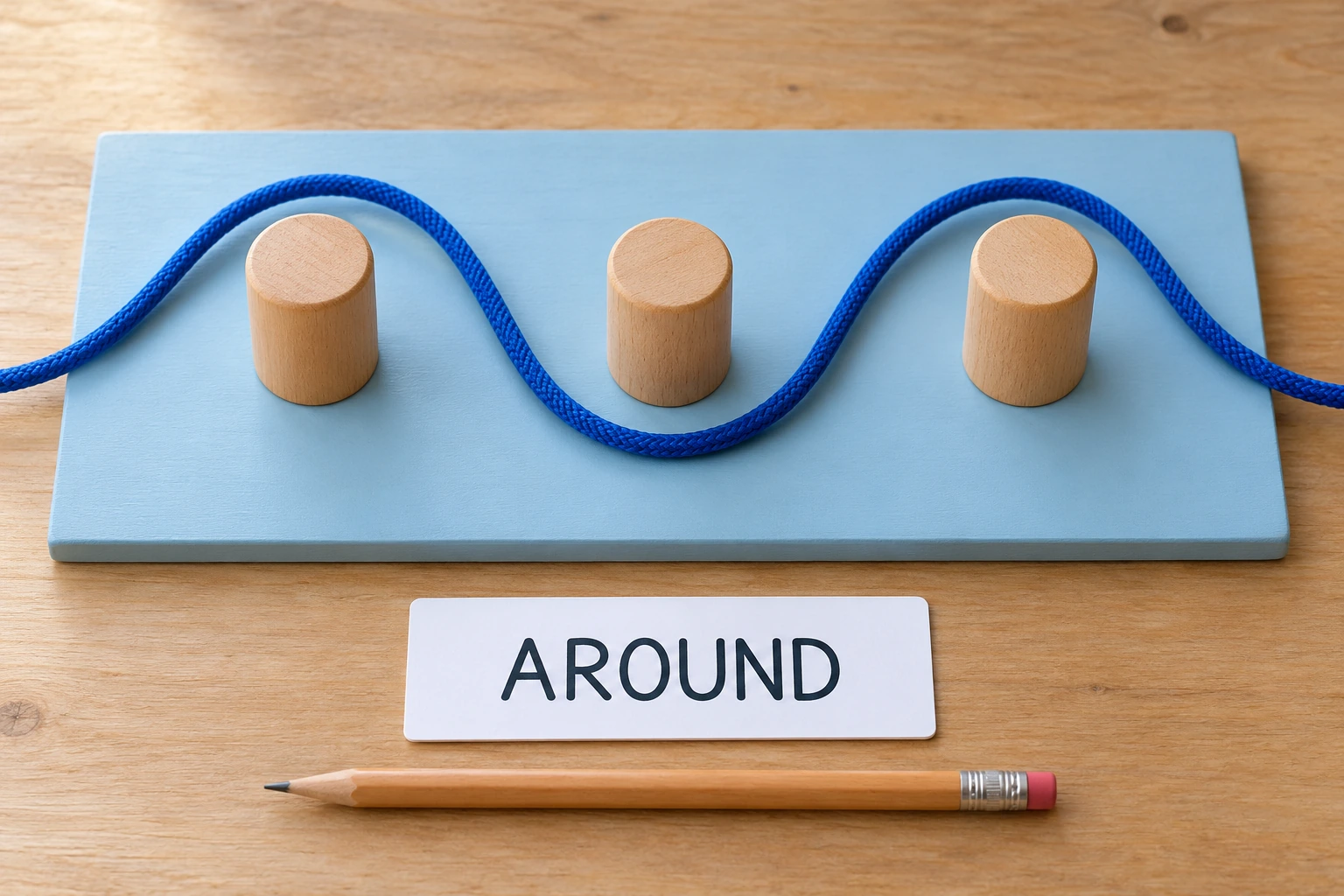
A teacher offers a small writing table with the worksheet and a separate completed cord route around large pegs. Children point to a place where the cord leaves space. Obstacle Pencil Weaving can then become a pencil-sized version of that comparison, with each child choosing an example row on their own copy.
After a turn, ask which obstacle mattered to one particular bend. Obstacle Pencil Weaving allows a pointed answer or a short explanation. Keep the conversation about the chosen route, without turning a classmate's different drawing into a competing standard. In the independent row, more than one sensible plan can be discussed.
The fourth guide can be examined without copying it later
The last supplied tracing route is useful to inspect before the final row, but it is not a required answer key for that row. Obstacle Pencil Weaving offers an example of clearance, not a single mandatory sequence for every independent drawing. Ask the child what they noticed rather than asking them to memorise every bend.
For another discussion of changing curved paths, the ocean-wave worksheet provides a related movement experience. Obstacle Pencil Weaving adds pegs whose locations give those turns a practical reason. The difference can be explained with a simple point to the obstacle beside a curve.

Four games for passing around, not aiming at
Make a cord delivery route
Place three large blocks on a play surface and lay a cord from one labelled endpoint to another without running through them. Obstacle Pencil Weaving can follow when a pencil route is welcome. Let the child change the cord plan and compare the new space around each obstacle before making another decision.
Become a clearance commentator
An adult moves a toy slowly near an obstacle while the child describes where there is room. Swap roles after one journey. Obstacle Pencil Weaving gives printed examples of the same relationship, but the game can remain on the tabletop if moving physical objects is the more appealing activity.
Design two valid journeys
Use a separate large drawing of a few obstacles and make two completed routes that pass around them differently. Discuss why both can be sensible. Obstacle Pencil Weaving offers a final independent row where a child's own plan matters. The demonstration should clarify the freedom to choose, rather than prescribe either example as the required answer.
Tell a peg's passing story
Let a coloured block pretend to be a peg watching a visitor travel around it. The child tells which side the visitor uses and what happens next. Obstacle Pencil Weaving can inspire those location words, while the story gives the obstacle a role beyond being something a pencil must avoid.
Obstacle Pencil Weaving without a dotted answer
Before the final row, locate its start and finish and inspect the peg positions. Ask the child to show a possible route above the paper. Obstacle Pencil Weaving now asks for a decision about where to travel, not merely a movement over supplied dots. Give the child time to change an idea during the rehearsal.
The route does not have to alternate above and below every peg in one prescribed pattern. Obstacle Pencil Weaving permits a different workable journey. The important comparison is whether the line travels around the pegs and reaches its endpoint. An adult should explain those criteria before suggesting that a route needs reconsideration.

✎ Common misunderstandings have different solutions
A child may aim through a peg because they have mistaken it for a target. Another may follow a guide accurately but be unsure how to plan the unmarked row. Obstacle Pencil Weaving reveals two different needs. The first calls for clarifying what is avoided; the second may benefit from a large cord route before drawing.
Use leave room around the peg as a brief reminder. Obstacle Pencil Weaving should not require repeated erasing until every gap looks identical. If a line touches an obstacle, inspect that location and ask what the child intended. Their next plan can use the information without discarding the whole attempt.
Support ages three to six through the available guide
Younger children may prefer pointing along one example or making a broad toy journey. Older preschoolers may be curious about planning the final row. Obstacle Pencil Weaving offers both guided and independent entry points, without requiring every child to complete the same number of paths.
The spiral-shell spacing activity offers another space comparison, while the flower-watering path sheet gives a longer directed journey. Choose Obstacle Pencil Weaving when a child's question concerns the gap between a travelling line and something in its way.
Return to a route decision worth remembering
Remember a bend that prompted the child's explanation. At a later sitting, offer a choice between examining an unused guide and designing another independent journey. Obstacle Pencil Weaving can be revisited through a change of route, rather than a demand to produce a neater repeat at greater speed.
Adults can browse NAEYC's home-writing article for families or the age-four literacy collection offered by PBS Parents. Obstacle Pencil Weaving can sit alongside pretend maps and meaningful route drawings made during ordinary play.
Save the clean Obstacle Pencil Weaving activity
The free sample preserves the original branded page. Choose the premium Obstacle Pencil Weaving download for the clean file, using the account associated with your eligible current membership. After access is confirmed, save the protected PDF and inspect its five complete rows in a viewer before printing.
Obstacle Pencil Weaving's premium edition has no watermark. The site's promotional text, domain and printed advertisements have been removed, while its routes, pegs and instructions remain. Keep every page edge within the print preview. The collection card leads to the separate $4 purchase containing all twenty new-concept sheets. The independent route is still the child's design choice.
Popular Worksheets
Printable resources families and teachers are downloading now.
 Free
 Free
 Free
 Free