
Toy Half Partners: 5 Joyful Whole-Picture Connections
Keep the toy partners with a wider set of puzzles. Select the combined 25-page edition for $5. Its clean sheets include this whole-picture matching task and the remaining supplied activities, ready for choosing by interest rather than a fixed daily sequence.
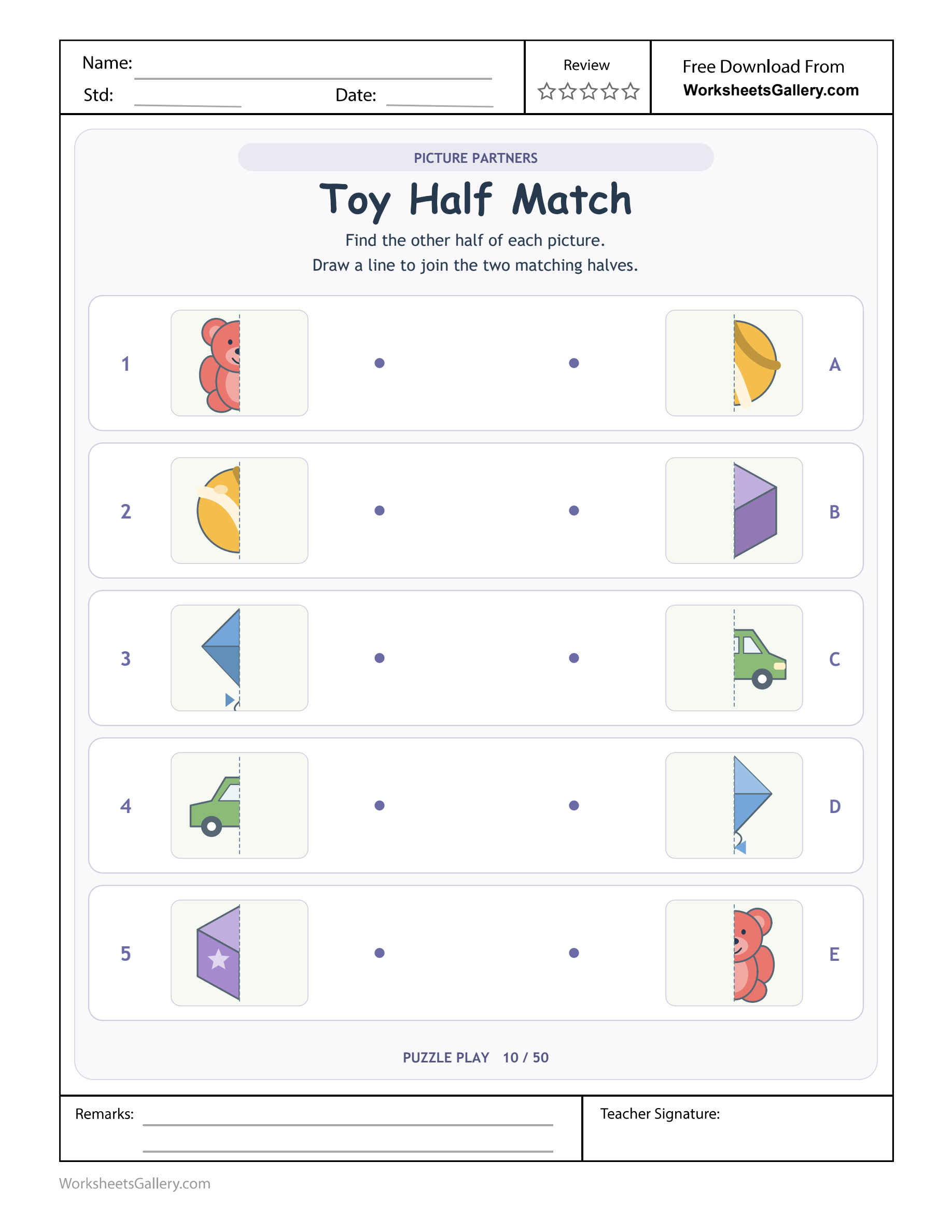
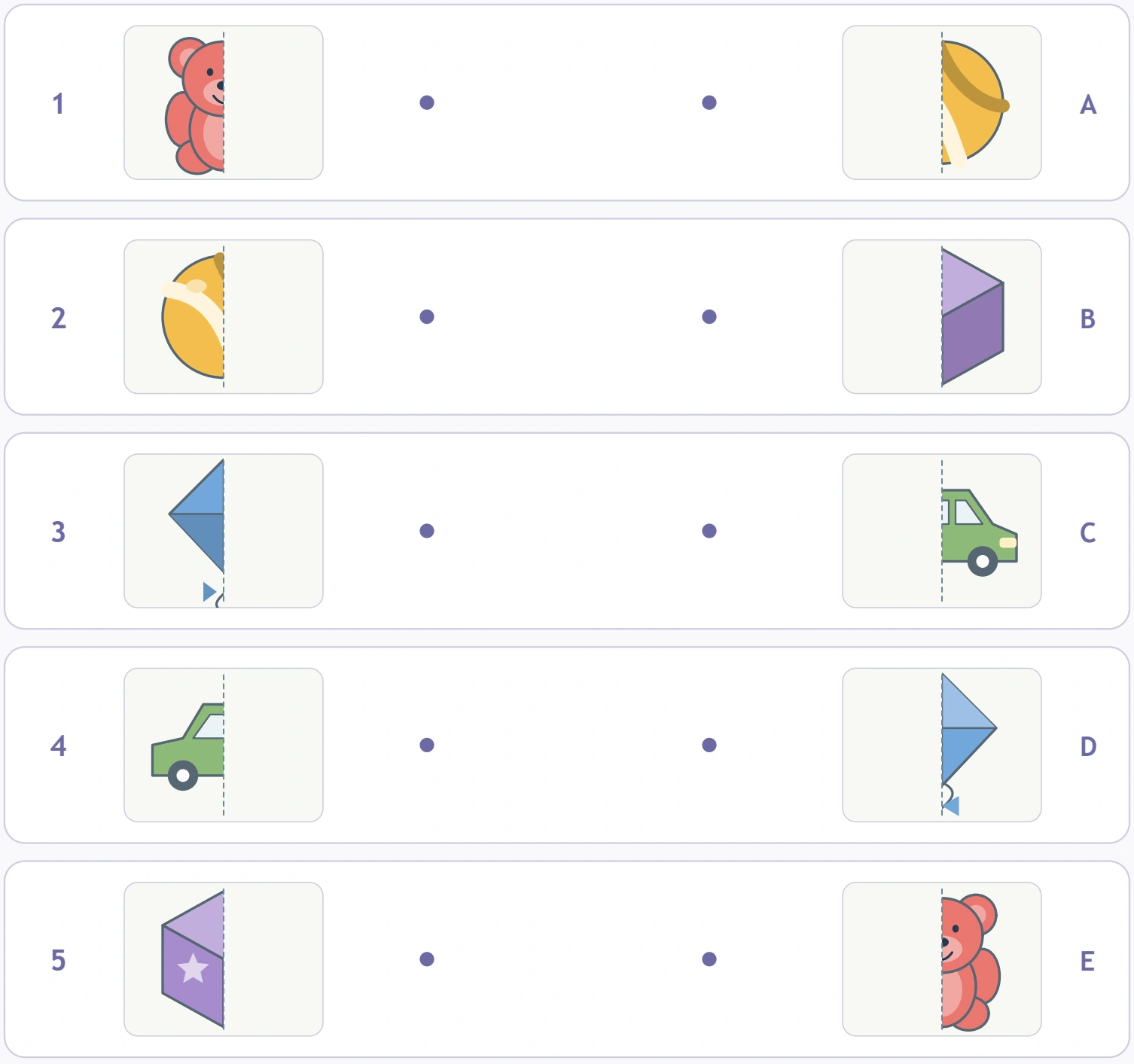
A teddy ear and a car wheel tell different stories about the rest of a picture. Toy Half Partners turns those distinctive details into five whole-toy matches. Children inspect left halves of a teddy, ball, kite, car and block, then search the lettered right sides for the correct partners. The answer may sit above or below the starting row, so direct horizontal joining is unreliable. Let a child describe the identifying part before drawing a line, and check the toy identities at both endpoints afterward.
Toy Half Partners: the rule on this particular sheet
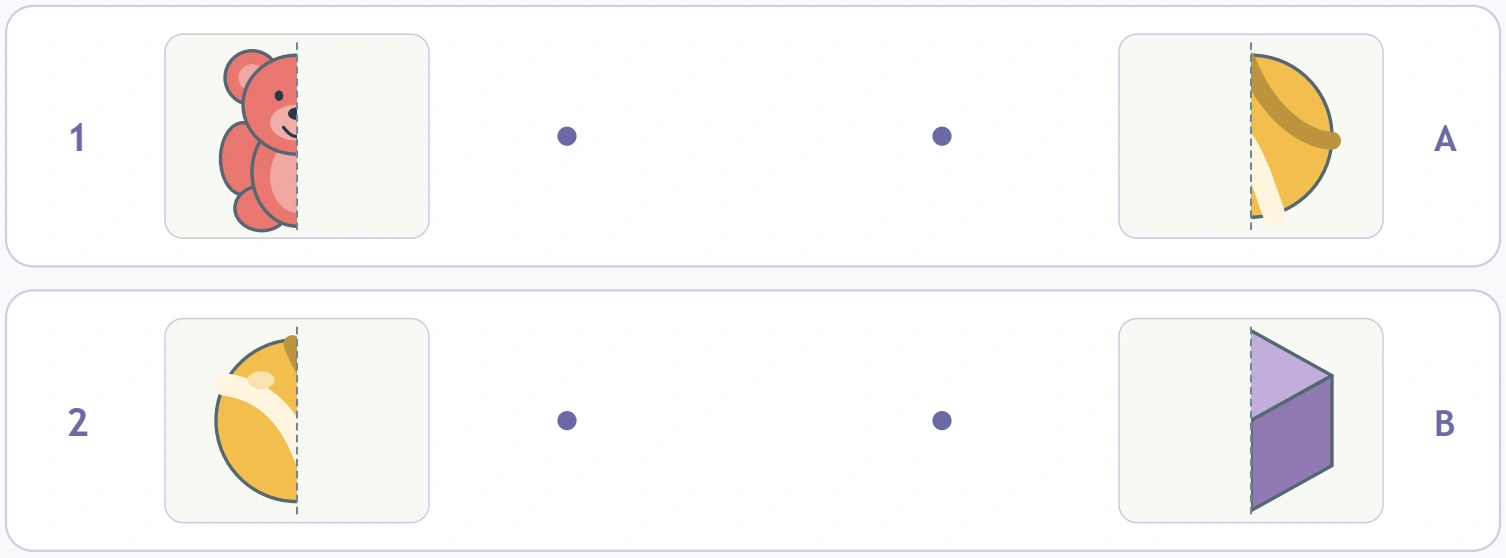
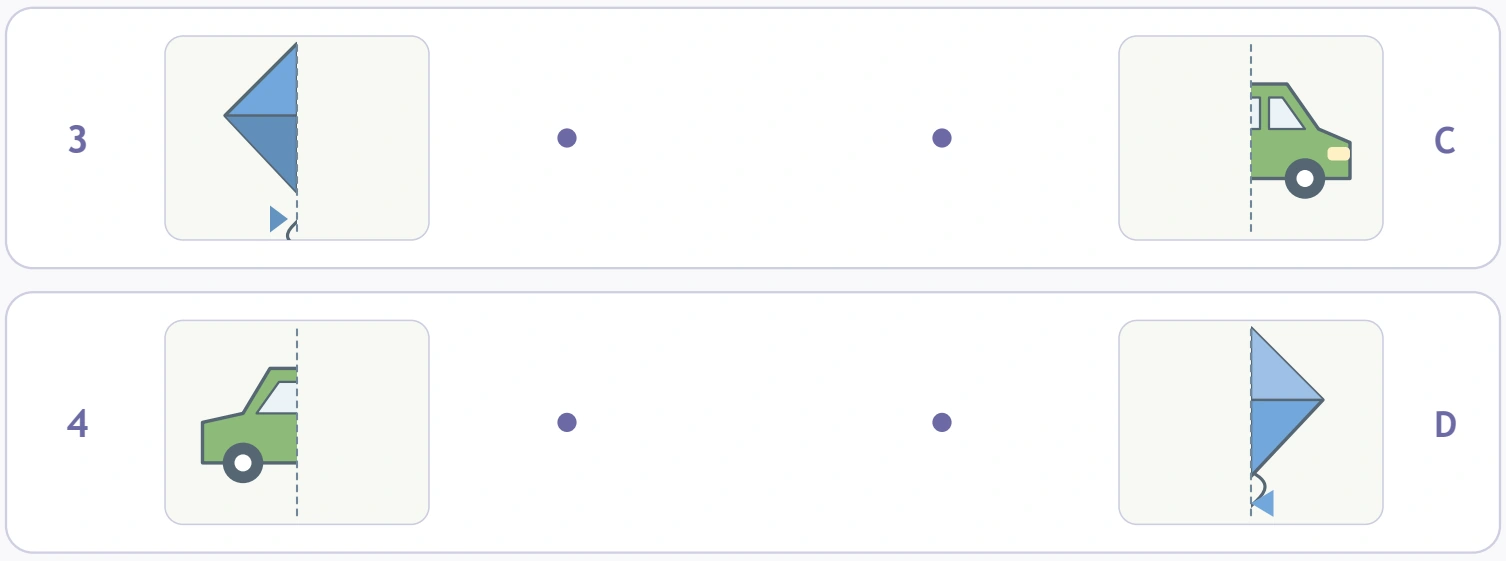
The left column contains halves of a teddy, ball, kite, car and block. Right halves A–E are arranged in a different order. Matching restores the identity of each toy through a connecting line.
Inspect the feature that makes the toy distinctive: a car wheel, a kite corner or a teddy outline. A broad colour resemblance may help locate candidates, but it cannot replace checking the actual object parts.
What car wheel reveals
For an adult check, teddy matches E, ball A, kite D, car C and block B. The printed activity does not require cutting the halves apart or drawing the missing toy portions.
The closest right-side dot may belong to another toy. Search the complete choice column, then return to the selected left half and verify that the two pieces could make the same whole picture.
A defining part can guide the search
The car’s wheel and the kite’s pointed edge provide clues that a generic colour word cannot. Ask which small part most clearly identifies the toy before comparing right halves. The child can then search for a partner that preserves the object, rather than one that merely contains a similar colour. A visible feature gives the match an explanation that another person can inspect.
6 observations in Toy Half Partners
Feature selection: Which detail identifies this toy
Here, one distinctive toy part can guide a search. The prompt “Which detail identifies this toy?” gives Zara a way to explain feature selection to the father.
Identity across halves: Could these halves form the same thing
Here, separate pieces can represent one complete object. The prompt “Could these halves form the same thing?” gives Zara a way to explain identity across halves to the father.
Rejecting colour shortcuts: Do the toy parts agree too
Here, matching hue does not guarantee matching object shape. The prompt “Do the toy parts agree too?” gives Zara a way to explain rejecting colour shortcuts to the father.
Searching beyond neighbours: Where else could the other half be
Here, a partner may occupy a distant lettered row. The prompt “Where else could the other half be?” gives Zara a way to explain searching beyond neighbours to the father.
Repair language: What part was missing from view
In Toy Half Partners, a child explains what makes the toy complete. The prompt “What part was missing from view?” gives Zara a way to explain repair language to the father.
Purposeful connecting: Are both endpoints on the same toy
In Toy Half Partners, a line records a chosen partnership rather than row height. The prompt “Are both endpoints on the same toy?” gives Zara a way to explain purposeful connecting to the father.
A practical Toy Half Partners sequence
Teddy and ball with Zara
Begin Toy Half Partners: teddy and ball. Teddy E and ball A are separate whole-object matches. Ask Zara, “Which detail identifies this toy?” The father and Zara can inspect teddy and ball together.
Kite edge with Zara
Next inspect Toy Half Partners: kite edge. Kite D continues the distinctive pointed shape. Ask Zara, “Could these halves form the same thing?” The father and Zara can inspect kite edge together.
Car wheel with Zara
Then confirm Toy Half Partners: car wheel. Car C supplies the matching vehicle half. Ask Zara, “Do the toy parts agree too?” The father and Zara can inspect car wheel together.
Block shape with Zara
Finally record Toy Half Partners: block shape. Block B completes the final toy pairing. Ask Zara, “Where else could the other half be?” The father and Zara can inspect block shape together.
Toy Half Partners adult reference
| Printed clue | Source check |
|---|---|
| Teddy and ball | Teddy E and ball A are separate whole-object matches. |
| Kite edge | Kite D continues the distinctive pointed shape. |
| Car wheel | Car C supplies the matching vehicle half. |
| Block shape | Block B completes the final toy pairing. |
Repaired pictures need matching identities
Pretend that each left half has arrived at a toy repair desk. For Toy Half Partners, A replacement part must belong to the same toy, even if another piece is attractive or sits closer. Ask the repairer to name the completed object and point to the agreeing outline. The story supports the comparison while avoiding an invented cutting or gluing requirement that is absent from the supplied sheet.
Imagine Zara at a home puzzle table
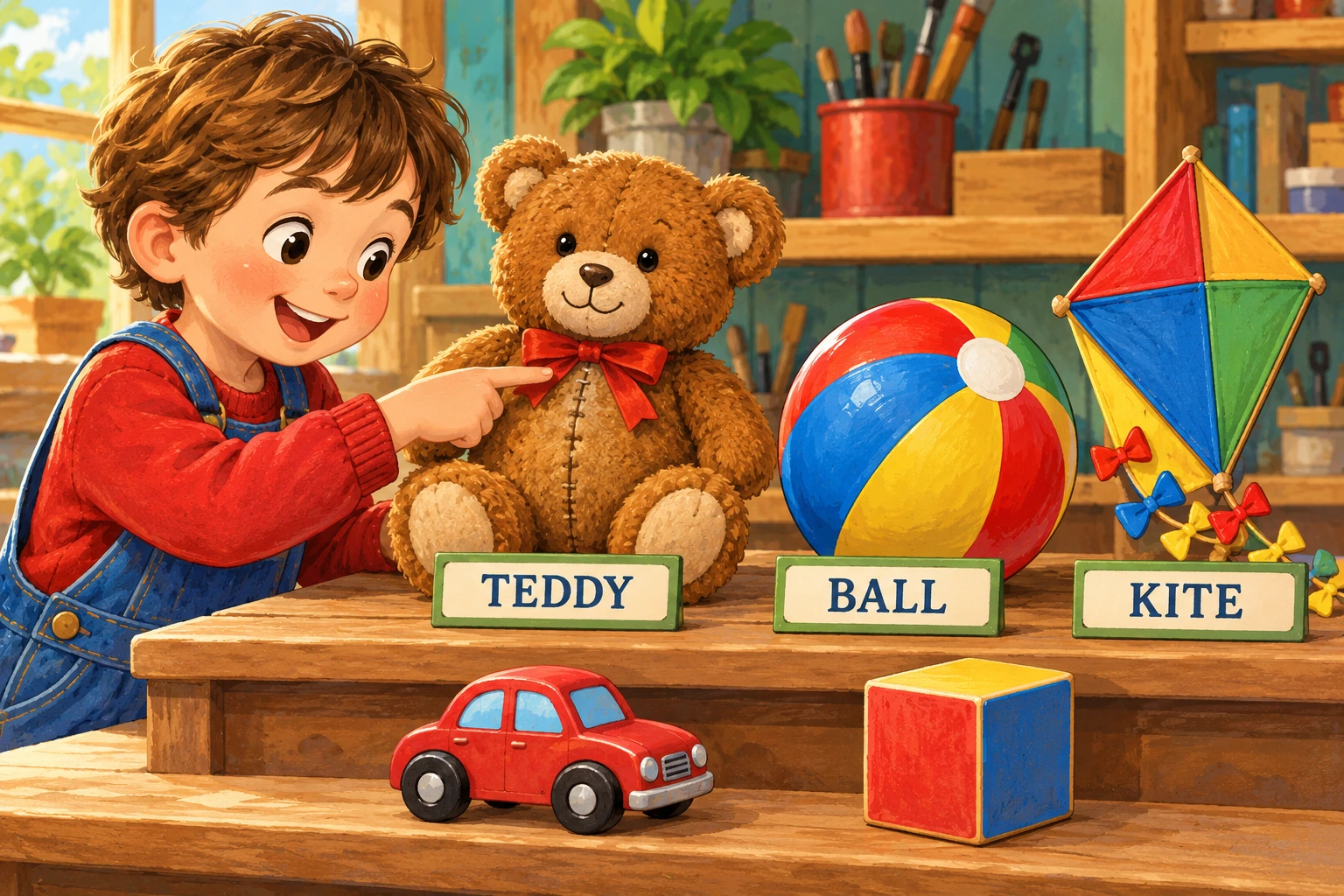
Zara points at a teddy ear and tells her father that the partner needs the rest of the bear, not another brown object. They compare the whole outline before drawing, turning one small feature into a useful identity clue. Here, Toy Half Partners gives Zara a reason to discuss feature selection using the Toy Half Match clues.
Five play invitations after Toy Half Partners
Open a teddy repair desk
Offer a few large split toy pictures and let a child request a missing partner by its defining detail. The repairer explains the complete toy before joining the pieces. After this Toy Half Partners play round, ask the father which clue Zara chose to explain.
Play wheel-or-corner clues
Describe a wheel, pointed kite corner or rounded ball edge without naming the toy. A listener selects a complete toy model and states the clue used. Let Zara demonstrate this example before another Toy Half Partners visit; ask the father to listen for Zara’s reasoning.
Compare two red toys
Place a red car and red ball together. Discuss why their shared colour cannot identify which right half belongs to a car picture. On a later Toy Half Partners visit, ask Zara what changed; the father can discuss Zara’s evidence.
Make a completed toy label
An adult writes TEDDY, BALL or KITE beneath a finished model. Match the complete word-and-picture example to a rejoined toy, keeping spelling support visible. Ask Zara how this example relates to Toy Half Partners; the father can follow the clue that Zara identifies.
Shuffle the repair shelf
Reorder the right halves of handmade toy pictures while leaving the left halves fixed. Find the new partner positions and notice how the identity rule remains unchanged. Keep Zara’s own explanation central in this Toy Half Partners game. Let the father hear what Zara observed.
Treat crossings as geometry, not failure
A connection from the teddy to its distant partner can pass through the area used by another line. That does not automatically invalidate either response. Follow the line from its chosen starting dot to the intended endpoint, then compare the toy halves. An adult can help distinguish an unclear pencil route from an incorrect identity match instead of treating both as the same error.
Toy Half Partners: car wheel mistakes
Children sometimes choose the right colour but the wrong toy, or assume crossing lines mean something has gone wrong. Check the endpoints and defining toy details. The reordered choices make diagonal and crossing connections legitimate possibilities. Invite Zara to discuss car wheel with the father.
Classroom partners inspect kite edge
Partners operate a pretend toy repair desk. One describes a visible half, and the other searches the right-hand choices for the correct replacement. They explain the repaired identity before recording a line, rather than competing to finish the entire sheet first. For a Toy Half Partners partner visit, identity across halves is this toy half partners partnership focus.

Let the child inspect an adult repair
Offer a separate handmade toy pair in which a ball half has been placed beside a teddy half. Ask what prevents the repair from making one complete toy. A child may enjoy correcting an adult’s obvious mismatch and explaining the missing relationship. Return to the printed candidates afterward so that the playful example clarifies the identity rule without giving away every worksheet partner.
Readiness for Toy Half Partners at ages 4–6
Begin with the child’s most familiar toy and accept a pointed partner choice before expecting a long line. An adult can name an unfamiliar block or kite without solving the visual match. Suggested range for Toy Half Partners: ages 4–6. Begin with feature selection and adult support.
For a comfortable Toy Half Partners visit, let Zara show teddy and ball before the father requests another response. Discuss repair language using the printed Toy Half Match example.
A fresh Toy Half Partners reason to return
Ask the child to explain a rejected half on the next visit. Naming the feature that does not belong makes a fresh comparison out of a familiar printed pair. Zara can show the father a new block shape observation during that short toy half partners visit.
Save a printable Toy Half Partners copy
The premium Toy Half Partners file gives eligible active members a printable without website watermark, domain branding or embedded advertisements. Its teddy, ball, kite, car and block halves keep their original positions and instructions. Choose the original sample independently when inspecting the supplied edition. Before printing, confirm that both toy columns fit inside the portrait margins. The separately purchased $5 collection includes the same sheet in its combined set of twenty-five clean activities.
Toy Half Partners: another printable to explore
Extend the feature selection conversation beyond Toy Half Partners with Teddy and ball before a road-width task; Rejecting colour shortcuts and picture-detail tracing; Searching beyond neighbours beside a car-and-flag maze.
Explore Toy Half Partners alongside NAEYC family-writing ideas and Toy Half Partners with PBS Parents literacy activities. Keep teddy and ball, searching beyond neighbours and purposeful connecting connected to the pictured puzzle.
Popular Worksheets
Printable resources families and teachers are downloading now.
 Free
 Free
 Free
 Free