Sorting: 5 Creative Letter Hunts for Happy Preschoolers
Curves, straight paths, and a surprising U open five letter hunts. Explore three existing worksheets through movable cards, clear rules, and room for children to explain.
An oval card lands beside a tall crossing, and a preschooler announces, “These belong together because mine are blue.” That is a sensible sorting idea, even when an adult was looking for curved lines. Letter shapes offer a small, interesting collection for exploring such decisions. These five sorting hunts connect existing Worksheets Gallery pages with movable cards, conversation, and an optional pencil attempt. Parents and teachers can begin with two contrasting capitals, listen to the child's rule, and introduce another feature when the first comparison feels comfortable. A completed alphabet is never the entry requirement.
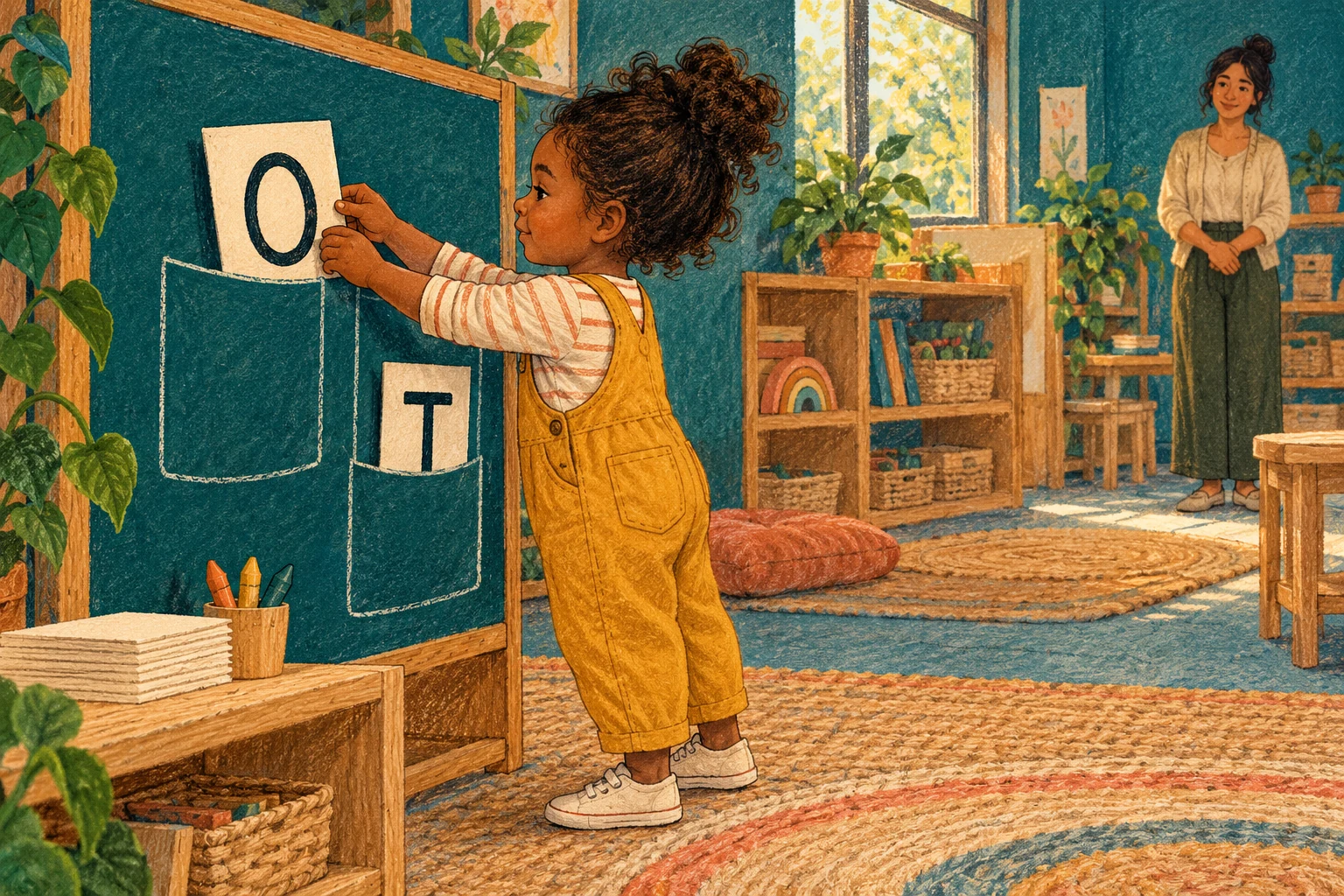
The child stands at a low display while the educator leaves room for an independent decision. The simple O and T cards suggest a sorting invitation.
Give sorting a visible rule before adding more letters
For this sorting collection, an attribute is a feature you can inspect: a straight part, a bend, or a closed loop. Start with uppercase O and T in the supplied models. O travels around a curved loop; T combines straight paths. Later, uppercase U provides straight sides joined by a curved bottom.
During sorting, follow the dotted centre path inside each large tracing model. Rounded outline tips and the thickness of the printed border are not the movement feature being compared. Keep the cards upright and copy the supplied forms consistently. Other typefaces, decorative lettering, and lowercase partners may introduce different features.
Say the current sorting rule aloud. “We are looking at straight and curved paths.” Letter names can join the conversation, but a child can show this comparison through pointing before naming every symbol.
Prepare a small gallery in four moves
- Choose the models. Open the worksheet suggestions below and inspect their previews. Begin with O and T. The pages list ages three to six; select the task by what this particular learner can explore.
- Make movable copies. An adult writes a few large capitals on plain cards, using the source models as references. Keep one letter per card. Leave the original printed worksheet intact for comparison.
- Offer clear destinations. Two trays or large paper spaces are enough for the first sorting turn. Add a drawn curved mark and a straight mark as reminders. Put uncertain cards in a separate waiting space.
- Demonstrate, then pause. Trace the O path with a finger, describe its bend, and choose a destination. Hand over one card. Let the child place it, point, or direct an adult's hand.
A sorting session can finish after a few thoughtful decisions. Keep spare cards nearby rather than covering the whole workspace at once. Invite another turn when the child shows interest.
Five sorting hunts, with a different question each time
Choose one sorting hunt today. They offer different entry points rather than a compulsory sequence or a five-part test. The first three connect directly to existing worksheets; the last two revisit the same cards with a new decision.
① Follow the loop around its whole journey
Use Oo Worksheet: 4 Brilliant Owl Loop Adventures as the curved-path sorting reference. Ask the child to follow the large capital with a finger, then find its partner among your O and T cards. Watch the entire path instead of checking one tiny section.
For sorting, place matching O cards in the curved-path space. Let the child explain with a circular gesture, a home-language word, or “It keeps going round.” If the child wants pencil practice, choose one dotted O from the page afterward. Recognising the path and controlling a small pencil loop are separate demands.
Look closely: the pictured owl gives the worksheet a theme. It does not make this shape hunt a lesson about the short-o sound.
② Find a route that stays straight
Bring in Tt Worksheet: 6 Powerful Tree Marker Label Games. Focus on its capital T, with a straight top bar and an upright. Invite the child to point along both parts before deciding where a new T card belongs.
Keep this sorting question steady: “Which card has only straight paths?” A blue T and a coral T can share a destination because colour is not today's rule. Change the card positions between turns so the learner has to inspect a feature rather than remember the left-hand pile.
The lowercase t on this page has its own lower ending. Leave it for a separate sorting comparison. A small version is not automatically the same path as a shrunken capital.
③ Welcome a visitor that needs a third space
When the first contrast is familiar, show Uu Worksheet: 4 Brilliant Umbrella Bottom Turn Wins. Follow the large uppercase U down its straight side, around its bottom, and up the other side. Ask whether either existing destination describes the whole journey.
This sorting visitor may need a new home labelled “straight and curved.” Demonstrate that third group if helpful. U has a bend, but it does not travel in a closed loop like O. A learner who points to the bottom has noticed something valuable even if the rest of the comparison needs support.
For sorting with two destinations, keep U in the waiting space if adding a third group feels confusing. Returning to two clear examples is a sensible planning decision.
④ Keep the feature when the colour changes
Draw the same uppercase O on two differently coloured cards, then make two matching T cards. Hold the shape models nearby. Before sorting, ask which feature the group agreed to inspect. Could a coral O live beside a blue O?
If the child makes colour families, describe that coherent idea: “You put blue with blue.” Then clarify whether you are adopting their rule or returning to paths. Avoid silently moving the cards. Sorting becomes easier to discuss when everyone knows which decision currently matters.
⑤ Let the curator announce a new rule
For a learner ready for another challenge, collect the cards into one pile and deliberately switch to sorting by card colour. Show a coloured sample beside each destination. The same O and T may now belong together. This makes a rule change visible rather than asking the child to guess what changed.
Return to path features only when the new rule is understood. NAEYC's discussion of playful learning games describes how changing sorting rules can offer opportunities to practise flexible thinking. Here, the adult controls the complexity: one announced change is enough, and staying with the original rule is also a useful choice.

The simple T, O and U cards suggest straight, curved, and combined paths for sorting. These are movable activity props rather than copies of the linked worksheets.
Six useful things to notice during sorting
- Looking beyond colour. A learner may compare the same path across differently coloured cards. That gives the adult a concrete example of attention to the agreed feature.
- Holding a rule in mind. Choosing another card for the same destination offers practice with a shared sorting instruction. Keep a sample visible when memory needs support.
- Describing a feature. Words such as straight, curved, side, and closed can accompany gestures. A child's pointing can be a useful explanation before a full sentence arrives.
- Comparing whole forms. U and O both bend, yet only O closes. Sorting invites a second look at the whole route rather than relying on a single resemblance.
- Revising with evidence. Moving a card after tracing its path shows a decision changing for a reason. Celebrate the inspection rather than the speed of correction.
- Connecting objects with print. In sorting, movable cards lead back to a stable worksheet model. The source remains available while children choose a broad gesture or a smaller tracing attempt.
Two sorting conversations adults might recognise
At home: a place for a puzzling U
Imagine Noor sorting cards on a hallway mat with her uncle. She places U beside O because both bend. Her uncle asks her to trace each complete journey. Noor stops at U's open top, then circles O without lifting her finger.
They make a third sorting space together. Noor dictates “straight sides, bend below” while her uncle writes the label. They leave the pencil worksheet until another day; the new explanation is enough to keep.
In class: different colours, shared evidence
In another imagined scene, three children organise a miniature letter exhibition. One chooses a card, one traces its feature, and one places it. A green T attracts a child who had been collecting green cards.
The educator points to the current sorting reminder and asks which path to check. The group compares two T cards of different colours. Then they swap jobs. The teacher records the cue that helped instead of ranking the children by how many cards they placed.
Adjust the demand you can actually see
Sorting is easier to interpret when the adult changes one demand at a time. A smaller collection, clearer model, or different response method may reveal understanding that a crowded page hides.
| What you notice | Change one thing | Watch for |
|---|---|---|
| A learner scans without choosing. | Offer just O and T with matching sample cards. | A point, placement, or directed choice. |
| Colour keeps replacing the path rule. | Use plain cards in one colour first. | A comparison of visible paths. |
| Three groups become overwhelming. | Set U aside and return to two destinations. | A steadier sorting rule across turns. |
| The child explains but avoids writing. | Keep the finger route and optional adult scribing. | Understanding without a pencil demand. |
Four ways the same idea can travel beyond cards
🔎 A sorting walk through a drawing
Look at a child's own picture for straight marks and bends. Circle a chosen example together on a separate sheet. Keep the discussion about marks, since a drawing's tree or face does not need to fit a single letter category.
🎭 A puppet who needs a reason
Let a puppet ask where its O belongs. The child can guide it with a gesture. During sorting, have the puppet request evidence once, then follow the explanation without demanding repeated performances.
🖼 A tiny exhibition label
Invite the child to choose a group and dictate its label. An adult records the words. Display the chosen examples beside the worksheet reference so a visitor can understand the sorting decision.
📮 A message for tomorrow's group
Save two cards and a reminder of the current rule in an envelope. On another day, invite a fresh explanation before adding anything new. Sorting can resume from a remembered decision without repeating every worksheet row.
Leave room for an idea to change
A surprising sorting placement deserves a question before a correction. In its February 2026 article, Erikson Institute discusses mistakes as opportunities to understand children's thinking. For this sorting collection, that means asking what feature the learner noticed, then checking it together.
“You followed the whole bend before choosing” gives a child something specific to recognise. Stop when attention fades, keep an interesting card for later, and let the learner decide whether to try one printed model. One explained choice can make a satisfying finish.
When selecting the linked worksheets, check each preview and access option. They currently offer a watermarked free PDF sample and a clean file requiring active membership. Choose the edition that suits your session, then print only what you plan to use.