Pairing: 5 Essential Games for Joyful Preschool Play
A spoon for each cup and a bookmark for each book make quantity relationships visible. Five everyday games connect practical play with three number pages.
A spoon waits beside one cup; another cup has nothing beside it yet. Before a child writes a numeral, that small arrangement already offers a mathematical problem. Pairing gives preschool learners a practical way to connect one object with one other object, check who or what has been included, and notice leftovers. This guide offers five everyday games for children aged roughly three to six, with flexible starting amounts and three existing number worksheets. Adults can follow the child's actions, introduce a little useful language and connect hands-on play with pictures without rushing into a full page of writing.
🥄 Pairing begins with one for each
The objects do not have to look alike. A spoon and a cup make a useful partnership because the invitation is to give each cup one spoon. A crayon can belong beside a sheet; a bookmark can belong beside a book. The relationship comes from the task, rather than identical colour, shape or size.
Start with a small visible collection. Put one partner beside each item, then inspect the arrangement. Has anything been missed? Does one item have two partners? Pairing makes those questions concrete. If both collections have been used with exactly one partner each, you have a way to discuss the same amount without relying only on how far a row stretches.
Knowing that two collections correspond is more than placing objects neatly. Erikson Institute explains how one-to-one correspondence develops and why children may still need support connecting those relationships with quantity. Keep asking what the arrangement shows. Do not assume that a tidy result proves every number idea is understood.
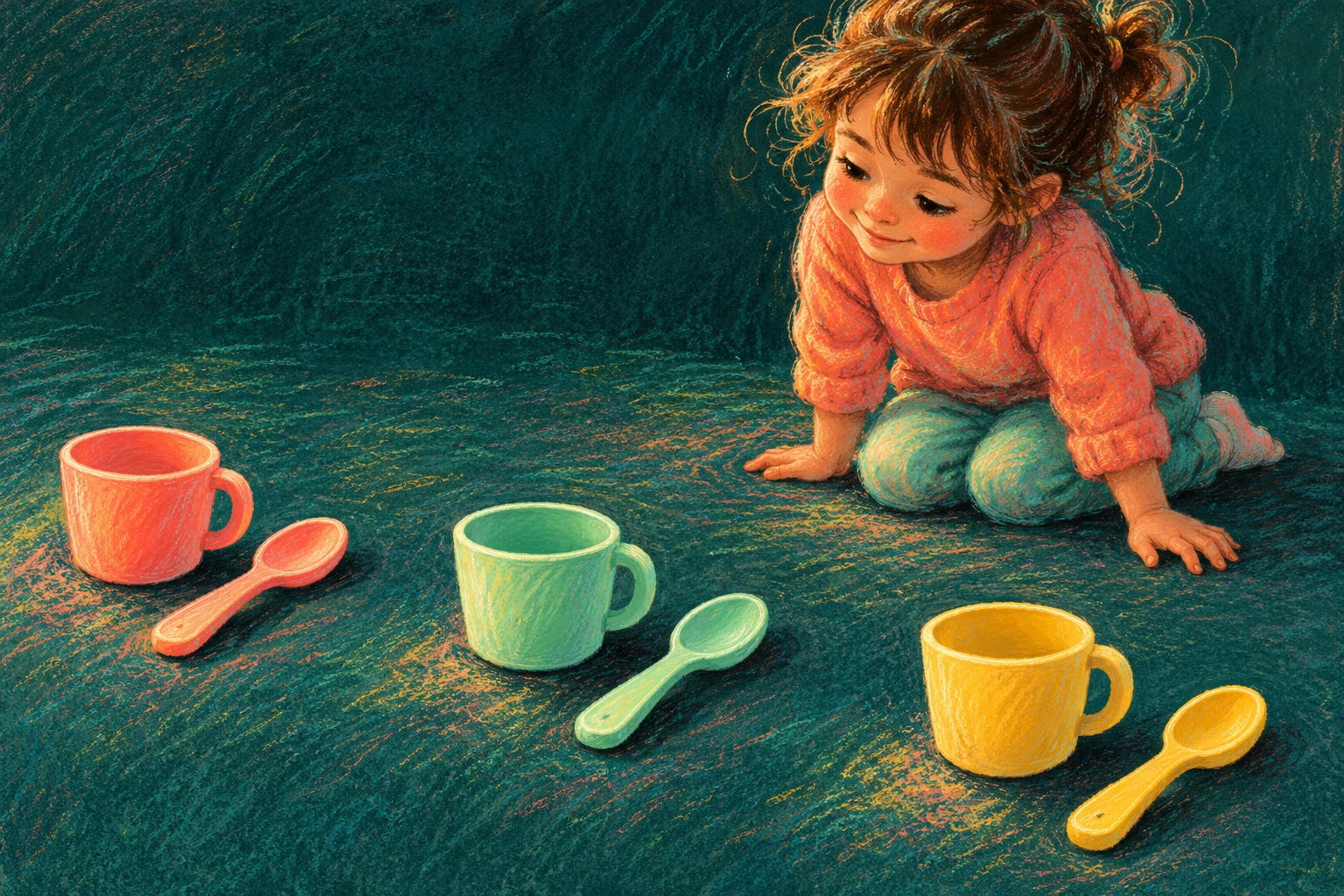
Three separated cup-and-spoon partners make the one-for-each relationship easy to inspect.
Game 1 · Cup-and-spoon pairing
Set out two or three empty play cups and place the spoons in a small group nearby. Invite the child to give each cup one spoon. Keep the cups separated enough that the intended partners are visible. A crowded pile makes it harder to see whether one cup has received a second spoon.
When pairing is complete, ask the child to show you how they checked it. Pointing along the partners is enough for a beginning explanation. If there is a spare spoon, leave it visible and discuss it: every cup has one, and this spoon has no cup. That observation can come before knowing the precise total.
For another round, change only one feature. Remove a spoon, add a cup or spread the same cups farther apart. Let the child discover what changed rather than announcing the answer immediately. Pairing stays manageable when the mathematical relationship is clear and the pretend tea party does not introduce several new rules at once.
Game 2 · Paper-and-crayon pairing
Lay out a few large paper squares, then offer a collection of thick crayons. Each paper receives one crayon beside its edge. The crayons can be different colours; a child does not need to make identical sets to establish one-for-each correspondence. Choose materials that are easy to handle and see.
After pairing, invite a small mark on each paper with its assigned crayon. This gives the arrangement a practical purpose and helps distinguish a paper already visited from one still waiting. A child can move the crayon to the other side after the mark, creating a visible record of the action.
If the learner gives one paper two crayons, look together for a paper without any. Model moving one crayon to that place and invite a fresh check. Avoid erasing the whole attempt or asking for a faster performance. The interesting work is coordinating one item with one destination.
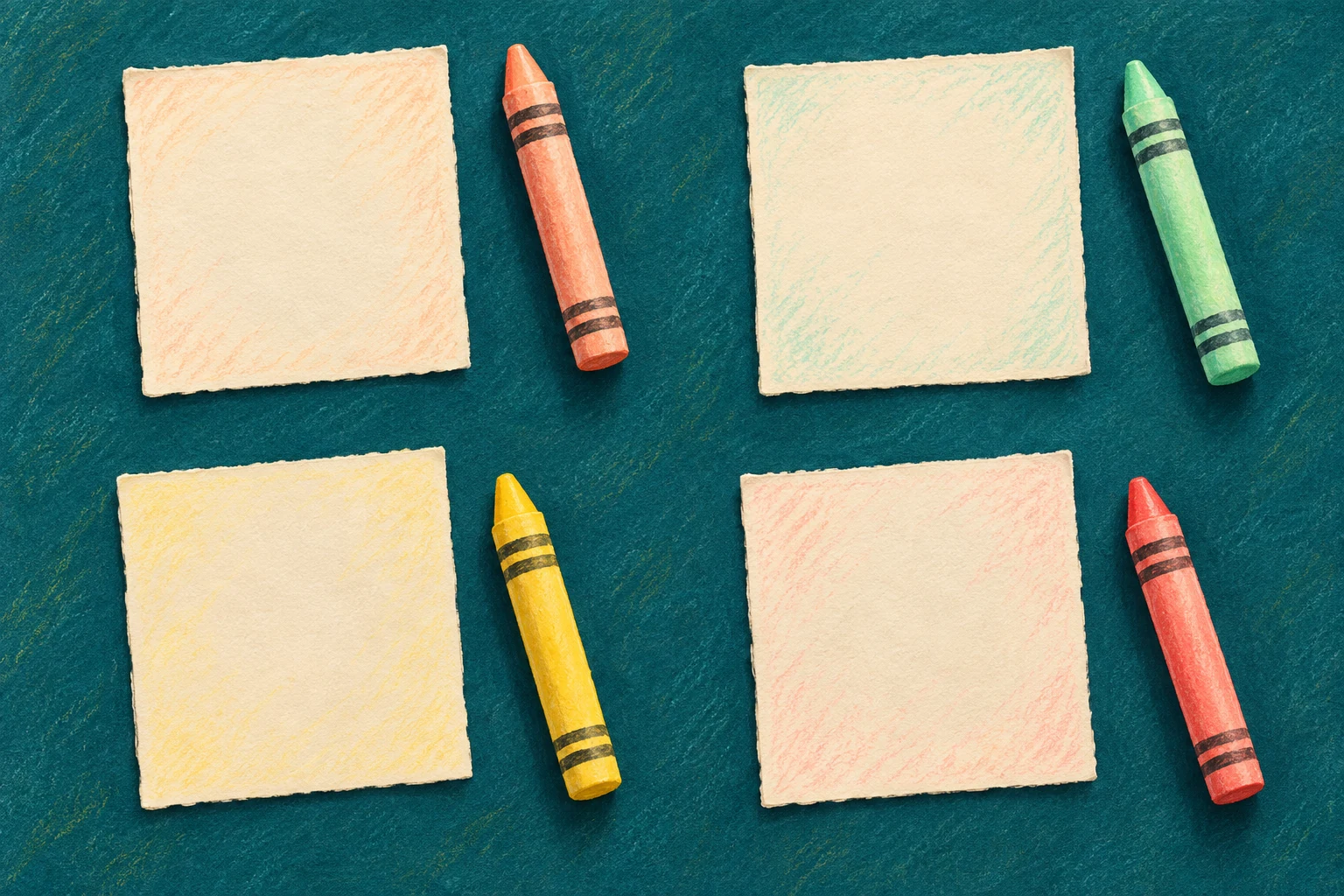
Each paper has a single crayon beside its edge. The objects illustrate separate activity props rather than a supplied worksheet.
Game 3 · Book-and-bookmark pairing
Gather a small number of familiar books and broad paper strips. Before using the strips as bookmarks, place one beside each closed book. Leave the covers visible and keep the partners separated. A large book and a small book still each receive one strip under this rule.
Ask whether pairing changes when the books are rearranged into a curve. The child can move each existing partner with its book, then inspect for gaps. Changing the layout while preserving the relationships gives a reason to talk about what moved and what stayed the same.
This game also creates a natural home routine. After shared reading, return one strip to each book that needs its place saved. Explain that the strip has a job in that particular book. Keep the quantity investigation separate from expecting preschoolers to read the titles or identify page numbers independently.

The three book-and-strip relationships remain visible without matching the covers by colour or size.
Game 4 · Picture-and-prop pairing
Pictures can become destinations for real objects. Select one clear picture group on a number worksheet and prepare a few large paper tabs. Place a tab just beside each whole picture without hiding its details. Do not place partners on separate parts of one object; a boat's sail and hull belong to the same boat here.
This pairing invitation connects a movable action with a printed arrangement. Once each picture has a partner, move the tabs into a row and compare them with the original group. Ask what each tab stood for. A child who cannot yet explain verbally can point back and forth between a tab and its picture.
The tabs are separate adult-prepared props. They are not supplied as a cut-out activity in the linked PDFs. Keep the original worksheet intact and let the child explore a selected group. There is no requirement to finish its tracing or colouring panels before trying this hands-on connection.
Game 5 · Pairing one touch with one spoken number
When a child is ready to count a small group, show how a number word can accompany one touch. Slow the action enough that your pointing and speech stay together. Pairing now links an object with a word in the count sequence, rather than with another physical object.
A child may recite number words more quickly than their finger moves. Count beside them on your own small collection, demonstrating the rhythm without taking over their hand. Moving each counted object into a clear space can provide another way to keep track. Use an amount the learner can coordinate comfortably.
Eastern Connecticut State University's guide to one-to-one correspondence in play and routines distinguishes object partnerships from coordinating counting words and objects. Use that distinction to describe what you observed. Successful pairing with props and a fluent spoken count are connected experiences, but one should not be assumed from the other.

The single touch illustrates where attention rests during a count. The other blocks remain separate and visible for the next actions.
Bring pairing to three existing picture groups
Two-boat pairing: inspect the whole objects
In Number 2 Worksheet: 6 Powerful Games for Happy Sailors, the two complete boats sit beside one another near the numeral model. Use that top picture group for pairing with two broad tabs, one just below each boat. Ask the child to indicate the complete boat each tab represents. Leave the mast, sail and hull together as one counted object.
Once the connection is visible, count the boats and then the tabs if the child is ready. Discuss how each collection has two items. Save the printed search, tracing and lower response tasks for another invitation if needed. The additional props support this blog activity; they do not change what the downloadable page contains.
Three-rocket pairing: keep every destination visible
Open Number 3 Worksheet: 4 Brilliant Rocket Mission Wins and notice the three rockets, with two above and one below. Place a paper tab alongside each whole rocket. Pairing across that arrangement asks the child to include a picture that is not in the top row, rather than simply moving a finger across a single line.
When checking, follow a route the child can see and explain. You might begin at the upper left, move to the upper right and then visit the lower picture, while making clear that this is one possible checking route. The quantity does not depend on choosing that particular order. Keep every rocket unobstructed while partners are placed.
Four-bear pairing: move from a compact group to a row
The top group in Number 4 Worksheet: 5 Wonderful Teddy Picnic Tasks shows four bears in two columns of two. Use four tabs to represent those complete pictures, then move only the tabs into a straight row beside the sheet. Pairing can show where the tabs came from even though their new layout looks different from the compact bear group.
Invite the child to trace the relationships with a gesture or point between partners. If that becomes confusing, return to the original arrangement and try fewer items with separate props. Do not interpret difficulty with this transformation as a fixed limit on the learner. The tracing model, numeral search and lower count-writing group remain separate options on the page.
Five things pairing makes worth noticing
- Keeping track through pairing. Moving a partner beside an item can show which destinations have already been visited. Observe whether the child returns to the same item unnecessarily.
- Identifying a whole. Pairing one tab with a boat encourages attention to the whole object. Ask what the tab represents rather than counting every visible part.
- Comparing collections through pairing. Partners provide a way to inspect whether anything remains unmatched. Support quantity language with the actual objects in view.
- Explaining an action. A gesture or brief phrase can show a checking strategy. Children need not deliver a formal explanation to contribute mathematical information.
- Revising a pairing plan. Noticing an empty destination gives a reason to move an extra partner. A correction can become part of the investigation without starting everything again.
Prepare a pairing invitation in five steps
- Choose a familiar pairing relationship. Use materials whose jobs are understandable, such as one spoon beside each play cup. Begin with a small number rather than a large mixed collection.
- Make the destinations visible. Separate the cups, papers or pictures. Provide enough room for partners to sit alongside without covering the features the child needs to inspect.
- Model one pairing. Name the relationship as you place a partner. Pause so the learner can continue, using a gesture or a brief reminder where helpful.
- Check pairing before changing. Look for unvisited destinations and spare partners. Invite the child to show the correspondence before introducing a numeral or another task.
- Alter a single feature. Change the spacing or the available amount, then look again. Keep the comparison small enough that the learner can follow what happened.
Pairing language that follows the objects
| What is visible | Useful words | A next invitation |
|---|---|---|
| Pairing is complete | Each cup has one | Show how you checked |
| One partner is spare | This spoon has no cup | Find whether a cup is waiting |
| One destination is empty | This paper has no crayon yet | Look for an unused partner |
| Pairing survives a move | The books changed places | Follow each existing partner |
| Counting is coordinated | One touch goes with one word | Check the whole collection |
Pairing at home: a guest joins the pretend cafe
Imagine Arin arranging three cup-and-spoon partners on the floor. His aunt brings another cup into the play. He pushes the cups together and says the table is ready, but the new cup has no spoon. She points to the pairing relationship they began with and asks him to show each cup's partner.
Arin checks slowly and requests another spoon. The adult acknowledges the specific discovery: one cup was waiting. She does not demand a written 4 before continuing the cafe story. This hypothetical exchange shows how a practical change can generate a quantity question while preserving the child's interest in pretend play.
Classroom pairing: supplies for an art table
At a preschool table, imagine children preparing paper and crayons for a small drawing group. One child distributes the crayons; a partner checks that every paper has one. The teacher watches the pairing rather than correcting the colours, since colour matching was never the task.
When another child arrives, the group adds a paper and checks the supply again. Later the teacher might offer the four-bear group to explore a related picture-to-prop relationship. This is an illustrative classroom possibility, not a claim that all children will transfer the idea immediately. Keep the invitation responsive to what the group actually does.
Four small extensions after pairing
Pairing deliveries with envelopes
Put one broad picture card beside each empty envelope. Let a pretend postal worker deliver the cards, then reopen the envelopes to check that the intended one-for-each arrangement remains.
Pairing on a winding path
Move existing book-and-strip partners along a curved floor route. Keep partners together during the move. Inspect the result before counting, so the changing layout remains the central question.
A missing-partner pairing story
Tell a brief story about a paper waiting for its crayon. Invite the child to supply the next action and demonstrate it with the props. Avoid turning the story into a timed challenge.
Exchange pairing roles
An adult arranges one small collection while the child supplies its partners. Swap jobs. Offering the destinations gives the learner another perspective on the pairing rule they have been using.
Enough time for a pairing connection
An unmatched item is a useful clue. Let a child inspect it, adjust the arrangement and check again. Understanding can grow through an unhurried return to the same small problem. Pairing is worth exploring for its own practical meaning, with counting and numeral writing introduced when they fit the learner's next step.
All three linked number pages are single-page PDFs for ages three to six, with watermarked free samples and clean files requiring active membership. The books, cups, tabs and other props here are separate play materials. One partner for each item gives the conversation something visible to follow. Begin there, then listen for the child's next idea.