
Number 4 Worksheet: 5 Wonderful Teddy Picnic Tasks
Attached Premium Package
The teddy picnic is one stop in the numbers 1–10 collection. Open the $3 bundle to obtain every supplied number sheet together, ordered from the kite page to ten balloons.
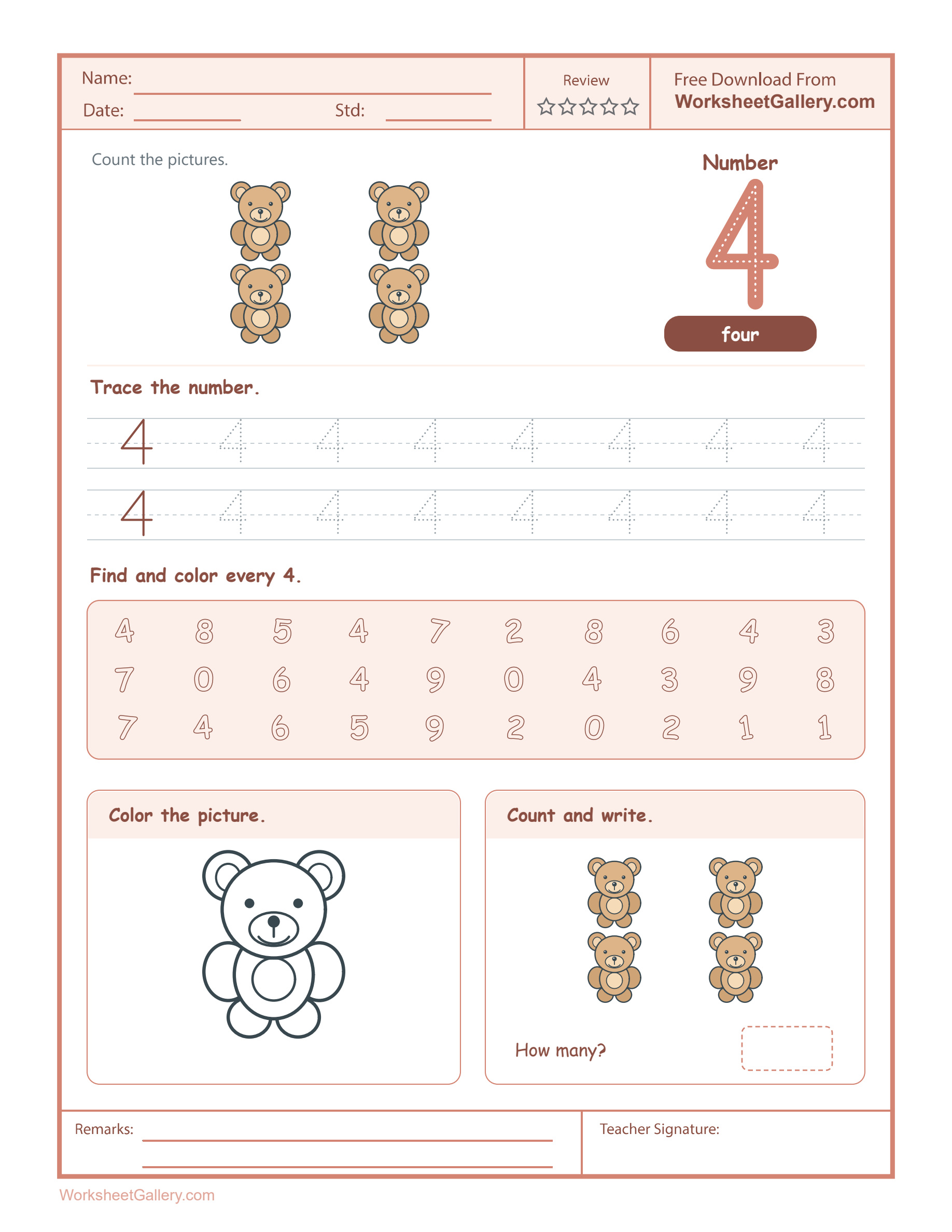
An empty picnic place can make a missing teddy bear easier to notice. Number 4 Worksheet play uses that idea with four bears arranged two above two, inviting children to account for every guest before recording the amount. The printable moves between pictured quantity, guided 4 formation, a numeral search, a large coloring bear and a lower response task. Use the Number 4 Worksheet as a small picnic plan: each complete bear needs a place, and an arrangement that looks tidy still needs a count to establish how many guests it contains.
Plan the Number 4 Worksheet picnic places
| Picnic check | Child's action | What an adult watches |
|---|---|---|
| Upper guests | Indicate each of four bears | Both columns are included |
| Paper places | Assign one place per bear | No guest receives two places |
| Picnic report | Say four teddy bears | The amount describes the whole group |
| Written amount | Refer to the 4 model | The symbol follows an established count |
Start with the picture instead of the paper places if the extra materials divide attention. The Number 4 Worksheet already contains everything needed to establish the quantity. A pretend picnic is a reason to discuss correspondence, not another required craft project.
The upper arrangement has two bears in one column and two in the other. It can be counted across rows or down columns. Select a visible route and check that every complete bear receives a count once, without introducing formal multiplication language.
The lower Number 4 Worksheet guests need a fresh report
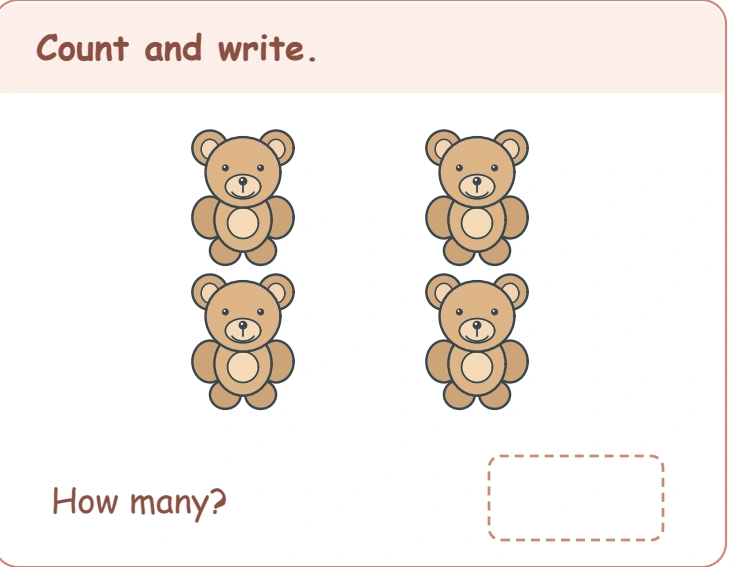
Four smaller teddy pictures appear in the lower-right activity. The learner counts that group and writes 4 in the blank response space. The reduced drawing size does not make these bears a smaller quantity than the upper group.
Ask which bears the Number 4 Worksheet response will describe. This question keeps the lower group separate from the top illustration and the single large coloring bear. The page does not ask the child to combine all its bear drawings into one total.
An answer of three deserves a look at the route. Perhaps one lower bear was skipped, or the finger returned to a previously counted guest. Have the learner show the objects already included before offering a correction.
Count complete teddy bears, including each bear's ears, body and paws as parts of the same toy. Number 4 Worksheet quantities concern the guests themselves rather than the number of circles inside their illustrations.
Maya's Number 4 Worksheet picnic has a missing place
Maya and her older sister lay out three blank paper places while keeping the four-bear picture visible. Maya assigns a place to each of the first three guests, then notices the remaining bear. Her sister asks what the plan still needs.
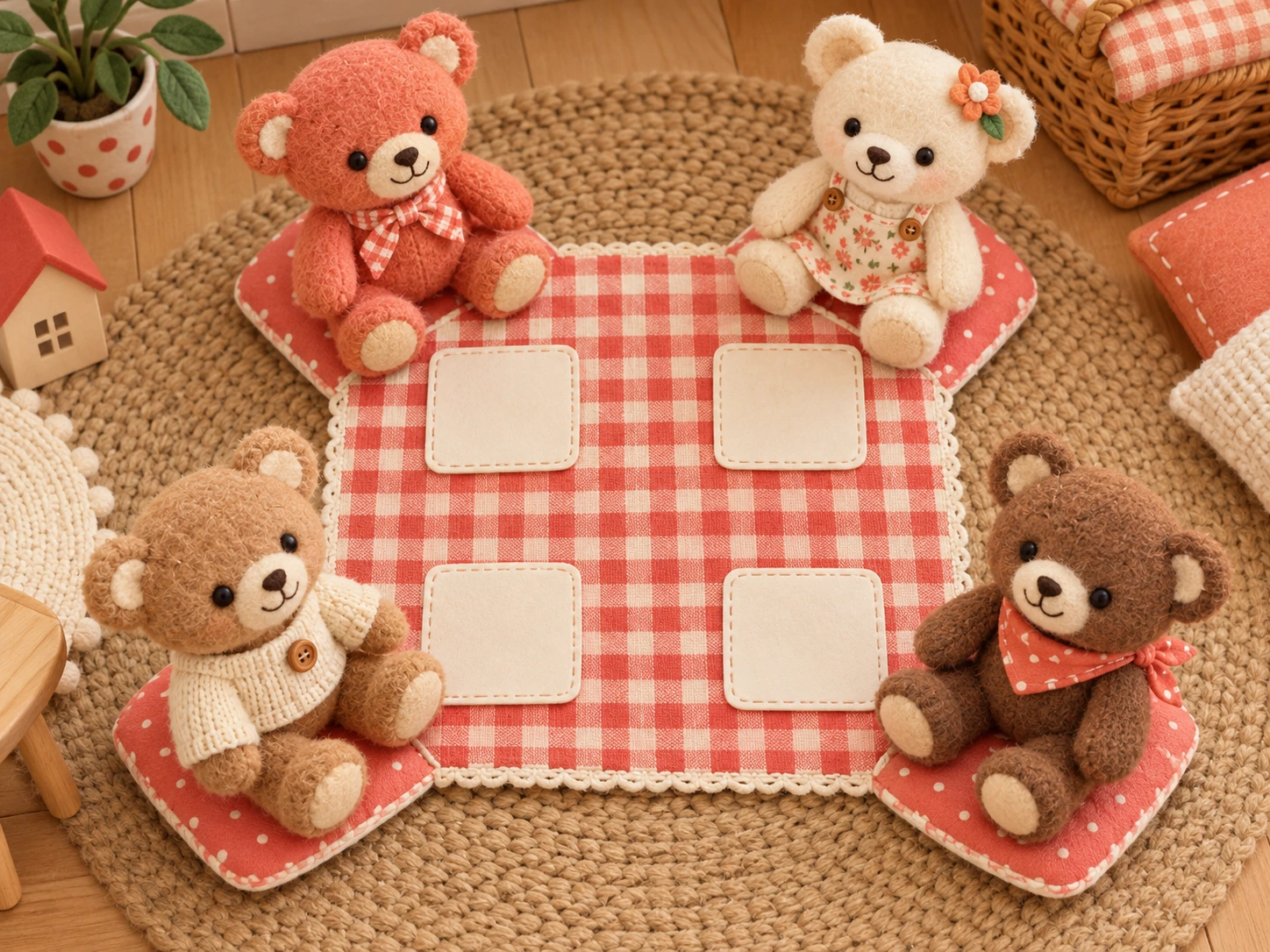
They add one more place and check the correspondence again. Maya reports four bears with a place for each. The extra place repairs a visible mismatch; it is not an instruction to add unrelated printed panels together.
This Number 4 Worksheet home scenario gives an omission a practical consequence. A guest without a place makes the missing match understandable, while the actual count establishes the complete amount after the plan has been repaired.
The textile picnic image offers an optional story setting with four bears and four unprinted places. Families can use drawn circles on scrap paper instead. Number 4 Worksheet learning depends on checking the matches, rather than owning the props shown in the illustration.
Five Number 4 Worksheet invitations for the picnic planner
1. Read a Number 4 Worksheet guest route aloud
Describe the path through the four pictured bears before counting: across the upper pair, then across the lower pair, for example. Let a partner follow the described route by pointing.
Count together afterward. Number 4 Worksheet planning language such as upper, lower and next gives a listener a way to check whether the proposed path includes every guest.
2. Repair one Number 4 Worksheet missing match
Use three paper places beside the upper picture and invite the learner to match them to the bears. Stop when a bear remains without a place and discuss what is missing from the pretend arrangement.
After the repair, count all the matched guests. The Number 4 Worksheet aim is an explainable correspondence, not a surprise trick or a demand to guess an absent amount.
3. Change Number 4 Worksheet places without changing guests
Move the four paper places from a square-like arrangement into a short row. Ask whether the same four pictured guests can still receive one place each, then check by matching again.
Number 4 Worksheet conversation can explore what changed and what remained constant. Rearranging the optional paper places does not itself add or remove a teddy bear.
4. Give a Number 4 Worksheet guest a color story
Decorate the large outline bear and invent a short description of its picnic outfit. Name the ears, paws or belly as picture details, while treating the completed illustration as one bear.
Locate the counted group again afterward. Number 4 Worksheet coloring is a separate creative task; its single outlined guest does not replace or enlarge the four-bear amount in the response panel.
5. Check a Number 4 Worksheet invitation numeral
Write 4 on a pretend invitation using the page model for reference. Have a partner compare the shape, then ask the planner to show the four guests that the invitation amount describes.
An adult may do the writing while the child dictates. Number 4 Worksheet understanding remains visible through the supported count and explanation, even if the numeral movement is still developing.
Keep the Number 4 Worksheet writing model consistent
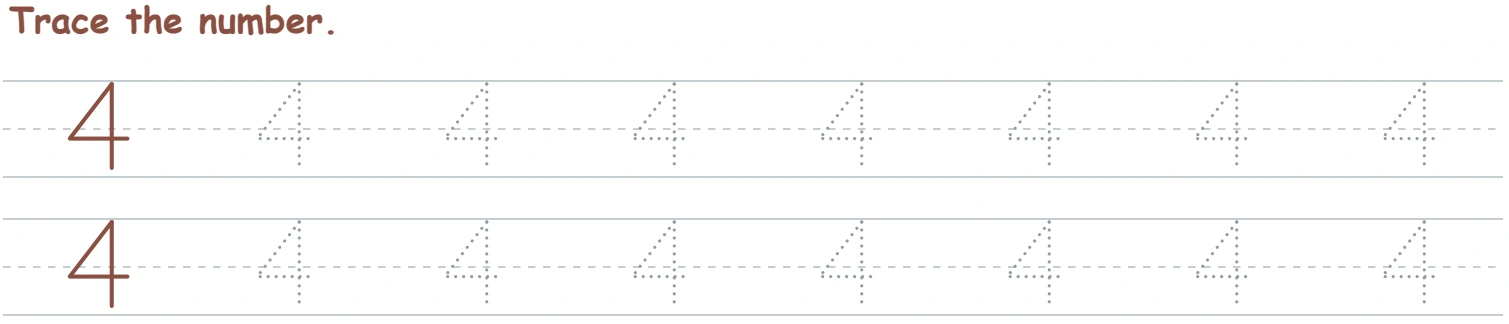
The supplied 4 has a diagonal section, a crossbar and a tall stroke. Inspect their meeting points with the learner. Its upper triangular space belongs to the numeral's structure; it is not another object-counting instruction.
Use the solid example beside the dotted practice forms. Number 4 Worksheet guidance is clearer when an adult demonstrates the same shape that the child will trace, rather than switching between different handwritten versions of four.
Try one example with a finger, then a pencil. If the crossing section extends too far or the tall part stops early, isolate that portion in a comparison with the model. The goal is a controlled, recognizable attempt, not identical marks across every space.
Both guided rows can be saved for several short visits. Number 4 Worksheet counting may be secure before the child is comfortable coordinating intersecting strokes, so offer help with the motor task without retesting the quantity each time.
Seven Number 4 Worksheet picnic-planning gains
- Number 4 Worksheet coverage. A complete route through the square-like group includes both lower guests rather than stopping after the upper pair.
- Number 4 Worksheet correspondence. One paper place for each bear makes an unmatched guest or an extra place available to inspect.
- Number 4 Worksheet quantity meaning. The final spoken four describes every included bear, rather than just naming a position in a chant.
- Number 4 Worksheet spatial talk. Rows, columns and relative locations provide useful language for explaining where a count went.
- Number 4 Worksheet shape control. Meeting and crossing numeral parts ask for directed movement within the printed guides.
- Number 4 Worksheet selection. Finding the target among other symbols calls for comparing complete numeral shapes.
- Number 4 Worksheet revision. A missing picnic match gives a concrete reason to adjust a plan and check the revised result.
These tasks involve attention, language and movement in different combinations. A supported gesture may reveal a clear quantity concept, while a fluent spoken answer may still need a check of which guests were actually included.
The Number 4 Worksheet search has a different guest list
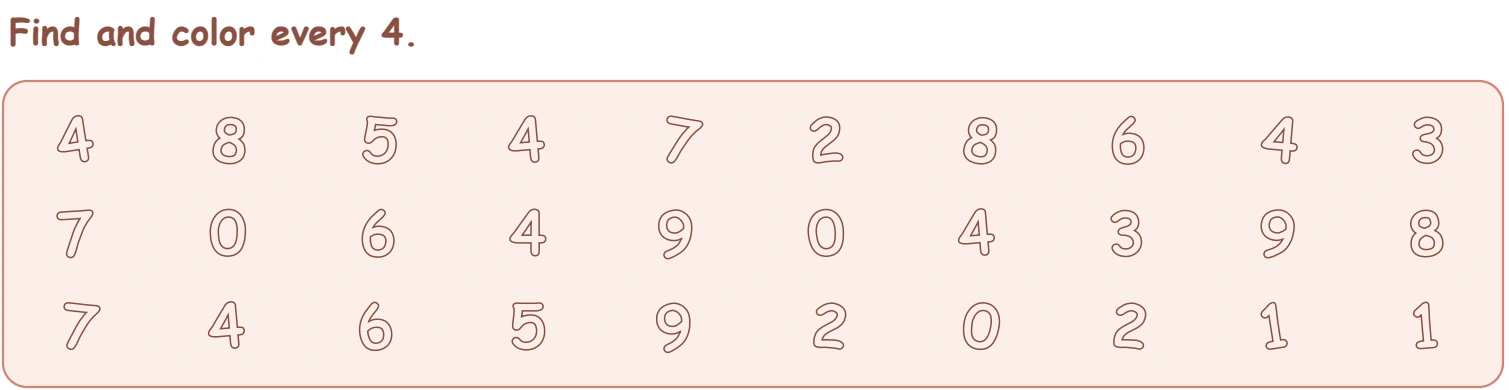
The numeral panel contains thirty entries and six matching 4 symbols. In its first row the targets occupy columns one, four and nine. Row two has targets at four and seven; row three has a target at two.
Read column positions from the left when checking. Number 4 Worksheet finding asks for every instance of the target numeral, so the learner should not stop after locating four matching entries. The pictured bear quantity and symbol-search result answer different instructions.
If a child selects 9 or another distractor, inspect the complete shape beside the target model. Ask where the crossbar and tall stroke appear in the intended 4. A comparison can be more helpful than simply naming the chosen entry incorrect.
The large Number 4 Worksheet bear offers a quiet pause
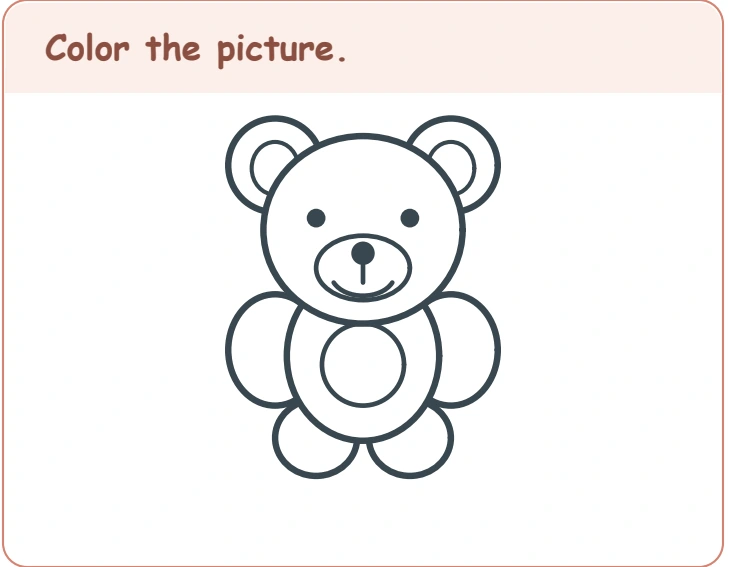
Coloring the teddy outline can follow a demanding search or precede a short counting conversation. Let the learner choose an outfit or color scheme while an adult listens to the description. No particular bear color is needed for a correct number response.
Return to a quantity panel when the question concerns four. Number 4 Worksheet movement can vary from filling a broad body area to following a thin numeral guide, and a child may welcome a change in scale and pace.
Try a Number 4 Worksheet picnic in a small class group
One child names a location in the upper arrangement while another identifies the bear there. Then the group checks a complete count. Use this demonstration to show why noticing a tidy pattern does not replace accounting for all four objects.
At preschool or kindergarten ages three to six, share the responsibilities as needed. A learner can match places, point to guests, speak the amount or help inspect the written symbol. Number 4 Worksheet participation does not require doing every role independently.
Record a specific observation in the remarks area if useful: perhaps the child independently found the skipped lower bear. On a later visit, choose a related task that lets the learner use that discovery again.
When the Number 4 Worksheet picnic plan needs adjusting
Counting the upper and lower panels together, counting ears instead of bears, or treating the six search targets as the pictured quantity are different misunderstandings. Identify the task and its unit before choosing the demonstration that will address the difficulty.
For numeral preparation, the starter line-route sheet separates simple movement practice. The extended ten-line activity offers varied changes of direction. Explore the five-picture counting and tracing lesson when a neighboring amount is useful.
Keep Number 4 Worksheet returns tied to an achievable picnic job. A corrected place setting can be a meaningful success. Recognize the child's explanation of the repair, then leave another manageable task for a future session.
Download the Number 4 Worksheet for your next pretend picnic
The free copy retains the source branding. Members with current eligible access can obtain the clean Number 4 Worksheet PDF, with website and domain watermarks removed and no ads added inside the printable document.
Choose US Letter portrait output and inspect the printer's full-page fit. Keep all four small lower bears visible, along with the dotted numeral intersections and the final answer box. Test the pale writing guides on one copy before preparing a group set.
Attached Premium Package connects this picnic page to the entire ten-number PDF, available for a $3 bundle purchase. Every pictured guest should have a place in the count.
Popular Worksheets
Printable resources families and teachers are downloading now.
 Free
 Free
 Free
 Free