
Master 10 Stellar Steps for Number 10 Tracing: Early Math Success

Welcome to the World of Number 10!
Number 10 Tracing gives learners focused practice. Learning to write numbers is a significant milestone for young children. This printable worksheet focuses on mastering the Number 10 Tracing, a crucial step in developing early mathematical understanding and handwriting proficiency. Designed with vibrant visuals and clear guidance, this resource aims to make the learning process enjoyable and effective for preschoolers and early elementary students. Through a variety of engaging activities, children will not only practice forming the numeral '10' but also reinforce their understanding of its quantity and place in the number sequence. Let's explore how this worksheet can support your child's educational journey and build a strong foundation for future learning.
To further enhance early math skills, consider our Number 9 Tracing worksheet, which offers complementary practice in number formation and recognition. This resource is designed to build upon the foundational skills developed with the Number 10 worksheet, ensuring a smooth progression in your child's learning journey. By engaging with a variety of number tracing activities, children can develop greater confidence and proficiency in early mathematics.
Key Learning Objectives
- Develop fine motor skills through guided tracing.
- Reinforce number recognition for the digit '10'.
- Understand the concept of quantity associated with the number ten.
- Improve hand-eye coordination and pencil grip.
- Build confidence in early writing abilities.
- Enhance visual discrimination by identifying the number 10.
Why Children Love This Activity
Number 10 Tracing gives learners focused practice. Children are naturally drawn to hands-on activities that feel like play. The visual appeal of the worksheet, with its clear number formation guides and playful elements like the tomatoes, makes learning feel less like a chore and more like an adventure. The sense of accomplishment they feel as they successfully trace and form the number '10' is a powerful motivator. This positive reinforcement encourages them to continue practicing and developing their skills, fostering a love for learning from an early age.
Understanding the Number 10 Tracing Worksheet
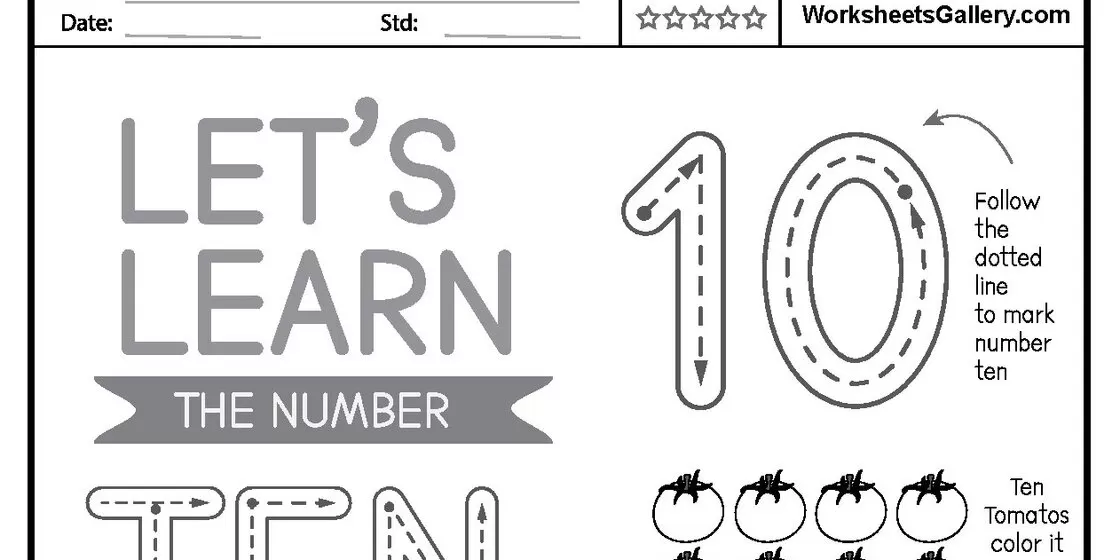
Number 10 Tracing gives learners focused practice. This worksheet is meticulously crafted to support children in mastering the numeral 10. It begins with a clear, large-format guide on how to correctly form the number, emphasizing the stroke order and direction. Following this, ample tracing lines provide repetitive practice, allowing children to build muscle memory and refine their motor control. The inclusion of a visual representation, such as the ten tomatoes, helps connect the abstract numeral to a concrete quantity, solidifying the concept of 'ten'. Further activities, like circling all instances of the number 10, challenge children to apply their recognition skills in a fun, game-like format. This multi-faceted approach ensures comprehensive learning and retention.
Detailed Breakdown of Activities
Numeral Formation and Tracing
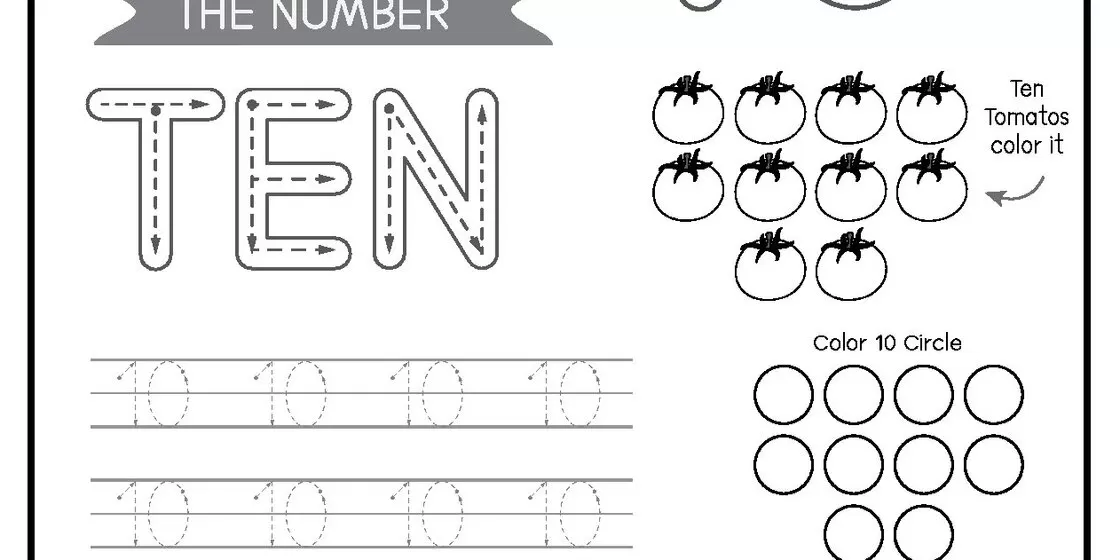
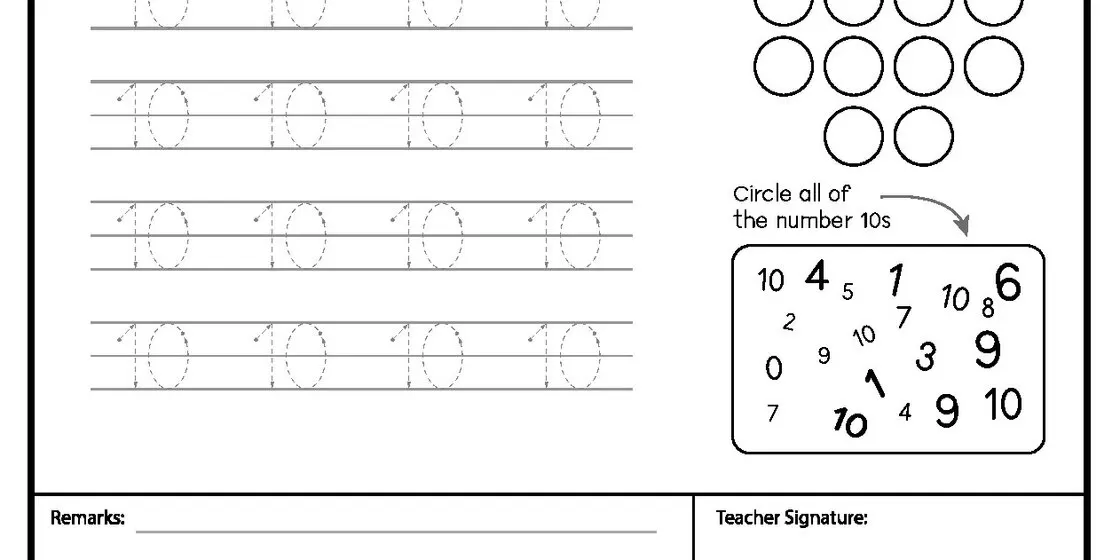
The worksheet features a prominent guide for tracing the number '10'. This includes a large, dotted numeral '10' that children can follow with their pencil, reinforcing the correct stroke order. Multiple rows of dotted '10's are provided for extensive practice, allowing children to develop fluency and consistency in their writing.
Quantity Association
A delightful section presents ten tomatoes, inviting children to color them. This visual aid directly links the numeral '10' to its corresponding quantity, helping children grasp the concept of 'ten' as a count of items. This is a vital step in developing number sense.
Number Identification Game
Children are tasked with identifying and circling all instances of the number 10 within a grid of various digits. This activity sharpens their visual scanning skills and reinforces their ability to recognize the numeral '10' amidst other numbers.
Word Recognition (Implicit)
While not explicitly a word tracing activity, the prominent display of the word 'TEN' in a large, stylized font alongside the numeral encourages incidental word recognition and familiarization with the written form of the number.
Benefits of Consistent Practice
Enhanced Fine Motor Skills
The act of tracing dotted lines requires precise control of the hand and fingers, strengthening the small muscles essential for writing and other detailed tasks.
Improved Number Sense
Connecting the numeral '10' to a quantity of ten objects, like the tomatoes, builds a fundamental understanding of what the number represents.
Boosted Cognitive Development
Activities like number identification games stimulate critical thinking, visual processing, and pattern recognition skills.
Increased Concentration
Focusing on tracing and identifying numbers helps children develop their attention span and ability to concentrate on a task.
Preparation for Formal Schooling
Mastering foundational numbers and writing skills through activities like this sets a strong academic groundwork for kindergarten and beyond.
Greater Self-Esteem
Successfully completing each section of the worksheet provides a sense of achievement, boosting a child's confidence and encouraging further effort.
Practical Application: Home and Classroom Scenarios
At Home: The "Ten Treasures" Hunt
Imagine a rainy afternoon. You can use this worksheet as a springboard for a fun 'Ten Treasures' hunt. After completing the tracing and coloring the tomatoes, ask your child to find ten small items around the house – ten blocks, ten crayons, ten small toys. As they gather each item, have them count aloud to ten. This reinforces the quantity and makes the abstract number tangible. You can even have them write the number '10' on a piece of paper after they've collected their treasures. This integrates the worksheet's learning into a playful, real-world context, making the concept of 'ten' memorable and exciting. For more number practice, explore our Number 9 Tracing worksheet.
In the Classroom: "Counting Crew" Activity
For educators, this worksheet can be a central piece of a 'Counting Crew' lesson. After individual practice with the Number 10 Tracing, divide students into small groups. Give each group ten counting bears or blocks. Ask them to arrange the bears into different groups that add up to ten (e.g., 5 and 5, 7 and 3). Then, have them use the worksheet's identification activity to find and circle all the '10's on a larger printout displayed at the front of the class. This collaborative approach encourages peer learning and reinforces the number's significance. You could also extend this by linking to our Number 8 Tracing worksheet for sequential learning.
Developing Essential Skills
Cognitive Skills
This worksheet actively engages a child's cognitive abilities. The tracing requires focus and memory of the number's form. The identification game sharpens visual discrimination and pattern recognition. Understanding that ten tomatoes represent the number '10' develops early number sense and conceptual understanding. These mental exercises are foundational for more complex mathematical thinking.
Motor Skills
The primary motor skill developed here is fine motor control. Holding a pencil correctly and guiding it along dotted lines refines the pincer grasp and hand-eye coordination. This is crucial not only for writing but also for tasks like buttoning clothes, using scissors, and manipulating small objects. The repetitive nature of tracing builds dexterity and stamina.
Language and Communication Skills
While not its main focus, the worksheet supports language development. Hearing the number 'ten' spoken, seeing it written, and associating it with a quantity all contribute to vocabulary building. Discussing the activities – such as counting the tomatoes or identifying the number 10 – encourages verbal expression and comprehension. This holistic approach ensures that children are developing a well-rounded set of skills, preparing them for future academic and personal success. For additional resources that support language and early learning, consider our Number 6 Tracing worksheet, which also incorporates elements of fun and skill-building.
Popular Worksheets
Printable resources families and teachers are downloading now.
 Free
Free
 Free
Free
 Free
Free
 Free
Free