
Amazing Number 8 Tracing: Essential Steps for Early Math Mastery

Discover a fantastic way to introduce your child to the shape and sound of the number eight! This printable worksheet offers a structured yet playful approach to mastering Number 8 Tracing, a crucial step in early mathematical development. It's designed to captivate young learners while building essential skills that form the bedrock for future academic success. Therefore, we'll explore how this simple activity can make a significant difference in a child's learning experience.
Why Focus on the Number 8 Tracing?
The number eight is more than just a digit; it's a gateway to understanding quantity, patterns, and sequences. For young children, recognizing and forming this number correctly is a significant milestone. This worksheet specifically targets the Number 8 Tracing, ensuring that children not only see the numeral but also feel how to create it with their own hands. This tactile learning process is incredibly effective for solidifying understanding and building confidence.
Key Learning Benefits
- Enhanced Fine Motor Skills: Tracing requires precise hand movements, strengthening the small muscles in the fingers and hands, which are vital for writing and other daily tasks.
- Improved Hand-Eye Coordination: Children learn to guide their pencil along the dotted lines, coordinating what they see with the movements of their hand.
- Number Recognition: Repeated exposure to the numeral '8' in various contexts helps children identify it instantly.
- Formation Mastery: The guided tracing ensures children learn the correct way to form the number eight, preventing common errors later on.
- Counting Practice: Activities like coloring eight tomatoes reinforce the concept of quantity associated with the numeral.
- Concentration and Focus: Completing the tracing and coloring tasks requires sustained attention, helping to develop a child's ability to focus.
- Pre-Writing Skills: The act of tracing is a fundamental pre-writing exercise, preparing children for forming letters and other symbols.
Understanding the Worksheet's Design

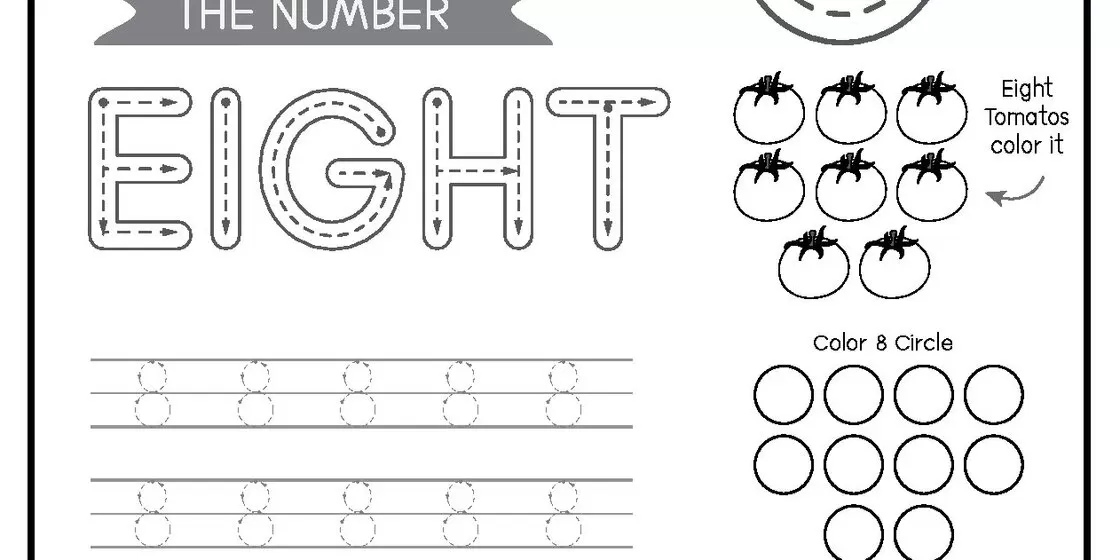
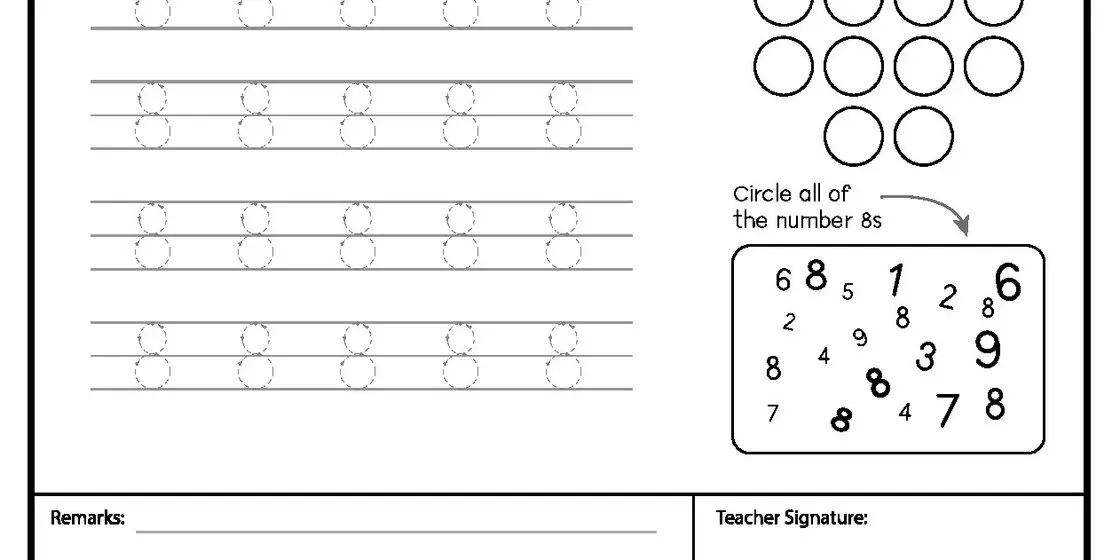
This worksheet is thoughtfully designed with multiple learning stations, each catering to different aspects of number comprehension. At the top, a clear instruction guides children to 'Follow the dotted line to mark number eight.' This is complemented by a large, stylized numeral '8' with dotted lines, offering ample space for practice. Below this, children are prompted to color 'Eight Tomatoes,' a delightful way to connect the numeral with a concrete quantity. Further down, rows of dashed '8's provide repetitive practice, reinforcing the shape and formation. Finally, a 'Circle all of the number 8s' activity sharpens their identification skills amidst other digits.
The 'Eight Tomatoes' Activity
Connecting abstract numbers to tangible objects is a cornerstone of early math education. The 'Eight Tomatoes' section serves this purpose beautifully. Children are asked to color eight tomatoes. This simple task achieves several goals: it provides a break from tracing, engages their artistic side, and crucially, reinforces the concept that 'eight' represents a specific quantity. As they color, encourage them to count each tomato aloud. Consequently, this dual action of coloring and counting solidifies the numerical value of eight in their minds.
Mastering the Shape: Tracing Practice
The core of this worksheet lies in its tracing exercises. The large, dotted numeral '8' at the top is perfect for initial attempts. Encourage children to hold their pencil or crayon with a proper grip. The dotted lines act as a gentle guide, helping them understand the curves and loops that form the number eight. As they progress, the smaller, repeated dashed '8's in the rows below offer more intensive practice. Focus on consistent formation and neatness.
Skill Development Breakdown
Cognitive Skills
- Number sense development
- Quantity association
- Pattern recognition
- Visual discrimination (in the 'circle the 8s' game)
Motor Skills
- Fine motor control
- Pencil grip refinement
- Hand-eye coordination
- Pre-writing stroke practice
Language Skills
- Numeral pronunciation
- Counting aloud
- Following instructions
- Describing shapes and quantities
Practical Application: Home and Classroom Scenarios
This worksheet is incredibly versatile. In a home setting, it can be a quiet activity during a child's independent learning time or a guided session with a parent. Imagine a cozy afternoon where your child sits at the table, happily coloring the tomatoes and then carefully tracing the number eight, asking questions about its shape. In a classroom, it can be used as part of a math center rotation. Teachers can introduce the number eight with a song or story, then have students complete the worksheet. Furthermore, it's an excellent tool for one-on-one intervention with students who need extra practice with number formation.
Scenario 1: The Afternoon Math Corner
At home, Sarah's mom sets up a small math corner with various activities. Today, it's time for the Number 8 Tracing worksheet. Sarah, aged five, eagerly grabs her crayons and starts coloring the eight tomatoes, counting them as she goes. "Look, Mommy, eight red tomatoes!" she exclaims. Afterward, she moves to tracing the large '8', carefully following the dots. Her mom sits nearby, offering gentle encouragement and reminding her to make the two circles connect smoothly. This focused time helps Sarah build her number sense and fine motor control in a relaxed environment.
Scenario 2: The Math Center Rotation
In Mrs. Davis's kindergarten class, the students rotate through different learning centers. The 'Number Fun' center features this Number 8 Tracing worksheet. Children arrive at the center, find a pencil, and begin. Some children focus on tracing the large '8', others are busy with the tomato coloring, and a few are diligently circling all the '8's they can find in the grid. Mrs. Davis observes, offering help where needed, praising neat tracing and correct identification. In essence, this center allows children to practice number skills at their own pace and in a hands-on way.
Common Mistakes and How to Avoid Them
Children learning to form the number eight might struggle with making the two circles connect properly or might reverse the number. To mitigate this:
- Emphasize the Starting Point: For the large '8' tracing, point out where to begin and the direction of the strokes.
- Break It Down: If forming the '8' is challenging, encourage drawing two separate circles first, then guiding them to connect them.
- Consistent Practice: Regular use of the worksheet, along with other resources like number 7 tracing and number 6 tracing, helps solidify correct formation.
- Avoid Rushing: Ensure the child has enough time to complete the activity without feeling pressured.
Encouraging Regular Practice
Consistency is key in early learning. Here are some ways to encourage your child:
- Make it a Routine: Set aside a specific time each day or week for math activities.
- Praise Effort, Not Just Perfection: Acknowledge their hard work and progress, even if the tracing isn't perfect.
- Connect to Real Life: Point out the number eight in everyday objects – eight wheels on a truck, eight fingers and thumbs, etc.
- Gamify Learning: Turn tracing into a game. Who can trace the neatest '8'? Can you find all the '8's before I do?
- Celebrate Milestones: Acknowledge when they successfully trace the number or correctly identify it.
Extended Activities and Play
Once your child is comfortable with Number 8 Tracing, extend the learning:
- Number Eight Scavenger Hunt: Hide eight objects around the room and have your child find them.
- Playdough Number Eight: Use playdough to form the number eight, reinforcing its shape through tactile play.
- Storytelling: Create a story featuring the number eight. Perhaps a character has eight legs, or they need to collect eight magical items. Additionally, this ties into creative writing and imagination.
- Counting Games: Use blocks or other manipulatives to count out sets of eight.
- Number Art: Have children draw their own pictures incorporating the number eight, such as eight balloons or eight stars. For more number practice, explore other resources like number 5 tracing activities.
Why Children Love This Activity
Children are naturally drawn to activities that involve coloring, drawing, and a sense of accomplishment. This worksheet provides all of that! The clear instructions, the visual appeal of the tomatoes, and the satisfying feeling of completing a tracing line all contribute to a positive learning experience. The 'circle the 8s' game adds an element of fun challenge, making them feel like detectives searching for hidden numbers. Therefore, when learning feels like play, children are more engaged and retain information better.
Age Appropriateness
This worksheet is ideally suited for children aged 4-6. At this age, children are typically developing the fine motor skills necessary for tracing and are beginning to grasp number concepts. Younger children (3-4) might benefit from more guided tracing with larger prompts or focusing primarily on the coloring and counting aspects, while older children (5-6) can engage with all sections of the worksheet and may be ready for more complex number activities.
Downloading Your Free Worksheet
Getting this valuable learning tool is simple! Click the download button to get a high-quality, printable PDF. This worksheet is completely free, with no watermarks and no distracting ads, ensuring a clean and focused learning experience for your child. Simply print it out, gather some crayons or pencils, and you're ready to begin the exciting journey of mastering the number eight!
Popular Worksheets
Printable resources families and teachers are downloading now.
 Free
Free
 Free
Free
 Free
Free
 Free
Free