
Amazing Number 9 Tracing: Essential Steps for Confident Writing

Discover the Wonders of Number Nine
Introducing the number nine to young learners can be a delightful experience, especially when guided by a well-structured and engaging worksheet. Therefore, this printable resource is crafted to make the process of learning and writing the numeral '9' both accessible and enjoyable. It’s more than just tracing; it’s about building a foundational understanding of quantity and numerical representation. For parents and educators, this worksheet offers a practical tool to support early mathematical development, ensuring that the journey of mastering Number 9 tracing is a positive and rewarding one. We’ll explore how this simple sheet can foster critical skills and provide a stepping stone for future academic success.
What's Inside This Engaging Worksheet?
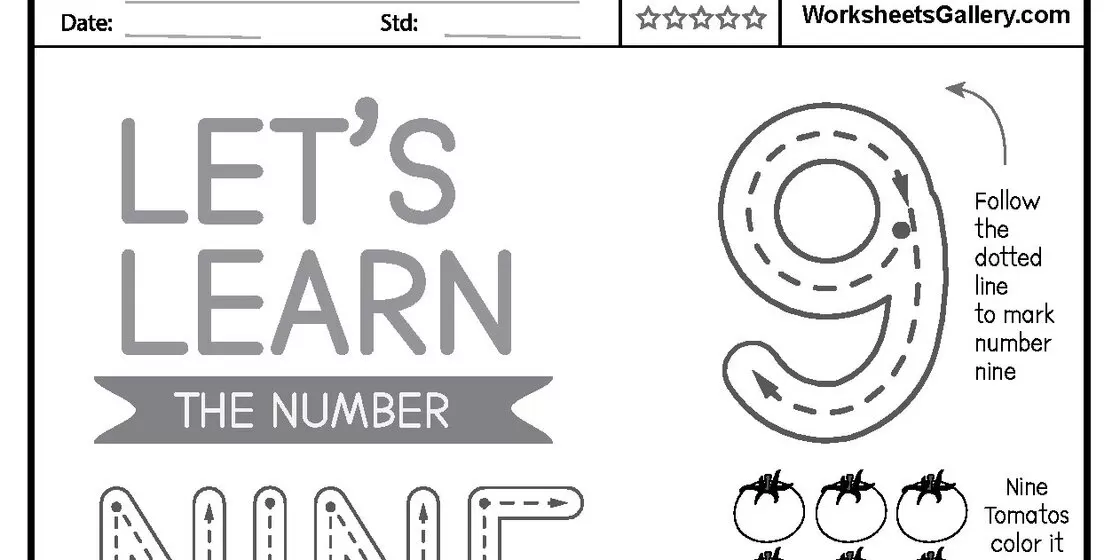
- Guided Tracing: Large, clear dotted lines for the numeral '9' help children practice correct formation.
- Visual Reinforcement: An illustration of the number nine presented as a dotted outline encourages children to follow along.
- Coloring Activity: Nine colorful tomatoes await children's artistic touch, reinforcing the quantity associated with the number nine.
- Number Recognition: A section challenges children to identify and circle all instances of the number '9' among other digits.
- Follow-the-Path: A maze-like path within the numeral '9' guides children's fine motor control.
Key Learning Benefits
- Fine Motor Skill Development: Holding and maneuvering a pencil or crayon to trace lines significantly enhances dexterity.
- Hand-Eye Coordination: Following dotted lines and staying within the boundaries improves the connection between visual input and motor output.
- Number Recognition: Repeated exposure and active identification of the numeral '9' solidify its visual form.
- Quantity Association: Activities like coloring nine tomatoes directly link the numeral to its corresponding amount.
- Concentration and Focus: Completing the various exercises requires sustained attention, building crucial focus skills.
- Pre-Writing Skills: Practicing controlled strokes prepares children for forming letters and other written symbols.
Mastering Number 9 Tracing: A Step-by-Step Approach

The journey to mastering any new skill begins with a clear plan and consistent practice. Consequently, for Number 9 tracing, this worksheet provides a structured environment that supports children at various stages of learning. The top section, with its large, dotted numeral and directional guide, is the ideal starting point. Children are encouraged to follow the dotted line, mimicking the shape of the number nine. This initial step is crucial for building muscle memory and understanding the physical stroke required.
The subsequent rows offer more practice, gradually increasing the child's independence as they become more familiar with the formation. Furthermore, the variety of activities ensures that learning remains engaging and addresses different learning styles.
Home-Based Learning Scenarios
At home, this worksheet can become a cornerstone of your child's early learning routine. Imagine a quiet afternoon where your child sits at the kitchen table, pencil in hand, ready to tackle the number nine. You can sit with them, offering gentle guidance and positive reinforcement. Start by introducing the number nine verbally and showing them the numeral on the sheet. Encourage them to trace the large '9' first, perhaps even using their finger to feel the shape before using a pencil. Celebrate each successfully traced number with praise or a small sticker. This creates a positive association with learning and builds confidence.
Another scenario involves turning the learning into a game. After tracing, present the tomato coloring activity. Ask your child to count the tomatoes as they color them, reinforcing the concept of nine. For the number identification task, you can make it a 'find the nine' treasure hunt around the page. This playful approach keeps children motivated and makes learning feel less like a chore and more like an adventure. You can also extend this by asking them to find other objects around the house that come in groups of nine, further solidifying the concept in their everyday environment.
Classroom Implementation Ideas
In a classroom setting, this Number 9 Tracing worksheet can be used in several effective ways. It's perfect for small group instruction, where a teacher can guide a handful of students through the exercises, providing immediate feedback and support. For instance, during a math center rotation, students can independently work through the tracing and coloring sections. The teacher can then circulate, checking for proper pencil grip and formation, offering targeted assistance to those who need it.
The number identification section is excellent for a whole-class activity. You could project the worksheet onto a smartboard and have students come up to circle the nines, or call out numbers and have them identify which ones are nines. This promotes active participation and peer learning. Furthermore, the coloring activity can be a calming transition between more demanding tasks, allowing children to express creativity while still engaging with the number nine. Consider laminating copies for repeated use with dry-erase markers, reducing paper waste and allowing for endless practice.
Developing Essential Skills Beyond Numerals
While the primary goal is to master the Number 9 tracing, the benefits extend far beyond simply writing a numeral. This worksheet is a powerful tool for developing crucial cognitive and motor skills that are foundational for overall academic success. The act of tracing, especially following dotted lines, refines a child’s fine motor control. This is essential not only for handwriting but also for tasks like buttoning clothes, using utensils, and manipulating small objects. The consistent practice of holding a writing instrument correctly and applying appropriate pressure is nurtured here.
Hand-eye coordination is another significant skill that is honed through these activities. Children learn to visually track the dotted line and translate that information into precise movements of their hands. This integration is vital for reading, sports, and many other daily activities. The number recognition game, where children must scan a group of numbers and identify specific instances of '9', sharpens their visual discrimination and attention to detail. They learn to differentiate between similar-looking numerals, a key step in developing mathematical literacy. The simple act of counting the nine tomatoes also reinforces one-to-one correspondence, a fundamental concept in early mathematics.
Extended Activities to Deepen Understanding
To further enhance the learning experience and make the number nine truly memorable, consider these extended activities:
- Nine Object Hunt: Ask your child to find and gather exactly nine small objects around the house or classroom – blocks, crayons, buttons, or toy cars. Count them together to confirm there are nine.
- Number Nine Storytelling: Create a short story that incorporates the number nine. For example, "Once upon a time, there were nine brave knights who went on an adventure to find a hidden treasure." Encourage your child to draw pictures for the story.
- Playdough Number Nine: Provide playdough and have your child roll it into a long snake and form the numeral '9'. This tactile activity reinforces the shape and is great for fine motor skills.
- Nine-Piece Puzzle: Find or create a simple puzzle with nine pieces. Completing the puzzle requires spatial reasoning and reinforces the quantity.
- Sing a Number Song: While there might not be a specific 'Number Nine' song, adapt familiar tunes or create simple chants about the number nine. Repetition through song is a powerful learning tool.
- Number Nine Collage: Provide old magazines or newspapers and ask your child to cut out or tear out pictures of things that come in groups of nine, or simply find the numeral '9' multiple times.
Why Children Love Learning with This Worksheet
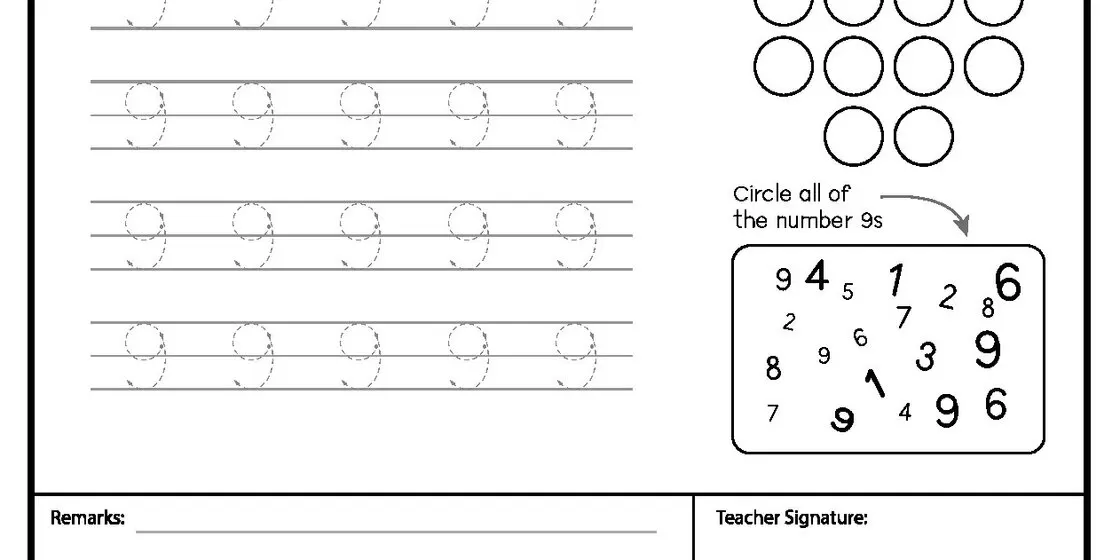
Children are naturally curious and learn best through play and engaging activities. This worksheet taps into that natural inclination. The visual appeal, with the clear numeral and the friendly tomato illustration, captures their attention. The tactile experience of tracing provides a satisfying sensory input. Moreover, the variety of tasks prevents monotony; they aren't just tracing lines repeatedly. They get to color, search, and identify, which appeals to different interests and learning preferences. Successfully completing each section provides a sense of accomplishment, boosting their confidence and encouraging them to tackle the next challenge. The playful nature of the activities, like the number search, makes them feel like they are playing a game rather than doing 'work'.
Age Appropriateness and Developmental Stages
This Number 9 Tracing worksheet is ideally suited for children aged 4-6 years old. At this stage, most children are developing their fine motor skills and beginning to recognize and form numerals. The large dotted lines and clear instructions cater to their developing abilities. Younger children, around 3-4 years old, might benefit from more direct adult supervision and assistance, focusing primarily on the tracing and coloring aspects. Older children, within the 5-6 age range, can tackle the number identification challenges with greater independence and might even be ready to explore more complex math concepts related to the number nine, such as simple addition or subtraction problems involving this quantity. It's a versatile tool that can be adapted to different developmental levels within this range.
Navigating Common Challenges
It's common for young children to encounter a few hurdles when learning to trace numbers. One frequent issue is an incorrect pencil grip, which can lead to fatigue and difficulty in forming the numeral correctly. Encourage a relaxed grip, often described as the 'tripod grip' (thumb, index finger, and middle finger). Another challenge might be staying within the dotted lines. Reassure children that it's okay if their first attempts aren't perfect. Gently guide their hand or offer verbal cues like 'slow down' or 'watch the line'.
Some children may struggle with the circular motion required for the '9'. Breaking it down into smaller steps—like forming a circle first, then adding the tail—can be helpful. In addition, for the number identification task, ensure the child understands the objective. If they are circling incorrect numbers, reiterate what the target number, nine, looks like. Patience and positive redirection are key to overcoming these common mistakes.
Encouraging Consistent Practice
Consistent practice is vital for solidifying learning. To encourage your child to engage with the Number 9 Tracing worksheet regularly, make it a positive and integrated part of their routine. Consider setting aside a short, dedicated time each day or a few times a week for these activities. Frame it as 'special learning time' rather than a chore. Display completed worksheets proudly on the refrigerator or a dedicated learning wall. This visual recognition validates their effort and provides motivation. Celebrate milestones, whether it's completing a page, tracing a number perfectly, or correctly identifying all the nines. Positive reinforcement, like verbal praise, a high-five, or a small reward, can go a long way. You can also introduce variety by using different colored pencils or crayons for tracing, or by incorporating the number nine into other daily activities, like counting snacks or toys.
Download and Print with Ease
Accessing this valuable learning tool is straightforward. Simply click the download button below to get your free, high-quality printable PDF of the Number 9 Tracing worksheet. This resource is designed to be printer-friendly, ensuring that you receive a clear, crisp copy without any distracting watermarks or advertisements. Print it on standard letter-sized paper for optimal results. You can print multiple copies to allow for repeated practice or to share with siblings or classmates. Laminating the worksheet after printing can also be a great way to create a reusable learning tool that can be used with dry-erase markers, offering an eco-friendly and cost-effective solution for ongoing skill development. Start your child's journey to mastering the number nine today!
Explore More Number and Letter Worksheets
Number Tracing Fun
Reinforce numeral formation with our collection of engaging tracing worksheets.
View All Number WorksheetsAlphabet Practice
Develop handwriting skills with our comprehensive letter tracing guides.
View All Letter WorksheetsEarly Math Resources
Discover more activities to build a strong foundation in early mathematics.
Explore Math ResourcesPopular Worksheets
Printable resources families and teachers are downloading now.
 Free
Free
 Free
Free
 Free
Free
 Free
Free